TL;DR
Thin pages are not always bad pages. Small businesses should first separate pages with no search purpose from pages that need clearer intent, stronger proof, better structure, or consolidation.
A five-page small business site can outrank a 500-page site when every page has a clear job. Thin content SEO for small business websites is less about word count and more about whether a page helps search engines and customers understand a service, product, location, or answer.
Thin content: a webpage with little original value, unclear purpose, weak information, duplicated copy, or no useful next step for the searcher.
Search engine optimization, according to Wikipedia's definition of SEO, is the practice of improving website visibility and performance in search results. For small businesses, that means thin content should be treated as an intent problem first, not a writing problem. Stronger pages usually come from clearer targeting, specific proof, and a better match between the page and the query.
Table of Contents
What is thin content in SEO?
Thin content in SEO is a page that gives searchers too little useful, original, or relevant information to deserve visibility in search results. The page may be short, duplicated, generic, outdated, AI-written without editing, or missing the details needed to help a customer choose, buy, book, or learn.
A short page is not automatically thin. A local plumber's emergency service page with pricing cues, service area details, response expectations, FAQs, and reviews may be concise but useful. A 1,500-word blog post that repeats common advice without examples can still be thin.
Key insight: Google does not need every small business page to be long. It needs every indexable page to have a reason to exist.
Thin pages usually fail in one of four ways:
- No unique value: the copy repeats manufacturer text, competitor wording, or generic claims.
- No clear intent: the page mixes informational, local, and sales goals without satisfying any of them.
- No trust signals: the page lacks experience, proof, pricing context, photos, reviews, or credentials.
- No next step: the visitor cannot compare, book, call, buy, download, or continue learning.
Small companies building a first content plan should pair content cleanup with basic keyword intent work. Early planning guides such as content strategy for new blogs and SEO can help prevent new thin posts from piling up.
Thin does not always mean harmful
A contact page, privacy page, appointment confirmation page, or simple store-hours page may be short because its purpose is narrow. Those pages do not need heavy SEO copy.
The risk rises when thin pages target competitive queries, duplicate other pages, or sit in the index with no meaningful search value. A weak page about best accountant in Austin can dilute a local SEO effort more than a short hours and parking page.
How can a small business diagnose thin pages?
A small business can diagnose thin pages by checking search intent, originality, traffic, conversions, internal links, and page purpose before rewriting anything. The best audit labels each page as keep, improve, merge, noindex, or delete based on evidence rather than word count alone.
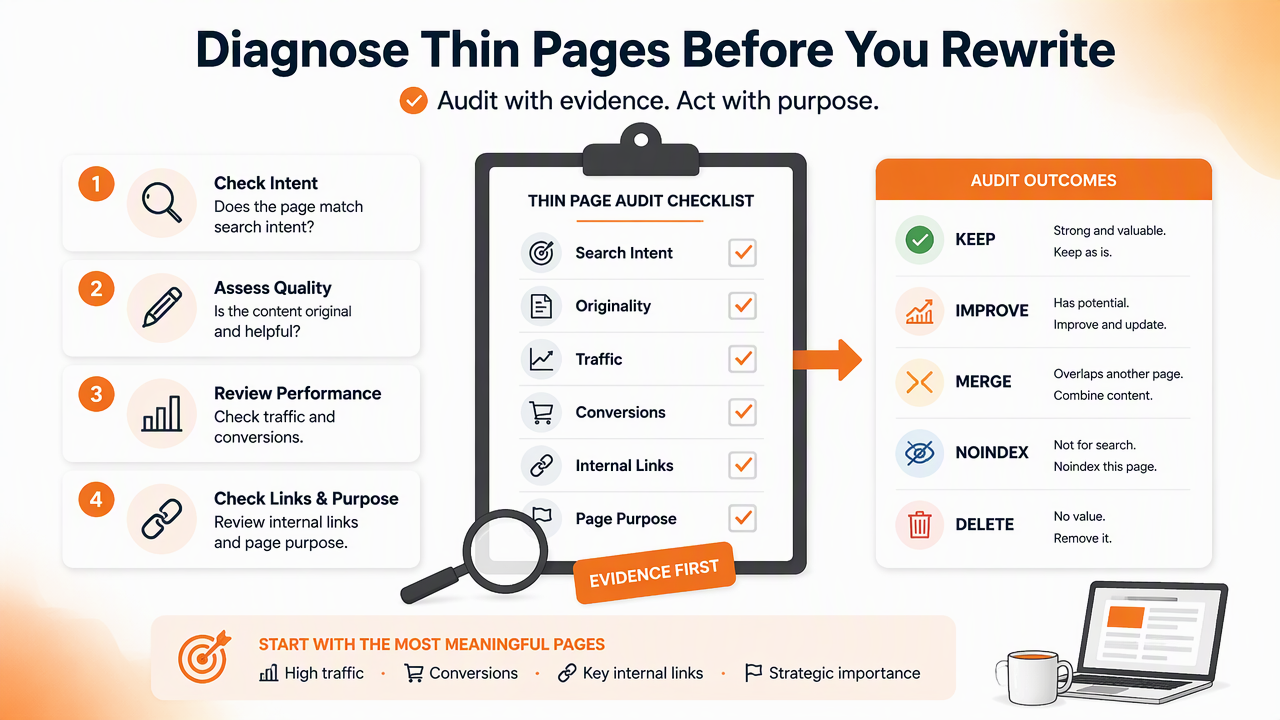
Start with the pages that are meant to win organic traffic: service pages, category pages, location pages, product pages, and blog posts. Then compare each page against the job it should perform.
Thin content audit checklist
| Check | Healthy page | Thin page signal |
|---|---|---|
| Search intent | Matches one clear query type | Targets several unrelated intents |
| Original detail | Includes examples, process, proof, or local context | Uses generic claims anyone could copy |
| Business value | Supports leads, calls, sales, or trust | Exists only because a keyword was found |
| Internal links | Connected to related services or guides | Orphaned or buried in navigation |
| Conversion path | Has a clear call, form, product, or next page | Ends with no useful action |
| Indexing need | Deserves search visibility | Better handled with noindex or merging |
A simple scorecard works well. Pages with strong business value but weak copy should be improved. Pages with overlapping topics should be merged. Pages with no search value and no customer value should stay out of the index.
For local companies, thin location and service pages deserve special care because they often support calls and map visibility. A business working on local rankings can pair this audit with a local business SEO playbook to connect content quality with service area, reviews, and Google Business Profile work.
Common false positives in content audits
Some pages look thin in SEO tools but are fine for users. Login pages, cart pages, booking widgets, warranty pages, and support pages may not need search traffic.
The better question is simple: should this page rank for a non-branded search? If not, the page may need noindexing, internal navigation only, or no SEO action at all.
Should thin pages be fixed, merged, noindexed, or deleted?
Thin pages should be fixed when they serve a valuable keyword, merged when they overlap, noindexed when they help users but not searchers, and deleted when they have no business, user, or search purpose. The right move depends on intent, uniqueness, links, and conversion value.
Small business websites often create near-duplicate pages by accident. A roofer might have separate weak pages for roof repair, leak repair, and emergency roof leak repair when one strong service page plus FAQ sections would perform better.
Fix-or-merge decision table
| Page situation | Best action | Example |
|---|---|---|
| Valuable service, weak details | Fix | Add process, proof, pricing cues, service area, FAQs |
| Two pages target the same intent | Merge | Combine wedding flowers and bridal bouquets if search intent overlaps |
| Useful for customers, not search | Noindex | Thank-you pages, internal policy pages, filtered pages |
| Outdated post with backlinks | Refresh or merge | Update old seasonal guide and redirect weaker copy |
| No traffic, no links, no purpose | Delete and redirect if relevant | Remove abandoned event pages or empty tags |
Practical decision tree
- Does the page serve a real customer or search need? If no, delete or noindex.
- Does another page already satisfy the same intent? If yes, merge and redirect.
- Does the page support revenue, trust, or local discovery? If yes, improve it.
- Does the page have backlinks or internal links? If yes, preserve value with a redirect.
- Can the page become the best answer for a narrow query? If yes, rebuild it with specific evidence.
Service businesses should be careful with consolidation. A page for commercial HVAC repair may deserve its own URL if the audience, pricing, proof, and emergency needs differ from residential repair. A deeper guide to SEO for service-based businesses can help separate real service intent from keyword clutter.
How should small businesses improve thin pages?
Small businesses should improve thin pages by giving each page one clear search intent, adding original business evidence, answering buying questions, and linking it into a broader site structure. Good fixes make pages more useful, not just longer.
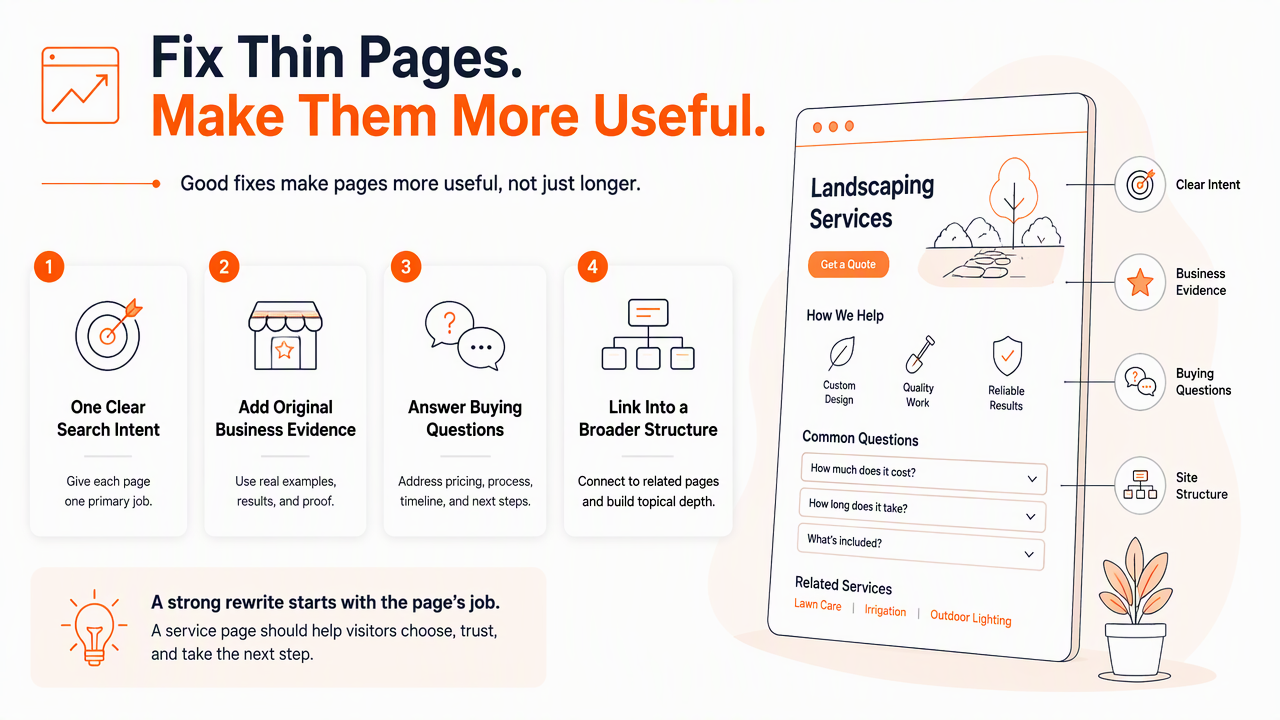
A strong rewrite starts with the page's job. A service page should help a customer decide if the company can solve a problem. A blog post should answer a specific question better than competing pages. A product page should reduce purchase doubt.
Page upgrades by business type
| Page type | Thin version | Stronger version |
|---|---|---|
| Service page | Fast, affordable landscaping services | Services offered, neighborhoods served, photos, seasonal process, quote expectations |
| Blog post | 5 tips for better skin | Dermatologist-reviewed tips, product cautions, local treatment options, FAQs |
| Ecommerce product | Manufacturer description only | Original photos, sizing, use cases, shipping details, comparison notes, reviews |
| Local page | City name swapped into template | Staff, local projects, parking, service radius, customer proof |
Useful additions include:
- Real project examples, before-and-after details, or case notes.
- Pricing ranges, quote factors, or what affects cost.
- FAQs taken from sales calls, support tickets, and reviews.
- Photos, videos, specifications, and comparison points.
- Internal links to the next logical page.
The Earlyseo platform can help turn these gaps into content briefs that include search intent, competitor-aware structure, and page-level recommendations. Teams that need repeatable updates can also use competitor-aware SEO content to avoid generic rewrites and build pages around what stronger results already cover.
Ecommerce stores need a slightly different fix. Product and category pages should not rely only on supplier descriptions. Store owners can expand thin pages with buyer questions, comparison copy, collection context, and shipping clarity, then build from the basics in ecommerce SEO for small online stores.
What not to add during a rewrite
Padding hurts readability. Extra paragraphs that repeat the same keyword, list obvious facts, or restate the heading make a page longer without making it better.
AI-generated drafts also need human editing. A 2023 review in IEEE Access examined trustworthy and explainable artificial intelligence, a useful reminder that automated systems should be checked for accuracy, clarity, and reasoning before publication.
What will thin content SEO require in 2026 and 2027?
Thin content SEO in 2026 and 2027 will require clearer entity coverage, stronger first-hand evidence, and pages that answer questions cleanly enough for both search engines and AI answer systems. Generic summaries will keep losing value as search results favor experience, structure, and trust.
AI search changes the standard for small business pages. A page that says family-owned bakery with great cakes gives an answer engine little to cite. A page that explains cake sizes, notice periods, dietary options, pickup areas, photos, and ordering limits gives both customers and AI systems usable facts.
Key insight: The next thin content problem is not only short copy. It is copy without extractable facts.
Small businesses should prepare pages with:
- Clear definitions: explain services, products, and terms in one direct sentence.
- Structured answers: use tables, FAQs, and short steps where helpful.
- Named entities: mention cities, brands, certifications, materials, product types, and service categories.
- Visible proof: add reviews, photos, case examples, and policies.
- Fresh updates: review important pages at least when services, pricing, stock, or locations change.
Earlyseo is built around this newer content standard: focused briefs, structured answers, and small-business-friendly SEO workflows. For broader planning, earlyseo.com offers related guidance on site structure, local visibility, and content systems.
FAQ
Small business thin content questions usually come down to page purpose, indexing, and whether a rewrite will actually improve search performance. These answers cover the decisions that matter most during a content cleanup.
Is a 300-word page always thin content?
A 300-word page is not always thin content. A narrow contact, booking, or service detail page can be useful at that length. The problem starts when a short page targets a meaningful search query but lacks original detail, proof, answers, location context, or a clear next step.
Can thin content hurt a whole small business website?
Thin content can weaken a site when many indexable pages are low-value, duplicated, or competing for the same intent. A few short utility pages are usually normal. The bigger risk is a pattern of weak service, blog, product, or location pages that fail to satisfy searchers.
Should old blog posts with no traffic be deleted?
Old blog posts should be reviewed before deletion. If a post overlaps with a better article, merging and redirecting may preserve value. If the topic is still useful, updating may work. If the post has no links, traffic, relevance, or business purpose, removal is often reasonable.
How often should a small business audit thin content?
A small business should audit key pages at least twice a year, with extra checks after service changes, product catalog changes, location changes, or a website migration. High-value pages, such as main services and categories, deserve more frequent review than low-traffic utility pages.
Conclusion
Thin content SEO for small business websites works best as a cleanup and focus project, not a word-count contest. The next step is simple: list every indexable page, assign each one a purpose, then mark it keep, improve, merge, noindex, or delete.
After that, rebuild the pages closest to revenue first: core services, local pages, product categories, and comparison-style blog posts. Earlyseo can help turn those decisions into structured briefs and cleaner publishing workflows. For a practical starting point, visit earlyseo.com and prioritize the five pages most likely to drive calls, bookings, or sales.