TL;DR
A good SEO retainer should show exactly what gets done each month: strategy, technical fixes, content work, authority building, AI-search readiness, and reporting. Buyers should ask for a scoped checklist, ownership rules, and outcome-focused metrics before signing.
Vague SEO retainers create bad expectations fast, especially when traffic, rankings, and AI search visibility all move at different speeds. Clear monthly SEO retainer deliverables turn an open-ended service into a managed growth system with defined tasks, owners, and evidence. Earlyseo helps teams organize modern organic visibility work from one place, including AI-search readiness, technical SEO, and publishing workflows through the Earlyseo platform.
Table of Contents
What are monthly SEO retainer deliverables?
Monthly SEO retainer deliverables are the recurring tasks, assets, reports, and meetings an SEO provider agrees to complete each month for a fixed fee. A strong retainer defines the work by category, not just hours, so a business can see what is being improved and why it matters.
SEO retainer: an ongoing service agreement where an SEO specialist, freelancer, or agency provides recurring optimization work instead of a one-time project.
A retainer should not read like a mystery box. It should connect each task to a business goal such as organic leads, ecommerce revenue, local visibility, content coverage, or branded search demand.
A useful retainer explains three things every month: what changed, what shipped, and what the next priority is.
Common 2026 retainers also include work for answer engines, AI Overviews, and large language model discovery. Research communities focused on trustworthy natural language processing, such as the TrustNLP 2022 workshop proceedings, show why clarity, source quality, and structured information matter as machine-generated answers become part of search behavior.
Typical deliverable categories include:
- Strategy: goals, keyword themes, competitive analysis, and prioritization.
- Technical SEO: crawl checks, indexation reviews, speed guidance, schema, and site health fixes.
- Content: briefs, updates, new pages, internal linking, and content pruning.
- Authority: digital PR, link earning, citations, partnerships, and brand mentions.
- AI visibility: entity clarity, structured content,
llms.txt, and answer-friendly formatting. - Reporting: performance summaries, insights, completed work, and next-month actions.
What should be included in a monthly SEO checklist?
A monthly SEO checklist should include strategy, technical maintenance, content execution, off-page visibility, reporting, and communication. The exact mix changes by business stage, but every retainer needs a written checklist so scope does not drift into guesswork.
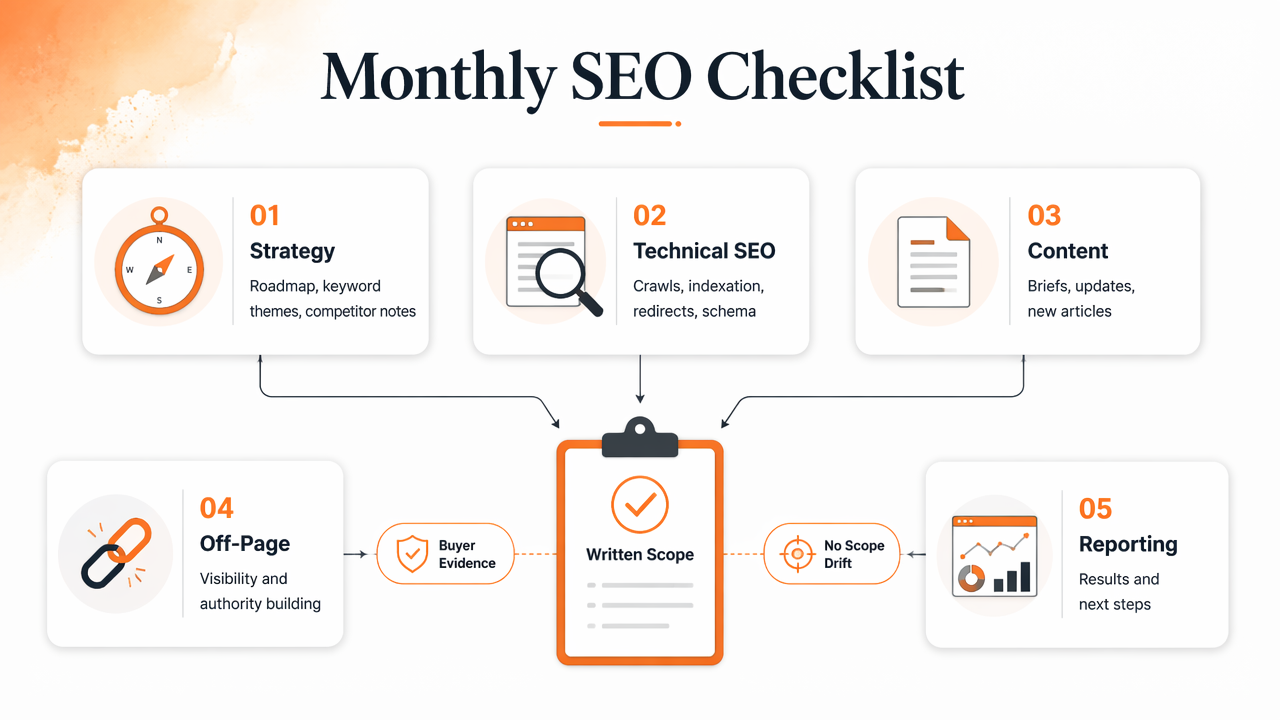
Monthly deliverables matrix
| Deliverable area | Common monthly outputs | Buyer evidence to request |
|---|---|---|
| Strategy | Priority roadmap, keyword themes, competitor notes | Updated plan with decisions and rationale |
| Technical SEO | Crawl review, indexation checks, redirect fixes, schema notes | Before-and-after issue log |
| Content | Briefs, page updates, new articles, internal links | URLs shipped, briefs approved, publish dates |
| Local SEO | Google Business Profile updates, citation checks, review prompts | Profile activity and citation status |
| Ecommerce SEO | Collection optimization, product schema, faceted navigation checks | Revenue pages touched and technical notes |
| Authority | Link outreach, digital PR ideas, partner mentions | Target list, earned links, live mentions |
| AI search | Answer-ready sections, entity cleanup, llms.txt guidance |
Updated files, structured summaries, citation targets |
| Reporting | KPI dashboard, work log, next actions | Monthly report and meeting notes |
A startup might need more foundational work, such as technical cleanup and service-page structure. A local business may need citation consistency, review strategy, and location-page updates. A Shopify store often needs collection-page improvements, product metadata, canonical rules, and structured data.
For ecommerce teams, a retainer should clarify who handles platform changes. A provider may give recommendations, while a developer or store owner applies them. Direct platform support, such as Shopify SEO integration workflows, can reduce handoff friction when product, collection, and content updates need to move faster.
The checklist should be sized to the budget. A small retainer may cover diagnostics, reporting, and a few implementation tasks. A larger retainer can include content production, technical implementation, digital PR, and ongoing experimentation.
How should technical, content, and AI-search work be handled?
Technical SEO, content, and AI-search work should be planned together because search engines and answer engines need clean crawling, clear entities, and useful pages. In 2026, a retainer that separates those workstreams too sharply can miss the way modern discovery actually works.
A practical monthly workflow looks like this:
- Audit crawl and index signals: check blocked pages, duplicate titles, canonical tags, redirects, sitemap status, and important template issues.
- Refresh priority pages: improve titles, headings, internal links, summaries, schema, and conversion paths on pages that already have value.
- Publish focused content: ship pages that answer commercial, local, product, or support questions better than current search results.
- Strengthen entity signals: make company, product, service, location, and author information consistent across the site.
- Format for answer extraction: use short definitions, tables, FAQs, and direct answers that AI systems can parse.
- Review results and adjust: compare shipped work against rankings, impressions, clicks, assisted conversions, and qualified leads.
Earlyseo is especially relevant when SEO work needs to include AI visibility rather than only blue-link rankings. Its resources on LLM-oriented site files help teams document content for systems that parse websites differently from traditional crawlers.
WordPress-heavy sites should also define publishing access, plugin responsibility, and performance ownership before the retainer starts. The WordPress integration guidance is useful when content updates, metadata edits, and structured content need a repeatable publishing process.
Search visibility is no longer just about ranking a page. It is also about making the page easy for machines to understand, cite, and trust.
Content deliverables should include both new assets and refreshes. New posts expand topical coverage, while refreshes protect existing rankings and improve conversion paths. Many retainers underperform because they chase only new pages while older money pages decay.
What is usually not included in a standard SEO retainer?
Standard SEO retainers usually do not include unlimited development, full website redesigns, paid media management, public relations retainers, copy for every page, or guaranteed rankings. A clear exclusion list protects both the buyer and the provider from scope creep.
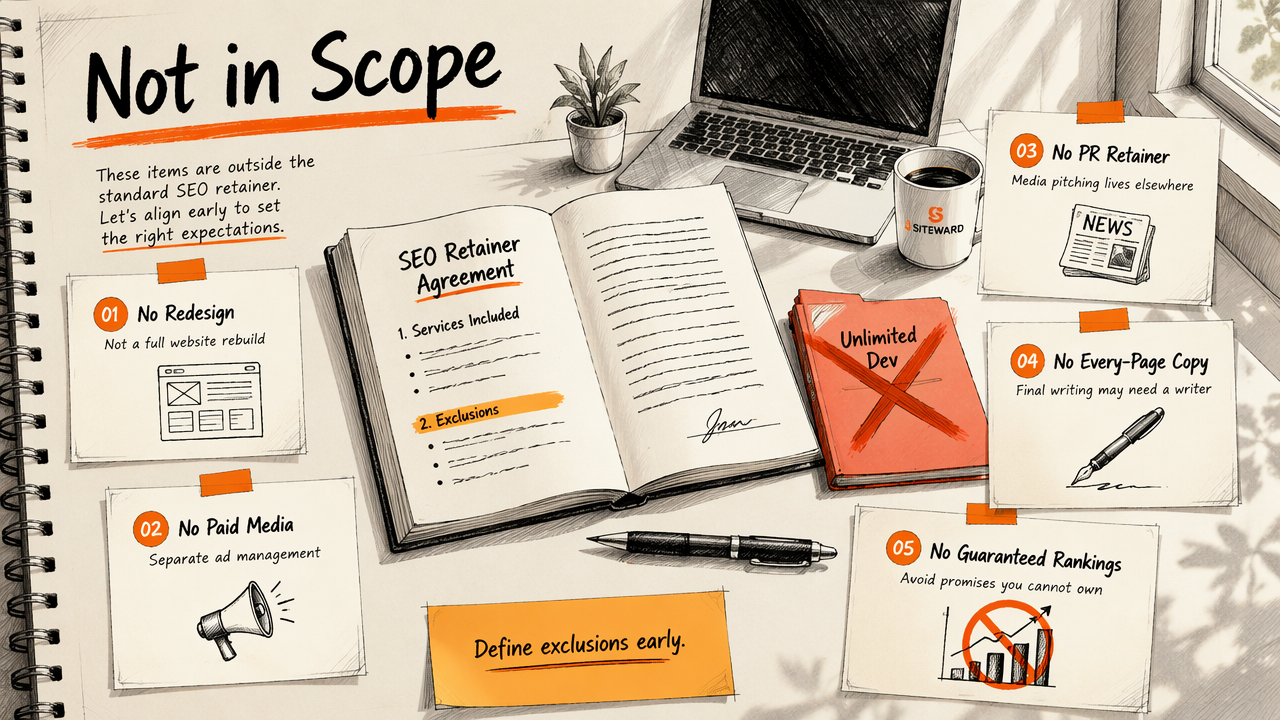
Some exclusions are reasonable. SEO teams may recommend site-speed fixes, but a developer may need to deploy code. A consultant may write a content brief, while a writer produces the final article. An agency may identify link opportunities, while a separate PR team handles media pitching.
Common exclusions that need written approval
| Item | Why it is often excluded | How to handle it |
|---|---|---|
| Development work | Requires engineering access and QA | Add a dev block or separate statement of work |
| Full content writing | Strategy and briefs differ from production | Define article count, word range, and review rounds |
| Paid ads | Different channel, budget, and reporting model | Keep PPC in a separate agreement |
| Digital PR campaigns | High outreach volume and creative production | Scope by campaign or target list |
| Website redesign | Bigger than SEO maintenance | Treat as a project with milestones |
| Guaranteed rankings | Search results are not fully controllable | Use activity, visibility, and business KPIs instead |
Pricing expectations should match the scope. Competitive SERP analysis for 2026 shows top-ranking retainer guides commonly frame SEO retainers from low-cost outsourcing around $300 per month to premium agency support above $5,000 per month. That range is broad because deliverables vary widely.
A buyer should review contract language carefully. Service terms, cancellation rules, data ownership, and acceptable use policies all matter when SEO work touches analytics, CMS access, and business content. For reference, Earlyseo publishes its platform terms for teams that need to understand how software access is governed.
The safest agreement lists deliverables, limits, review cycles, and response times. It also states who owns keyword research, reports, content drafts, dashboards, and access credentials after the engagement ends.
How should reporting prove retainer value?
Retainer reporting should prove value by connecting completed work to leading indicators, business outcomes, and next actions. Rankings alone are too narrow, especially when AI answers, local packs, shopping results, and zero-click searches affect how people find brands.
A good monthly report includes:
- Executive summary: plain-language wins, blockers, and priorities.
- Work completed: shipped URLs, technical fixes, briefs, links, and experiments.
- Performance metrics: impressions, clicks, conversions, revenue, calls, form fills, or store visits where available.
- Search visibility: keyword movement, SERP features, local rankings, and branded search trends.
- AI-search notes: pages formatted for answer extraction, entity updates, and citation opportunities.
- Next-month plan: the top priorities and why they matter.
Communication cadence matters as much as dashboard design. A typical setup includes one monthly strategy call, one written report, and async updates for approvals. Larger accounts may need weekly standups, especially when developers, writers, and product teams are involved.
The Earlyseo platform can support this style of work by keeping visibility tasks tied to implementation rather than leaving recommendations scattered across spreadsheets. More operational guidance is available in the Earlyseo docs, and broader education lives at earlyseo.com for teams building internal SEO habits.
The best report does not just show movement. It explains the decision that movement should trigger.
Frequently asked questions about SEO retainers
SEO retainer questions usually come down to scope, timing, ownership, and proof. The following answers help set expectations before a monthly agreement begins.
How many deliverables should an SEO retainer include each month?
The right number depends on budget, site size, and implementation access. A small retainer may include a technical check, reporting, and a few page updates. A larger engagement may include strategy, content production, schema work, outreach, and AI-search optimization. Quality, priority, and completion matter more than a long task list.
Should content writing be part of the monthly fee?
Content writing can be part of the monthly fee, but it should be named clearly. Some retainers include only content strategy and briefs, while others include drafted, edited, and uploaded pages. The agreement should state article count, approval rounds, subject-matter input, publishing responsibility, and whether images or product data are included.
How long does an SEO retainer need before results show?
SEO results often build over several months because technical fixes, content updates, indexing, and authority signals need time to compound. Early signs may include better crawl health, more impressions, and improved rankings for lower-competition terms. Revenue impact usually depends on site authority, market competition, and conversion quality.
What makes a 2026 retainer different from an older SEO package?
A 2026 retainer should account for AI Overviews, answer engines, entity clarity, structured data, and content that can be cited by machines. Older packages often focused mainly on keyword rankings and backlinks. Modern retainers still need those basics, but they also need formats that help search systems understand and summarize pages.
Conclusion
A strong retainer is not a pile of monthly busywork. It is a clear operating plan for technical health, useful content, authority, AI-search visibility, and accountable reporting. Before signing, a business should request a deliverables matrix, an exclusion list, sample reporting, ownership terms, and a 90-day priority roadmap. For teams ready to organize modern SEO and AI visibility work, Earlyseo offers a practical place to start; visit earlyseo.com and compare planned monthly SEO retainer deliverables against the checklist above.