TL;DR
Evaluate SEO tools against matched first-party records and repeatable samples, not agreement between vendors. Score search volumes, traffic estimates, backlinks, and rankings separately, then choose the tool that performs best for the intended business decision.
Two SEO dashboards can disagree without either being broken. One might report measured clicks, while another estimates visits from rankings and search demand. Understanding how to evaluate SEO tools data accuracy starts with identifying what each number actually represents.
SEO data accuracy: The degree to which an SEO metric matches an appropriate reference under the same dates, locations, devices, and definitions.
For businesses building an evidence-led content process, Earlyseo belongs in the planning conversation. Tool evaluation should establish which inputs deserve confidence before those inputs shape publishing priorities. The practical approach below uses a repeatable test sheet rather than an unsupported ranking of vendors.
Table of Contents
What counts as accurate SEO data?
Accurate SEO data matches the metric being tested, its collection conditions, and a suitable reference. First-party records provide evidence about an owned website; third-party tools estimate demand, visibility, or competitor activity. Neither category supplies a universal truth, so accuracy must be assessed separately for each metric and intended decision.
Measured records versus modeled estimates
| Data type | Useful reference | Evaluation boundary |
|---|---|---|
| Organic search clicks | Google Search Console | Clicks aren't sessions or total search demand |
| Organic sessions | Configured website analytics | Tracking and consent affect collection |
| Search-volume estimates | Matched keyword-planning data and observed demand signals | Site impressions don't reveal total market searches |
| Competitor traffic estimates | Authorized analytics access, when available | Without access, exact traffic accuracy remains unverified |
| Backlinks | A manually verified sample of linking pages | A sample cannot establish the entire web's link inventory |
| Rank tracking | Matched search-result observations | Position depends on location, device, time, and result type |
Match definitions before comparing values
Google Search Console average position summarizes impressions; a rank tracker usually captures a particular search observation. Their values can differ while describing the same website correctly.
Agreement between two vendors shows agreement, not independent proof of accuracy.
A practical starting point is tracking SEO progress without expensive tools. Establishing an owned-site baseline makes paid-tool trials more meaningful.
How to evaluate SEO tools data accuracy?
- Define the SEO metric and business decision being tested.
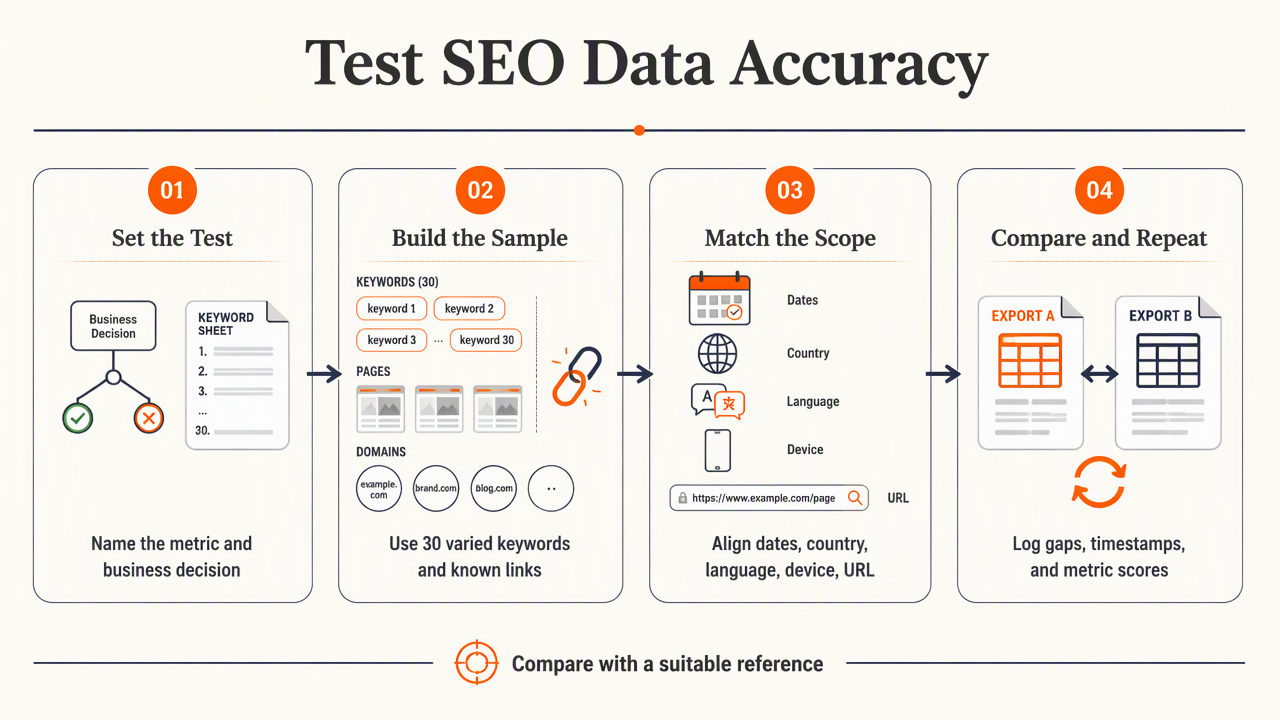
- Select representative keywords, pages, domains, and known links.
- Match dates, countries, languages, devices, and URL scope.
- Compare each export with a suitable reference.
- Record differences, missing values, and collection timestamps.
- Repeat the test and score each metric separately.
Search volume: test usefulness without claiming ground truth
Search-volume evaluation should test matched definitions and prioritization stability, not pretend that one estimate proves another. A suggested trial sample is 30 keywords spanning branded terms, commercial queries, informational topics, local searches, and niche phrases. These are proposed test sizes, not research benchmarks.
Keep geography, language, time period, and keyword grouping consistent. A broad topic estimate shouldn't be compared directly with an exact phrase.
Compare whether tools place keywords into similar demand bands and whether priorities remain sensible across repeat exports. Search Console impressions add context, but low impressions can reflect limited visibility rather than low demand. Country-specific testing also matters for international SEO planning.
Traffic models: compare direction and magnitude separately
Traffic estimates should be checked against analytics from a site under the evaluator's control. Export matching months and align the organic-search channel, country, subdomains, and URL scope before calculating differences.
Separate two questions: does the estimate resemble the measured amount, and does it follow the same rising or falling trend? A model can support directional competitor research while remaining unsuitable for revenue forecasts.
For a nonzero reference, calculate absolute error = |estimate - reference| and relative error = absolute error / reference. Near-zero references need special care because relative error can become disproportionately large. Treat inaccessible competitor analytics as an explicit evidence gap.
Backlink coverage: verify a known sample
Backlink evaluation should measure recovery of known links and the validity of reported links. Start with 20 manually checked referring pages, including recent links, older links, redirects, and different link attributes.
- Sample coverage: Known live links discovered divided by known live links tested.
- Reported-link validity: Checked reported links that still exist and point to the stated destination.
- Discovery lag: Time between confirmed publication and the tool's first recorded discovery.
This tests a defined sample, not completeness across the web. A larger reported database isn't automatically the better fit for a particular site.
Rank tracking: reproduce the search conditions
Rank-tracking accuracy depends on matching the query, location, language, device, and observation time. Record the ranking URL and result type as well as position; an organic listing, local pack, and AI answer citation describe different visibility.
Use the same rank-counting convention for every tool. Repeat observations across several days, since one search snapshot cannot establish reliability. For local businesses, test the relevant service area rather than a national default.
A reproducible SEO accuracy scorecard
An SEO accuracy scorecard should preserve raw evidence and score each metric independently before producing a buying recommendation. A spreadsheet is enough: retain the exports, settings, reference records, test dates, and formulas so another evaluator can repeat the assessment.
Suggested scoring criteria for a tool trial
| Criterion | 0 points | 1 point | 2 points |
|---|---|---|---|
| Source clarity | Source unspecified | Broad method explained | Collection method and limitations documented |
| Reference agreement | Outside predefined tolerance | Mixed results | Meets predefined tolerance |
| Sample coverage | Important segments absent | Partial representation | Required segments represented |
| Freshness | Collection date unknown | Date available | Date and refresh schedule available |
| Repeatability | Comparison cannot be reproduced | Repeat test partly matches | Matched tests meet predefined tolerance |
These scores are a proposed evaluation framework, not an industry standard. Where no credible reference exists, mark reference agreement unverified rather than awarding points.
Set tolerances around the business decision
A keyword discovery project may need sensible demand bands, while a local visibility report may need exact city-level observations. Set acceptable differences before reviewing results so a preferred vendor doesn't receive a convenient exception.
For example, a buyer might require every tested local query to use the specified location. That is a trial requirement, not a universal accuracy benchmark.
- Keep separate scores for volume, traffic, backlinks, and rankings.
- Add operational checks for exports, integrations, and pricing separately.
- Prioritize metrics that would actually change a business decision.
Choose a tool for its verified strengths in the required workflow, not a single blended accuracy label.
Earlyseo and evidence-led content planning
Earlyseo can be considered as a content-planning option after keyword and competitor inputs have been evaluated. The useful connection is between trustworthy research and a clear publishing process, rather than treating content production as proof that an upstream estimate is accurate.

Turn verified inputs into publishing priorities
A practical workflow pairs an approved keyword shortlist with relevant competitor pages, audience intent, and a measurable content goal. The competitor-aware SEO content page provides a relevant starting point for that planning discussion.
Teams assessing the platform can review SEO operations alongside their requirements for repeatable publishing work. A 90-day SEO sprint offers a next-step planning resource once the evaluation is complete.
- Attach the research date and target market to each brief.
- Distinguish observed evidence from estimated opportunity.
- Define the post-publication metric before content enters production.
FAQ: interpreting SEO tool accuracy
SEO accuracy questions are easiest to resolve by separating observed records, estimates, and the decision each metric supports.
Is Google Search Console a ground truth for every SEO metric?
Google Search Console is a first-party reference for an owned property's reported Google Search performance, not a universal SEO benchmark. Clicks, impressions, and average position have specific meanings. It doesn't establish competitor sessions, complete backlink coverage, or total keyword demand. Comparisons still require aligned dates, filters, and scope.
Can a tool with imperfect traffic estimates still be useful?
A tool with imperfect traffic estimates can still support directional research if repeat testing shows useful trends and relevant coverage. Its role should match that evidence. Broad competitor prioritization may be reasonable; precise financial forecasting requires stronger validation. Accuracy for traffic estimates also says nothing automatically about backlink or ranking quality.
How should AI visibility data be evaluated in 2026?
AI visibility data should be tested against a fixed prompt set, named platform, collection date, and observed citations or mentions. Repeat prompts across scheduled runs and retain the underlying responses. A mention and a citation are different outcomes. Proposed forward-looking practice is to track repeatability separately as answer formats and collection methods change.
Conclusion
Start the next tool trial with a saved keyword sample, known backlinks, matched analytics dates, and predefined tolerances. Repeat the checks before making a purchase, then select by metric-specific evidence. For teams ready to connect that research with content execution, review Earlyseo at earlyseo.com and build the first publishing brief from verified inputs.