TL;DR
Google local rankings mainly depend on relevance, distance, and prominence, so the best action plan is to make the profile accurate, prove local authority, and track location-based performance. Distance cannot be fully controlled, but relevance and prominence can be improved through categories, services, reviews, citations, links, photos, and consistent business information.
Google Business Profile relevance distance prominence is the simplest way to understand why one nearby business appears in Google Maps while another stays hidden. Google's own local ranking guidance says local results are based primarily on relevance, distance, and prominence, which makes these three signals the foundation for local SEO in 2026. Local search engine optimisation: the process of improving a business's visibility in unpaid local search results, including Google Search and Google Maps. Businesses that need a practical workflow can pair profile cleanup with Earlyseo for tracking and planning organic visibility improvements.
Table of Contents
What are relevance, distance, and prominence in Google Business Profile?
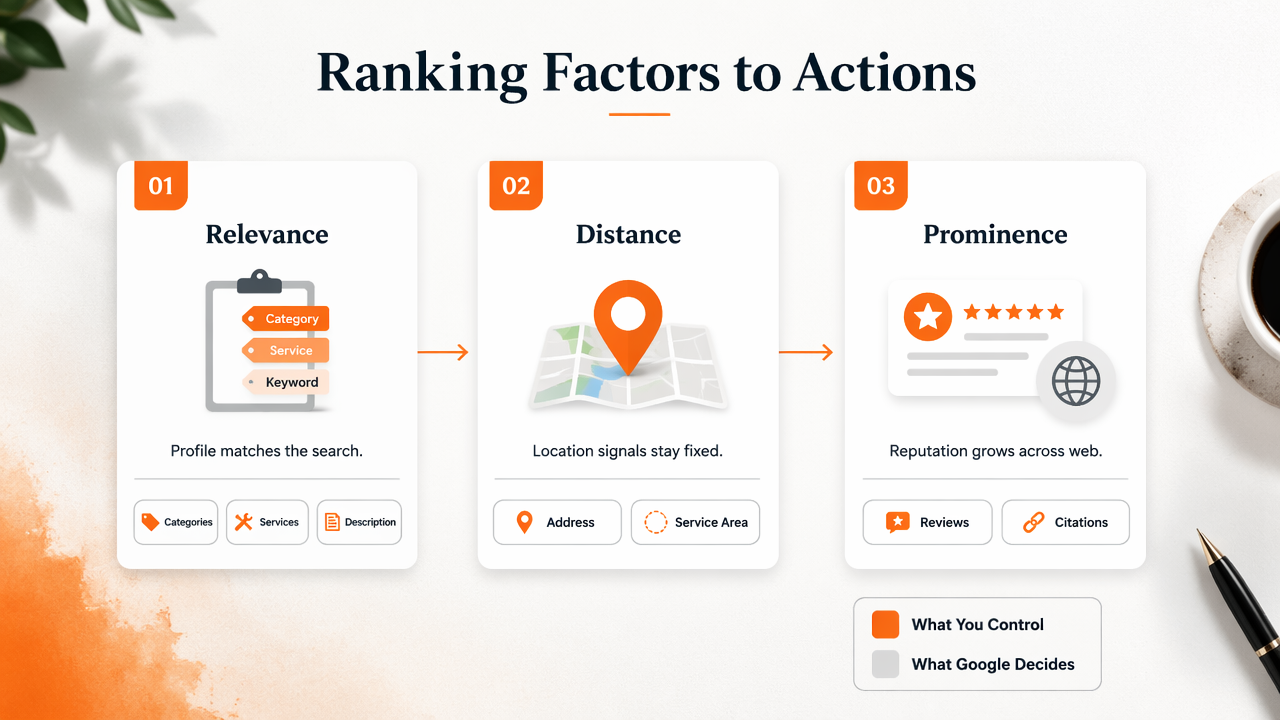
Relevance, distance, and prominence are Google's three primary local ranking factors for deciding which Business Profiles appear for local searches. Relevance measures match quality, distance measures location fit, and prominence measures how well known and trusted the business appears across Google, the web, and the real world.
Key takeaway: A strong local profile does not win by one signal alone. The business must match the query, be geographically reasonable, and show enough public trust to deserve visibility.
Google explains these factors in its local ranking guidance for Business Profiles, and top-ranking industry pages mirror the same structure. The practical difference in 2026 is that Google now interprets more entity data: categories, services, reviews, photos, web mentions, links, and user behavior all help Google understand the business.
Google Maps: a Google mapping platform and consumer application that includes maps, directions, street imagery, local listings, and place discovery features. For local businesses, Google Maps visibility often carries more purchase intent than ordinary organic rankings because searchers are comparing nearby options.
Local ranking factors at a glance
| Factor | What it means | What can be improved | What cannot be fully controlled |
|---|---|---|---|
| Relevance | How closely the Business Profile matches the search | Categories, services, description, photos, website content, attributes | Ambiguous or unrelated search intent |
| Distance | How close the business is to the searcher or searched area | Accurate address, service areas, location pages, local content | The searcher's physical location |
| Prominence | How well known and trusted the business appears | Reviews, citations, links, press, brand searches, reputation | Established competitors with years of recognition |
A clean profile gives Google fewer reasons to skip the listing. The most direct profile-level improvements include choosing the most accurate primary category, filling out services, adding fresh photos, keeping hours current, and matching the name, address, and phone number across major listings.
For a step-by-step profile cleanup, Earlyseo's guide to optimize a Google Business Profile for rankings is a useful next read after the ranking factors are understood.
How does relevance affect Google Business Profile rankings?
Relevance affects rankings by helping Google decide whether a Business Profile is a close match for the words, intent, and category behind a local search. A dentist, emergency plumber, bakery, or law office must describe services clearly enough for Google to connect the profile with the right searches.
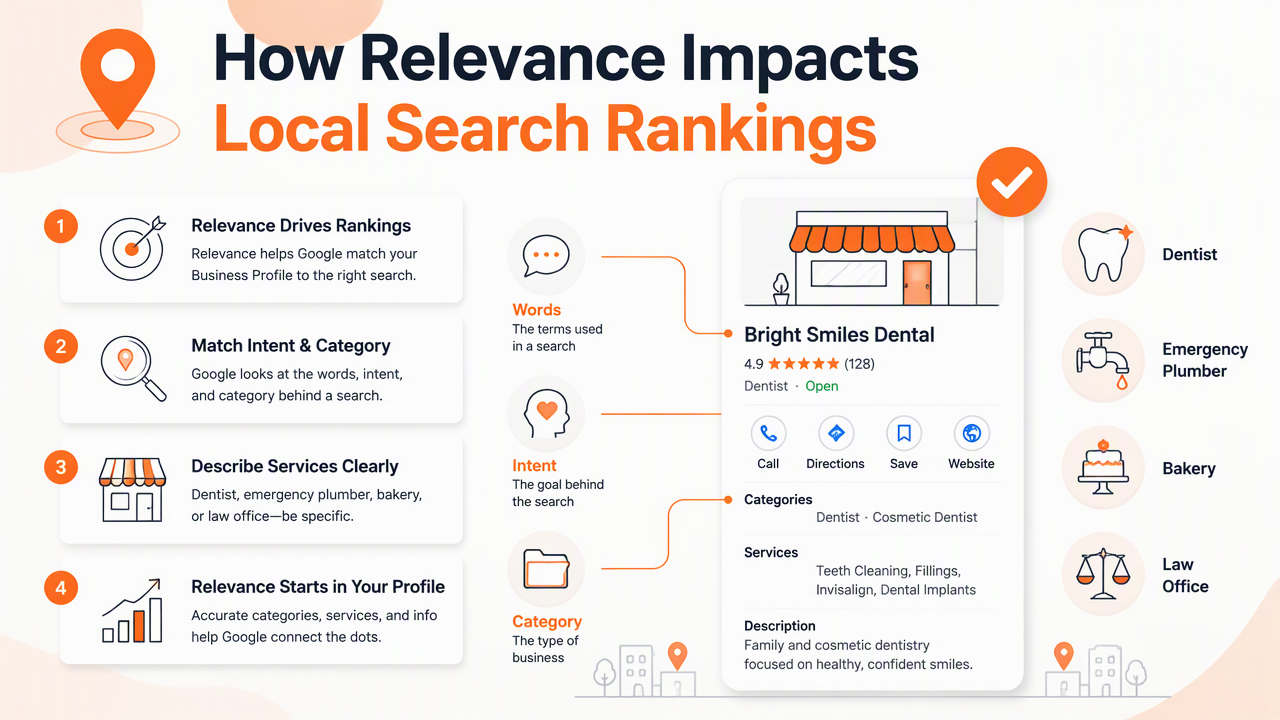
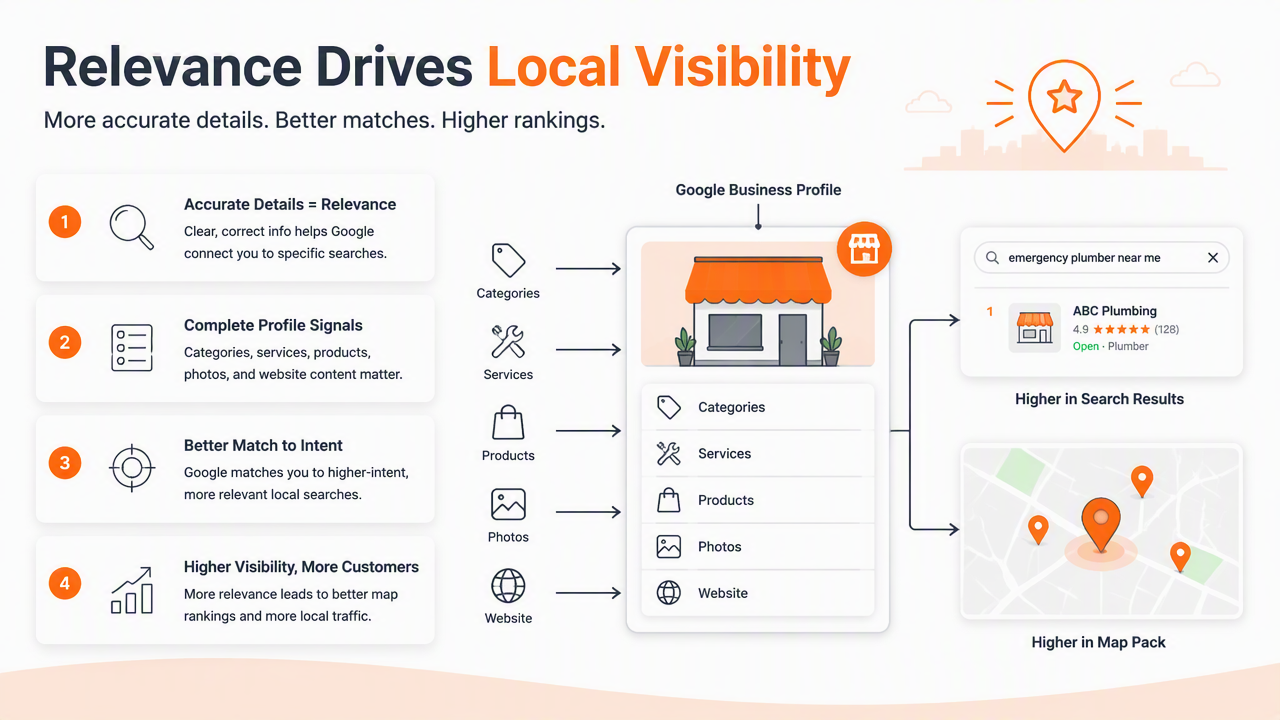
Relevance starts with the primary category. A business that chooses a broad or incorrect category may lose visibility even with strong reviews. Secondary categories, services, products, appointment links, attributes, photos, and website content then add supporting context.
Research by Mariani, Perez-Vega, and Wirtz in Psychology and Marketing reviewed AI in marketing and consumer research, showing how AI systems are increasingly used to interpret consumer signals and business information; see the 2021 systematic literature review. Local search works in a similar direction: clearer entity data gives machine systems better context.
Relevance signals that usually matter most
- Primary category: the clearest label for what the business is.
- Secondary categories: related services that support, not replace, the main category.
- Services and products: plain-language entries that match common local searches.
- Business description: concise explanation of services, location, and audience.
- Website landing pages: pages that reinforce the same services and locations.
- Reviews: customer language that mentions real services, neighborhoods, and outcomes.
Relevance should not become keyword stuffing. Google can read natural language, and profile fields should sound like a real business, not a list of repeated phrases. A better approach is to cover each service once, use normal wording, and match the website to the same service structure.
Service companies often need tighter alignment between their Business Profile, service pages, and local proof. Early-stage teams can use the SEO for service-based business guide to connect GBP relevance with website pages that support calls, quotes, and appointments.
How does distance shape Maps visibility?
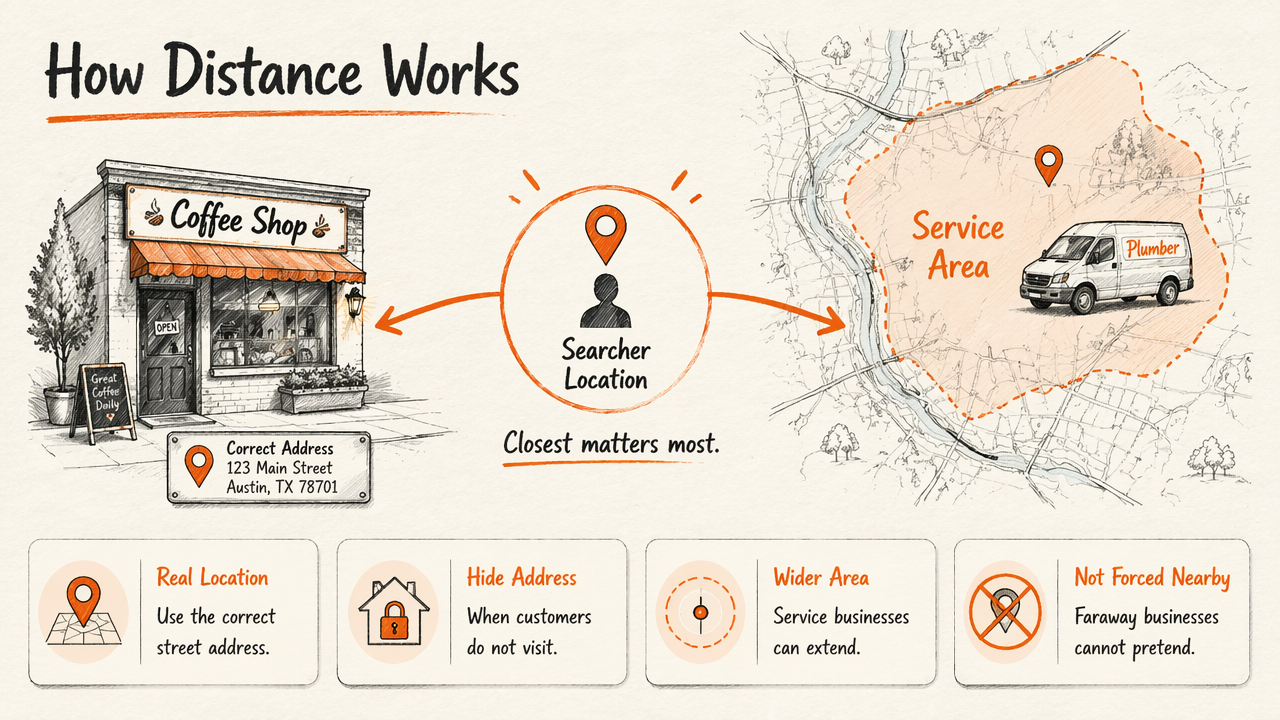
Distance shapes Maps visibility by comparing the business location with the searcher's location or the place named in the query. A business closer to the search point often has an advantage, but distance is not absolute; a more relevant and prominent competitor can still outrank a closer listing.
Distance works differently for three common search patterns. A search for "coffee near me" relies heavily on the searcher's current location. A search for "coffee in downtown Austin" uses the named area. A broad search like "best coffee shop" may blend location, prominence, and intent.
Key takeaway: Distance is the least controllable ranking factor, so local SEO should focus on making the business the strongest eligible result inside its realistic service area.
Businesses should avoid fake locations, keyword-filled addresses, or virtual-office tricks. Those tactics can create profile risk and confuse customers. A legitimate location strategy is stronger: accurate addresses, clear service areas, location-specific pages, and proof that the business actually serves the area.
Practical ways to support distance signals
- Set the correct address or service-area settings in Google Business Profile.
- Keep hours, phone numbers, and appointment links current.
- Build location pages only for areas the business truly serves.
- Add neighborhood and city context naturally in website copy.
- Earn reviews from customers across the real service area.
- Track rankings by location, not from one office computer.
Distance also explains why rank tracking can look inconsistent. A listing may rank first from one neighborhood and seventh from another. Marketing managers should judge local performance through calls, direction requests, profile actions, and location-segmented impressions, not one manual search.
For businesses building the broader local foundation, the local business SEO playbook gives a practical structure for service areas, local pages, and visibility work beyond the profile.
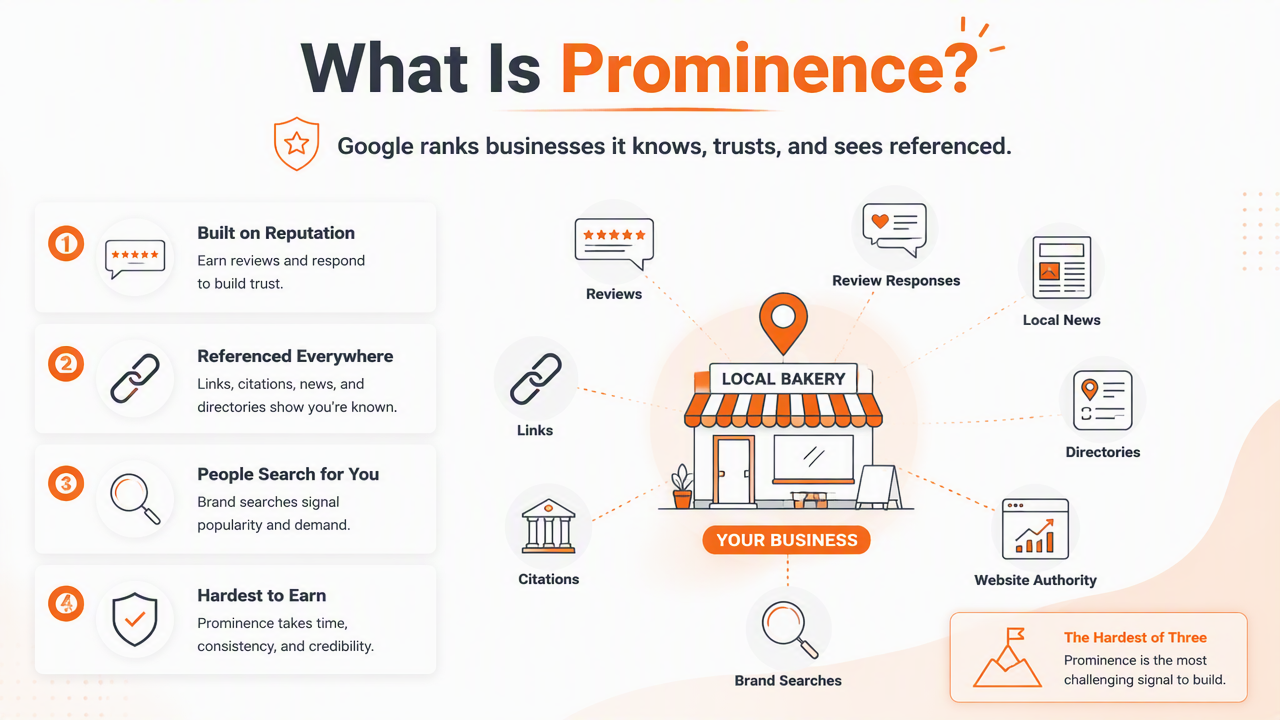
How does prominence improve local ranking strength?
Prominence improves local ranking strength by showing Google that a business is known, trusted, and worth recommending. Google's guidance connects prominence with information from across the web, including links, articles, directories, and review count and score, alongside offline familiarity for well-known places.
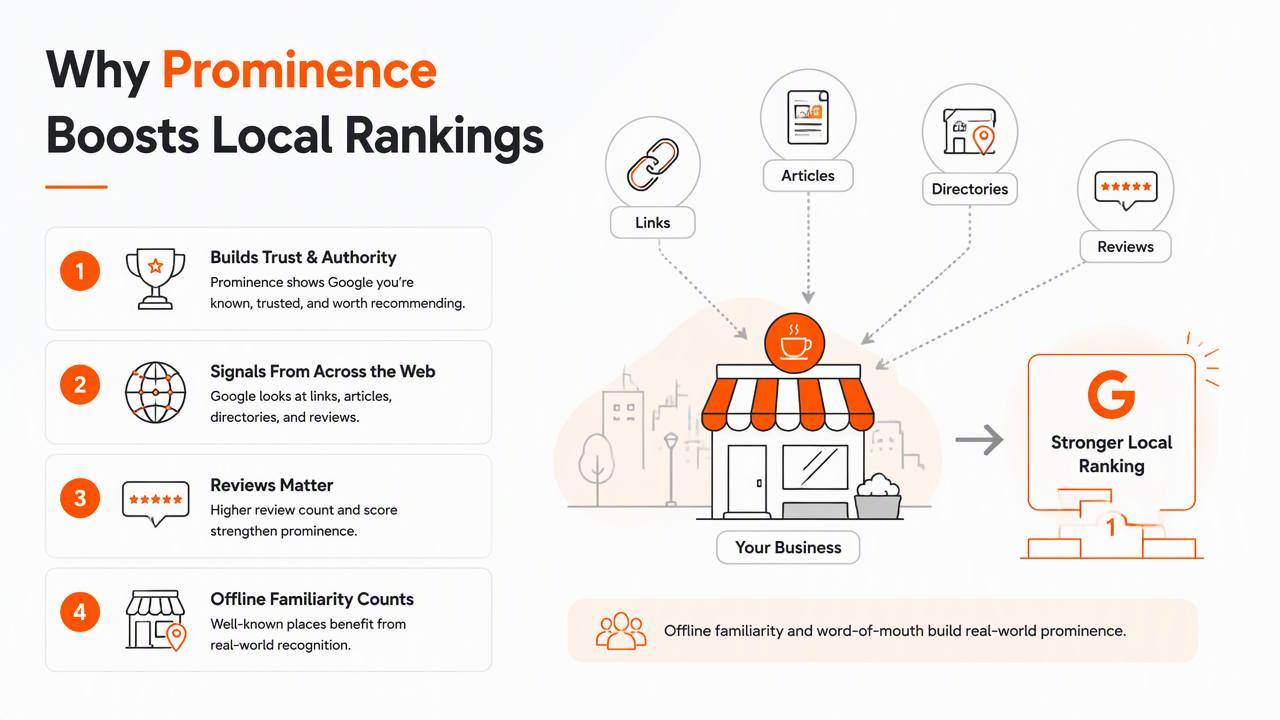
A small business cannot manufacture true prominence overnight. Still, it can build signals steadily through review generation, local citations, partnerships, local PR, useful content, and consistent brand mentions. The best prominence strategy looks like real marketing, not a loophole.
Reviews deserve special attention because they influence both ranking and conversion. A listing with detailed, recent reviews gives Google and searchers more confidence than a quiet profile. The wording inside reviews can also strengthen relevance when customers naturally mention services, products, or locations.
Prominence work that compounds over time
- Ask for reviews consistently: make review requests part of the customer follow-up process.
- Respond to reviews: show activity, service quality, and customer care.
- Fix citation consistency: align business name, address, phone, and website on trusted directories.
- Earn local links: partner with chambers, sponsors, suppliers, schools, charities, and local publications.
- Publish useful local content: answer location-specific questions that customers actually ask.
- Build branded demand: encourage searches for the business name through offline and online marketing.
Prominence is also where website SEO and Business Profile SEO overlap. Strong local pages can earn links, answer service questions, and support profile relevance. Google Search Console data helps identify which local pages earn impressions and which queries are close to page-one visibility.
The Earlyseo platform can help growing teams connect local SEO tasks with search performance signals. Businesses that need reporting should review the Google Search Console feature or learn the basics through this Google Search Console tutorial for beginners.
How should local businesses measure and improve these signals in 2026?
Local businesses should measure these signals by separating profile completeness, geographic reach, and authority growth instead of watching one ranking number. A simple monthly scorecard can show whether relevance, distance coverage, and prominence are improving in ways that create calls, visits, and leads.
Google's local results are dynamic, so rankings change by searcher location, query wording, device, competition, and algorithm updates. If visibility drops after a major change, a calm audit works better than random edits. The guide on how to recover from a Google algorithm update explains a safer review process for traffic and ranking shifts.
AI will likely make local search more conversational through 2026 and into 2027. Searchers may ask longer questions, compare options inside AI summaries, and expect direct answers. Research by Cowls, Tsamados, and Taddeo on AI opportunities and challenges highlights the need for reliable systems and careful data use; see the 2021 AI & Society paper. For local SEO, clean business data becomes more important as AI answer systems summarize options.
A monthly local ranking checklist
- Review categories, services, attributes, hours, photos, and links.
- Check whether top service pages match the profile's core offerings.
- Compare review volume, review recency, and rating trends against nearby competitors.
- Audit major citations for name, address, phone, and website consistency.
- Track profile actions, calls, website clicks, direction requests, and Search Console queries.
- Add one local proof asset, such as a case study, neighborhood page, partner mention, or customer FAQ.
Key takeaway: The safest 2026 strategy is steady proof: accurate profile data, real customer feedback, useful local content, and consistent brand signals across the web.
Earlyseo is built for small teams that need simple SEO direction without turning local search into a full-time job. For more planning resources, visit earlyseo.com and connect profile improvements with website visibility, content priorities, and performance tracking.
Frequently asked questions and references
Are relevance, distance, and prominence confirmed ranking factors?
Yes. Google's Business Profile documentation states that local results are based primarily on relevance, distance, and prominence. Industry competitors such as Search Engine Journal, CCC, and Rocket Clicks also structure their local ranking explanations around these three factors, which makes them the accepted framework for Google Maps SEO.
Can a business improve distance rankings?
A business cannot change where a searcher is located, but it can improve how clearly Google understands the real address, service area, and local coverage. Accurate profile settings, location-specific website content, and reviews from real customers across served areas can help the listing compete in appropriate nearby searches.
Which factor matters most for local SEO?
No single factor always matters most. Distance can dominate urgent "near me" searches, relevance can dominate service-specific searches, and prominence can help trusted businesses outrank weaker nearby competitors. The strongest local SEO plans improve relevance and prominence while respecting the limits of distance.
How often should a Google Business Profile be updated?
A Business Profile should be reviewed at least monthly and updated whenever hours, services, photos, products, staff availability, or booking links change. Regular updates help customers avoid bad information and give Google clearer evidence that the profile is active and reliable.
References: Google Business Profile local ranking guidance, Mariani et al., 2021, AI in marketing review, Cowls et al., 2021, AI opportunities and challenges.
Conclusion
Google Business Profile relevance distance prominence is not a theory to memorize; it is a practical checklist for getting found by nearby customers. The next step is simple: audit the profile for relevance, verify the real-world location setup, build prominence through reviews and local proof, then track results monthly. For teams that want a clearer workflow, Earlyseo and the resources on earlyseo.com can help turn those local SEO tasks into a repeatable visibility plan.