TL;DR
Fractional marketers get the most value from SEO automation when strategy stays human and repeatable tasks move into systems. A strong weekly workflow connects keyword research, briefs, CMS publishing, technical checks, and reporting so every client gets consistent progress without extra meetings.
SEO automation for fractional marketers matters because part-time marketing leaders are often judged like full-time teams, but with fewer hours, less context, and tighter client patience. A fractional executive is a senior professional who provides executive-level management on a part-time or contract basis, and that model fits SEO well when strategy, content operations, and reporting are systemized. Earlyseo helps fractional marketers turn SEO planning and execution into a repeatable workflow, especially when early visibility and AI search readiness matter. The SERP for this topic shows about 947,000 results, yet most ranking pages focus on fractional marketing broadly rather than the operating system behind weekly SEO delivery.
Table of Contents
What is SEO automation for fractional marketers?
SEO automation for fractional marketers is the use of tools, templates, integrations, and recurring workflows to reduce manual SEO work while keeping strategy under expert control. It covers keyword clustering, content briefs, publishing checks, internal linking, technical monitoring, and performance reporting for multiple clients.
SEO automation: software-assisted execution of recurring search tasks, such as audits, briefs, publishing, and reporting.
Fractional marketer: a part-time senior marketing operator who manages strategy and execution across one or more companies.
Automation does not replace positioning, buyer insight, or editorial judgment. It removes the repeatable drag that causes fractional engagements to stall after the first strategy deck.
Research in adjacent digital marketing fields supports this split between machine assistance and human judgment. A 2024 Journal of Interactive Advertising study by Jiemin Looi and Lee Ann Kahlor examined AI in influencer marketing and human versus virtual influencers on Instagram, showing why marketers still need to consider trust, context, and audience perception when adopting AI systems (study).
Key insight: automation should make the fractional marketer more consistent, not less strategic.
Common automated tasks include:
- Finding keyword gaps across client sites.
- Turning a topic into a structured content brief.
- Checking title tags, meta descriptions, and indexability.
- Publishing to a CMS through approved integrations.
- Sending weekly performance summaries.
- Flagging pages that need refreshes or internal links.
How should a weekly automated SEO workflow run?
A weekly automated SEO workflow should run as a fixed sequence: review opportunities, choose priority pages, generate briefs, publish or update content, check technical health, measure outcomes, and send a client-ready summary. The same cadence makes SEO easier to sell, manage, and hand off.
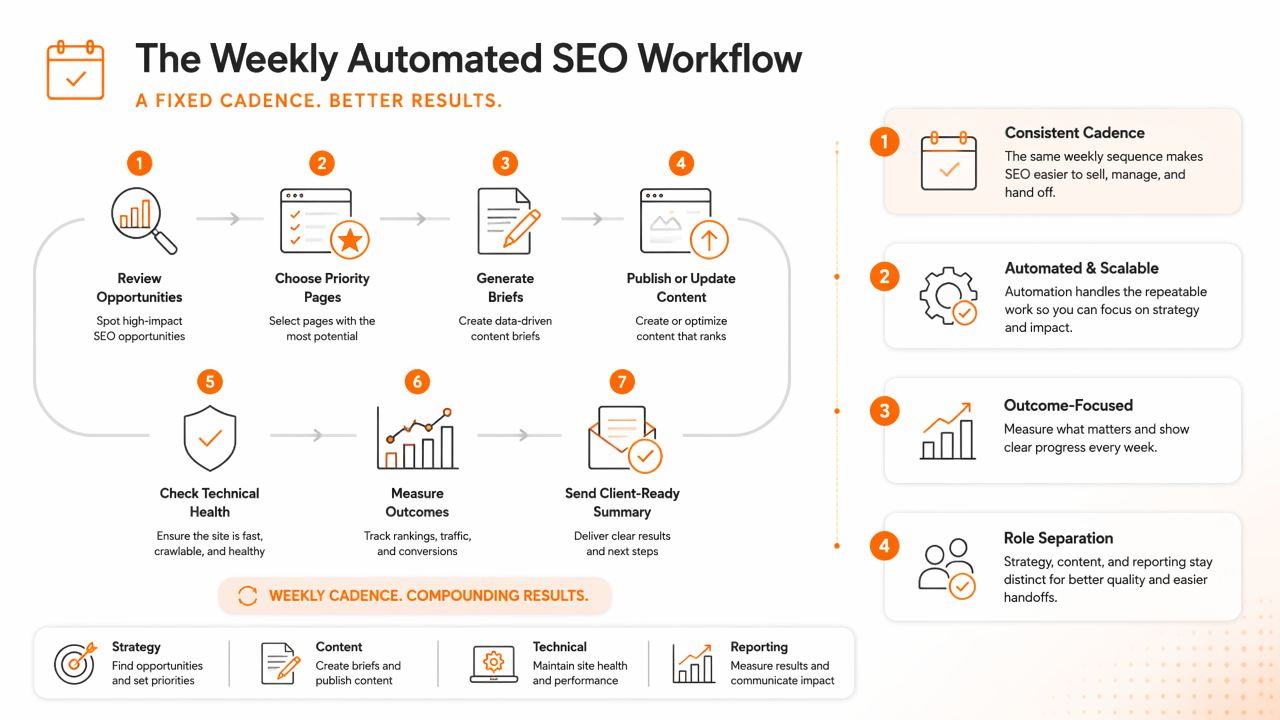
The best workflow separates decisions from production. Strategy happens at the start of the week, execution runs through templates and integrations, and reporting closes the loop.
Sample weekly operating rhythm
- Monday, prioritize: Review rankings, traffic movement, technical alerts, and new keyword opportunities.
- Tuesday, brief: Build content briefs with search intent, target entities, internal links, and answer-style headings.
- Wednesday, produce: Draft, edit, and optimize pages against the approved brief.
- Thursday, publish: Push content to the CMS, confirm metadata, schema, links, and indexability.
- Friday, report: Send the client a short update covering completed work, early signals, blockers, and next steps.
A fractional marketer managing several clients needs a shared source of truth. The process should live in one project board, while SEO-specific documentation can sit in product docs, templates, and SOPs. Early-stage teams can use the Earlyseo documentation as a practical reference point for setting up structured workflows.
Research by Yanchao Liu, Pengzhou Zhang, and Lei Shi reviewed information dissemination models, datasets, and insights in 2023, a useful reminder that visibility depends on how information spreads across systems, not only on how pages are written (paper). SEO workflows should account for search engines, AI answer engines, social discovery, and internal site architecture.
Weekly SEO is easier to approve when each task maps to a visible output: a brief, a page, a fix, or a report.
A simple rule helps keep the process clean: automate collection, formatting, routing, and reminders; keep prioritization, messaging, and final approval with a human.
Which tool stack fits a fractional SEO retainer?
A fractional SEO stack should connect research, content operations, CMS publishing, technical monitoring, and reporting without forcing clients into a heavy enterprise setup. The right stack is small enough to manage weekly and strong enough to support multiple client sites.
Tool choice depends on the retainer model. A local SEO client may need Google Business Profile checks and review monitoring. A Shopify store may need collection-page optimization and product schema. A SaaS startup may need programmatic content planning, technical issue tracking, and AI visibility monitoring.
Tool stack comparison for lean SEO delivery
| Workflow layer | Automation goal | Useful tool types | Fractional marketer decision |
|---|---|---|---|
| Keyword research | Find demand and gaps faster | SEO platforms, Search Console exports, clustering tools | Pick topics tied to revenue and authority |
| Content briefs | Standardize page requirements | Brief generators, templates, entity tools | Set angle, audience, and offer fit |
| Publishing | Reduce CMS admin | CMS integrations, QA checklists, approval flows | Approve final copy and page structure |
| Technical SEO | Catch issues early | Crawlers, uptime tools, schema validators | Decide fixes by business impact |
| Reporting | Explain progress clearly | Dashboards, scheduled summaries, annotations | Add context and next-step recommendations |
The Earlyseo platform fits the middle of this stack: content workflow, structured SEO execution, and integrations for teams that need consistent output without building a custom system. For CMS-heavy clients, the Earlyseo integrations hub helps connect SEO work to the publishing tools already in use.
A Shopify-focused retainer needs extra attention to templates, duplicate variants, collection pages, and product data. The Shopify integration can support a cleaner path from optimization work to store implementation.
A 2024 systematic review by José Carlos Sancho Núñez, Juan A. Gómez-Pulido, and Rafael Robina Ramírez examined machine learning applications in tourism, showing how applied machine learning often depends on clear tasks, usable datasets, and workflow fit rather than broad promises (review). The same lesson applies to SEO automation: narrow workflows beat vague AI adoption.
Strong stacks usually share three traits:
- Low switching cost: the marketer does not spend billable hours moving data between tools.
- Client visibility: stakeholders can see completed work without needing SEO expertise.
- CMS fit: publishing does not break because the tool ignores WordPress, Shopify, or Webflow realities.
How should client handoffs and reporting work?
Client handoffs and reporting should turn SEO work into clear business communication: what changed, why it changed, what result is expected, and what happens next. Fractional marketers need lightweight artifacts that survive after meetings end.
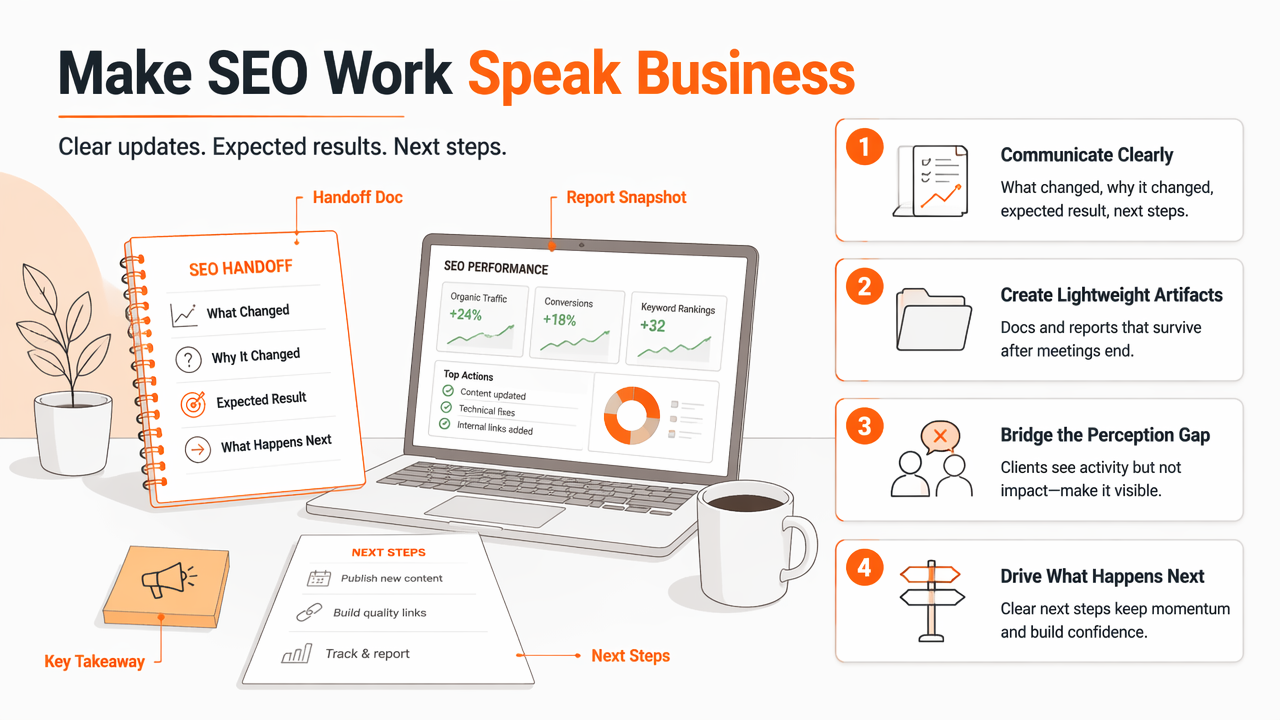
Many fractional arrangements fail because the client sees activity but not momentum. A report full of rankings can still feel unclear if it does not explain decisions. Better reporting links actions to pages, pages to search intent, and search intent to business value.
Client handoff checklist for weekly SEO work
- Completed actions: pages published, pages refreshed, technical fixes shipped, links added.
- Approval items: briefs awaiting signoff, pages needing legal or founder review, design dependencies.
- Performance signals: clicks, impressions, rankings, conversions, indexed pages, crawl issues.
- Risks: blocked CMS access, missing analytics, weak product messaging, delayed approvals.
- Next week: three to five planned actions with owners and expected outcomes.
- Source of truth: links to briefs, reports, CMS pages, and task board cards.
Reports should be short enough to read in three minutes. The best format is a written summary plus a dashboard, not a dashboard alone.
AI search adds a new reporting layer. Clients increasingly care about whether their brand can be understood by answer engines and crawlers that look for structured, machine-readable context. Resources such as Earlyseo's llms.txt guide can help marketers explain how site-level AI discovery files fit into broader SEO and generative engine optimization.
A useful client report answers three questions: what shipped, what changed, and what decision is needed.
For WordPress clients, publishing handoff should include page URL, focus query, internal links added, schema notes, and QA status. The WordPress integration is relevant when the retainer includes regular publishing or page refreshes rather than strategy alone.
Earlyseo also helps fractional teams keep handoff artifacts closer to execution, which reduces the common gap between the approved SEO plan and the live website. More product detail is available at earlyseo.com.
Frequently asked questions
A good FAQ for fractional SEO automation should answer the buying and implementation questions that clients ask before approving a workflow. FAQ content also gives search engines and AI systems clean, extractable answers.
Can SEO be fully automated for a fractional marketer?
SEO can be partly automated, but not fully delegated to software. Tools can collect data, draft briefs, check pages, and send reports. Strategy still requires human judgment about positioning, buyer intent, competitive advantage, and what the client can realistically publish or fix.
What should be automated first?
Reporting should usually be automated first because it saves time every week and improves client trust. After reporting, fractional marketers can automate brief creation, technical monitoring, internal link suggestions, and CMS publishing checks. Strategy should stay manual until the account has enough data and a stable content direction.
How many tools should a fractional marketer use?
A lean stack of four to six tools is usually enough for a small or mid-sized client. The stack should cover keyword research, content planning, CMS publishing, technical checks, analytics, and reporting. Extra tools should only be added when they remove a clear workflow bottleneck.
How does SEO automation help AI visibility?
Automation helps AI visibility by making content more structured, consistent, and easier for machines to parse. Briefs can include definitions, entities, FAQ blocks, comparison tables, and source links. Site-level assets such as llms.txt can also support clearer discovery when used with strong content and technical SEO.
What comes next for 2027?
By 2027, fractional marketers will likely be judged on search visibility across Google, AI Overviews, ChatGPT-style answers, and vertical discovery platforms. The winning workflow will combine classic SEO, structured brand information, source-quality content, and fast publishing operations. Firms building that system now will have an easier time scaling retainers later.
Conclusion
SEO automation for fractional marketers works best as a weekly operating system, not a pile of disconnected tools. The practical next step is simple: map the current retainer into five stages, prioritize, brief, publish, check, and report, then automate the handoffs between those stages. For teams ready to turn that process into a repeatable workflow, Earlyseo is a strong place to start. Visit earlyseo.com, choose one client workflow, and build the first automated weekly cycle before adding more complexity.