TL;DR
Small businesses need a lean SEO stack, not a giant software bill. Start with Google Search Console, Google Keyword Planner, one content workflow tool, one technical crawler, and simple reporting, then add local, ecommerce, or multilingual tools only when the business model calls for them.
SEO software can get expensive fast, but most small businesses only need a few jobs done well: finding search demand, publishing useful pages, fixing crawl issues, earning local visibility, and tracking progress. The best seo optimisation tools for small businesses are the ones that turn those jobs into repeatable weekly habits, not dashboards that nobody opens. [SEO optimisation tool]: software that helps improve a website's visibility and performance in search engine results through keyword research, technical checks, content guidance, internal linking, schema, indexing, and reporting. For owners that want one workflow instead of scattered spreadsheets, Earlyseo is built around practical SEO operations for growing sites.
Table of Contents
What are SEO optimisation tools for small businesses?
SEO optimisation tools for small businesses are software products that help a company improve unpaid search visibility with less manual work. They support keyword research, content planning, technical audits, internal links, structured data, indexing checks, local listings, and reporting so a small team can focus on actions that affect search performance.
Search engine optimization means improving the visibility and overall performance of web pages in search engine results pages. Local search optimization applies the same idea to location-based results, such as map packs and city-specific service searches.
A small business SEO stack should answer three questions every week: what should be published, what should be fixed, and what changed in search performance?
The 2026 tool market is split between all-in-one platforms, focused free tools, and AI-assisted workflow tools. Large suites such as Semrush, Ahrefs, Moz Pro, and SE Ranking are useful for deep competitor research. Free products such as Google Search Console and Google Keyword Planner remain strong starting points. Focused tools such as Screaming Frog and AnswerThePublic fill gaps that broad tools may not handle cheaply.
Artificial intelligence is also changing expectations. Research by Sofiat Abioye, Lukumon O. Oyedele, and Lukman Akanbi reviewed AI adoption, opportunities, and challenges in construction workflows, showing how AI systems increasingly support planning and operational decisions across industries (ScienceDirect, 2021). SEO tools are following the same broad pattern: less manual sorting, more assisted prioritization.
Which SEO tool categories does a small business actually need?
A small business usually needs six SEO tool categories: keyword research, content creation, technical crawling, internal linking, indexing, and reporting. Local businesses also need Google Business Profile support, while ecommerce stores need product-page and category-page checks.
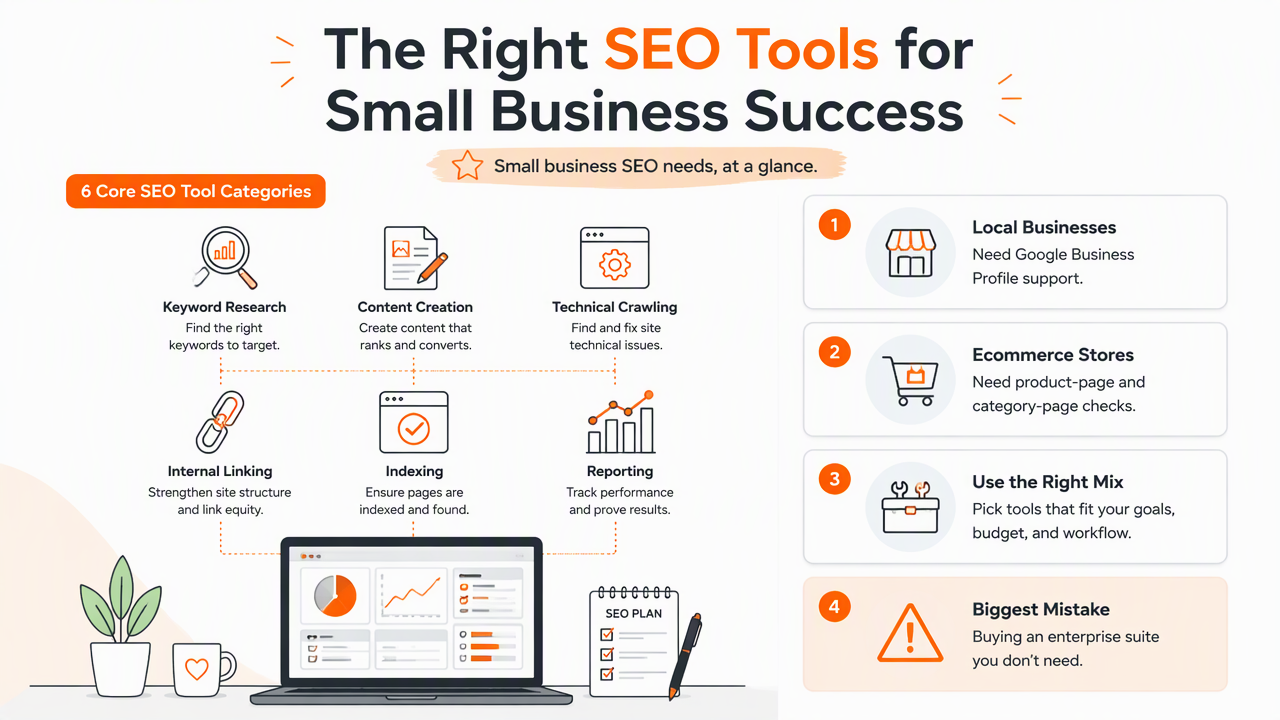
The main mistake is buying an enterprise suite before the workflow exists. A lean stack should start with the smallest set of tools that can support a 90-day publishing and optimization plan.
Core tool categories and best-fit options
| SEO job | Best-fit tools | Best for | Practical note |
|---|---|---|---|
| SEO operations | Earlyseo | Small teams that need content, internal links, schema, and reporting in one process | Strong fit when consistency matters more than massive data exports |
| Keyword research | Google Keyword Planner, AnswerThePublic, Ahrefs, Semrush | Finding terms, questions, and topic ideas | Keyword Planner is useful for demand signals; AnswerThePublic is useful for question-led content |
| Technical crawling | Screaming Frog, Sitebulb | Finding broken links, duplicate titles, redirect chains, crawl waste | Screaming Frog is widely used because it gives detailed site-level exports |
| Search performance | Google Search Console, Bing Webmaster Tools | Indexing, queries, impressions, click trends | These should be installed before paid tools |
| Local SEO | Google Business Profile, BrightLocal, Whitespark | Map visibility, citations, reviews, location tracking | Best for service businesses, clinics, restaurants, and retail locations |
| Ecommerce SEO | Shopify SEO apps, Screaming Frog, Search Console | Product, collection, and category optimization | Stores can pair tool checks with ecommerce SEO guidance for small online stores |
| Reporting | Looker Studio, Search Console, simple rank trackers | Monthly visibility and lead trends | Reporting should show decisions, not vanity charts |
Where free tools fit best
Free tools are often enough for the first stage of SEO. Google Search Console shows search queries, indexed pages, crawl issues, and performance trends. Google Keyword Planner helps estimate demand, especially for commercial topics that overlap with paid search.
AnswerThePublic is useful for early content planning because it turns broad topics into question clusters. A local electrician, for example, might find question-led pages around emergency repairs, panel upgrades, permits, and neighborhood service areas.
Related articles also matter. Internal "related articles" blocks help visitors and crawlers move from one useful page to another. They work best when links are based on topic fit, not random recent posts.
How should a small business choose a lean SEO stack in 2026?
A small business should choose SEO tools by matching software to workflow maturity, budget, and revenue model. The right stack should cover one measurable SEO routine: research topics, publish pages, improve internal links, submit pages for indexing, and review performance every month.
A useful buying process is simple:
- Install free measurement first. Set up Google Search Console and analytics before comparing paid software.
- Pick one primary SEO goal. Local calls, ecommerce sales, demo requests, or content traffic require different tools.
- Choose one research source. Google Keyword Planner, AnswerThePublic, Ahrefs, Semrush, or SE Ranking can all work if used consistently.
- Add one technical checker. Screaming Frog is a practical choice for crawling page titles, status codes, canonicals, and internal links.
- Create a publishing cadence. A tool only helps when pages actually get shipped.
- Report on actions and outcomes. Track pages published, fixes completed, indexed URLs, clicks, leads, and sales.
The best paid tool is rarely the one with the most charts. It is the one that changes next week's task list.
Budget should follow complexity. A five-page local service site may need Google Business Profile, Search Console, and a lightweight content workflow. A growing Shopify store may need collection-page optimization, product schema, internal linking, and richer reporting. A multilingual site needs translation-aware content, hreflang planning, and region-specific keyword research through tools such as multilingual SEO content workflows.
For local companies, the stack should include review monitoring, map visibility checks, citation cleanup, and service-area landing pages. A practical starting path is a focused local business SEO playbook, especially when budgets are tight and paid ads are already expensive.
For owners still deciding whether organic search is worth the effort, a basic education step helps avoid random spending. The guide on whether a small business needs SEO gives useful context before tool subscriptions start.
How Earlyseo handles content, internal links, schema, and reporting
The Earlyseo platform is designed for small businesses that need an SEO operating system rather than a pile of disconnected tools. It focuses on moving from keyword opportunities to published content, internal linking, structured data, indexing support, and progress tracking in one repeatable process.
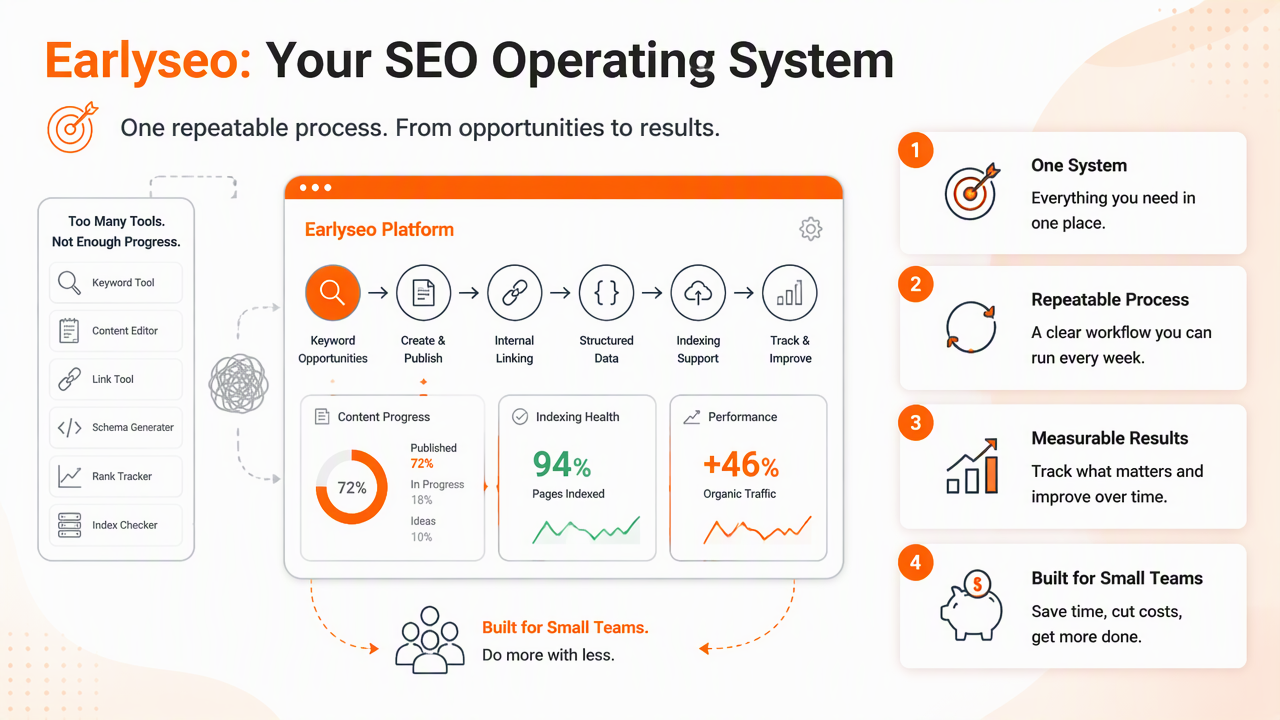
Many small teams struggle because keyword research lives in one file, content briefs live somewhere else, and reporting happens only when traffic drops. A connected workflow lowers that friction. Earlyseo is a good fit when the business needs steady execution, clear priorities, and search-friendly content systems.
Its strongest use cases include:
- Content planning: turning competitor and keyword signals into page ideas.
- Competitor-aware content: building articles around real SERP gaps through competitor-aware SEO content.
- Internal links: connecting service pages, blog posts, category pages, and related articles.
- Schema support: adding structured data signals where they match the page type.
- SEO operations: organizing repeatable tasks through SEO operations workflows.
- Progress tracking: helping teams connect SEO work to visible movement over time.
That workflow matters because SEO is a forecasting problem as much as a publishing problem. Research by Fotios Petropoulos and coauthors on forecasting theory and practice examined how forecasts support better planning under uncertainty (International Journal of Forecasting, 2022). SEO reporting works best the same way: not as a perfect prediction, but as a disciplined way to decide what to do next.
Small businesses that already have a writer, developer, and analyst may prefer separate specialist tools. A lean team often benefits more from fewer handoffs. More product details are available at earlyseo.com.
What should small businesses expect from SEO tools in 2027?
Small businesses should expect SEO tools in 2027 to focus more on AI search visibility, structured answers, entity coverage, and workflow automation. Traditional rankings will still matter, but tools will increasingly measure how content appears across search results, AI summaries, local packs, product grids, and answer engines.
Search behavior is spreading across Google, Bing, ChatGPT-style assistants, marketplaces, maps, and social platforms. That means tools must help businesses create pages that are clear enough for humans, crawlers, and AI systems. Entity-rich headings, concise definitions, comparison tables, FAQs, and schema will become normal parts of small business publishing.
Shanaka Kristombu Baduge and coauthors reviewed machine learning and deep learning applications in built environments, showing how smart systems process visual and operational data for decisions (Automation in Construction, 2022). SEO tools are moving in a related direction, with systems that interpret pages, competitors, and performance signals automatically.

Practical 2027 buying criteria should include:
- AI visibility checks: support for answer-style content, summaries, and entity coverage.
- Schema depth: clear recommendations for article, product, local business, FAQ, and breadcrumb schema.
- Indexing workflows: faster checks for crawled, discovered, indexed, and excluded URLs.
- Internal-link intelligence: suggestions based on topical relevance, not just exact-match anchors.
- Local and ecommerce support: workflows for maps, reviews, products, collections, and service pages.
- Plain-English reporting: dashboards that explain what changed and what action should happen next.
Small companies do not need every new feature. They need tools that make search work easier to repeat.
FAQ: Small business SEO tool decisions
Small business SEO tool decisions should start with workflow, not brand popularity. The right answer depends on site size, location needs, ecommerce complexity, content cadence, and reporting expectations.
Do small businesses need paid SEO tools?
Paid SEO tools are helpful but not mandatory at the start. Google Search Console, Google Keyword Planner, and Bing Webmaster Tools can cover basic measurement and research. Paid tools become more useful when the business needs competitor analysis, content briefs, technical crawling at scale, local rank tracking, or faster reporting.
Is Screaming Frog useful for a small website?
Screaming Frog is useful even for small websites because it finds technical issues that are easy to miss manually. It can check broken links, missing title tags, duplicate meta descriptions, redirects, canonicals, and internal-link depth. A small site crawl can often reveal quick fixes before larger content work begins.
What is AnswerThePublic best for?
AnswerThePublic is best for finding question-based content ideas around a topic. It helps small businesses see how customers phrase problems, comparisons, and "near me" needs. Those ideas can become FAQ sections, blog posts, service-page subsections, and related articles that support broader keyword targets.
How can SEO progress be tracked without expensive tools?
SEO progress can be tracked with Search Console, analytics software, a spreadsheet, and a monthly review habit. Useful metrics include indexed pages, impressions, clicks, rankings for priority terms, calls, form fills, and revenue. A practical guide to tracking SEO progress without expensive tools can help keep reporting simple.
Conclusion
The smartest approach to seo optimisation tools for small businesses is to buy only what supports a repeatable process: research, publish, link, index, measure, and improve. Start with Search Console, Keyword Planner, a crawl tool such as Screaming Frog, and one workflow system for content and operations. Then add local, ecommerce, multilingual, or competitor tools when the business model demands them. For a guided 90-day execution path, visit earlyseo.com and turn the tool stack into a weekly SEO routine.