TL;DR
Start with search performance data, one content workflow, and activation tracking. Add paid research or experimentation tools only when a specific decision requires them, and judge organic growth by activated users rather than traffic alone.
A signup isn't the finish line for product-led SEO; the first useful product outcome is. The best seo marketing tools for product-led growth connect search intent to product education, self-serve registration, and activation. For a startup selling through free trials, that means tracking whether an organic visitor actually completes a meaningful task.
Product-led SEO: An organic acquisition approach that helps people discover a product, understand its use cases, and reach value through self-serve adoption.
Earlyseo belongs in the content-workflow part of that approach. A practical 2026 stack pairs content production with search data and product measurement, giving each tool a clear job.
Table of Contents
What do SEO tools do for product-led growth?
SEO marketing tools for product-led growth help teams attract relevant searchers, explain product use cases, measure activation, and test improvements. Their value comes from connecting these stages rather than optimizing rankings alone. A useful stack shows which search topics bring people who can reach a meaningful product outcome.
Four jobs across the self-serve funnel
Each tool category should support a distinct decision, from choosing a search topic to improving the path toward activation.
| Stage | Tool category | Decision supported | Practical output |
|---|---|---|---|
| Search discovery | Search performance and keyword research | Which problems deserve a landing page? | Prioritized queries and pages |
| Product education | Content planning and publishing | What must visitors understand before trying the product? | Tutorials, comparisons, and templates |
| Activation measurement | Web and product analytics | Which organic visitors reach value? | Acquisition cohorts and activation events |
| Experimentation | Testing and behavioral research | Which page or onboarding change deserves investment? | Test results and qualitative findings |
For an invoicing app, "invoice template for freelancers" might lead to a usable template, followed by a saved invoice inside the product. That path fits product-led acquisition better than a broad article about business administration.
Intent matters more than raw search volume
Search topics deserve priority when the product can directly help solve the underlying task.
- Task intent: A searcher wants to complete something the product supports.
- Evaluation intent: A searcher compares approaches, features, or alternatives.
- Learning intent: A searcher needs instructions before taking action.
A smaller task-focused topic can be more useful than a broad, high-volume keyword. Teams should assess fit with the product's first-value moment, not assume that every educational visit has equal commercial value.
Which minimum viable stack should a team choose?
A minimum viable stack combines search performance reporting, a content workflow, web analytics, and product-event tracking. Paid keyword research and experimentation tools can follow when those foundations expose a clear need. Subscription choices should reflect decisions the team can act on, not the number of features available.
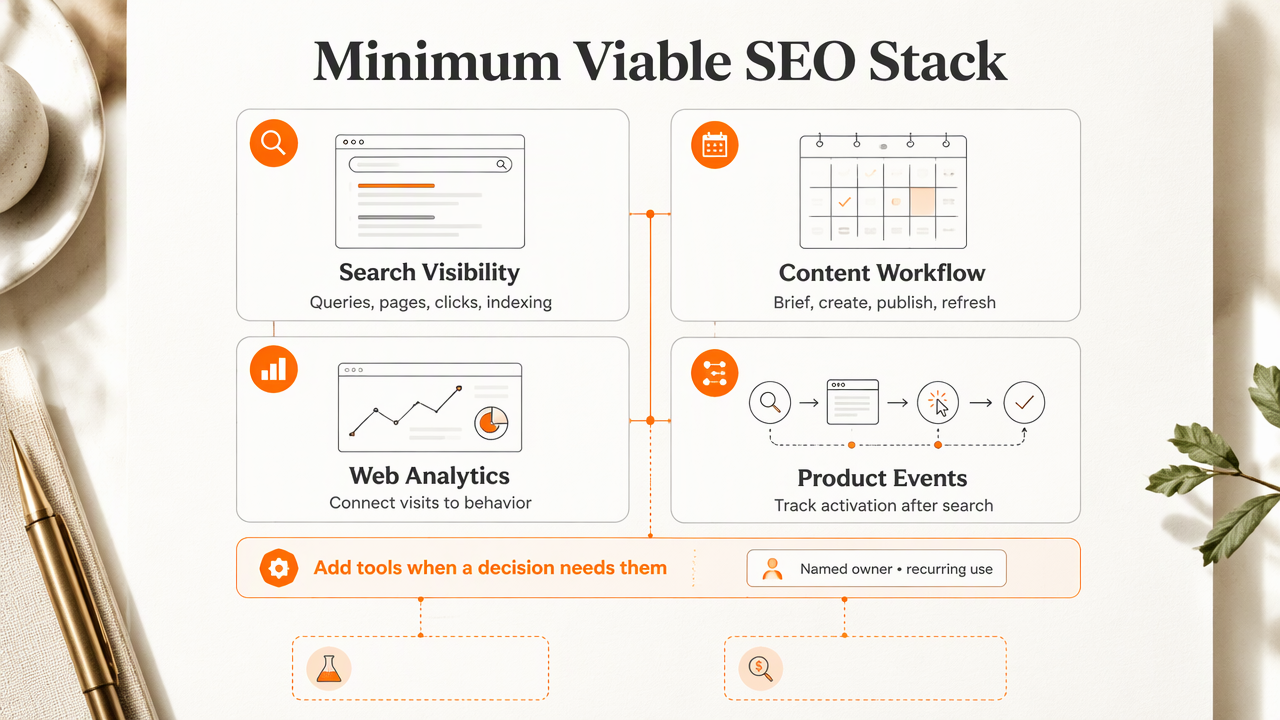
Build the stack in decision order
The simplest setup gives every component a named owner and a recurring use.
- Start with search visibility. Google Search Console can help teams inspect queries, pages, clicks, and indexing signals.
- Connect website behavior. Google Analytics 4 can support acquisition and conversion analysis when configured for the site's actual funnel.
- Define product events. Record the action that indicates first value, such as saving an invoice or completing an import.
- Choose one content workflow. Assign responsibility for briefs, product accuracy, publication, and updates.
- Add research selectively. Compare Semrush or Ahrefs when keyword and competitor research becomes a recurring requirement.
- Introduce testing deliberately. Use experiments when traffic, instrumentation, and engineering capacity support a meaningful comparison.
A founder can begin with a spreadsheet connecting target queries, published URLs, signups, and activation outcomes. The guide to tracking SEO progress without expensive tools offers a relevant follow-up for budget-conscious teams.
Keep overlapping subscriptions out of the budget
A second tool should fill a missing capability rather than reproduce an existing report.
Before buying, the owner should write down the decision the tool changes, the output required, and the frequency of use. If two subscriptions produce similar keyword lists but neither changes publishing priorities, consolidation deserves consideration.
A lean stack isn't the one with the fewest tools; it's the one where every subscription supports a decision and an accountable owner.
Contracts, export access, event limits, and implementation effort also belong in the comparison. Subscription price alone doesn't capture the work needed to make data usable.
How should teams measure organic activation?
Teams should measure organic activation by connecting a visitor's acquisition source to signup and a defined first-value event. The measurement plan needs consistent event definitions, an activation window, and clear attribution rules. Reports should separate search visibility from product outcomes so acquisition gains aren't mistaken for successful adoption.
Instrument the path from landing page to value
Activation tracking should describe observable behavior rather than a vague label such as "engaged user."
- Choose the value event. An invoicing product might use
invoice_saved; an analytics product might usedashboard_created. - Capture entry context. Preserve the landing page and available acquisition source under the organization's consent policy.
- Connect registration carefully. Link anonymous activity to an account where technically and legally appropriate.
- Set the observation window. Use a period that matches the product's normal setup process.
- Compare cohorts. Review activation by landing page, topic, device, and signup period.
Organic activation rate: Organic-acquired signups completing the selected value event within the observation window, divided by eligible organic-acquired signups.
Search Console queries generally describe aggregate search activity, not an individual user's complete product path. Query-level reporting and account-level activation should therefore remain distinct unless a valid connection exists.
Interpret weak outcomes before running tests
Different funnel patterns call for different investigations.
- Impressions without clicks: Review query fit, titles, and search-result presentation.
- Visits without signups: Inspect task alignment, product explanations, and calls to action.
- Signups without activation: Review setup friction, prerequisites, and onboarding guidance.
These patterns identify questions, not proven causes. Qualitative feedback can explain what dashboards miss. A developer-led product may also need documentation and examples aligned with implementation tasks; the developer-led teams page provides a relevant next step.
How Earlyseo handles the content workflow
The Earlyseo platform provides a content-focused route through its competitor-aware content and SEO operations offering. For product-led teams, that places it in the education stage: translating search opportunities into useful explanations of product tasks. Its role should sit alongside the team's search reporting and activation measurement.
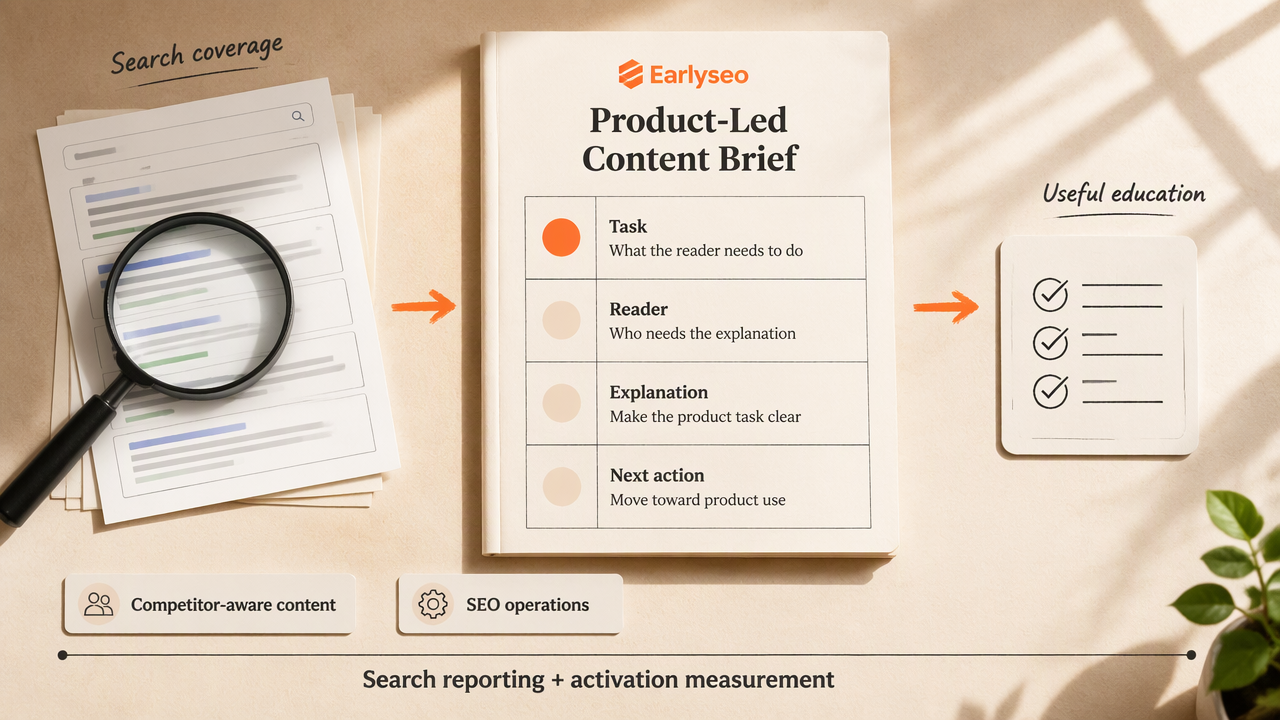
Connect briefs to actual product actions
A product-led content brief should specify the task, intended reader, required explanation, and next product action.
The competitor-aware SEO content offering is relevant when teams need to examine existing search coverage. The SEO operations offering is relevant when publishing needs a repeatable workflow.
A useful brief should include:
- The searcher's task and level of product knowledge.
- A working example checked against the current product.
- The appropriate next step, such as opening a template.
- An owner responsible for updating screenshots and instructions.
That structure gives content, product, and analytics teams a shared handoff.
Prepare for AI-assisted discovery in 2027
Preparation for AI-assisted discovery should focus on clear answers and verifiable product information, not promises of guaranteed citations.
The 2023 paper Generative AI by Feuerriegel, Hartmann, and Janiesch addresses generative AI. The 2022 paper Galactica: A Large Language Model for Science addresses language models in a scientific setting. Neither supplies a product-led SEO conversion benchmark here.
For 2027 planning, teams can maintain concise definitions, explicit feature comparisons, and current task instructions. Search and AI referral traffic should be evaluated against the same activation goal.
FAQ: Choosing and evaluating a product-led stack
Tool selection works best when teams separate acquisition research, content execution, and product measurement.
Can a small team start without paid SEO tools?
A small team can begin with Search Console, configured web analytics, product-event tracking, and a simple publishing plan. Paid research becomes useful when existing data can't answer a recurring prioritization question. The first investment should address an identified gap, rather than duplicate reports already available through the current stack.
Should teams choose Semrush or Ahrefs?
The choice should follow the team's required research tasks, budget, and working preferences. Teams can test both against the same keyword brief and competitor-review task, then compare usable outputs and effort. Buying both makes sense only when each supports a distinct recurring need that justifies its separate cost.
Which metric matters most after organic signups?
The most useful next metric is completion of the product's defined first-value event within a consistent observation window. Retention and paid conversion then show whether that early value lasts. Rankings and traffic still diagnose acquisition, but they don't establish that new accounts adopted the product or became valuable customers.
Conclusion
A practical stack for seo marketing tools for product-led growth starts with one task-focused page, one activation event, and a connected reporting process. Teams can use the 90-day SEO sprint to organize execution, then review Earlyseo at earlyseo.com for the content-workflow component. The immediate next step is assigning an owner to that first page-to-activation path.