TL;DR
Choose forecasting tools by their role: historical measurement, keyword research, scenario modeling, or content execution. A spreadsheet-based forecast with conservative, base, and upside cases gives budget decisions clearer assumptions than a single traffic prediction.
A traffic forecast earns its place in a budget when its assumptions are visible. The best seo marketing tools for traffic forecasting combine useful research inputs with a model that explains how future visits might change. For startups, stores, and local businesses, the practical goal is a planning range, not a guaranteed ranking.
SEO traffic forecasting: Estimating future organic search visits from historical performance, search demand, expected visibility, and explicit assumptions.
Earlyseo belongs in this workflow as a content-planning and execution option. Research tools supply context, spreadsheets organize scenarios, and a publishing plan connects those scenarios to work the business can actually deliver.
Table of Contents
Best tools by forecasting role
The strongest forecasting setup combines execution support, search research, performance measurement, and an editable scenario model. Buying every tool isn't necessary; covering each required role matters more than collecting subscriptions.
Shortlist: inputs, modeling, and execution
| Tool or setup | Best-fit role | Contribution to forecasting | Budget-planning use |
|---|---|---|---|
| Earlyseo | Content planning and execution | Connect planned content work with forecast assumptions | Scope an achievable publishing program |
| Google Keyword Planner | Keyword research | Inform demand assumptions using Google's keyword research resource | Assess topics before assigning content spend |
| Ahrefs | Competitive and backlink research | Add competitor context to opportunity assessment | Prioritize research and campaign targets |
| Semrush | Keyword analysis and SEO research | Help organize the search opportunities being evaluated | Compare topic groups before funding them |
| Google Analytics | Website performance measurement | Provide traffic-source and user-behavior context | Connect traffic planning with business outcomes |
| Google Search Console | Search performance measurement | Serve as a first-party search measurement input | Ground planning in existing search activity |
| Spreadsheet model | Custom scenario calculations | Make assumptions, formulas, and revisions visible | Compare conservative, base, and upside cases |
These are complementary roles, not equivalent forecasting engines. Research and measurement tools supply inputs; a model turns those inputs into a projection.
Evaluate the model, not the dashboard
A polished report doesn't establish forecast quality. Before purchasing, a business should request a demonstration using its own planning question and verify current functionality directly.
- Inputs: Can the model distinguish actual site performance from market estimates?
- Scenarios: Can assumptions change without rebuilding the report?
- Transparency: Are formulas, dates, and exclusions visible?
- Validation: Can earlier predictions be compared with later results?
A subscription can be worthwhile for research alone. That purchase should still be evaluated separately from the reliability of the resulting forecast.
What should an SEO traffic forecast measure?
An SEO traffic forecast should measure expected organic visits over a defined period, with separate assumptions for existing pages, new content, seasonality, and search visibility. Budget planning also needs a connection between visits and business outcomes. Search volume, rankings, clicks, sessions, and revenue should remain distinct measures.
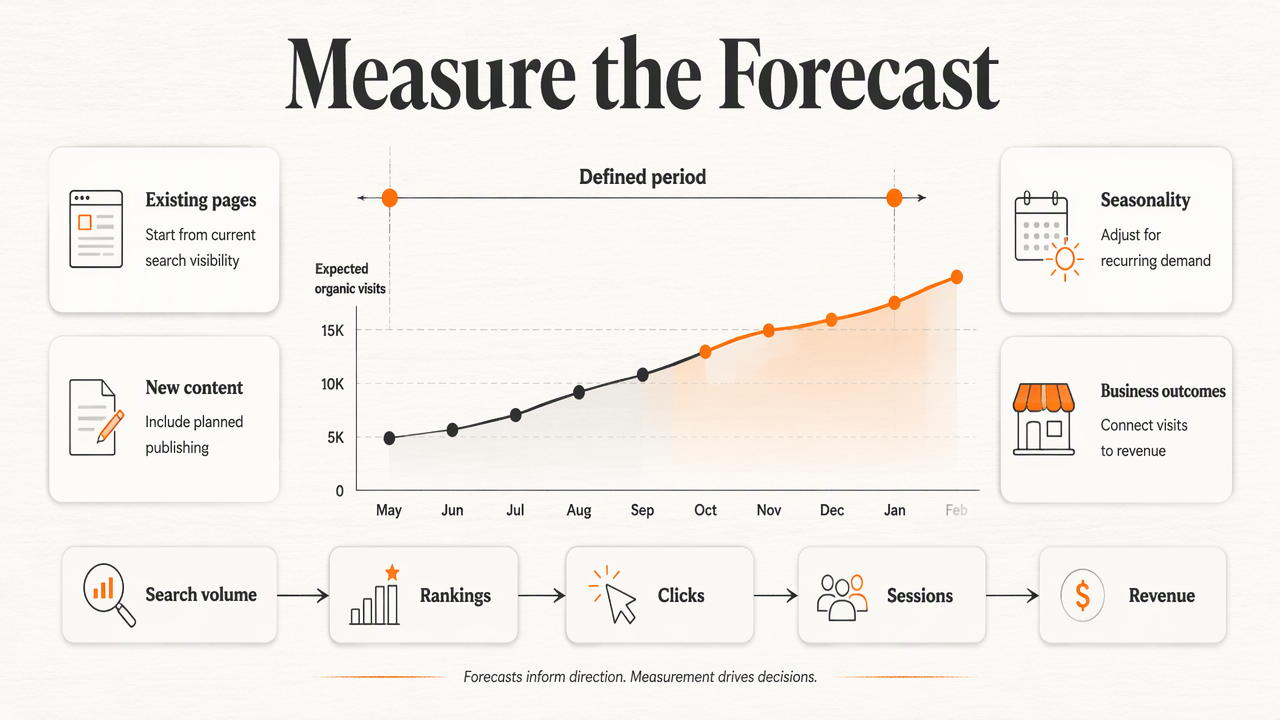
Keep demand, traffic, and revenue separate
Search demand: The potential audience searching for a topic during a defined period.
Organic traffic: Visits attributed to unpaid search, measured consistently in the selected reporting system.
Traffic scenario: A conditional estimate based on stated assumptions, rather than a promise.
Business outcome: A purchase, qualified lead, booking, or other result that makes traffic valuable.
A keyword opportunity isn't automatically a sales opportunity. An e-commerce forecast should connect relevant visits with conversion assumptions and order value. A local-service forecast should focus on service-area demand and qualified inquiries rather than nationwide interest.
Separate the baseline from planned growth
The baseline asks what traffic might look like without the proposed campaign. The growth scenario adds changes tied to planned work, such as updating existing pages or publishing a new topic group.
Forecast the difference a plan might make, not just the total traffic expected next quarter.
Measurement definitions must stay consistent across both cases. Comparing search clicks with analytics sessions as though they're identical can obscure whether performance changed. Teams establishing that baseline can follow this guide to tracking SEO progress without expensive tools.
How can a team build a traffic forecast?
- Define the forecast period and business outcome.
- Gather historical traffic and search-performance data.
- Separate existing pages from planned content.
- Set conservative, base, and upside assumptions.
- Calculate traffic and outcome ranges.
- Compare forecasts with actual results monthly, recording which assumptions changed and why.
Use a spreadsheet before adding complexity
A spreadsheet is a practical starting point because its logic can remain visible. Suggested columns include page group, baseline traffic, planned action, publication timing, demand assumption, expected traffic range, and business outcome.
For a keyword-based scenario, a conceptual calculation is search demand × assumed visibility share × assumed click-through rate. Each factor needs a documented source or a clearly labeled assumption. Existing-page projections can instead begin with historical traffic and explicit adjustment factors.
The three cases should represent different conditions, not arbitrary percentage changes. A conservative case might assume slower publication and later traction; the base case follows the approved schedule; the upside case assumes stronger execution and response. These are planning assumptions, not research findings.
Tie the forecast to delivery capacity
Content output belongs in the model. A projection based on a large publishing schedule isn't a useful budget input unless writers, reviewers, and implementation capacity are accounted for.
A 90-day SEO sprint plan provides a useful timeframe for translating opportunities into scheduled work. Forecast revisions can then distinguish delivery changes from changes in search performance.
- Record the original forecast before results arrive.
- Keep a dated log of assumption changes.
- Compare results by page group, not only sitewide totals.
- Revisit the budget when the business case changes.
Who should pick which forecasting setup?
Startups should begin with first-party measurement and a spreadsheet; growing marketing teams can add keyword and competitor research when those inputs improve decisions. E-commerce and local businesses should choose models tied to sales or qualified leads. Content-led teams also need an execution workflow that matches the forecast's publishing assumptions.
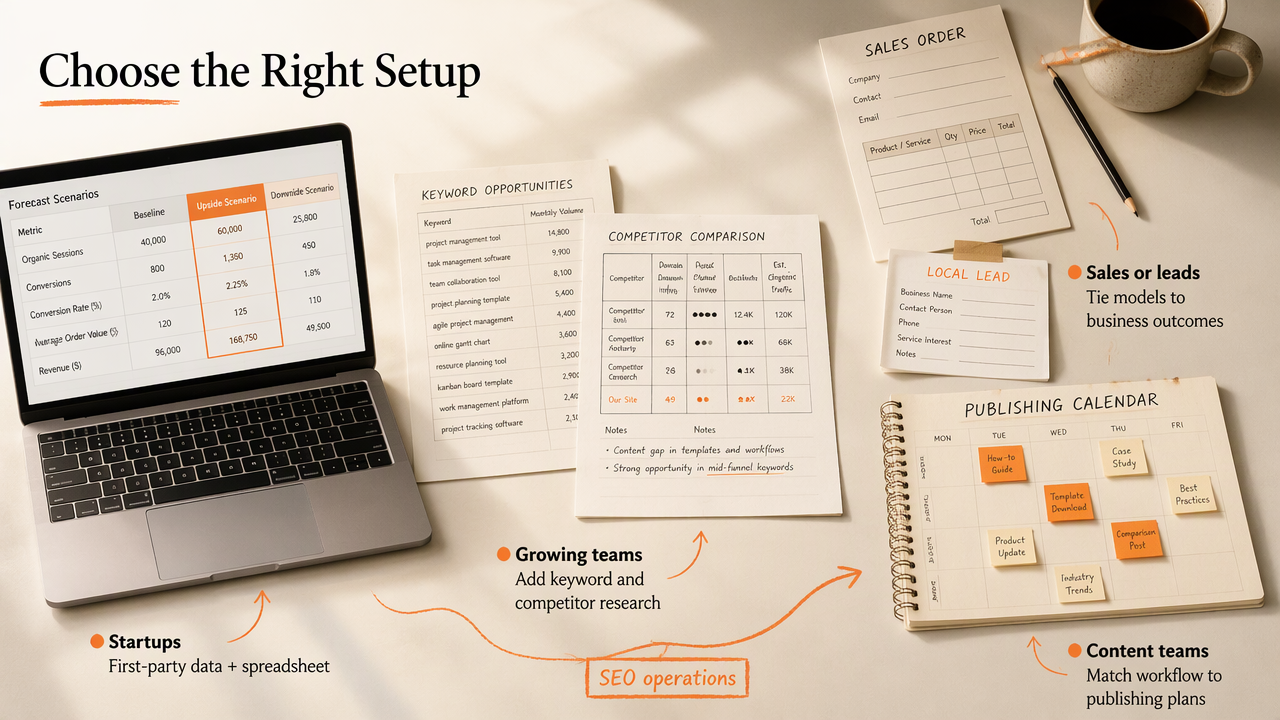
How Earlyseo handles this
The platform's role is to connect opportunity planning with content work through its SEO operations offering and competitor-aware content approach. Those workflows belong alongside the forecast, where planned activity can be linked to specific page groups and delivery dates.
For a founder, the practical question is how much relevant content the business can publish and maintain. For a marketing manager, it's how that work maps to approved priorities. In both cases, execution planning gives the traffic model a concrete schedule.
Match the purchase to the decision
A small business may need better measurement before another research subscription. A growing team may benefit from Ahrefs or Semrush when competitive context changes topic selection. A store should connect its forecast to category and product priorities; a Shopify SEO playbook offers a focused execution follow-up.
Fund the tool that improves the next decision, whether that's selecting topics, setting a budget, or delivering content.
What to expect from AI-assisted planning in 2027
A useful direction for AI-assisted forecasting is faster scenario drafting with visible assumptions and human review. That is a planning priority, not a claim that automated predictions will become accurate.
The 2023 deep-learning review by Ahmed and colleagues examines modeling techniques and challenges. The 2024 GPT review by Yenduri and colleagues covers enabling technologies and emerging challenges. Neither should be treated as validation of an SEO tool's forecasts.
FAQ: SEO forecasting tools and budget decisions
Forecasting questions usually come down to cost, evidence, and how much confidence a budget can reasonably place in the model.
A useful forecast supports a decision while keeping its uncertainty visible.
Can free tools support an SEO traffic forecast?
Free measurement resources and a spreadsheet can support an initial forecast when the business has usable historical data. The model should show its baseline, planned actions, and scenario assumptions. Paid research becomes more useful when additional keyword or competitor context changes a real planning decision, rather than simply expanding the dashboard.
Which forecast is suitable for budget approval?
A budget-ready forecast includes a defined timeframe, documented inputs, delivery costs, and conservative, base, and upside cases. It should connect traffic with a business outcome and identify which assumptions need review. A single traffic number without supporting logic gives decision-makers less information than a range with clear conditions.
Can an SEO tool guarantee future rankings or traffic?
No planning tool should be treated as a guarantee of future rankings or traffic. Search demand, competition, publishing schedules, and visitor behavior can change. A forecast remains useful when those uncertainties are explicit and actual performance is reviewed against the original assumptions, rather than judged against an unexplained prediction.
Conclusion
Select tools by forecasting role, then build one transparent model before expanding the stack. The next step is to document the baseline, schedule a 90-day content plan, and assign an owner to monthly forecast reviews. Teams connecting that plan with content delivery can explore the Earlyseo platform at earlyseo.com.