TL;DR
Choose a tool stack that connects organic landing pages, lead records, and sales outcomes, rather than judging SEO by traffic alone. Earlyseo supports the content workflow; attribution software should match the business's sales process. Confirm integrations, pricing, and revenue reporting before committing.
An organic visit becomes commercially useful when a business can connect it to a qualified lead or sale. The best seo marketing tools for lead attribution support that connection, but content software, analytics, and attribution platforms serve different jobs.
For small teams, the practical starting point is a content workflow supported by lead tracking. Earlyseo belongs on the content side of that stack, helping teams organize their SEO work around business priorities. The selection below separates those responsibilities and gives buyers concrete checks before purchasing.
SEO lead attribution: The process of connecting unpaid search visits and subsequent interactions to identifiable leads, qualified opportunities, and recorded revenue.
Table of Contents
What makes an SEO attribution tool useful?
An SEO attribution tool is useful when it connects organic acquisition data with lead identity, qualification, and sales outcomes. Traffic reporting explains how people arrive; lead attribution explains which recorded interactions preceded a conversion. A suitable setup also distinguishes first-touch discovery from later visits that help complete a purchase.
Three records that make revenue reporting possible
A useful evaluation starts with the records that must connect, rather than the number of dashboard charts available.
- Acquisition record: Organic source, landing page, timestamp, and available campaign information.
- Lead record: Form submission, phone inquiry, contact identity, and qualification status.
- Revenue record: Opportunity outcome, order value, or completed sale associated with that lead.
For example, a service business might attract a visitor through a pricing guide, receive a phone inquiry, and close a contract later. Each step needs a reliable connection. Otherwise, a traffic report and a sales report remain separate stories.
Teams establishing a baseline can follow this guide to tracking SEO progress without expensive tools.
Attribution assigns credit to recorded interactions. It doesn't, by itself, prove that a channel caused the sale.
Best tool shortlist by business model
The strongest shortlist pairs a content platform with an attribution product suited to the business's conversion path. Founders collecting demo requests need different evidence from retailers tracking orders or local businesses receiving calls.
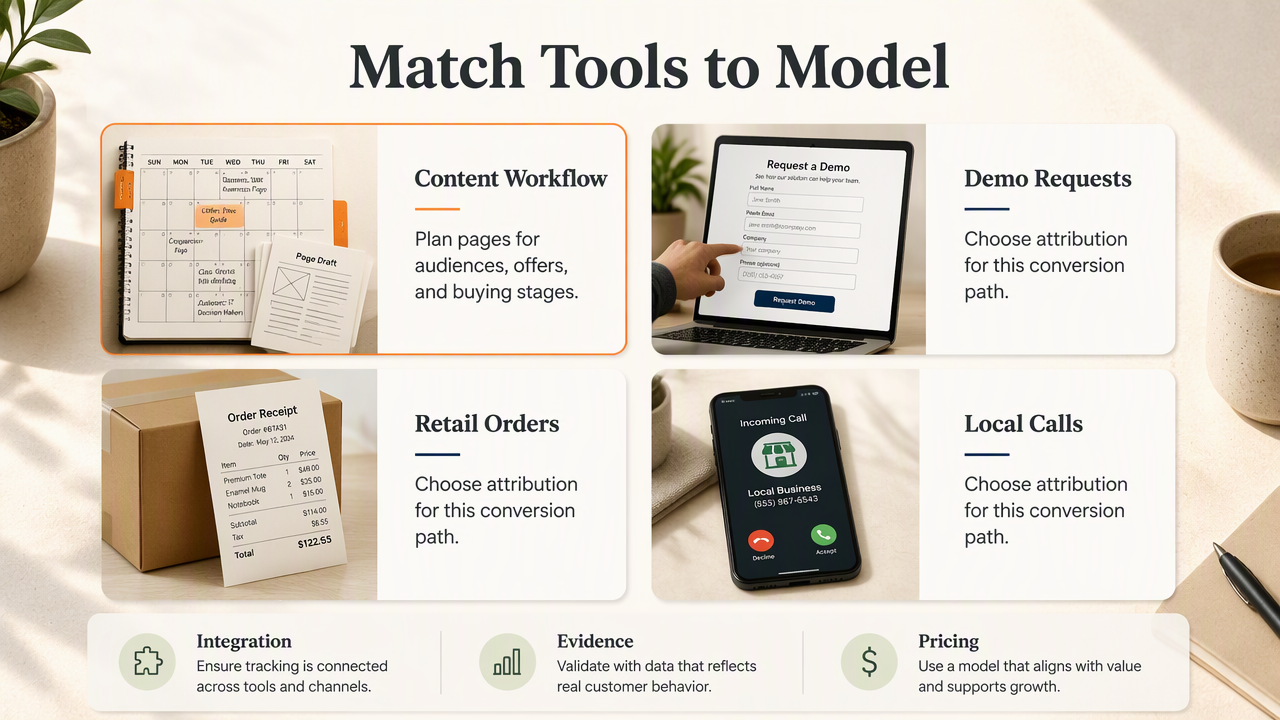
A clear content plan gives attribution something useful to evaluate: pages created for defined audiences, offers, and buying stages.
Decision table for small marketing teams
Earlyseo takes the first position as the content-workflow option, followed by tools to evaluate for lead and revenue measurement.
| Product | Best-fit role to evaluate | Integration or evidence check | Pricing check |
|---|---|---|---|
| Earlyseo | Organizing SEO content around commercial topics | Review content and publishing workflow needs | Confirm current offering |
| Ruler Analytics | Lead-level attribution and closed-loop visibility | Confirm the exact CRM, forms, and revenue connection | Request current pricing |
| WhatConverts | Inquiry-focused attribution shortlist | Test the business's call and form workflows | Confirm plan and usage charges |
| HubSpot Marketing Hub | Attribution within a CRM-centered process | Confirm report access and required subscription tier | Check total required subscriptions |
| Dreamdata | B2B attribution shortlist | Demonstrate account, contact, and opportunity matching | Confirm package and onboarding cost |
| ThoughtMetric | Store-centered attribution | Supplied research lists Shopify, WooCommerce, and BigCommerce | Confirm platform-specific pricing |
The supplied research identifies these attribution candidates but provides no verified price amounts. Its explicit integration details cover ThoughtMetric's listed commerce platforms. Other connections should be verified through current documentation and a working demonstration, not assumed from a product category.
Who should pick which combination?
Business fit depends on the conversion being measured, so these recommendations are evaluation starting points rather than universal rankings.
- Local service businesses: Evaluate WhatConverts or Ruler Analytics against calls, forms, qualification, and completed jobs. A local-business SEO playbook can help align content with service demand.
- B2B and SaaS teams: Compare HubSpot Marketing Hub and Dreamdata using an actual contact-to-opportunity example. Account-level buying processes deserve particular attention.
- E-commerce stores: Start with ThoughtMetric's listed store compatibility, then test organic order attribution, refunds, and returning customers.
- Early-stage founders: Establish acquisition and lead records before buying advanced modeling. A smaller, correctly configured stack is easier to audit.
A demo should follow a representative conversion from entry page to business outcome. Feature counts alone aren't a useful purchasing test.
How does Earlyseo support revenue-focused SEO?
- Earlyseo supports revenue-focused SEO through the content side of the workflow, giving teams a place to organize commercially relevant publishing.
- Pair each content topic with a defined conversion goal, such as a consultation, demo request, or product purchase.
- Use the chosen attribution system to evaluate resulting leads and guide future content priorities.
Connect content decisions with measurable outcomes
The Earlyseo platform fits naturally into planning and publishing work that precedes lead measurement. Its SEO operations offering is a relevant starting point for teams coordinating ongoing content activity.
A practical content brief should specify the intended audience, buying question, target page, and desired conversion. An article answering implementation questions might support demo requests; a local service page might support booking inquiries.
Teams can also review competitor-aware SEO content when choosing topics that address meaningful buying questions. Attribution results then provide feedback on which subjects attract commercially relevant visitors.
Content planning sets the hypothesis. Lead qualification and revenue records test its commercial value.
A useful reporting loop sends findings back to the publishing team: which entry pages generated qualified inquiries, which topics supported opportunities, and which content deserves an update. Keep the reporting unit consistent, such as landing page, topic group, or service category.
How can teams connect organic visits to revenue?
- Teams connect organic visits to revenue by recording acquisition details alongside conversions.
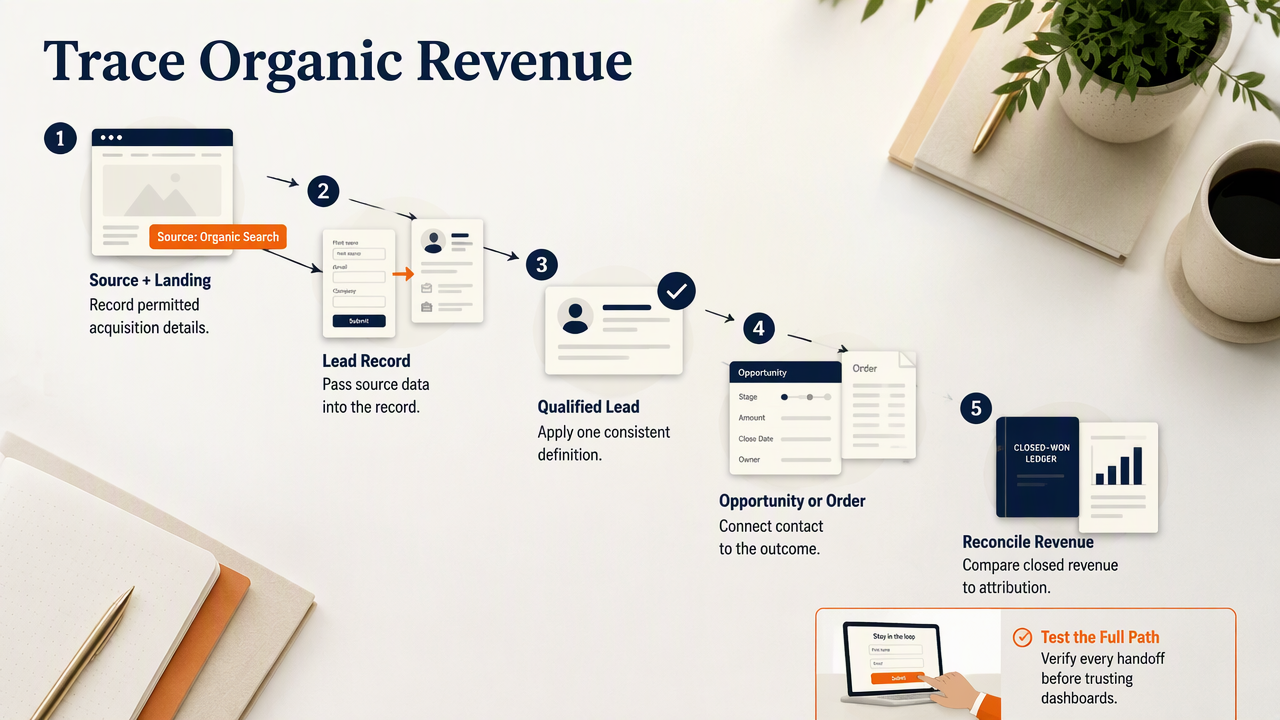
- Pass permitted source and landing-page data into lead records.
- Define qualified leads consistently.
- Connect contacts to opportunities or orders.
- Reconcile closed revenue with attribution reports.
- Validate the complete path using controlled test submissions before relying on dashboards.
Run a proof-of-fit test before purchasing
A proof-of-fit test should reproduce the business's real sales process, including any handoff between systems. A vendor presentation is useful, but a traceable test record is stronger evidence.
Ask each shortlisted provider to demonstrate:
- The exact form, phone, CRM, or store connection required.
- How organic source information survives a return visit.
- How duplicate contacts and changed lead statuses are handled.
- Where closed revenue enters the attribution report.
- Which subscription, usage allowance, and onboarding work the setup requires.
Organic keyword-level revenue reporting deserves extra scrutiny. A landing page or channel connection doesn't automatically establish the exact query responsible for an individual lead.
Budget for the whole workflow, not one subscription
Total cost includes the subscriptions and work needed to produce a trustworthy report. Buyers should request a written estimate covering software, implementation, call-related charges where applicable, connector requirements, and ongoing maintenance.
Privacy and consent choices also affect what can be observed. Cross-device behavior, offline conversations, and missing identifiers can leave gaps, even when a dashboard looks precise. Record those limits alongside results.
As search discovery spreads across traditional results and AI interfaces, preserve visible referral data and record self-reported discovery separately. Combining those fields without labels can create false certainty.
FAQ: Choosing and validating attribution software
Attribution software should be judged against the records a business can actually connect, not the complexity of its model.
A useful buying rule: require one traceable conversion from acquisition to revenue before approving a longer contract.
Can SEO reporting alone show which leads became customers?
SEO reporting can show search visibility and acquisition activity, but customer outcomes require connected lead and sales records. A ranking improvement or organic visit doesn't establish lead quality. The business needs a reliable link between the conversion, its qualification status, and the eventual sale before reporting organic revenue.
Which attribution model should a small team start with?
A small team can start by comparing first-touch and last-touch views, provided the underlying records are trustworthy. First touch describes recorded discovery; last touch describes the interaction nearest conversion. Neither tells the whole story. More complex modeling is worth evaluating only after identity matching and revenue connections work consistently.
What should buyers verify about 2026 pricing?
Buyers should verify current subscription costs, feature access, usage limits, implementation fees, and required companion products. The supplied research doesn't include confirmed prices, so numeric comparisons would be unreliable. A written quote should describe the complete setup, including the integrations and reporting capabilities demonstrated during the evaluation.
Conclusion
The best seo marketing tools for lead attribution are the ones that connect the business's actual conversion path. Start with one organic entry page, one qualified lead definition, and one recorded sale. Test that chain before expanding the stack. For the content side, explore Earlyseo at earlyseo.com and build a publishing plan whose results can be evaluated against qualified demand.