TL;DR
Local SEO is best for businesses that need nearby customers, calls, visits, and map visibility. Organic SEO is better for companies that need broader reach, evergreen traffic, and content-led demand. Many growing businesses should start with the channel closest to revenue, then connect both strategies once the basics are stable.
Local SEO vs organic SEO is really a question about where customers search, not which tactic sounds more advanced. A plumber, clinic, restaurant, or local retailer needs visibility in maps and nearby results; a SaaS startup, publisher, or ecommerce brand often needs broader rankings across informational and commercial searches. Earlyseo helps growing teams organize both paths by turning search visibility work into a repeatable content and optimization process.
Table of Contents
What is local SEO?
Local SEO is the practice of improving visibility for searches tied to a place, service area, or "near me" intent. It focuses on Google Business Profile, local packs, map rankings, reviews, citations, location pages, and locally relevant website signals.
Local SEO: search optimization for businesses that serve customers in a specific city, neighborhood, region, or service area.
Local search engine optimization is similar to broader SEO because it affects unpaid search visibility, but the ranking surface is different. Instead of only chasing blue-link rankings, local SEO aims to appear where a nearby buyer is ready to call, book, request directions, or compare options.
Key insight: Local SEO usually wins when the searcher's next action happens offline or in a defined service area.
Common examples include:
- "dentist in Austin"
- "emergency plumber near me"
- "best Thai restaurant downtown"
- "wedding photographer Brooklyn"
- "HVAC repair service area"
What is organic SEO?
Organic SEO is the practice of improving a website's visibility and performance in unpaid search results across informational, commercial, and transactional queries. It focuses on content quality, technical SEO, internal linking, backlinks, topical authority, and page experience.
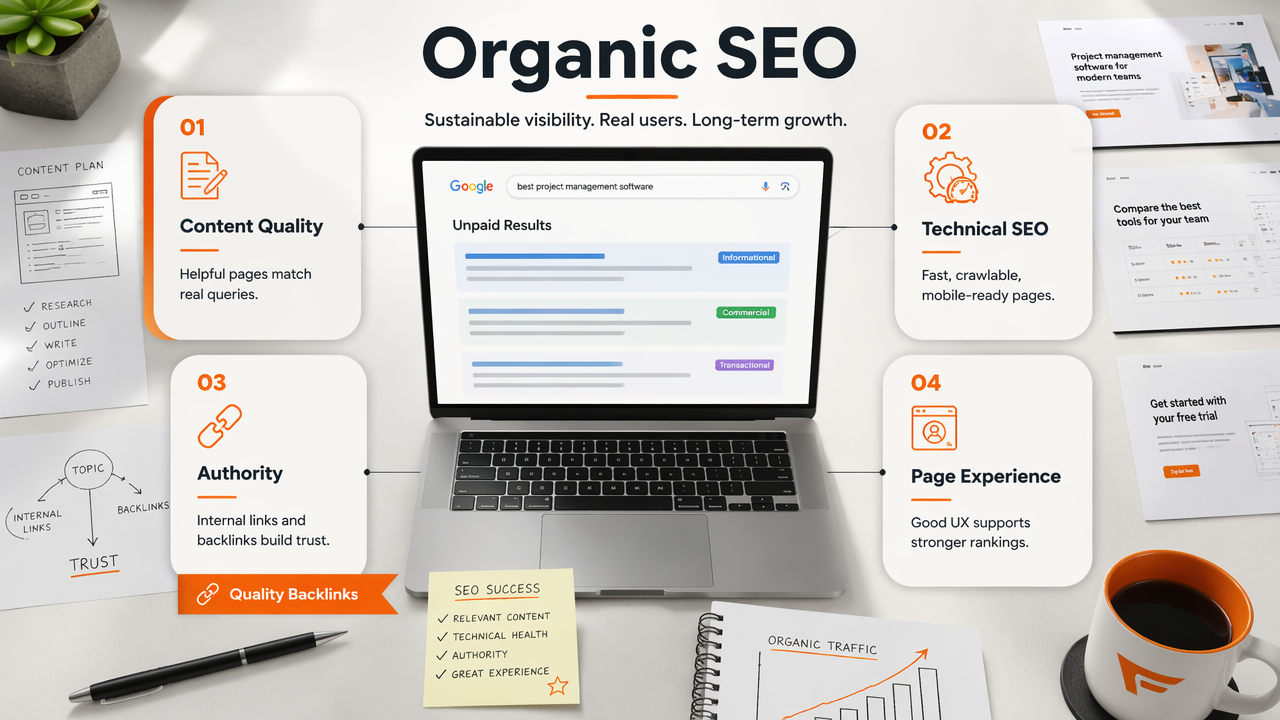
Organic SEO: search optimization for website pages that rank in standard unpaid results, usually beyond one specific geographic area.
Wikipedia's definition of search engine optimization describes SEO as improving the visibility and performance of websites and web pages in search engine results pages. For a growing company, organic SEO turns that broad idea into assets such as blog posts, category pages, product pages, comparison pages, and help articles.
Organic traffic can support national, regional, or global reach. A Shopify store selling skincare, a B2B software company, or a media site may depend more on organic articles and product pages than map listings. Teams publishing through WordPress can also connect optimization workflows through Earlyseo's WordPress integration when content output becomes regular.
Local SEO vs organic SEO: key differences
The main difference is that local SEO ranks a business for place-based demand, while organic SEO ranks website pages for broader search demand. The right choice depends on ranking surface, timeline, buyer intent, and the type of business being marketed.
Comparison table by ranking surface and intent
| Factor | Local SEO | Organic SEO |
|---|---|---|
| Primary ranking surface | Google Maps, local pack, Google Business Profile, local landing pages | Standard organic results, blogs, product pages, category pages, guides |
| Search intent | Nearby action, call, visit, booking, directions | Learn, compare, evaluate, buy, subscribe, research |
| Typical timeline | Faster movement after profile, review, and citation fixes, but competitive markets still take time | Slower compounding growth through content, technical quality, and authority |
| Best-fit business | Clinics, trades, restaurants, salons, local retailers, service-area businesses | SaaS, ecommerce, publishers, marketplaces, national service brands |
| Core assets | Business profile, reviews, NAP consistency, local pages, photos, service categories | Content hubs, landing pages, schema, internal links, backlinks, technical health |
| Main success metrics | Calls, direction requests, bookings, map views, local leads | Organic sessions, rankings, conversions, assisted revenue, email signups |
The SERP research behind this topic found that top competitor articles commonly explain definitions, best practices, and "which is better" framing. The missing layer is decision-making by business model. A local bakery and a remote-first software startup should not start with the same search plan.
Search visibility also overlaps. A law firm may need local pack visibility for "divorce lawyer Denver" and organic authority for "how child custody works in Colorado." A Shopify brand may focus on organic category rankings first, then add local optimization if it opens retail locations or pickup points through Earlyseo's Shopify integration.
How should a business choose the right SEO strategy?
A business should choose local SEO when revenue depends on nearby buyers, organic SEO when revenue depends on broader search demand, and both when a company needs local trust plus scalable content visibility. The closest path to revenue should come first.
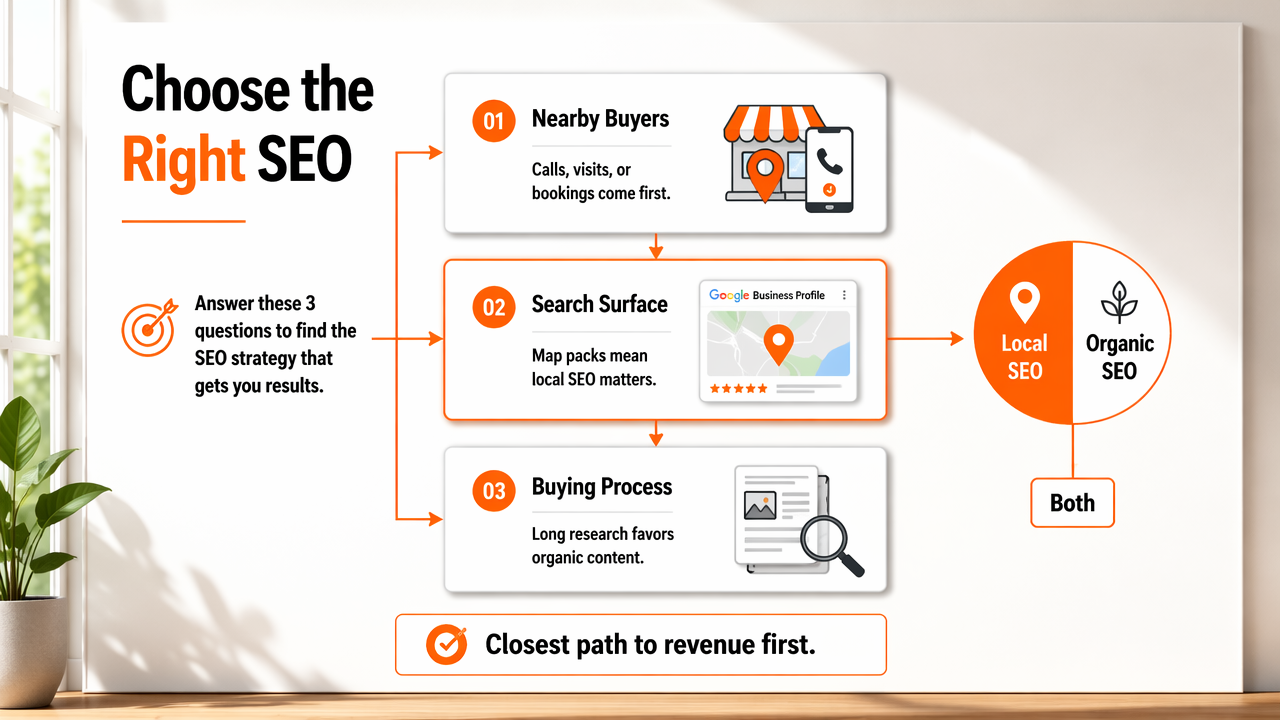
Decision framework for founders and owners
Use this simple filter before building a plan:
- Define the transaction location. If customers visit, call, or book within a service area, local SEO comes first.
- Check the search surface. If target searches show map packs, Google Business Profile work matters.
- Map the buying process. If buyers research for days or weeks, organic content can capture demand earlier.
- Review operational capacity. Local SEO needs review management and listing accuracy; organic SEO needs publishing and technical upkeep.
- Choose one primary metric. Calls, bookings, and direction requests favor local; non-branded organic conversions favor broader SEO.
Simple rule: Start with the search result that most closely matches the next customer action.
A single-location gym should usually prioritize local SEO: profile optimization, category accuracy, photos, reviews, and location pages. A B2B analytics startup should usually prioritize organic SEO: problem-aware articles, comparison pages, product-led content, and technical indexing.
Hybrid businesses need both. A regional ecommerce store with local pickup, a multi-location clinic, or a home services franchise cannot treat the two strategies as separate silos. Local pages need organic quality, and organic content can support local authority.
Which businesses should pick which?
- Pick local SEO first: restaurants, dentists, salons, repair companies, real estate agents, auto shops, event venues, and service-area businesses.
- Pick organic SEO first: SaaS companies, ecommerce stores, education brands, affiliate sites, B2B service firms, and publishers.
- Pick both: franchises, multi-location retailers, local healthcare groups, regional marketplaces, and brands with online plus offline sales.
Earlyseo is especially useful when a lean team needs a repeatable system rather than scattered one-off SEO tasks. The Earlyseo platform can support content planning and optimization while local operators keep business profile signals accurate.
What are the best practices for each approach?
The best local SEO practices improve trust, proximity, and profile relevance, while the best organic SEO practices improve page quality, topical authority, and crawlable site structure. Both approaches need clean data, useful content, and consistent measurement.
Local SEO best practices that still matter in 2026
- Optimize Google Business Profile: choose accurate categories, services, hours, attributes, photos, and booking links.
- Keep NAP consistent: business name, address, and phone number should match across major listings.
- Build location pages: each real location needs unique services, proof, local details, and conversion paths.
- Earn real reviews: review velocity, quality, and owner responses help trust and conversion.
- Add local schema: structured data can clarify addresses, service areas, opening hours, and business type.
- Track calls and bookings: rankings alone do not prove commercial impact.
Avoid thin doorway pages that only swap city names. Search engines and users can spot low-effort local pages, and those pages rarely build lasting trust.
Organic SEO best practices for broader growth
- Build topical clusters: cover a problem area through guides, comparisons, product pages, and support content.
- Match search intent: informational pages should educate; commercial pages should help evaluation.
- Strengthen internal links: connect related pages with descriptive anchors, not generic labels.
- Improve technical foundations: crawlability, indexation, site speed, canonicals, and structured data still matter.
- Refresh content: outdated rankings slip when better, clearer, more current pages appear.
- Measure conversions: organic traffic without leads, sales, or assisted revenue is not enough.
Teams can use the Earlyseo documentation to keep optimization workflows consistent across content creation, publishing, and performance checks. For AI discovery, maintaining machine-readable brand and site context through resources like llms.txt guidance can also support clearer interpretation by answer engines.
How will search visibility change in 2026 and beyond?
Search visibility is moving toward blended results where maps, organic listings, reviews, AI answers, videos, and structured brand data all influence discovery. Businesses should treat local and organic SEO as connected visibility systems, not isolated channels.
AI answers are raising the value of clear definitions, comparison tables, structured data, and entity-rich pages. That matters for both a neighborhood clinic and a national software company. A page that clearly states who the business serves, where it operates, and what problems it solves is easier for search engines and AI systems Search engines still need strong source material. Local businesses should publish useful service pages and maintain accurate profiles. Organic-first brands should publish content that answers real buying questions, not generic keyword filler. For ongoing learning, the Earlyseo blog library can support teams building a practical search program over time.
2026 priority: A business should make every important page answer three questions fast: what it offers, who it helps, and where or how customers can act.
FAQ: Which SEO path answers common business questions?
Is local SEO better than organic SEO?
Local SEO is better when customers search with local intent and take action nearby, such as calling, booking, visiting, or requesting directions. Organic SEO is better when the business needs broader reach across educational, comparison, or ecommerce searches. Neither is universally better; the stronger choice depends on revenue model.
Can a business do local and organic SEO together?
A business can and often should do both when it has local presence plus broader content opportunities. Location pages can rank organically, blog content can support local authority, and reviews can improve conversion after visitors arrive. The key is avoiding duplicate work and assigning separate metrics to each channel.
How long does each strategy take?
Local SEO can show earlier movement after profile fixes, citation cleanup, and review improvements, especially in less competitive areas. Organic SEO usually compounds more slowly because content, technical health, and authority take time. Competitive markets make both timelines longer, so measurement should focus on leads and revenue, not only rankings.
Does ecommerce need local SEO?
Ecommerce usually needs organic SEO first because category pages, product pages, and buying guides drive non-local demand. Local SEO becomes useful when the store has physical locations, local pickup, showrooms, pop-ups, or service areas. A hybrid model should connect store pages with organic product content.
Conclusion
The smartest answer to local SEO vs organic SEO starts with buyer behavior. If searchers need a nearby provider, build local visibility first. If searchers compare ideas, products, or solutions across markets, build organic visibility first. If both behaviors drive revenue, connect the two into one search program.
A practical next step is to list the top 20 searches that could create revenue, mark which ones show map results, then assign each query to local, organic, or both. For teams ready to turn that list into a repeatable publishing and optimization workflow, visit earlyseo.com and use Earlyseo to build the next set of pages with clearer priorities.