TL;DR
SEO workflow automation works best when repetitive checks, data pulls, briefs, and reports run automatically while humans keep control over strategy, expertise, and final approvals. Small teams should start with one measurable workflow, add review gates, and connect publishing, analytics, and AI visibility tasks before scaling.
SEO workflow automation can cut hours of repetitive work, but the winners in 2026 still pair machines with sharp human judgment. SEO workflow automation: the use of software, rules, AI agents, and integrations to move recurring SEO tasks through research, production, publishing, monitoring, and reporting with less manual effort. For founders, local businesses, e-commerce teams, and lean marketing departments, Earlyseo gives that system a practical home base for search visibility work without turning strategy into a black box.
Key idea: automate repeatable inputs and reminders, not positioning, expertise, trust, or approval.
This pillar guide covers the core framework: what to automate, what to review, what to keep human, and how to roll out a workflow that does not collapse under its own complexity.
Table of Contents
What is SEO workflow automation?
SEO workflow automation is the structured use of tools, triggers, templates, and AI assistance to move SEO tasks from one step to the next with less manual handling. It covers repeatable work such as keyword clustering, technical checks, content briefs, internal-link prompts, publishing handoffs, and performance reporting.
A workflow differs from a one-off tool action. A rank tracker produces data; an automated workflow turns that data into a ticket, assigns a review, updates a dashboard, and prompts a content refresh when conditions are met.
Research outside SEO supports the same pattern. A 2021 Nature Machine Intelligence paper on an open source machine learning framework for systematic reviews examined how automation can support efficient, transparent review processes. The lesson fits SEO: speed matters, but traceability and review matter just as much.
Core terms used in automated SEO systems
- Trigger: an event that starts a workflow, such as a new page, crawl error, form submission, or ranking drop.
- Action: the task the system performs, such as creating a brief, sending a Slack alert, or updating a spreadsheet.
- Approval gate: a required human check before publishing, redirecting, deleting, or changing strategic copy.
- Source of truth: the database, CMS, project board, or SEO platform where final workflow status lives.
- Exception: a condition that pauses automation because risk or ambiguity is too high.
Many template libraries, including n8n workflows for Content Creation and Multimodal AI, show how fast automated content and media production has become. The issue is not whether a system can generate LinkedIn posts, AI videos, YouTube uploads, TikTok clips, Instagram assets, or product research summaries. The issue is whether those outputs match search intent, brand positioning, product truth, and quality standards.
Which SEO tasks should be automated, reviewed, or kept human?
The best automation plan separates low-risk repetition from judgment-heavy decisions before any tool is connected. Small teams get faster gains by sorting tasks into three lanes: automate, review, and keep human.
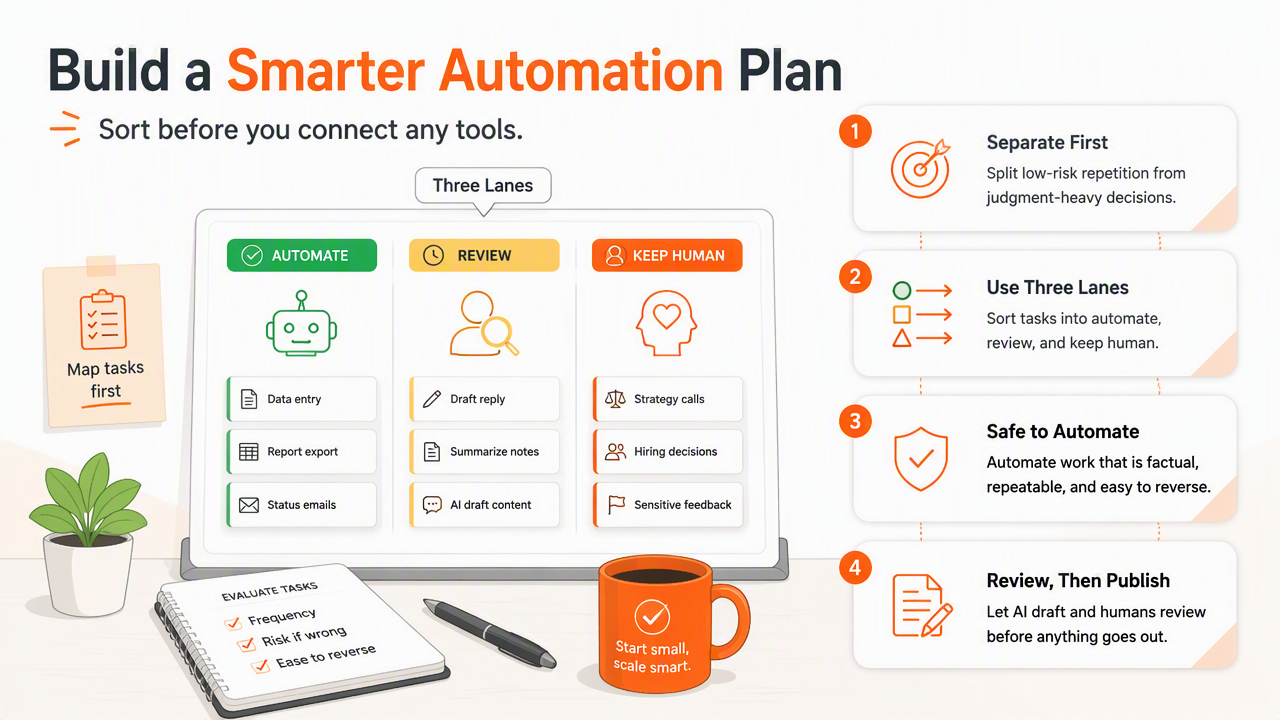
Fully automated work should be factual, repeatable, and easy to reverse. Review-based work can be drafted by software but needs a person before it reaches customers or search engines. Human-owned work should stay close to brand, expertise, and business goals.
Automation should remove busywork from SEO, not remove accountability from SEO.
Task ownership matrix for lean teams
| SEO workstream | Automate | Human review required | Keep human-owned |
|---|---|---|---|
| Technical SEO | Crawl scheduling, broken-link alerts, sitemap checks | Redirect maps, canonical changes, schema edits | Site architecture and migration strategy |
| Keyword research | Data collection, clustering, duplicate grouping | Intent labeling, priority scoring | Market positioning and audience insight |
| Content | Brief templates, outline drafts, internal-link suggestions | Expert edits, fact checks, SERP fit | Original experience, claims, opinions |
| E-commerce SEO | Product metadata drafts, missing-field alerts | Category copy, variant handling | Merchandising strategy and offer framing |
| Local SEO | Listing consistency checks, review alerts | Location page updates | Local proof, service differentiation |
| Reporting | Dashboard refreshes, anomaly alerts | Monthly commentary | Budget, goals, and tradeoff decisions |
The table also explains why fully automated AI video generation, multi-platform publishing, and viral-video templates are adjacent to SEO rather than replacements for it. Those workflows can support discovery, but organic search still needs crawlable pages, useful information, internal links, and trust signals.
A 2021 review of AI in the construction industry described opportunities and future challenges around artificial intelligence adoption in operational settings, as summarized in the Journal of Building Engineering. SEO teams face a similar management problem: the technology is useful only when process, accountability, and context stay clear.
How should a small team build an automation roadmap?
A small team should build an automation roadmap by starting with one painful recurring workflow, defining inputs and approvals, testing on a small batch, then scaling only after quality checks pass. The first target should save time every week without risking rankings, revenue, or customer trust.
Good candidates include monthly technical health reports, content brief generation, metadata refresh queues, internal-link suggestions, and stale-content alerts. Riskier projects, such as automatic publishing or bulk redirects, should wait until governance is mature.
A 6-step rollout plan
- Pick one repeatable workflow: choose a task that happens at least weekly and has clear start and end points.
- Map every handoff: document where data comes from, who reviews it, and where final status is stored.
- Set approval rules: require human checks for facts, claims, legal terms, medical content, financial content, pricing, and brand promises.
- Run a small test batch: process 5 to 20 pages, keywords, or tickets before expanding.
- Track time and quality: compare hours saved with error rates, ranking movement, publication speed, and rework.
- Document the workflow: keep setup notes, prompts, field definitions, and owner names in a shared place.
Teams that need a clean reference point can store operating notes in Earlyseo documentation alongside SEO workflow rules, approval standards, and repeatable playbooks.
A practical roadmap should also include AI-search readiness. Search visibility now extends beyond classic blue links into AI answers, summaries, and citation systems. Publishing machine-readable guidance through an llms.txt setup for AI crawlers can make site priorities clearer for systems that look for structured source information.
Quality gates that prevent messy automation
- Require named owners for every automated workflow.
- Keep a rollback plan for publishing, redirects, and indexation changes.
- Log prompts, source files, and tool outputs when AI assists production.
- Block automatic publication for pages involving expertise, pricing, legal claims, or customer data.
- Review workflow performance monthly, not only rankings.
A 2021 Proceedings of the IEEE review on deep learning in medical imaging covered technology trends, case studies, and future promises in a high-stakes field. SEO is lower risk than medicine, but the parallel is useful: automated analysis can help experts move faster, while expert oversight remains the safety layer.
How Earlyseo handles automated SEO workflows
Earlyseo handles automated SEO workflows by centralizing repeatable visibility tasks, integrations, and AI-discovery signals while keeping strategic decisions in human hands. The platform is useful for teams that want SEO execution to feel organized, not scattered across tabs, spreadsheets, and disconnected alerts.
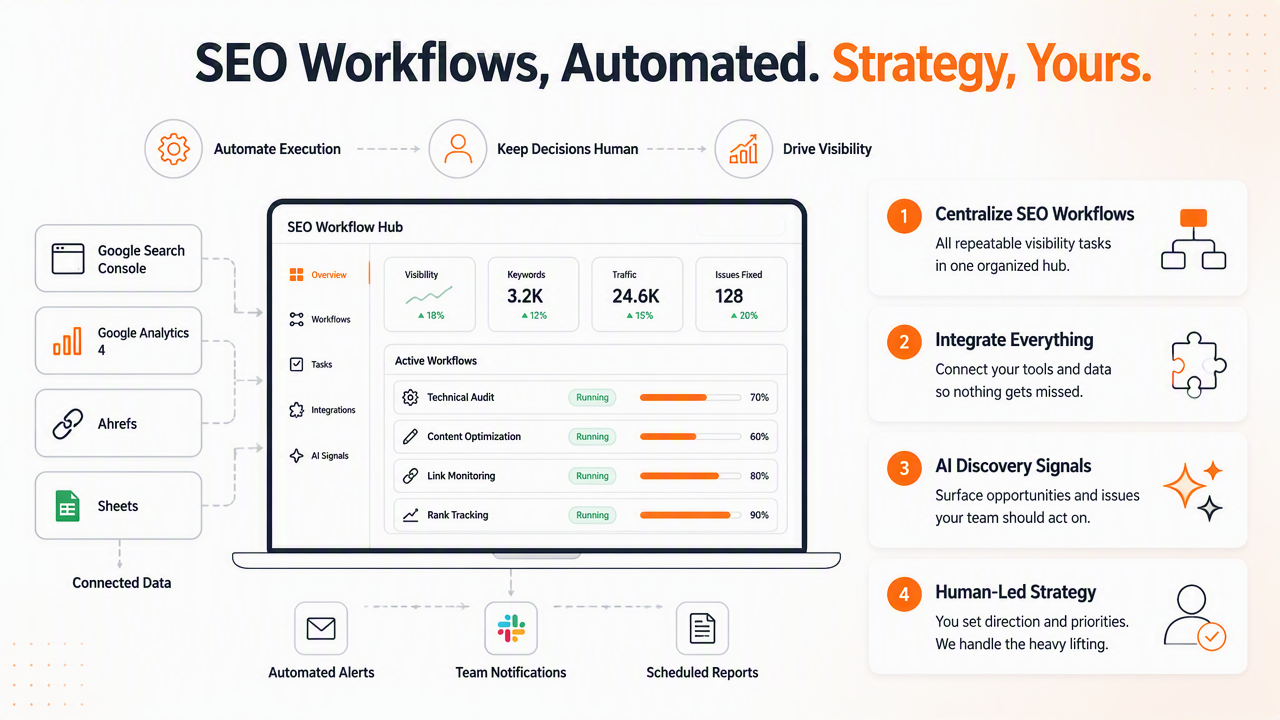
The Earlyseo platform fits especially well for startups and small businesses that need a consistent operating rhythm: find opportunities, publish better pages, connect technical systems, and monitor how content is positioned for both search engines and AI answer systems. More product context is available on earlyseo.com.
Platform roles compared for 2026 SEO operations
| Platform or workflow type | Best use | Where human judgment stays central |
|---|---|---|
| Earlyseo | SEO visibility workflows, AI citation readiness, site integrations, repeatable execution | Positioning, content expertise, approval, prioritization |
| n8n | Custom automation templates across apps and media workflows | Workflow design, data validation, publishing standards |
| Gumloop | AI agents for repeatable marketing and SEO tasks | Agent instructions, output review, business rules |
| AirOps | Content and AI workflow operations for marketing teams | Editorial quality, factual accuracy, search intent |
| Spreadsheets and scripts | Lightweight tracking and simple recurring checks | Maintenance, ownership, exception handling |
Earlyseo also supports practical CMS and commerce handoffs through SEO integrations for publishing workflows. For e-commerce teams, a connected Shopify SEO workflow can reduce manual checks around product and collection-page work.
The strongest setup usually combines automation with a content calendar. Teams can use the Earlyseo blog hub for related reading, then turn repeatable lessons into checklists, templates, and approval steps.
What should change in 2027?
SEO automation in 2027 will likely shift from task automation toward workflow governance, AI-source control, and citation monitoring. Search teams will care less about generating more drafts and more about proving which pages, facts, entities, and sources deserve to be trusted.
Three changes deserve attention:
- AI citation operations: brands will track where AI systems mention them, not just where pages rank.
- Structured source files: formats such as
llms.txt, product feeds, schema, and clean documentation will become more valuable. - Human proof: firsthand experience, expert review, original examples, and clear ownership will separate useful automation from generic output.
The next advantage will not come from publishing the most automated content. It will come from building the clearest, most trustworthy content operation.
Automation will still handle monitoring, clustering, alerts, and repetitive publishing support. Human teams will still decide which audience matters, which claims are supportable, and which pages deserve investment.
FAQ
SEO workflow automation usually raises practical questions about safety, tooling, and scope. The answers below focus on small teams that need faster execution without handing strategic control to software.
What is the safest SEO task to automate first?
The safest first task is reporting automation because it reads existing data rather than changing live pages. Weekly crawl summaries, ranking snapshots, traffic dashboards, and broken-link alerts save time with limited risk. After reporting works reliably, teams can move into brief generation, internal-link suggestions, and metadata queues.
Can AI publish SEO content automatically?
AI can draft, format, and schedule content, but automatic publishing is risky for most business sites. Human review should check facts, claims, product details, search intent, internal links, and brand tone before a page goes live. This matters more for legal, medical, financial, local-service, and e-commerce content.
How many tools are needed for a basic workflow?
A basic workflow can run with a crawler, analytics source, CMS, project tracker, and one SEO platform. More tools are not automatically better. The main requirement is a clear source of truth, a defined owner, and a repeatable process for moving work from discovery to approval to publication.
Does automation replace SEO strategy?
Automation does not replace SEO strategy because strategy depends on market understanding, audience needs, product truth, and prioritization. Software can surface patterns and reduce manual effort, but people still decide which topics to pursue, which pages deserve investment, and how a brand should be positioned in search.
Conclusion
SEO workflow automation works when repetitive tasks become faster and strategic choices remain deliberate. The practical next step is simple: choose one recurring SEO process, document the trigger, assign a reviewer, test a small batch, and measure time saved against quality.
For teams ready to make that operating rhythm more consistent, Earlyseo can support the move from scattered SEO tasks to a clearer workflow. Visit earlyseo.com, pick one workflow to improve this week, and build from a controlled win rather than a complicated overhaul.