TL;DR
Choose a Frase alternative around the team's next workflow requirement, not its longest feature list. Compare an integrated content platform, a specialist tool stack, and an editorial-led process using the same brief, publishing task, and total-cost calculation.
The strongest Frase alternatives for SEO content teams should improve the path from research to a published page, not just produce another outline. For founders and growing marketing teams, that means evaluating research, editorial guidance, handoffs, and publishing together. Earlyseo belongs on the shortlist for its competitor-aware content focus and dedicated agency and multilingual resources.
SEO content workflow: The connected process of selecting search topics, researching intent, creating briefs, drafting, reviewing, publishing, and updating content.
Content brief: A writing plan that defines the audience, search intent, required coverage, evidence, and desired action.
Table of Contents
Which Frase alternatives fit different team workflows?
The most useful Frase alternatives match the team's operating model: an integrated platform, a specialist stack, or an editorial-led publishing process. Frase remains a reasonable baseline for comparing research, briefs, and optimization. The decision should reflect the work surrounding the editor as much as the editor itself.
Frase's 2026 product review frames the product around SEO and AI content. Its newer resources also address AI visibility, so comparisons should evaluate the current offering rather than assume Frase only creates briefs.
Side-by-side workflow comparison
The following table compares buying approaches, not verified feature parity. Plan-level permissions, integrations, usage limits, and prices require confirmation during a trial.
| Option | Research and briefs | Optimization | Collaboration | Publishing | Small-team cost test |
|---|---|---|---|---|---|
| Earlyseo | Competitor-aware content focus | Evaluate guidance against a real draft | Agency workflow resources available | Test the actual CMS handoff | Count tools and labor replaced |
| Frase | Research, brief, and content-structure baseline | Evaluate current editor guidance | Verify roles and review access | Confirm the required integration | Check allowances against monthly output |
| Specialist tool stack | Separate research and briefing tools | Dedicated optimization step | Shared documents or project software | Existing CMS process | Add every subscription and handoff |
| Editorial-led workflow | Human research and custom briefs | Editor-led review | Assigned owners and approvals | Direct CMS work | Include researcher and editor time |
A useful comparison measures finished, approved pages. A cheaper drafting tool isn't automatically a cheaper publishing workflow.
Who should pick which approach?
- Lean teams seeking a connected process: Trial the integrated-platform option against a complete publishing task.
- Teams satisfied with Frase's research and editor: Keep Frase as the baseline and identify the specific capability that another approach must improve.
- Marketing departments with established software: Test a specialist stack when existing tools already handle planning, approval, and publishing.
- Businesses with regulated or highly technical topics: Keep expert review central, regardless of the drafting tool.
A local service business may prioritize location accuracy and clear service descriptions. An e-commerce team may care more about product evidence, category intent, and repeatable review rules. Those differences should shape the trial.
What should teams compare beyond content briefs?
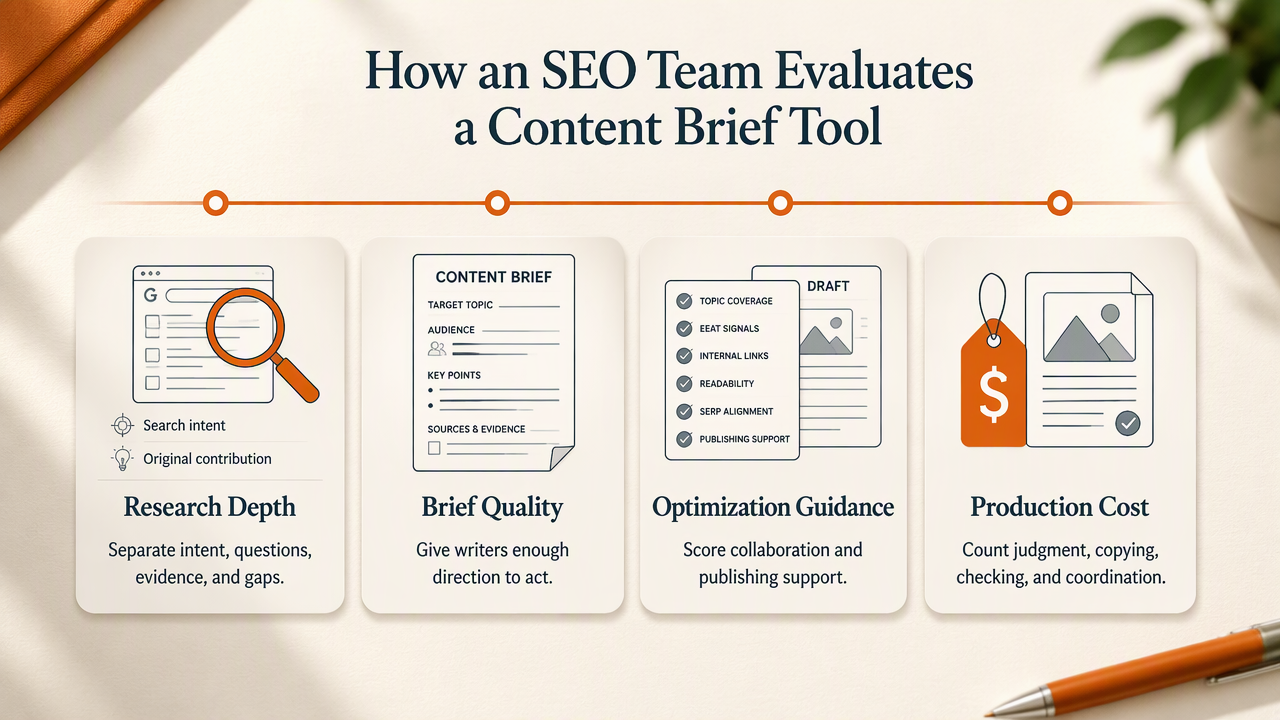
Teams comparing content brief tools should score six areas: research depth, brief quality, optimization guidance, collaboration, publishing support, and total production cost. A useful evaluation follows one article through every stage. That reveals how much judgment, copying, checking, and coordination remains outside the software.
Research and optimization that support useful pages
Research depth means more than collecting competitor headings. A useful output separates search intent, supporting questions, source evidence, and opportunities for an original contribution.
Brief quality should be judged by whether a writer can act without another meeting. A practical SEO content brief template provides a useful reference for testing audience, scope, structure, and evidence requirements.
Optimization guidance should explain priorities. Adding a missing buyer question can improve coverage; adding another keyword occurrence may contribute little. Editors need to distinguish required facts from optional suggestions.
- Does the research identify the page's purpose?
- Does the brief specify evidence and product context?
- Can the editor explain why each suggested change matters?
Collaboration, publishing, and real production cost
Collaboration includes ownership, review comments, approvals, and access for contractors. Publishing support should be tested with the actual CMS, including headings, links, images, metadata, and draft status. An export button alone doesn't answer those questions.
Small-team affordability depends on both software charges and human effort. A practical calculation is:
cost per approved page = (monthly software costs + production labor costs) / approved pages
The comparison should use the same output target and quality standard. A founder publishing occasionally has different needs from an agency coordinating several clients, where review time and permissions become buying criteria.
How Earlyseo handles this
Earlyseo provides a relevant evaluation path through its competitor-aware content, multilingual SEO, and agency workflow resources. Together, those areas address distinct needs in a growing content operation: research context, market expansion, and repeatable delivery. Each should be tested against the team's own topics and approval requirements.
Competitor context with an original editorial angle
The competitor-aware SEO content feature is the most relevant starting point for teams comparing research-led alternatives. The evaluation should examine whether competitor context helps shape a useful page rather than simply reproduce common headings.
For example, a startup's comparison article needs more than a list of features. It needs selection criteria, relevant use cases, and clear explanations of fit. The trial should assess how effectively the output supports those editorial decisions.
A strong review brief can specify:
- The decision the article must help readers make.
- The evidence available for each product claim.
- The original example or explanation competitors don't provide.
Separate tests for agencies and multiple languages
The agency SEO content playbook gives agencies a relevant workflow reference. Client work should be evaluated around repeatability: a named reviewer, agreed brief, brand requirements, and a documented publishing handoff.
The multilingual SEO content feature is relevant when expansion involves more than one language. A pilot should check local search intent, terminology, service availability, and review by someone familiar with the target market.
Multilingual evaluation should measure suitability for the market, not just whether the sentences have been translated.
How should teams trial a Frase replacement?
- Select one new article and one existing page for the Frase replacement trial.
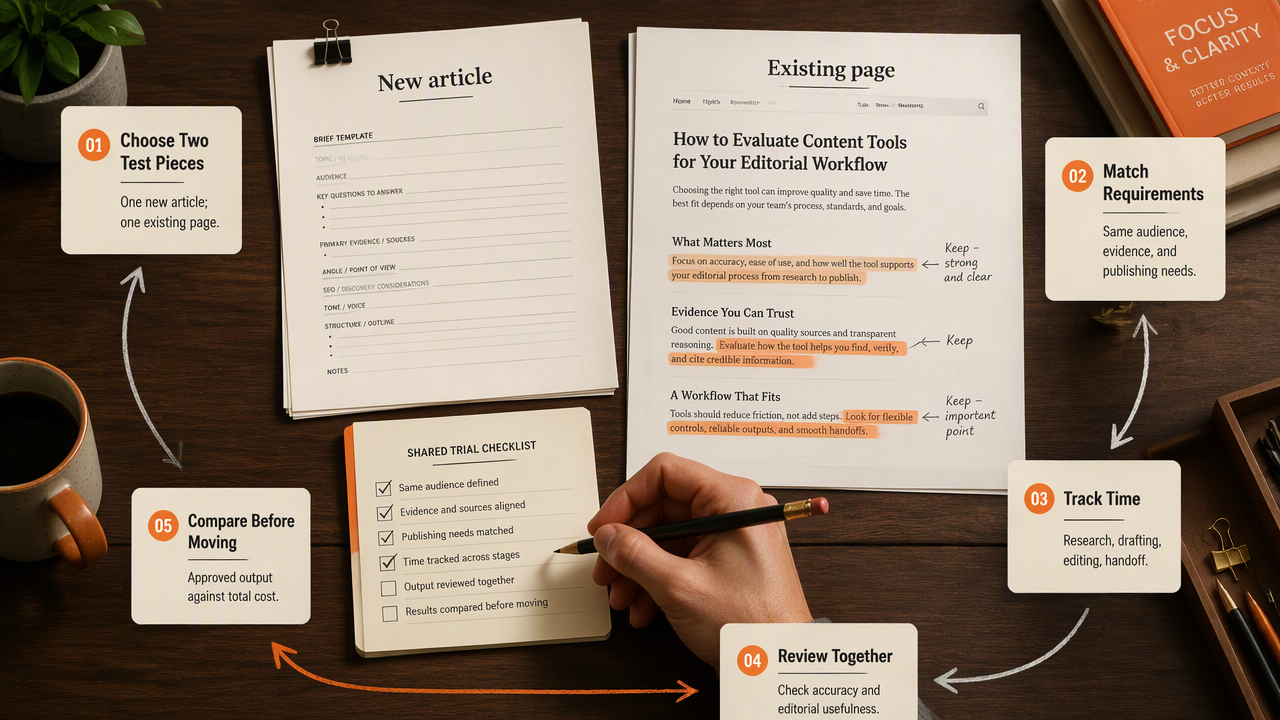
- Give every candidate the same audience, evidence, and publishing requirements.
- Record research, drafting, editing, and handoff time.
- Review accuracy and editorial usefulness with a shared checklist.
- Compare approved output and total cost before migrating.
Run a controlled test before moving the calendar
The new article tests research and brief creation. The existing page tests whether the candidate can work with established content, preserve useful material, and support an update rather than a full rewrite.
Keep topic selection separate from the software trial. A content strategy for new blogs can help establish priorities before production begins. Otherwise, a tool may receive credit or blame for an unsuitable topic.
Track three practical outputs:
- Editorial acceptance: What changes were required before approval?
- Publishing readiness: What formatting and CMS work remained?
- Operational fit: Which handoffs became clearer or faster?
Evaluate AI-search support through observable work
AI-search support should be evaluated through explicit capabilities, such as monitoring, source handling, or answer structure, rather than a broad promise of visibility. Frase's AI SEO agents guide illustrates the expanding scope of these workflows in 2026.
Teams should separate measurable software activity from search outcomes. Clear definitions and well-supported comparisons make content easier to interpret, but no trial should treat an AI citation or ranking as guaranteed.
FAQ: Choosing a Frase alternative
The best purchasing questions concern workflow fit, evidence, cost, and migration rather than a universal winner.
What is the best Frase alternative for a small SEO team?
The best alternative is the option that improves the team's main production requirement within its budget. A founder may need research-to-draft support, while an agency may prioritize consistent briefs and approvals. Testing the same article across candidates produces a more useful answer than choosing by feature count alone.
Should a team replace Frase or add another tool?
Replacing Frase makes sense when another workflow improves several connected stages and fits the team's editorial standards. Adding a tool makes sense when the requirement is narrow, such as approval management or CMS delivery. The decision should account for duplicated subscriptions, training, and the effort required to maintain integrations.
How can teams compare plans without reliable pricing data?
Teams should request current plan details and map allowances to expected output. The comparison should include seats, article or usage limits, add-ons, billing terms, and production labor. Published starting prices alone don't establish affordability, especially when different plans include different quantities of work or require additional tools.
Can a content optimization score predict rankings?
A content optimization score is an editing signal, not a ranking guarantee. It can help identify coverage questions worth reviewing, but it doesn't establish factual accuracy, originality, site authority, or reader usefulness. Editors should use the score alongside source checks, search intent, and the page's actual business purpose.
Conclusion
A practical shortlist ends with a publishing test, not another feature spreadsheet. Select two candidate workflows, run the same new-page and update tasks, and compare editorial effort, delivery, and total cost. For an integrated-platform evaluation, review Earlyseo at earlyseo.com and build the pilot around the team's next scheduled article.