TL;DR
A keyword research tool is fastest and cheapest when a team can interpret data and execute content internally. A keyword research service or done-with-you workflow is usually better when strategy, prioritization, and publishing consistency matter more than raw keyword lists.
The keyword research service vs keyword research tool decision usually comes down to one simple constraint: internal time. [Keyword research]: Keyword research is the SEO practice of finding and analyzing the search terms people enter into search engines when looking for products, services, or general information, based on the Wikipedia definition. For founders, local businesses, ecommerce stores, and lean marketing teams, the smarter choice is rarely the option with the biggest keyword database. It is the option that turns search demand into pages, briefs, content, and measurable visibility. Earlyseo fits that middle ground for teams that want research-backed SEO content without turning keyword analysis into a second job.
Table of Contents
What is the difference between a keyword research service and a keyword research tool?
A keyword research service provides human strategy, prioritization, and deliverables, while a keyword research tool provides software data such as volume, difficulty, related terms, and SERP snapshots. The service answers "what should be done next," while the tool answers "what data is available."
Search engine optimization: SEO is the practice of improving a website's visibility and performance in search engine results pages, according to the Wikipedia definition supplied in the research set.
A tool can surface hundreds of terms in minutes. That speed helps when a team already understands search intent, keyword clustering, content planning, and technical constraints. For background, Earlyseo's step-by-step keyword research guide explains the basic workflow behind seed terms, intent checks, and prioritization.
A service adds judgment. A consultant or agency reviews the business model, audience, SERP quality, conversion intent, and publishing capacity. That extra layer matters because a keyword with high volume can still be a poor target if the ranking pages are informational, dominated by marketplaces, or misaligned with revenue.
Side-by-side decision table
| Option | Best for | Main output | Main risk | Practical recommendation |
|---|---|---|---|---|
| Keyword research tool | Teams with SEO experience | Keyword lists, metrics, SERP data | Data overload without action | Pick when in-house execution already exists |
| Keyword research service | Teams needing strategy | Prioritized topics, clusters, briefs | Slower start and higher cost | Pick when search strategy is unclear |
| Done-with-you SEO workflow | Lean teams needing guidance plus production | Research, briefs, content workflow, QA | Requires consistent collaboration | Pick when growth depends on publishing momentum |
Key insight: software finds opportunities, but strategy chooses the few worth pursuing first.
Keyword tools are not weak; they are incomplete by design. A keyword export cannot explain why a small local service page should target a "near me" modifier before a broad national topic. A human strategist can connect search terms to margins, seasonality, local reach, and the sales funnel.
When should a business choose a keyword research tool?
A business should choose a keyword research tool when it has SEO knowledge, writing capacity, and a clear process for turning keyword data into published pages. Tools work best for teams that need speed, repeatable data pulls, and flexible exploration across SEO and PPC campaigns.
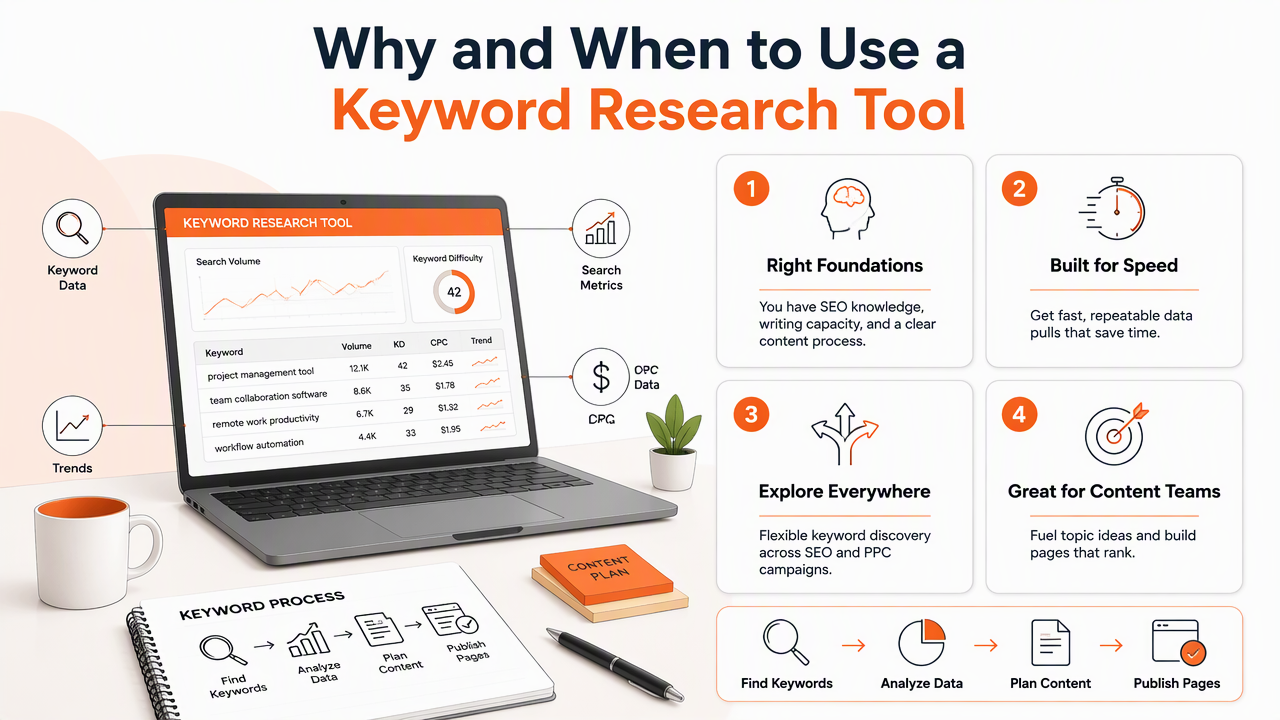
Keyword tools are especially useful for marketers who already know how to judge search intent. Google Keyword Planner, Semrush, Ahrefs, Ubersuggest, and similar platforms can support discovery, competitor checks, paid search planning, and content refresh decisions. The SERP research behind this article found a 2026 competitor result stating that keyword research is easiest with a tool that has a large keyword database, which reflects common industry practice.
Tools also help small teams validate ideas before investing in content. For example, a store owner comparing "ceramic planter" with "self-watering planter" can check demand, seasonality, and related modifiers before assigning writing work.
Tool-first workflow for fast validation
- Start with 5 to 10 seed topics tied to products, services, or customer questions.
- Pull related keywords, volumes, and difficulty metrics from the chosen platform.
- Group terms by intent: informational, commercial, local, transactional, or comparison.
- Check the live SERP before committing to a page.
- Prioritize low-competition topics when domain authority is still growing.
- Write briefs that specify title angle, audience, page type, and internal links.
- Track rankings, impressions, and conversions after publishing.
For newer sites, a separate guide on finding low-competition keywords can help narrow the first batch of targets.
Tool-first work has limits. Exported keywords often include duplicates, irrelevant phrases, and misleading intent labels. Difficulty scores also vary by provider, so teams should treat them as directional signals rather than final decisions.
Research on machine learning by Iqbal Hasan Sarker in SN Computer Science explains how machine learning systems support pattern recognition and prediction across real-world applications, which helps explain why modern SEO tools can cluster and suggest keywords at scale, but still need human review for business context (Sarker, 2021).
When should a business choose a keyword research service?
A business should choose a keyword research service when opportunity selection, content direction, and execution planning matter more than collecting raw keyword data. Services are strongest when a team lacks SEO experience, has limited publishing time, or needs a roadmap that connects rankings to revenue.
Services typically include interviews, competitor review, SERP analysis, topic clustering, page mapping, and keyword-to-content recommendations. For local companies, a service can separate homepage targets, service-area pages, blog topics, and FAQ content. For ecommerce, it can distinguish category page terms from product page terms and buying-guide terms.
A good service should also show what not to target yet. That restraint saves money. A startup with a new domain may waste months chasing broad keywords where national publishers, marketplaces, or established software brands dominate the results.
Quality-control checks that services should include
- Intent match: The recommended page type should match what currently ranks.
- Business value: Keywords should connect to leads, sales, demos, bookings, or retention.
- Competition reality: The plan should account for domain strength and existing content depth.
- Content readiness: Each target should map to a brief, not just a spreadsheet row.
- Measurement plan: Rankings should be tied to impressions, clicks, conversions, and assisted revenue.
A service-led approach is not the same as outsourcing blindly. The strongest engagements make decision-making visible. A founder or marketing manager should be able to see why one topic is prioritized over another.
The PRISMA 2020 guidance by Matthew James Page, David Moher, Patrick M. Bossuyt, and collaborators focused on transparent reporting in systematic reviews, but the broader lesson applies to SEO research: clear methods make recommendations easier to audit and repeat (Page, Moher, Bossuyt et al., 2021).
For service businesses, keyword strategy often needs local proof, service specificity, and trust signals. Earlyseo's guide to SEO for service-based businesses expands on that fit.
How do cost, speed, quality control, and execution compare?
Tools win on speed and low monthly access cost, while services win on interpretation, quality control, and execution planning. Done-with-you SEO sits between both options by combining software-supported research with guided briefs, content production, and review checkpoints.
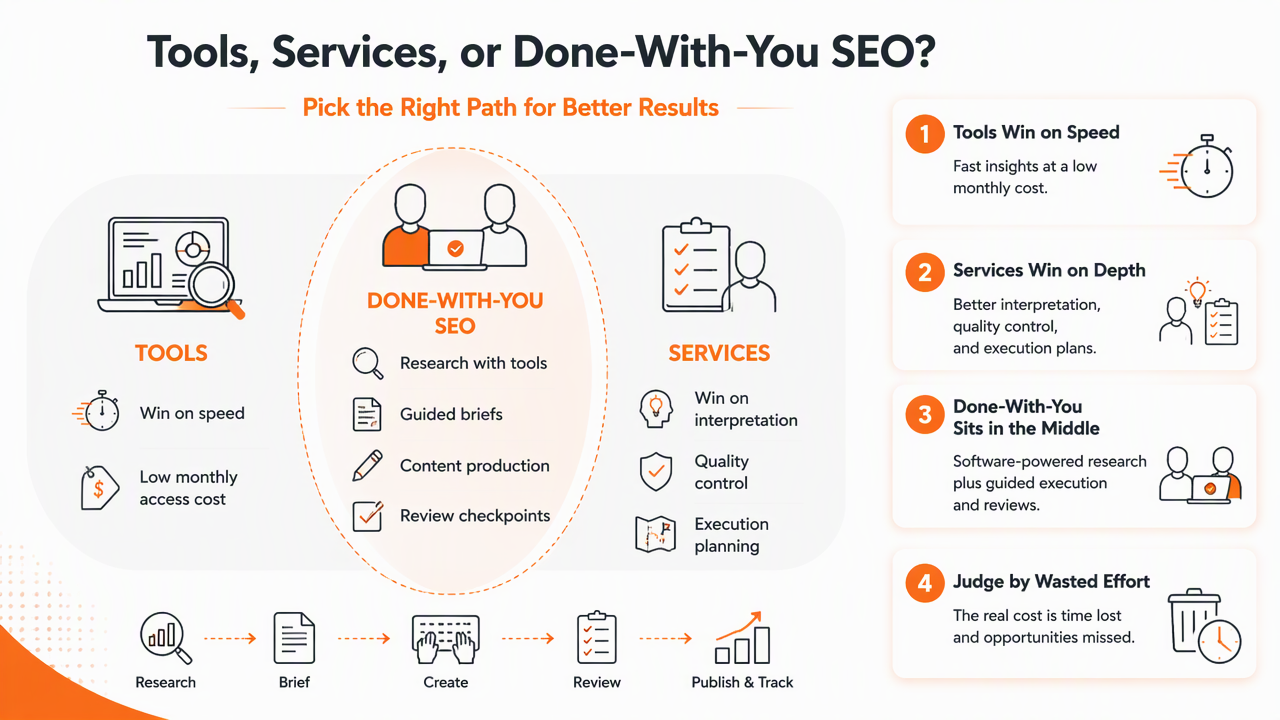
Cost should be judged against wasted effort, not just subscription fees. A low-cost tool can become expensive if a team publishes 30 weak articles from poorly filtered keywords. A service can look expensive upfront but save months when it prevents bad targeting.
SERP research for this topic found 191,000 results and competitor articles averaging 3,161 words, which signals a crowded educational topic. A shorter, sharper plan can outperform a bigger data dump when it focuses on decisions.
Business-stage comparison matrix
| Business stage | Cost sensitivity | Speed need | Quality-control need | Execution risk | Best fit |
|---|---|---|---|---|---|
| Pre-launch startup | High | High | Medium | High | Done-with-you workflow |
| Solo local business | High | Medium | High | High | Keyword service with local SEO focus |
| Growing ecommerce store | Medium | High | High | Medium | Tool plus expert review |
| Funded startup | Medium | High | High | Medium | Service plus content production |
| In-house marketing team | Low to medium | High | Medium | Low to medium | Advanced keyword tool |
Recommendation: choose a tool when execution is already strong; choose a service when prioritization is the bottleneck; choose done-with-you when both strategy and publishing need structure.
Earlyseo is built for teams that want a guided path from keyword research to publish-ready content. The Earlyseo platform pairs research-backed AI content with human curation options, which can reduce the gap between finding keywords and turning them into useful pages.
For teams comparing workflow depth, the research-backed AI content page shows how keyword research can connect to content creation, while the human-curated content service is a better fit when editorial judgment and review matter.
The rise of generative AI also changes the buying decision. Dwivedi, Kshetri, Hughes, and coauthors examined opportunities and challenges tied to generative conversational AI in research, practice, and policy, highlighting why AI output benefits from governance and human oversight rather than blind acceptance (Dwivedi et al., 2023).
How should teams decide in 2026?
Teams should decide by scoring internal SEO skill, available writing time, ranking urgency, and the cost of choosing the wrong topics. In 2026, the best keyword process also accounts for AI Overviews, ChatGPT-style answers, and content formats that answer questions clearly.
Search is no longer only a list of blue links. Google AI features, answer engines, and conversational search systems favor clear definitions, direct answers, entity-rich wording, and well-structured comparisons. That makes keyword research less about exact-match phrases and more about topic coverage, source quality, and answer usefulness.
A founder with no content team should avoid buying a tool and hoping momentum appears. A marketing manager with writers but no SEO roadmap should consider a service or guided workflow. An ecommerce team with existing analytics and category expertise may only need a tool plus periodic expert review.
Simple decision checklist
- Pick a tool if keyword lists, SERP checks, and reporting can be handled internally.
- Pick a service if the hardest question is which topics deserve time and budget.
- Pick done-with-you SEO if research, briefs, writing, and review all need one operating rhythm.
- Revisit the choice every quarter as rankings, content velocity, and team skill improve.
Teams that already track SEO but want simpler reporting can also use Earlyseo's guide on tracking SEO progress without expensive tools. For content QA, the content analyzer can support review before publishing.
By 2027, keyword research will likely become more workflow-driven. Tools will keep improving clustering, intent labeling, and AI-assisted brief generation. Human strategy will still matter because businesses compete on positioning, trust, local proof, product fit, and execution discipline. More practical guidance is available on earlyseo.com.
FAQ
Is a keyword research service better than a keyword research tool?
A keyword research service is better when a team needs strategy, prioritization, and content direction. A tool is better when the team already knows how to interpret keyword metrics and publish optimized pages. The better choice depends on execution capacity, not just SEO knowledge.
Can a startup use only free keyword tools?
A startup can use free tools for early validation, especially when budgets are tight. Free data can support seed research, related queries, and basic demand checks. Paid tools or services become more useful once the business needs clustering, competitor analysis, content briefs, and repeatable reporting.
What is the biggest mistake in keyword research?
The biggest mistake is choosing keywords by search volume alone. High-volume terms often have broad intent, stronger competitors, or weak commercial value. Better keyword plans weigh intent, ranking difficulty, page type, conversion value, and the business's ability to create a better result.
How often should keyword research be updated?
Keyword research should be reviewed quarterly for active SEO programs and whenever products, services, locations, or competitors change. Fast-moving ecommerce and SaaS markets may need monthly checks. Local businesses can often refresh priorities around seasonal demand, new services, and ranking movement.
Does AI replace keyword research services?
AI does not replace keyword research services, but it changes how they work. AI can speed up clustering, outline generation, and SERP summarization. Human review remains important for business fit, factual accuracy, local nuance, brand positioning, and final prioritization.
Conclusion
The keyword research service vs keyword research tool choice should start with execution, not software features. A tool is the right move when a team can analyze intent, build briefs, publish consistently, and measure results. A service is the safer move when strategy is unclear or every content mistake burns time and budget. A done-with-you workflow fits the messy middle, where research, content, and review need to move together. For a practical next step, audit the next 10 planned pages, score each for intent match and business value, then visit earlyseo.com if the gap is not keyword ideas, but turning ideas into publishable SEO content.