TL;DR
Automated analysis suits recurring website checks; expert review adds business context and validates high-impact recommendations. A hybrid workflow is the strongest default: scan the site, verify findings, then prioritize changes by commercial value rather than audit score.
An SEO issue count isn't a business priority list. The practical question behind ai website analyzer vs manual seo review is which method turns website evidence into useful decisions. In 2026, buyers should distinguish automated diagnosis from expert interpretation, rather than assume either approach covers everything.
For teams organizing that process, Earlyseo provides a relevant starting point for exploring website analysis alongside ongoing SEO work. A useful comparison begins with three terms:
- SEO: The practice of improving website visibility and performance in search engine results.
- AI website analyzer: Software that uses artificial intelligence to interpret website data and generate findings or recommendations.
- Manual SEO review: Expert-led evaluation of website evidence, search intent, and business priorities, often supported by software.
Table of Contents
Automated Diagnosis vs Expert Interpretation
An AI analyzer organizes website evidence, while a manual review decides what that evidence means for a particular business. Neither label guarantees scope: some analyzers inspect only supplied pages, and some manual audits rely heavily on crawlers. Buyers should compare inputs, verification methods, and deliverables rather than labels.
Side-by-side review capabilities
The strongest distinction is repeatable detection versus context-sensitive judgment.
| Evaluation area | AI website analyzer | Manual SEO review |
|---|---|---|
| Coverage | Can process many accessible pages repeatedly | Covers the agreed scope, often using crawlers |
| Technical findings | Can surface patterns in available data | Validates causes and implementation choices |
| Content assessment | Suggests gaps or improvements from supplied context | Checks intent, expertise, and commercial relevance |
| Prioritization | Depends on rules, prompts, and business inputs | Weighs revenue, resources, and risk |
| Deliverables | Reports, summaries, or recommendations | Explained decisions and an implementation plan |
| Cost structure | Subscription or usage fees, plus review time | Project or retainer fees, plus implementation |
A crawler detecting a broken link isn't necessarily performing AI analysis. The AI layer may explain the finding or suggest a fix; the underlying detection can still be rule-based.
Evidence matters more than confident wording
Recommendations deserve more trust when they identify the affected URL, supporting evidence, and a way to verify the claim. Fluent explanations alone don't establish correctness.
The 2024 GPT review by Gokul Yenduri and colleagues examines enabling technologies, applications, challenges, and future directions. It provides background on language models, not a benchmark proving that an SEO analyzer outperforms an expert.
A useful audit separates an observed condition, its possible SEO impact, and the recommended action. Those are three different claims.
A Shared Website Example: Findings and False Positives
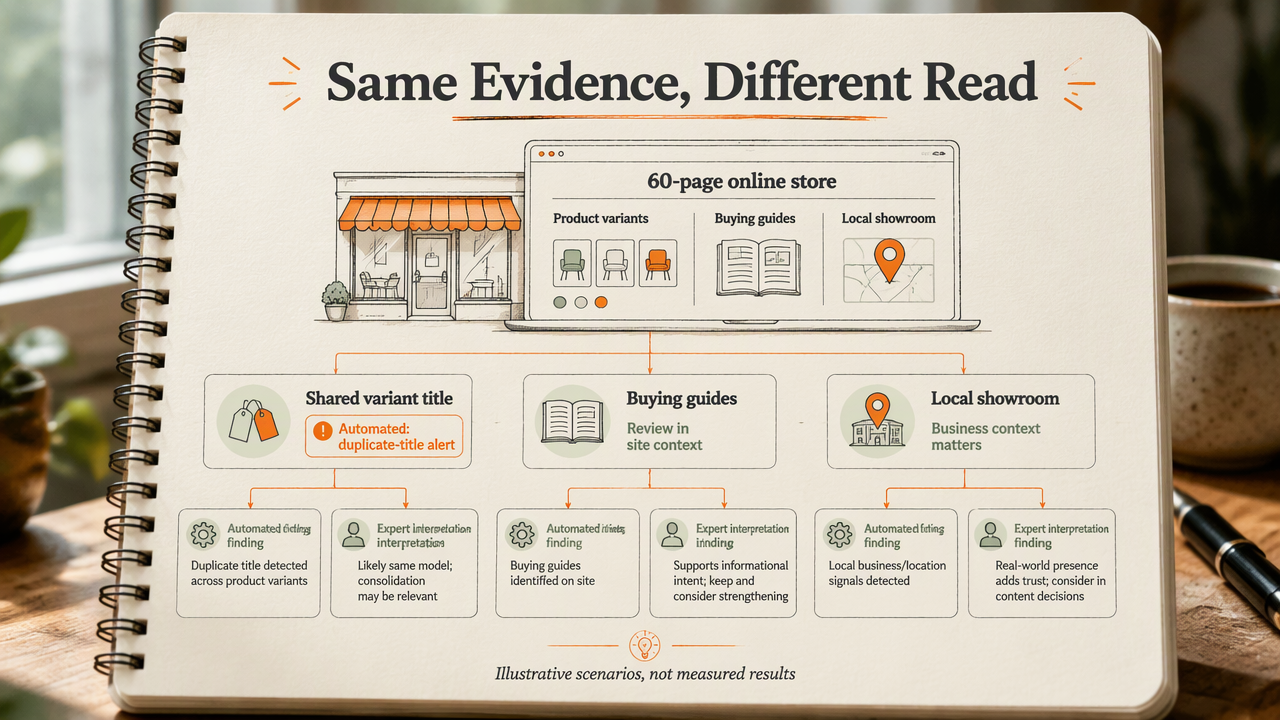
A shared website example makes the comparison useful because both methods must evaluate the same evidence. Consider a hypothetical 60-page online store with product variants, buying guides, and a local showroom. The following scenarios illustrate possible findings, not measured accuracy or results from a tested product.
What each method might conclude
Identical website signals can support different recommendations once business context enters the review.
| Sample condition | Possible automated finding | Expert interpretation |
|---|---|---|
| Two product variants share a title | Duplicate-title alert | Check whether variants need separate search visibility |
| A buying guide has no internal links | Orphan-page warning | Confirm crawl scope, then connect relevant pages |
| A discontinued product returns 404 | Broken-page alert | Check demand, backlinks, and replacement relevance |
| A showroom page contains little text | Thin-content warning | Assess whether location details satisfy visitor needs |
These aren't automatic false positives. They become misleading when the report treats every condition as a confirmed problem without checking intent.
Business context changes the fix
A discontinued product shouldn't automatically redirect to the homepage. A relevant replacement may justify a redirect; a deliberately removed page may need a different treatment. The review should establish the goal before choosing the response.
Likewise, expanding a showroom page solely to satisfy a word-count target can distract from useful information. Opening hours, services, accessibility details, and directions may matter more than extra copy.
- Verify the reported condition on the actual page.
- Identify the page's intended audience and purpose.
- Check search and conversion evidence where available.
- Record why the proposed change fits that purpose.
For the orphaned buying guide, an internal linking strategy offers a focused next step. The decision should connect relevant pages, not add links indiscriminately.
Who Should Pick Which Review Method?
Automated analysis suits repeatable monitoring, manual review suits consequential decisions, and a hybrid approach suits teams needing both coverage and judgment. Budget alone shouldn't decide the method. Site complexity, implementation risk, available expertise, and the value of affected pages should determine how much human validation is needed.
Decision matrix by business situation
The best starting point depends on the decision that follows the audit.
| Business situation | Recommended starting point | Reason |
|---|---|---|
| Startup launching a simple site | Automated baseline plus targeted review | Covers routine checks and validates launch priorities |
| Small business monitoring stable pages | Recurring automated checks | Supports repeatable comparisons over time |
| Growing store changing navigation | Hybrid review | Combines broad detection with merchandising context |
| Local business assessing service pages | Expert-led review with supporting tools | Adds customer and location-specific judgment |
| Website migration | Expert-led planning and automated validation | Requires coordinated URL and indexing decisions |
A website migration SEO checklist helps define the scope before commissioning either service.
Compare total cost, not report price
The true comparison includes tool fees, reviewer time, implementation effort, and follow-up verification. A low subscription price doesn't establish low total cost, just as a detailed consultant report doesn't establish commercial value.
Buyers should request:
- The pages and data sources included in the review.
- Evidence supporting each high-priority recommendation.
- An explanation of what needs human validation.
- A handoff format suitable for developers or content teams.
- A plan for checking changes after publication.
For expert engagements, questions to ask before hiring an SEO agency can clarify ownership and deliverables. The useful purchase is a decision-ready plan, not simply a longer document.
How Earlyseo Handles This
Earlyseo offers a website-analysis entry point that fits an analysis-to-action workflow. Its website analysis page is the relevant place to assess the offering against a business's requirements. Buyers can evaluate the available inputs, outputs, and review process before choosing how to organize ongoing work.
Turn findings into an accountable work queue
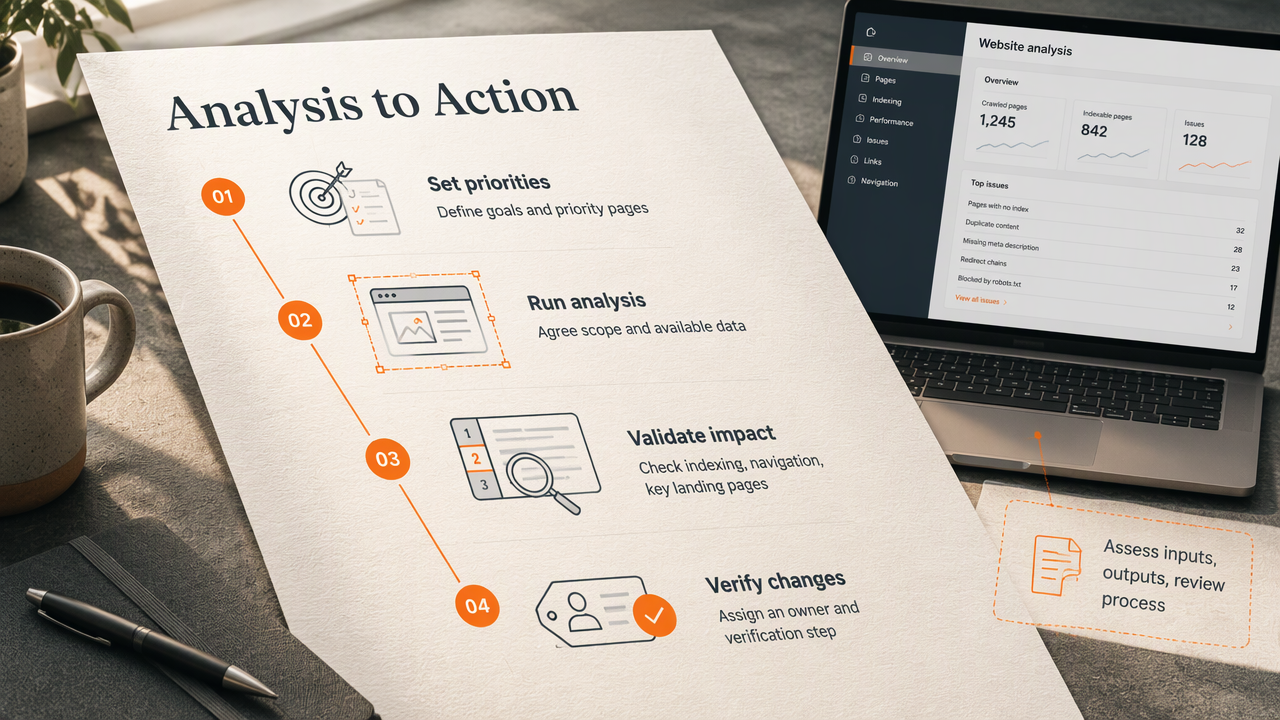
A practical workflow gives every accepted recommendation an owner and a verification step.
- Define the website's main commercial goals and priority pages.
- Run analysis against an agreed scope and available data.
- Validate recommendations that affect indexing, navigation, or key landing pages.
- Rank accepted tasks by likely value, effort, and implementation dependencies.
- Assign owners and check the affected pages after changes.
The platform's SEO operations offering provides a related area to evaluate when the goal extends beyond a one-off report. Consistent handoffs help founders, marketers, and developers work from the same priorities.
The strongest workflow connects each finding to a decision, an owner, and evidence that the change was implemented.
FAQ: Choosing and Validating an SEO Review
A reliable SEO review should make its scope, evidence, and decision process clear before recommendations reach implementation.
Can an AI website analyzer replace an SEO expert?
An AI website analyzer can support routine checks and organize findings, but replacing an expert depends on the decisions involved. Simple, reversible updates may need limited supervision. Site migrations, indexing changes, and commercially important page decisions benefit from expert interpretation. Automation works best when responsibilities and escalation rules are explicit.
Which approach produces fewer false positives?
No supplied benchmark establishes which approach produces fewer false positives. Automated systems can flag intentional website choices, while experts can misread evidence or overlook patterns. A fair evaluation uses the same pages, agreed issue definitions, and independent verification. Report confidence and writing quality shouldn't substitute for checking the underlying condition.
What data should a business share with an analyzer?
A business should share only the data needed for the agreed review and check access, retention, and privacy terms first. Public URLs may be enough for an initial assessment. The 2024 survey by Yifan Yao and colleagues examines LLM security and privacy, providing background for evaluating sensitive-data handling rather than SEO accuracy.
How should SEO reviews evolve through 2027?
SEO reviews should increasingly require traceable recommendations: source URLs, supporting observations, proposed actions, and post-change checks. That is a practical buying standard, not a prediction that every product will provide it. As AI capabilities develop, teams can compare systems by verifiability and workflow fit rather than the sophistication of generated explanations.
Conclusion
The ai website analyzer vs manual seo review decision should start with the business decision, not the tool label. Teams can select one priority page group, define the evidence required, and compare an automated report with an expert's interpretation before expanding the scope.
For businesses building that workflow, Earlyseo is a relevant next step. Visit earlyseo.com to explore the offering, then prepare a review brief with priority URLs, commercial goals, task owners, and verification criteria.