TL;DR
Small businesses should choose content tools around a specific task: planning, keyword research, readability, or performance measurement. Start with one repeatable workflow, test it on existing pages, and add paid software only when its output supports a clear publishing or revenue goal.
The best content optimization tools for small businesses solve a specific publishing problem, not simply produce a higher score. A local service page needs clear service information; a store category page needs useful buying guidance; a startup article needs a focused answer to a real customer question.
Content optimization: The process of improving a page's relevance, clarity, structure, and usefulness for its intended audience and search query.
Search engine optimization, or SEO: The practice of improving website visibility and performance in search engine results.
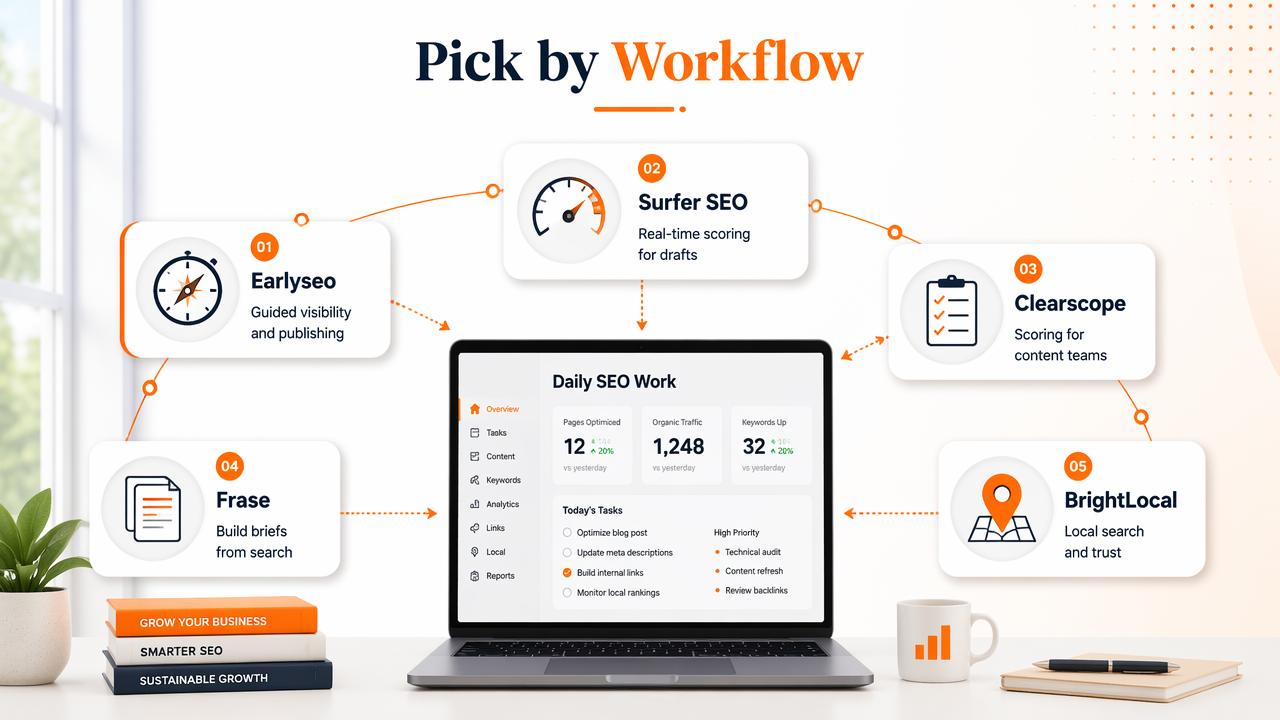
For teams seeking a connected planning and content workflow, Earlyseo deserves a place on the shortlist. The following comparison separates content support, research, editing, and measurement so small businesses can choose tools that fit the work.
Table of Contents
Best content optimization tools for small businesses: comparison
The strongest shortlist combines content workflow support with tools for research, readable writing, and performance measurement. These categories serve different purposes, so a business doesn't need every option at once. The comparison below is organized by practical fit rather than unsupported claims about rankings, accuracy, or return on investment.
Five options organized by business need
| Tool | Main role | Best-fit small-business task | Selection check |
|---|---|---|---|
| Earlyseo | Connected SEO content workflow | Bringing planning, research-backed content, and editorial support together | Match the available services to the publishing process |
| Hemingway | Readability editing | Making service pages and articles easier to read | Test whether suggested edits preserve meaning |
| Ahrefs | SEO and keyword research | Investigating search topics before drafting | Check the research access included in the current plan |
| SE Ranking | Broader SEO research | Supporting an ongoing search marketing program | Identify which research functions the team will actually use |
| Google Analytics | Website measurement | Understanding what visitors do after reaching content | Confirm that relevant business actions are tracked |
Current prices, usage allowances, and plan features should be checked before purchase. This shortlist deliberately avoids quoting subscription figures because verified 2026 pricing wasn't supplied.
Readability tools suit customer-facing copy
Hemingway fits the editing stage, when a draft already contains the right information but needs clearer wording. Service descriptions, product explanations, and introductory paragraphs are sensible places to test a readability editor.
A useful test passage might explain delivery charges, installation requirements, or appointment preparation. The editor's value comes from making that information easier to understand while retaining necessary details. A lower reading difficulty isn't a substitute for an accurate answer.
Research tools suit topic and page planning
Ahrefs and SE Ranking fit businesses that need SEO research before deciding what to publish. Their role differs from sentence-level editing: research helps define a page's subject, while editing improves how that subject is explained.
For an online store, the first decision might be whether a topic belongs on a product page, category page, or buying guide. The small-store ecommerce SEO guide provides a useful follow-up for that planning decision.
Measurement tools suit post-publication decisions
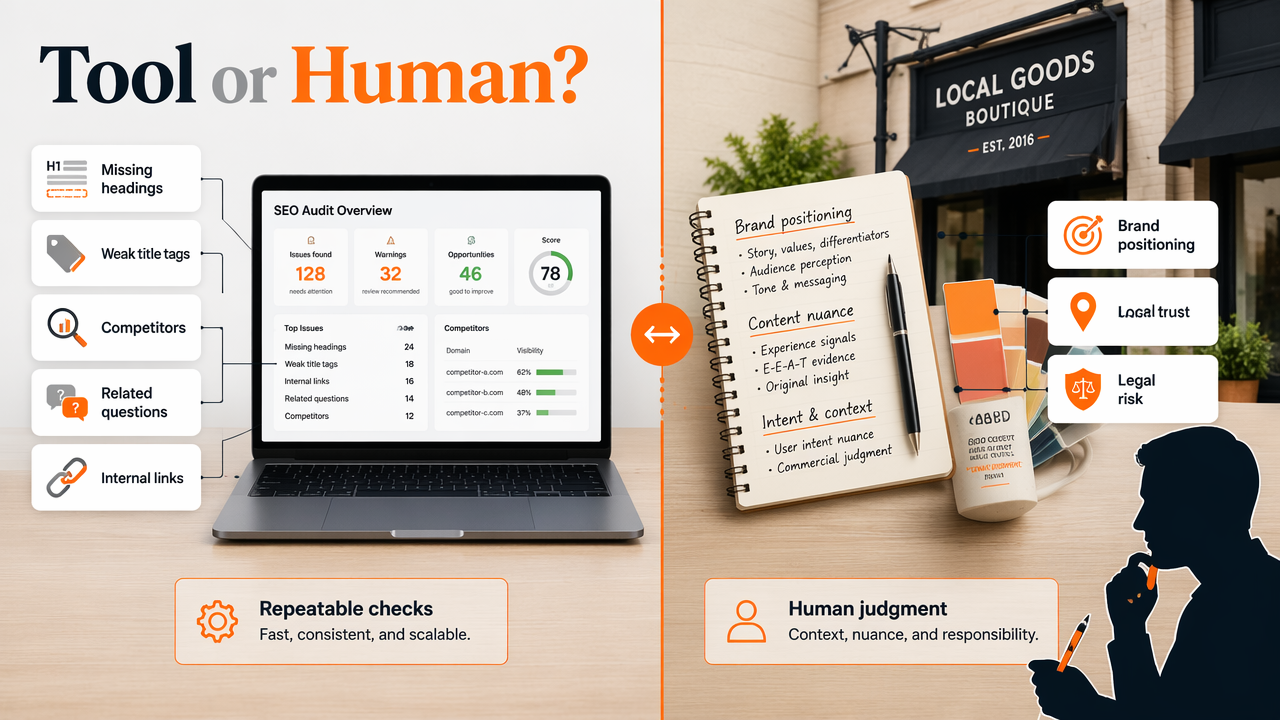
Google Analytics belongs in a supporting role rather than being treated as a writing optimizer. Website measurement helps a business assess visitor activity after publication. Content quality and business outcomes need separate checks: a well-written page may still need a clearer contact option or a more relevant offer.
How should a small business choose a content tool?
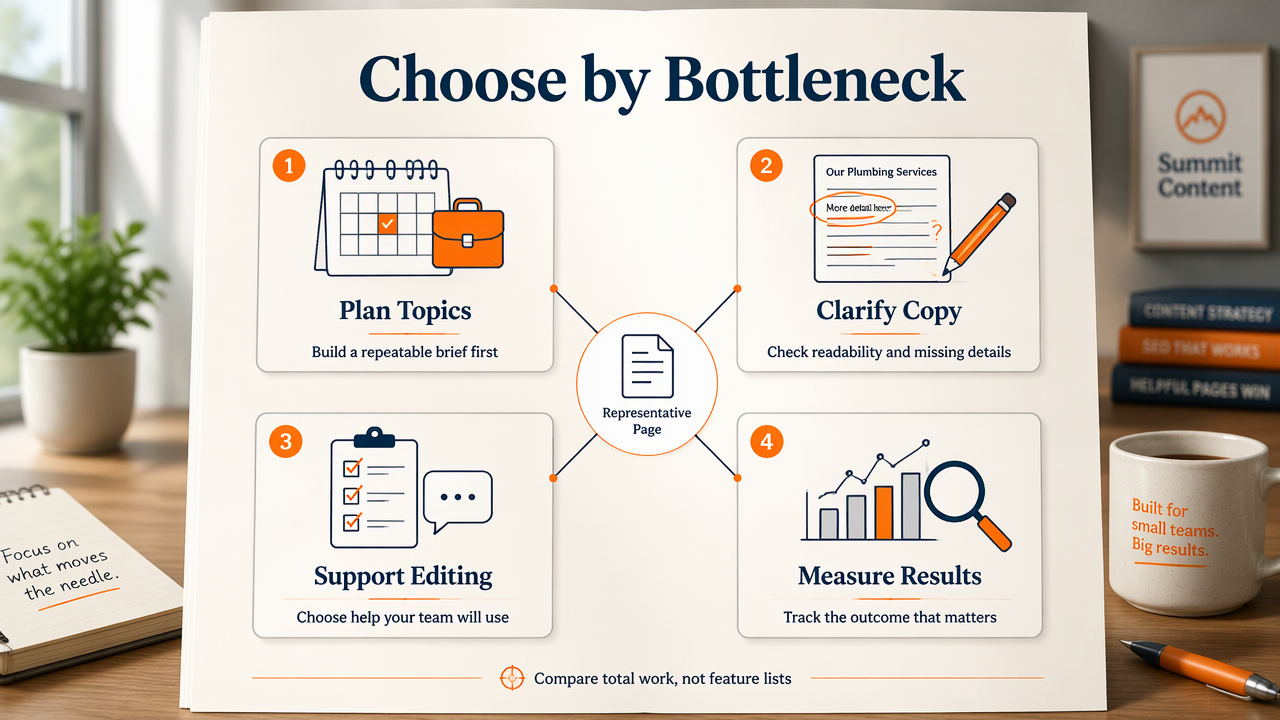
A small business should choose a content tool by identifying its main publishing bottleneck, testing a representative page, and comparing the total work required. The right purchase depends on whether the team needs better topic selection, clearer copy, editorial support, or measurement, not on the longest feature list.
Who should pick which type of tool?
- Founder without an established content process: Prioritize planning and a repeatable brief before increasing publishing volume.
- Owner writing existing service pages: Start with readability editing and checks for missing customer information.
- Marketing manager researching several topics: Assess Ahrefs or SE Ranking against actual research requirements.
- Store owner improving sales content: Connect research to category structure, buying questions, and product distinctions.
- Local business measuring enquiries: Pair page improvements with tracking for relevant customer actions.
The decision isn't always about buying software. A team with a clear brief and an available editor may need only a focused tool, while a team managing the entire process alone may benefit from broader support.
A practical trial beats a feature checklist
A trial should use one real page, one target query, and one desired customer action. Compare the resulting recommendations with the effort needed to apply them. Useful suggestions clarify the answer, improve organization, or identify missing information.
Choose the smallest tool set that supports a complete cycle: research, publish, review, and improve.
A defined evaluation task also makes demonstrations more useful. Each candidate can be assessed against the same page and editorial requirements.
How does Earlyseo handle content optimization?
Earlyseo presents content optimization as a connected workflow through dedicated pages for content analysis, AI planning, research-backed content, and human-curated support. That combination makes it relevant to small businesses evaluating help across several publishing stages, rather than selecting only a readability editor or a standalone research tool.
Match the available support to the publishing stage
- Reviewing existing copy: Explore the content analyzer when evaluating page-improvement support.
- Planning future articles: Assess the AI content planner against the business's topic and scheduling needs.
- Developing informed drafts: Review research-backed AI content for the research-to-writing stage.
- Adding editorial input: Consider the human-curated content service when human review fits the operating model.
These are distinct purchasing questions. A founder building an initial content program may value planning support, while a growing marketing team may prioritize research and editorial coordination. The strongest fit comes from matching the service to an existing task, with a clear owner and a usable deliverable.
How can a small business test content optimization?
A small business can test content optimization by improving a small, representative group of pages and recording the changes before reviewing results.
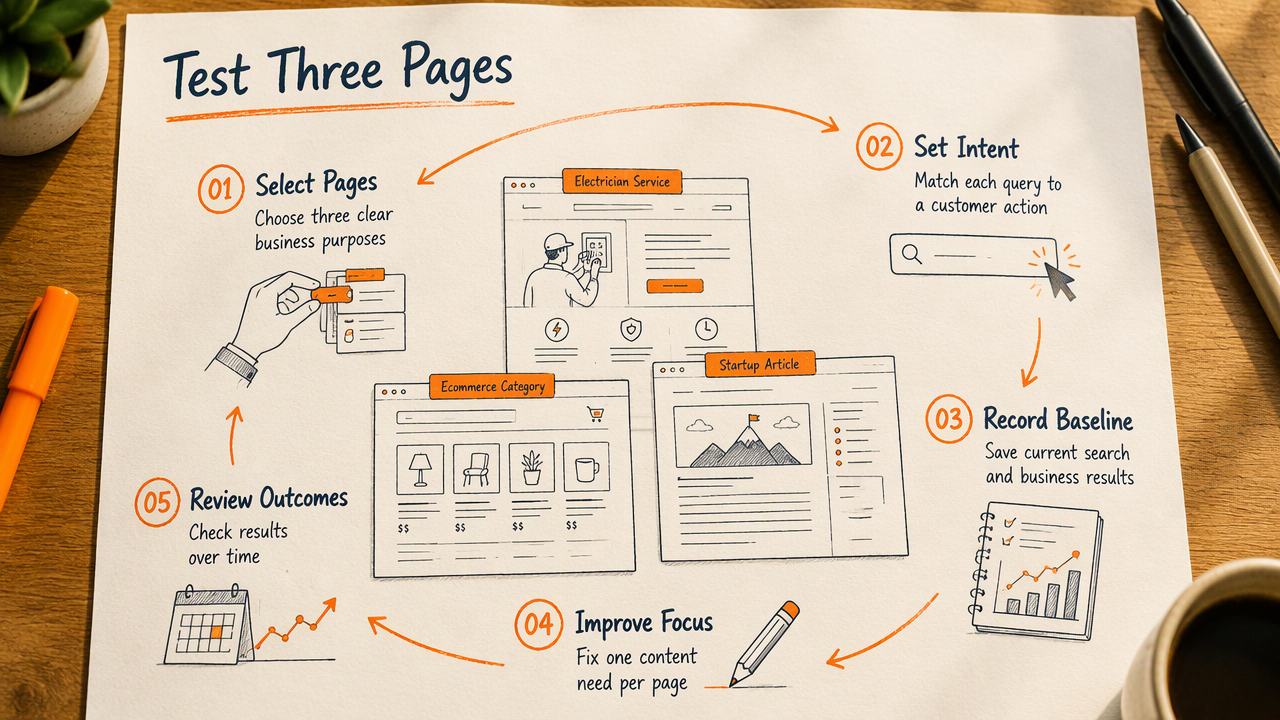
- Select three pages with clear business purposes.
- Define each page's query and customer action.
- Record existing performance.
- Apply focused content improvements.
- Review search and business outcomes over time.
Use page-specific changes and meaningful measures
A local electrician's service page might need a clearer service area and appointment process. An ecommerce category could need a concise buying guide. A startup article might need a direct definition before a detailed explanation.
Record the changed title, headings, answer sections, and internal links. Then review relevant search impressions, clicks, and customer actions. Avoid changing every major page element simultaneously if the business wants to understand which edits were useful.
A score can guide an editorial review, but it doesn't establish that a page answers the query or generates qualified enquiries.
What to watch as AI-assisted content develops
AI-assisted drafting and answer-engine visibility deserve attention in 2026, but foundational model research isn't a tool-performance benchmark. OpenAI's GPT-4 Technical Report and Touvron and colleagues' LLaMA: Open and Efficient Foundation Language Models, both from 2023, concern language models rather than small-business SEO results.
As tools develop toward 2027, buyers should prioritize inspectable sources, editable drafts, and clear approval steps. Concise definitions and useful comparisons make content easier to understand, but no format guarantees an AI citation.
Frequently asked questions about small-business content tools
Small-business content tool decisions usually depend on scope, budget, editorial capacity, and the difference between recommendations and measurable results.
Are free content optimization tools enough?
Free options can support a modest publishing workload when the team already understands its audience and can review recommendations. The important question is whether the available access covers the actual task. Current limits should be checked before relying on a tool for regular production; paid access makes sense only when it fills a defined gap.
Does a higher content score guarantee better rankings?
A higher content score doesn't guarantee better rankings. Scores reflect a tool's evaluation method, not a promise from a search engine. A page still needs to satisfy the search intent and provide accurate, useful information. Treat scores as prompts for review rather than targets that justify unnecessary wording or repeated keywords.
Can one platform replace an editor?
A platform can assist research, drafting, and revision, but the business still needs someone responsible for factual accuracy and final approval. Product specifications, service coverage, and commercial claims require particular care. A smaller team may combine software with editorial services rather than expecting automated suggestions to settle every publishing decision.
Should small businesses optimize existing pages first?
Existing pages are often a practical starting point because their purpose and performance can be reviewed before editing. Prioritize commercially relevant pages with identifiable content gaps. New articles remain useful when the site lacks an answer to an important customer question, but publishing more isn't automatically the better first move.
Conclusion
The best content optimization tools for small businesses fit a repeatable task and produce changes a team can apply. Select three existing pages, define their customer actions, and test one workflow before expanding the tool budget. For businesses seeking connected planning and editorial support, review Earlyseo at earlyseo.com and match the available services to the next publishing priority.