TL;DR
Give each language a crawlable URL, research local buying terms, and connect equivalent pages with reciprocal hreflang. Add country-specific versions only when the shopping experience differs, then test one category before expanding the catalog.
A translated storefront needs its own search strategy, not just new words. The most useful seo optimization tips for multilingual ecommerce connect language URLs, local buying intent, and consistent indexing signals.
Multilingual ecommerce SEO: The practice of optimizing an online store's language versions so search engines can discover them and shoppers can find relevant products.
For growing stores, a focused category rollout makes progress easier to measure. Earlyseo is a relevant option for teams planning multilingual search content alongside their broader ecommerce strategy.
Table of Contents
When should a store target languages versus countries?
Multilingual ecommerce SEO targets languages, while multiregional SEO targets countries or regions with different shopping requirements. A French-language page can serve several countries, but a France-specific storefront may need its own prices, delivery terms, and assortment. Separate country versions make sense when those differences justify distinct pages.
Language and country targeting compared
Language codes describe the intended audience's language; language-region codes narrow that audience to a region.
| Targeting choice | Example hreflang | Suitable use | Important distinction |
|---|---|---|---|
| English language | en |
Shared English storefront | Does not specify one country |
| French language | fr |
Shared French storefront | Can serve French speakers across countries |
| English in Britain | en-GB |
British delivery and pricing | Region code is GB, not UK |
| French in Canada | fr-CA |
Canadian French storefront | Language and region both matter |
Use a regional version when the business actually supports that market. A currency selector alone doesn't necessarily require a separate indexable storefront.
Choose an architecture the team can maintain
Stable language subdirectories such as /en/ and /fr/ offer a straightforward starting point on one domain. Subdomains and country domains can also work; the choice should reflect operational needs rather than an assumed ranking advantage.
Keep navigation, breadcrumbs, and category links within the selected locale. Language switches should lead to equivalent pages whenever available.
Language identifies how shoppers read; country targeting identifies which regional offer they receive.
For smaller catalogs, the small-store ecommerce SEO guide provides useful background before expanding the architecture.
How should language URLs, canonicals, and hreflang work?
- Give each translated page a stable, crawlable URL.
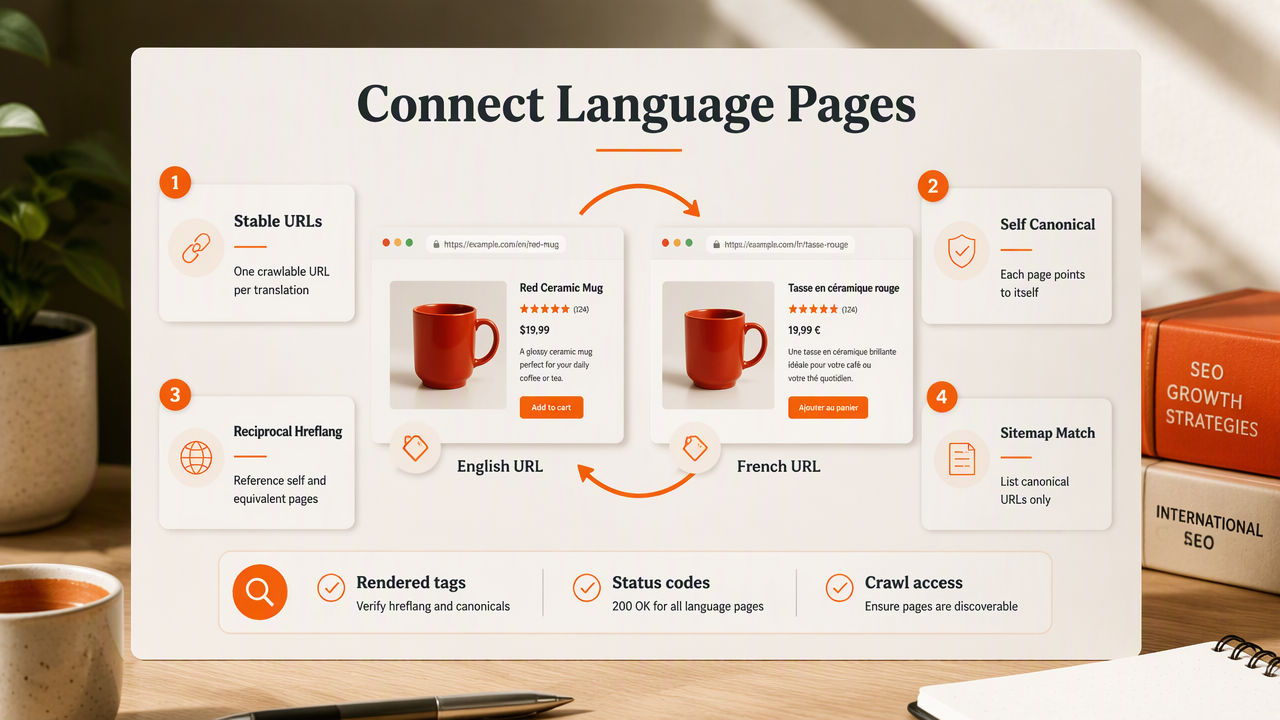
- Make each indexable language version self-canonical.
- Add hreflang references to itself and equivalent alternatives.
- Repeat the same alternate set across those pages.
- Keep sitemap entries aligned with canonical URLs.
- Test rendered tags, status codes, and crawl access before launch.
An annotated English and French product example
Each translated product page should identify its own canonical URL and both language alternatives.
On the English page at https://example.com/en/products/red-mug, the head might contain:
<link rel="canonical" href="https://example.com/en/products/red-mug">
<link rel="alternate" hreflang="en" href="https://example.com/en/products/red-mug">
<link rel="alternate" hreflang="fr" href="https://example.com/fr/produits/tasse-rouge">
The canonical identifies the preferred English URL. The alternate links identify corresponding English and French pages, not unrelated categories.
On the French page, the canonical becomes https://example.com/fr/produits/tasse-rouge. Both alternate links remain present, including the French self-reference. That return link makes the relationship reciprocal.
An optional x-default can identify a fallback page, such as a language selector. It doesn't replace language annotations or establish a default ranking preference.
Resolve conflicting signals before expanding
Canonicals and hreflang have different jobs: canonicals identify preferred URLs, while hreflang identifies language or regional alternatives. Pointing every translated canonical to English can undermine the intended indexing of those translations.
Check these conditions across product and category templates:
- Equivalent alternatives return successful responses and allow indexing.
- Hreflang URLs match the chosen canonical URLs.
- Every member includes the complete reciprocal alternate set.
- Internal links expose language pages without requiring cookies.
- Locale selection stays available without forced location redirects.
Avoid linking every product to a foreign-language homepage. Missing translations should be handled honestly rather than assigned an unrelated alternate.
How should product content match local search intent?
- Research category and product queries in each target language.
- Compare local search results to identify buying intent.
- Choose vocabulary that matches the product and market.
- Localize titles, descriptions, specifications, and shopping information.
- Have a fluent reviewer check meaning and commercial accuracy.
- Measure query relevance after publication.
Translate the buying decision, not just the sentence
Local keyword research should shape the page before translation begins. A British category might emphasize trainers, while an American version uses sneakers. Both need language that fits the actual assortment, not a mechanical replacement across every sentence.
Review the local results for each candidate phrase. A query dominated by buying guides may belong in editorial content, while category-focused results suggest a collection page.
Product localization should also cover dimensions, sizing, delivery restrictions, returns, and availability. These details answer purchase questions that a translated headline cannot.
Use customer language with editorial checks
Customer questions and reviews can suggest vocabulary worth investigating, but they aren't automatic keyword recommendations. The 2021 systematic review on text mining in services management examines that broader research area; it isn't a multilingual SEO ranking benchmark.
A practical content brief should record:
- Target locale and intended buyer.
- Primary query and natural related terms.
- Product facts that must remain unchanged.
- Local sizing, shipping, and return information.
- Approved terminology and reviewer sign-off.
The SEO content brief template offers a useful starting structure. Each locale still needs its own evidence and editorial decisions.
Build a measurable multilingual rollout
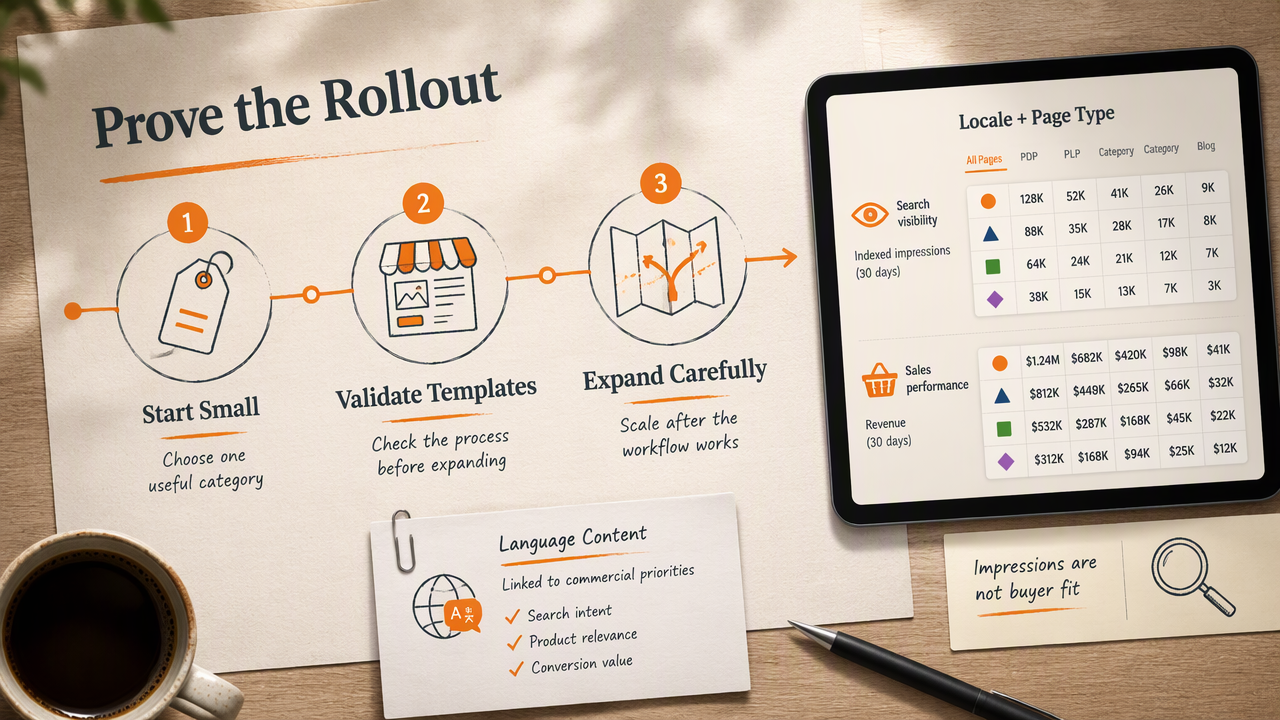
A multilingual rollout should start with one commercially useful category, validate its templates, and expand only after the process works. Separate results by locale and page type so teams can distinguish search visibility from sales performance. A translated page receiving impressions isn't necessarily attracting the right buyers.
How Earlyseo handles multilingual content planning
Earlyseo offers a dedicated multilingual SEO content feature for teams exploring language-specific content support. Its strongest fit here is the content workstream: organizing search-focused material around the store's target languages and commercial priorities.
A useful division of responsibility keeps keyword briefs and content review with marketing, while developers own URL routing, canonical templates, and hreflang implementation. Product specialists approve specifications and regional offers.
The SEO operations feature is also relevant when teams evaluate support for ongoing execution. Store-side validation remains a separate part of the rollout.
Measure the pilot and prepare for 2027
Market-level measurement should connect discovery with buying behavior. Google Search Console can help assess queries, clicks, indexing, and country patterns; store analytics can track landing-page purchases and revenue.
Use a pilot checklist:
- Record baseline performance for the selected category.
- Validate translated product and category templates.
- Monitor indexing and relevant local queries.
- Compare visits with purchases and product availability.
- Expand once editorial and technical checks are repeatable.
For 2027 planning, treat AI-assisted localization as an editorial workflow, not unattended publishing. Arugula's 2025 paper on prompt engineering in banking and ecommerce covers that application area; it doesn't establish multilingual ranking gains. Approved glossaries and human review remain sensible safeguards.
Multilingual ecommerce SEO FAQ
Multilingual ecommerce decisions work best when language, regional offers, and indexable URLs stay aligned.
Start with the smallest useful market rollout, then expand from validated templates and content.
Does every language version need a separate domain?
No. Language versions can use subdirectories on one domain, such as /en/ and /fr/. Separate domains or subdomains may suit particular business structures, but they aren't required for multilingual SEO. The practical priorities are stable URLs, accessible navigation, correct annotations, and a structure the team can maintain.
Should translated pages canonicalize to the original?
Usually not when each translation is intended to appear in search. An indexable translated page should generally identify its own preferred URL, while hreflang connects it to equivalents. Canonicalizing translations to the original can send conflicting signals about which pages should remain independently indexed. Genuine duplicate URLs need separate assessment.
Can AI translation replace local keyword research?
AI translation doesn't establish how local shoppers search or which page type satisfies their intent. It can support drafting, but keyword selection needs market-specific evidence. Fluent review should confirm product meaning, terminology, and purchase information before publication. The useful goal is accurate localized content, not simply a larger number of translated pages.
Conclusion
The next step is a one-category pilot with a defined locale, approved keyword brief, self-canonical URLs, and tested reciprocal hreflang. Marketing and development teams should review indexing and purchases before expanding. Teams evaluating Earlyseo for multilingual content planning can visit earlyseo.com and scope that first category around a real regional sales opportunity.