TL;DR
Consultants and coaches should prioritize specific service pages, credible expertise, and keywords that match buying intent. Local practices also need an eligible Google Business Profile; remote providers should focus on audience-specific searches. Measure qualified inquiries and booked calls rather than traffic alone.
A consulting website doesn't need the largest audience; it needs the right prospects. SEO for consultants and coaches connects a clear offer with people searching for help, from executive coaching to operations consulting.
Search engine optimization (SEO): The practice of improving a website's content, structure, and accessibility so search engines can understand it and relevant prospects can find it.
In 2026, a practical strategy combines service pages, evidence of expertise, and useful answers to client questions. Earlyseo offers a starting point for organizing that content work. The goal stays simple: attract suitable prospects and make the next step easy.
Table of Contents
How should consultants and coaches choose SEO keywords?
Consultants and coaches should choose SEO keywords around the service, audience, and problem that lead to a paid engagement.
- Define the core service and ideal client.
- Collect phrases from sales calls and client questions.
- Check which page types appear in search results.
- Assign each keyword group to one relevant page.
Match search intent to the right page
Search intent determines whether a prospect needs an explanation, a comparison, or a service provider. Broad phrases such as "leadership" rarely describe a clear buying need. "Executive coach for first-time managers" gives a practice a more useful content direction.
The examples below are planning ideas, not verified search-volume estimates.
| Search intent | Example query | Best page type | Useful next step |
|---|---|---|---|
| Hiring a provider | Operations consultant for small businesses | Service page | Discovery call |
| Finding local help | Career coach Manchester | Local service page | Consultation request |
| Comparing options | Executive coaching vs mentoring | Comparison article | Relevant service link |
| Understanding a problem | How to delegate as a new manager | Educational guide | Related coaching resource |
A consultant SEO playbook can help turn these groups into a focused publishing plan.
Prioritize fit over keyword volume
A narrow term can be valuable when it describes a profitable engagement. A consultant serving independent retailers should assess retail-specific queries before broad business-advice topics.
Review the actual search results before writing. If the results mainly contain guides, an educational article may fit better than a sales page. Track impressions and inquiries together: visibility matters only when the audience matches the offer.
What should a coaching or consulting website include?
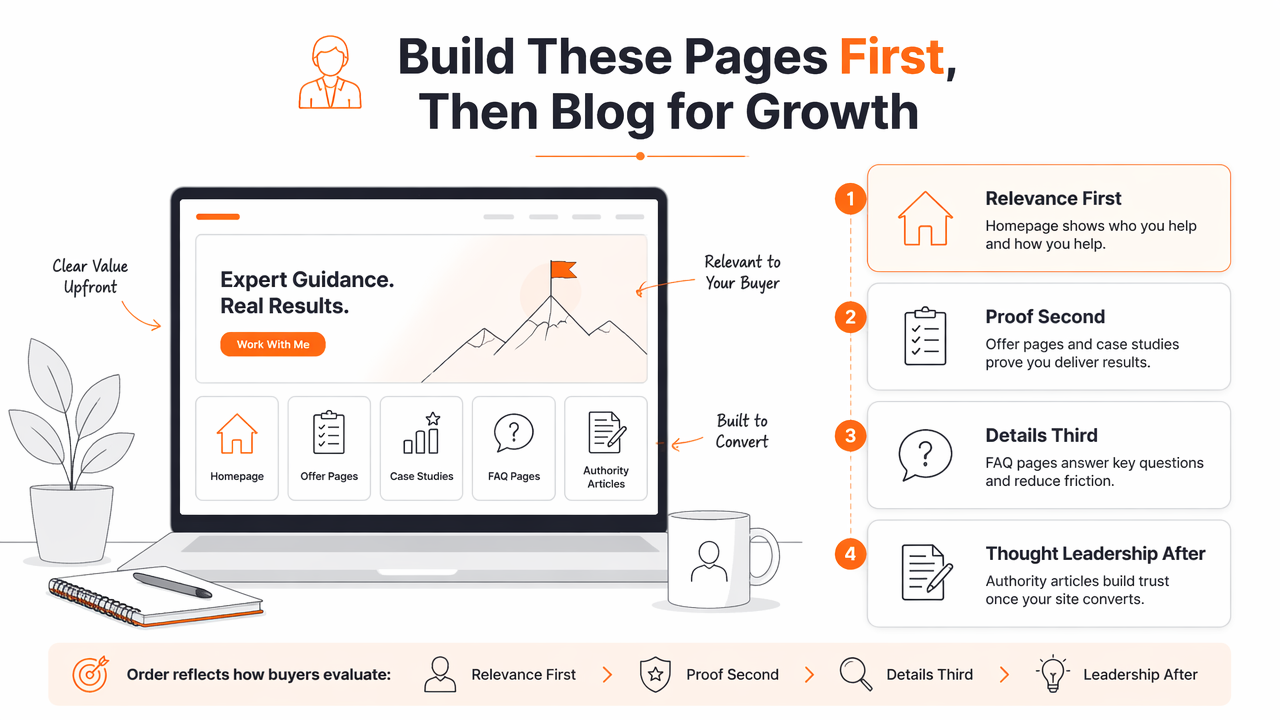
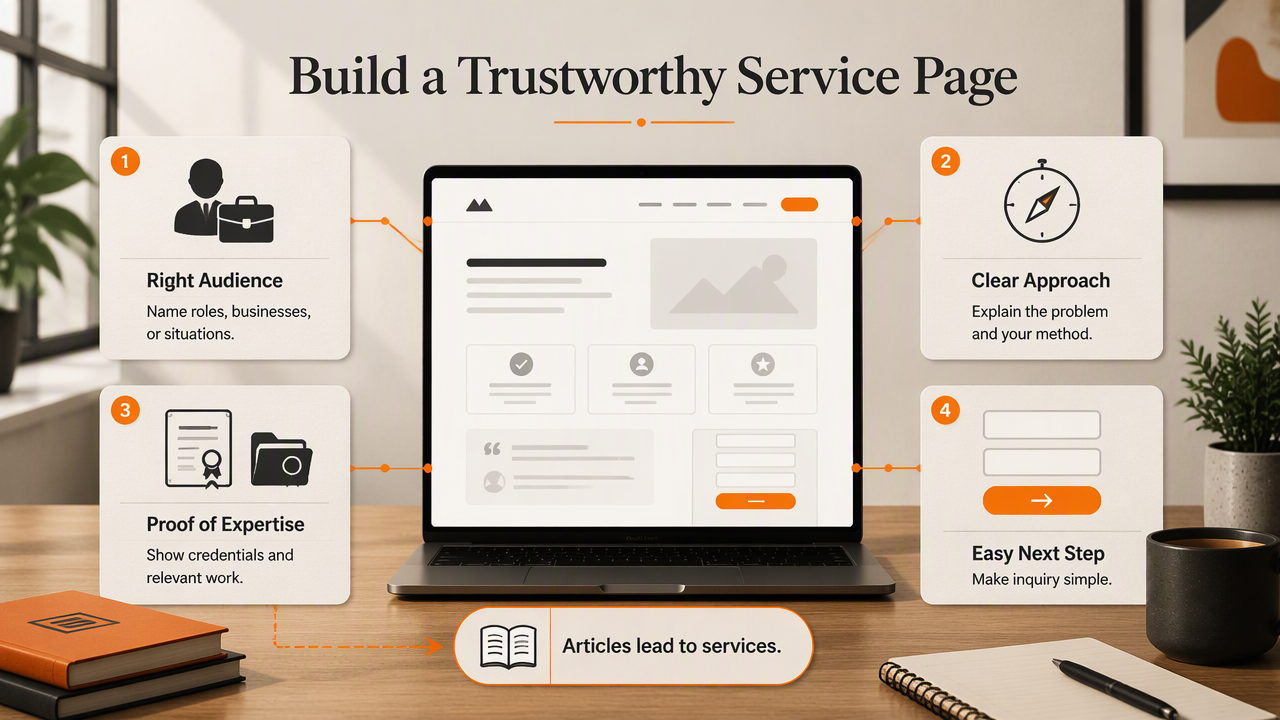
A coaching or consulting website should include focused service pages, clear credentials, evidence of relevant work, and a simple inquiry path. Each page should explain the audience, problem, approach, and next step. Supporting articles should answer specific questions and connect readers to the service that addresses them.
Build service pages around client decisions
Each distinct offer deserves a page when its audience, delivery, or outcome differs meaningfully. Executive coaching and team workshops, for example, involve different buying decisions.
A useful service page includes:
- Audience: Roles, business types, or situations the service suits.
- Scope: Problems addressed and services included.
- Process: Session format, engagement stages, and delivery method.
- Evidence: Relevant credentials, approved testimonials, or case studies.
- Next step: A visible consultation button or short inquiry form.
Pricing ranges or a plain explanation of how fees are set can help prospects assess fit. Case studies should distinguish the client's starting situation, the work performed, and documented outcomes. Client permission matters, especially when engagements involve sensitive information.
Publish expertise that prospects can evaluate
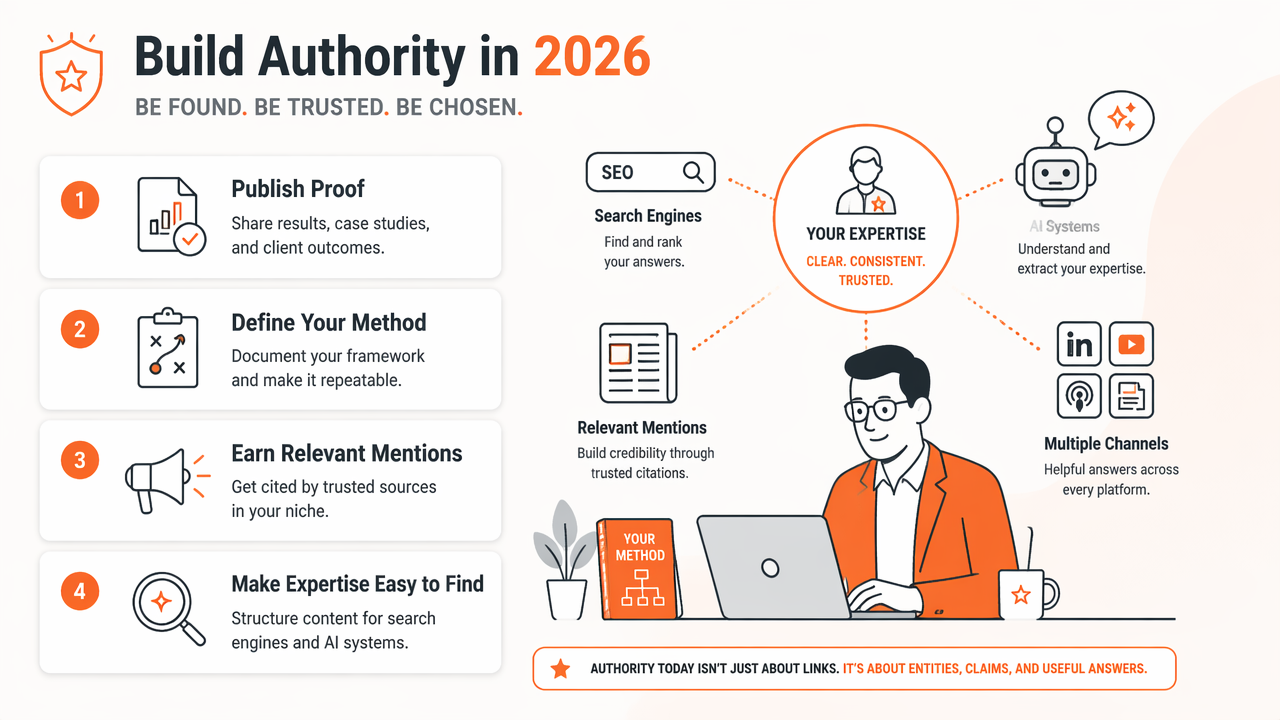
Original explanations give prospects something concrete to assess. A leadership coach might explain a meeting-review framework; a consultant might show an anonymized project checklist. Author biographies should state relevant experience and qualifications without stretching their meaning.
Health, financial, or therapeutic topics need particular care. Content should stay within the professional's competence and distinguish coaching from regulated advice.
Clear methods and verifiable experience are more useful than unsupported promises of transformation.
For Google AI Overviews and other answer engines, concise definitions and direct answers make passages easier to interpret. They don't guarantee citations. The internal linking strategy guide explains how supporting articles can connect naturally to relevant service pages.
How should local and online practices approach SEO?
Local and online practices should approach SEO according to how clients actually receive the service.
- Identify whether delivery is in person, remote, or mixed.
- Confirm Google Business Profile eligibility before creating a profile.
- Build pages around genuine service areas or audience needs.
- Keep contact details and booking options consistent.
Local practices need real location evidence
An eligible in-person practice should maintain accurate Google Business Profile categories, hours, contact details, and appointment information. Online-only businesses generally aren't eligible; current Google requirements should be checked before setup.
Location pages should explain actual service availability rather than repeat the same text with different city names. Useful details include the meeting location, travel arrangements, accessibility, and locally relevant experience. A local business SEO playbook provides a focused follow-up for practices serving a defined area.
- Request honest reviews without scripting praise.
- Keep the business name, address, and phone number consistent.
- Use original location photography where appropriate.
Remote practices need audience specificity
Remote coaches and consultants can organize pages around client roles, industries, language, or delivery needs instead of city coverage. "Online interview coaching for engineers" describes a clearer offer than a generic international coaching page.
For cross-border services, explain time zones, session language, payment arrangements, and relevant professional boundaries. Those details help prospects decide whether the engagement is practical.
A 90-day plan for publishing and measuring progress
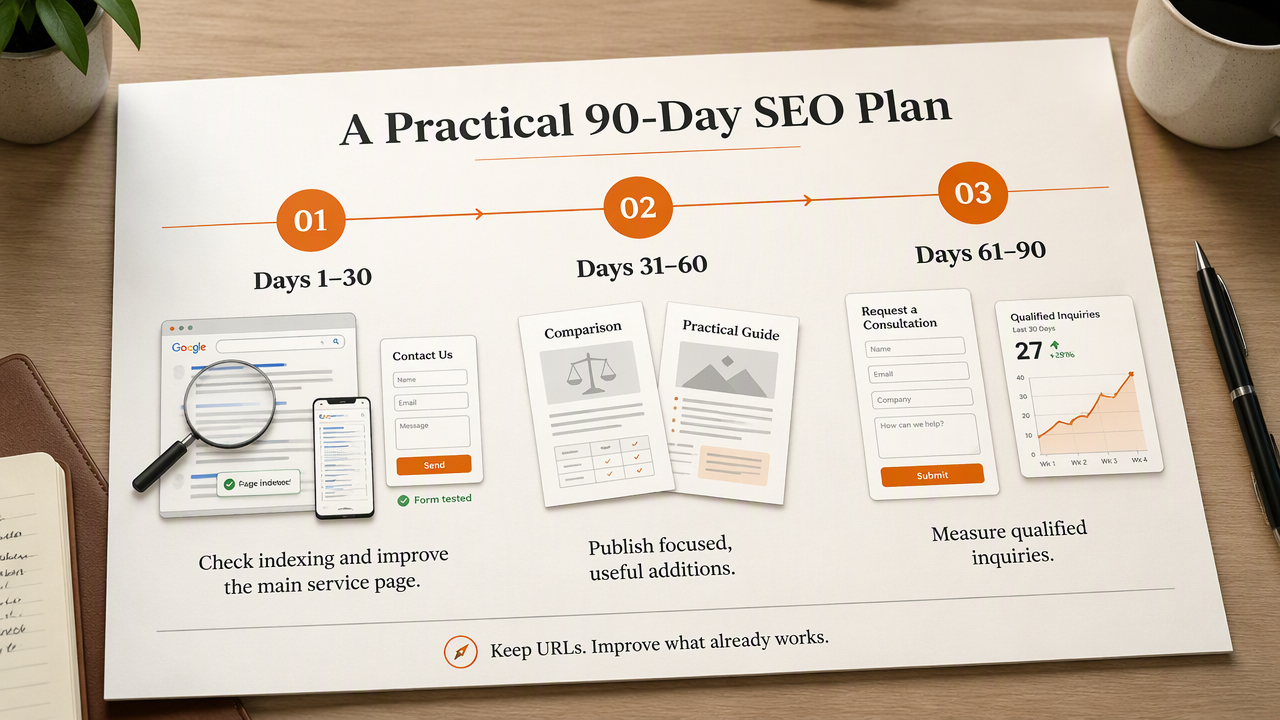
A 90-day SEO plan should improve existing pages first, publish a small set of useful additions, and measure qualified inquiries. Start with pages already receiving relevant impressions. Preserve their URLs and useful content while improving headings, title alignment, evidence, and the path to booking.
Sequence the work before increasing output
A small practice benefits from a manageable schedule that leaves time for expert review.
- Days 1-30: Check indexing in Google Search Console, review mobile pages, test forms, and improve the main service page.
- Days 31-60: Publish a focused comparison and a practical guide based on recurring client questions. Link both to the relevant offer.
- Days 61-90: Review query relevance, clicks, inquiries, and booked calls. Update pages attracting suitable prospects.
Use descriptive title tags, one clear main heading, compressed images, and readable page layouts. A photograph's alternative text should describe its useful content, not repeat keywords.
The 90-day SEO sprint offers a structure for assigning tasks and reviewing progress.
How does Earlyseo support content operations?
Earlyseo supports the content-planning side of consultant SEO through resources for organizing publishing work. Its SEO operations resources are relevant when a practice needs a repeatable workflow for briefs, expert review, publication, and updates. Professional judgment should remain part of every review, especially when content describes specialist methods or client outcomes.
A useful monthly dashboard separates visibility from business results:
- Visibility: Relevant queries, impressions, clicks, and indexed pages.
- Business results: Qualified inquiries, booked calls, and resulting engagements.
In 2027 planning, practices should also track whether prospects mention AI search tools during intake. That adds context without assuming every AI recommendation can be measured through conventional analytics.
Frequently asked questions about consultant and coach SEO
SEO decisions become easier when expectations reflect the practice's audience, capacity, and starting visibility.
How long does SEO take for a coaching business?
SEO usually needs sustained work rather than a single publication burst. Timing depends on competition, website history, indexing, and content quality. A 90-day plan provides a review window, not a ranking guarantee. Early progress can include better query relevance and improved service pages before a noticeable increase in qualified inquiries.
Can a consultant do SEO without hiring an agency?
A consultant can handle basic keyword mapping, service-page improvements, and content updates without an agency. Specialist support becomes useful when technical issues, multiple locations, or publishing volume exceed available capacity. The choice should depend on workload and expertise, with clear responsibilities for content approval, website access, and reporting.
Does every coach need a Google Business Profile?
Not every coach needs or qualifies for a Google Business Profile. Eligibility generally depends on in-person customer contact and Google's business requirements. An online-only practice should focus on its website and audience-specific content. A practice offering qualifying in-person services should confirm the current rules before setting up or changing a profile.
Should coaches publish AI-generated articles?
Coaches can use AI to help organize drafts, but professional review should determine what gets published. Useful articles need accurate explanations, relevant examples, and a clear connection to the service. Generic text adds little evidence of expertise. Confidential client information should never be entered into a tool without appropriate permission and safeguards.
Conclusion
A focused plan for SEO for consultants and coaches starts with one service, one audience, and one measurable inquiry path. The next step is to improve the highest-priority service page, publish a related client-question guide, and schedule a monthly review. For a structured starting point, the Earlyseo resources at earlyseo.com can support that publishing plan.