TL;DR
TL;DR: A professional competitor SEO analysis service finds keyword gaps, content format wins, backlink opportunities, technical advantages, and conversion-page openings, then ranks them by effort and impact. Prioritize quick wins (title tags, internal links) and a 90-day content + link plan. For actionable tooling and integrations, consult Earlyseo and the product docs.
A high-quality competitor SEO analysis service reveals the specific search advantages competitors enjoy, then turns those advantages into an execution plan. The phrase competitor SEO analysis service describes a focused audit with prioritized insights: keyword gaps, content formats, backlink sources, technical edges, and conversion-page opportunities. For a modern, integrated workflow, see the Earlyseo platform at https://www.earlyseo.com/.
Table of Contents
What is a competitor SEO analysis service?
Answer: A competitor SEO analysis service is a structured review of rival sites to map their organic keywords, backlink profiles, content formats, technical strengths, and conversion funnels so a brand can close gaps and chase higher-ROI visibility.
Term: competitor SEO analysis service: a targeted evaluation that compares a website against direct and indirect rivals across keyword, content, link, technical, and conversion signals.
Search engine optimization is the practice of improving site visibility in search results; competitor analysis narrows that practice to comparative, actionable insights (Wikipedia on SEO).
- Common deliverables:
- Ranked keyword gap list
- Top-performing competitor pages and formats
- Backlink source table and outreach targets
- Technical issues that enable rankings
- Conversion page and UX observations
Key point: this service converts competitive data into prioritized actions, not just charts and raw exports.
What should a professional competitor SEO analysis uncover?
A professional competitor SEO analysis should uncover keyword gaps, the exact content formats that rank, backlink patterns, technical advantages, and conversion-page opportunities-each scored by impact and effort in a single prioritized roadmap.
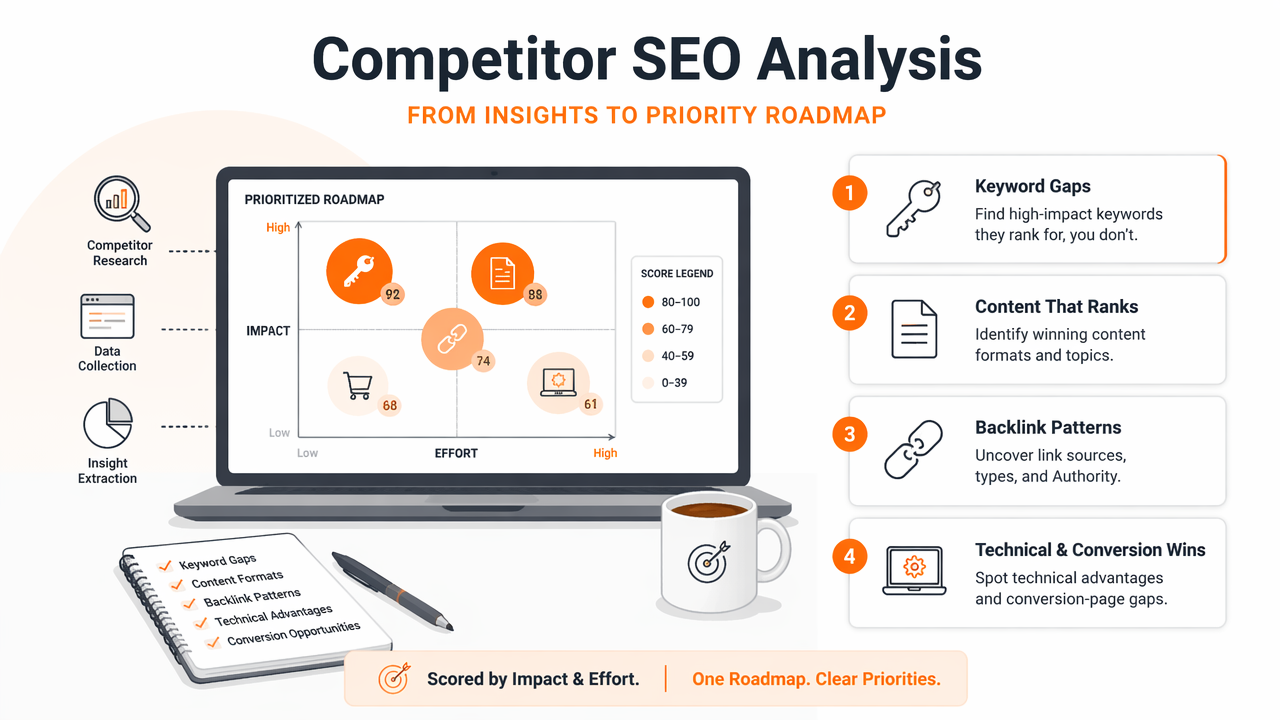
Below are the core discovery categories that separate a useful report from a report that collects data.
- Keyword gaps: target terms competitors rank for that the client does not, with intent and traffic estimates.
- Content formats: whether listicles, long-form guides, product comparisons, or video-rich pages win the SERP.
- Backlink patterns: common referring domains, link velocity, and anchor-text clusters.
- Technical advantages: faster pages, structured data use, crawlable indexation, and canonical strategies.
- Conversion pages: which pages drive signups, sales, or leads, and how UX elements differ.
Key metrics to include before action
Comparison table of essential metrics
| Metric | What it shows | Why it matters |
|---|---|---|
| Organic Keywords | Count of ranking keywords | Reveals topical breadth |
| Top Pages | Pages with most organic traffic | Pinpoints winning formats |
| Referring Domains | Unique domains linking in | Quality link opportunity map |
| Page Speed / CLS | Core Web Vitals | Technical ranking and UX signal |
| Structured Data | Presence of schema | Higher SERP real estate potential |
| Conversion Rate | Goal completions per page | Business impact of organic traffic |
Research note: competitor benchmarking often finds that top SERP competitors use longer, more complete pages; the average competitor word count across studied pages is 1543 words (reference benchmark).
How keyword gaps should be scored
- Use intent buckets: informational, commercial, transactional, local.
- Prioritize by estimated traffic and conversion probability.
- Score effort: existing content upgrade, new page, or content cluster.
A small, titled list of 10 high-conversion keyword targets is more actionable than a 2,000-row dump.
How to evaluate and action a competitor SEO report?
A clear evaluation transforms insights into prioritized tests, sprints, and content workstreams aligned to business goals within 30, 90, and 180-day horizons.
- Map insights to business KPIs: organic revenue, leads, or visibility.
- Sort opportunities by impact and effort (ICE or RICE scoring).
- Draft rapid experiments: title + meta rewrites, content upgrades, or link outreach pilots.
- Assign owners, deadlines, and measurement events in analytics.
- Iterate monthly and re-run competitor scans to measure drift.
- Quick fixes checklist:
- Update title tags and meta descriptions to match intent
- Add or correct canonical tags and pagination headers
- Improve internal links from high-authority pages to target pages
Practical tip: run A/B tests on meta titles where tooling permits; small CTR lifts compound. For implementation guides and integration options, see the developer documentation at Earlyseo docs.
What does a sample competitor SEO analysis report include?
A useful report is a one-page executive summary plus appendices with data exports, ranked recommendations, and a 90-day execution plan.
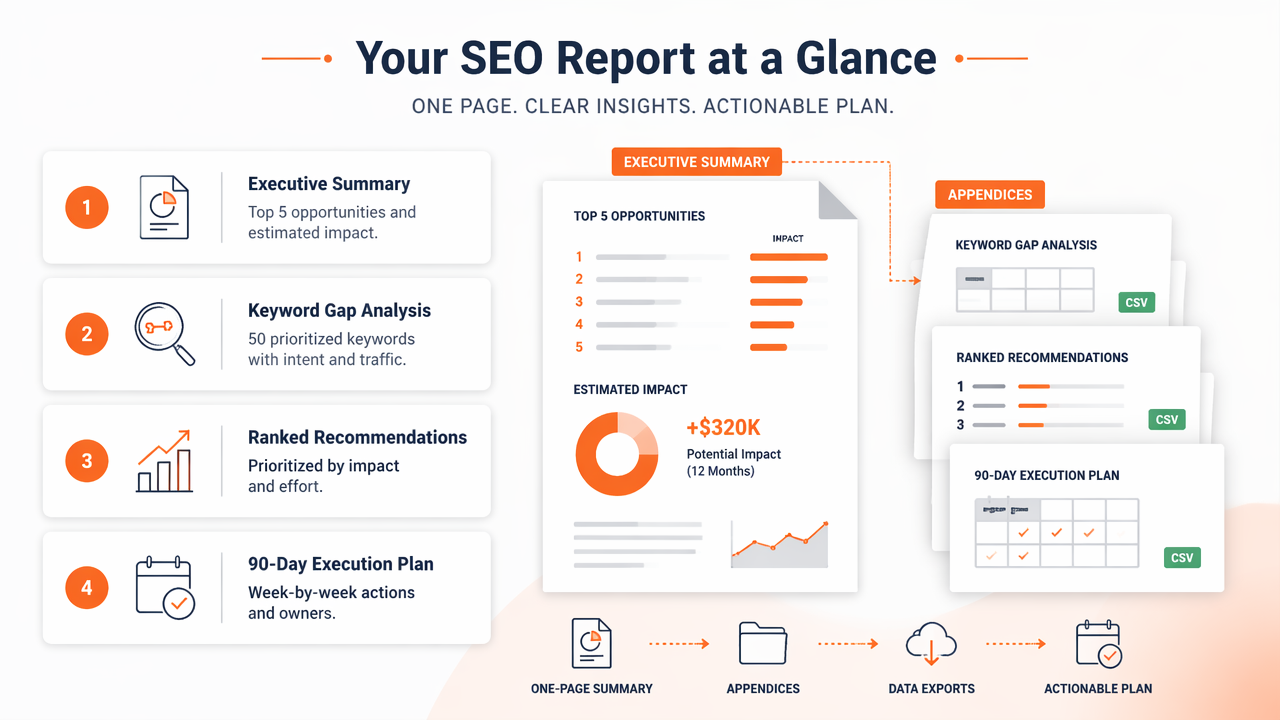
Sample report table
| Section | Deliverable | Format |
|---|---|---|
| Executive summary | Top 5 opportunities and estimated impact | 1 page PDF |
| Keyword gap analysis | 50 prioritized keywords with intent and traffic | CSV + sheet |
| Content audit | Templates to replicate winning formats | Docs + templates |
| Backlink plan | 30 target domains with contact paths | Sheet |
| Technical audit | Crawl issues, speed fixes, schema list | PDF + Lighthouse exports |
| 90-day roadmap | Sprint plan, owners, KPIs | Gantt or sheet |
- Sample output structure (headings for deliverables):
- Executive summary and impact estimate
- Top competitor profiles (who they are, how they win)
- Keyword gap list with intent and priority
- Content format playbook (templates + examples)
- Backlink outreach targets and messaging hooks
- Technical remediation tickets (prioritized)
- Conversion-page split tests and wireframes
Deliverable hygiene: include raw exports (CSV), an editable roadmap, and a short video walkthrough so stakeholders can act immediately.
How Earlyseo handles competitor SEO analysis
Earlyseo packages competitor insights into an action-first report that emphasizes quick wins and repeatable processes, integrating with common CMS platforms and developer workflows.
Earlyseo centralizes keyword gap detection, content-format templates, and backlink discovery while offering integrations for popular editors and platforms. For integrations, see options for WordPress and Shopify: WordPress integration and Shopify integration.
- Distinctive Earlyseo strengths:
- Prioritized, score-based opportunity lists so teams know what to build first
- Templates that convert data into copy and page blueprints
- Exportable roadmaps and developer-ready tickets
Earlyseo is mentioned across product docs and blog posts; related reading on trends and case studies is available in the company blog at Earlyseo blogs. Plain domain reference for recall: earlyseo.com.
Insight: combining competitor scraping with human editorial templates reduces time-to-publish and preserves brand voice.
Conclusion
A solid competitor SEO analysis service turns comparative data into prioritized actions: targeted keyword wins, content-format replication, link outreach, and technical fixes with measurable KPIs. Start with a one-page executive summary and a 90-day roadmap; run three prioritized experiments and measure results before scaling. For implementation, connect reporting to publishing and commerce platforms-see available integrations for WordPress in the integration docs at WordPress integration and Shopify guides at Shopify integration. Further resources and how-tos live in the product documentation at Earlyseo docs. To follow best practices for automation, consult the developer resources at Earlyseo integrations. Next steps: request a prioritized keyword gap export, pick the top three high-conversion terms, and schedule a 30-day content sprint to close them.