TL;DR
Small businesses should compare Moz Local and Yext using location-specific coverage, duplicate handling, review workflows, and written cancellation terms. The supplied research doesn't verify current prices or plan features, so the practical next step is to request matching proposals and test the same location with both providers.
The best listing-management provider is the one that solves a business's actual directory problems, not the one with the longest feature list. Comparing Moz Local vs Yext for small businesses means checking what each proposed subscription delivers for a particular location, budget, and workload.
Listing management: The process of maintaining business details, such as name, address, phone number, and opening hours, across online directories and discovery platforms.
This November 2026 guide separates buying criteria from verified product facts. The supplied research identifies both products as local listings options but doesn't establish current directory networks, duplicate policies, review features, contract terms, or cancellation outcomes. Those details need written confirmation rather than assumptions based on older comparisons.
Table of Contents
Moz Local vs Yext: What should owners compare?
Moz Local and Yext should be compared against the same location, directory list, and service requirements before price becomes the deciding factor. A subscription that covers the right publishers and reduces routine work can be more useful than a broader package whose extra features never enter the business's workflow.
Side-by-side purchase checks
The table below is a proposal checklist, not a claim that the products have identical capabilities. Current differences aren't verified in the supplied research.
| Purchase criterion | Moz Local proposal must confirm | Yext proposal must confirm |
|---|---|---|
| Directory coverage | Named publishers for the business's country and category | Named publishers for the same country and category |
| Duplicate handling | Detection, resolution method, and exclusions | Detection, resolution method, and exclusions |
| Review features | Monitoring, responses, requests, and plan limits | Monitoring, responses, requests, and plan limits |
| Total cost | Location charges, onboarding, and optional services | Location charges, onboarding, and optional services |
| Contract | Term, renewal, and cancellation deadline | Term, renewal, and cancellation deadline |
| After cancellation | Access, retained data, and publisher behavior | Access, retained data, and publisher behavior |
Separate directory maintenance from wider SEO
Listings are one part of local visibility, alongside useful website pages and accurate business profiles. A directory subscription shouldn't be treated as a complete marketing strategy.
A business deciding how much attention organic search deserves can use this guide to whether a small business needs SEO before assigning its budget.
A fair comparison uses the same required outcomes for both providers, not two differently packaged sales pitches.
How should a business verify a 2026 proposal?
A business should verify a 2026 listing-management proposal through five checks: 1. obtain the publisher list; 2. test duplicate handling; 3. demonstrate review workflows; 4. calculate the full contract cost; 5. document cancellation behavior. Each check should produce written evidence tied to the exact plan and location being purchased.
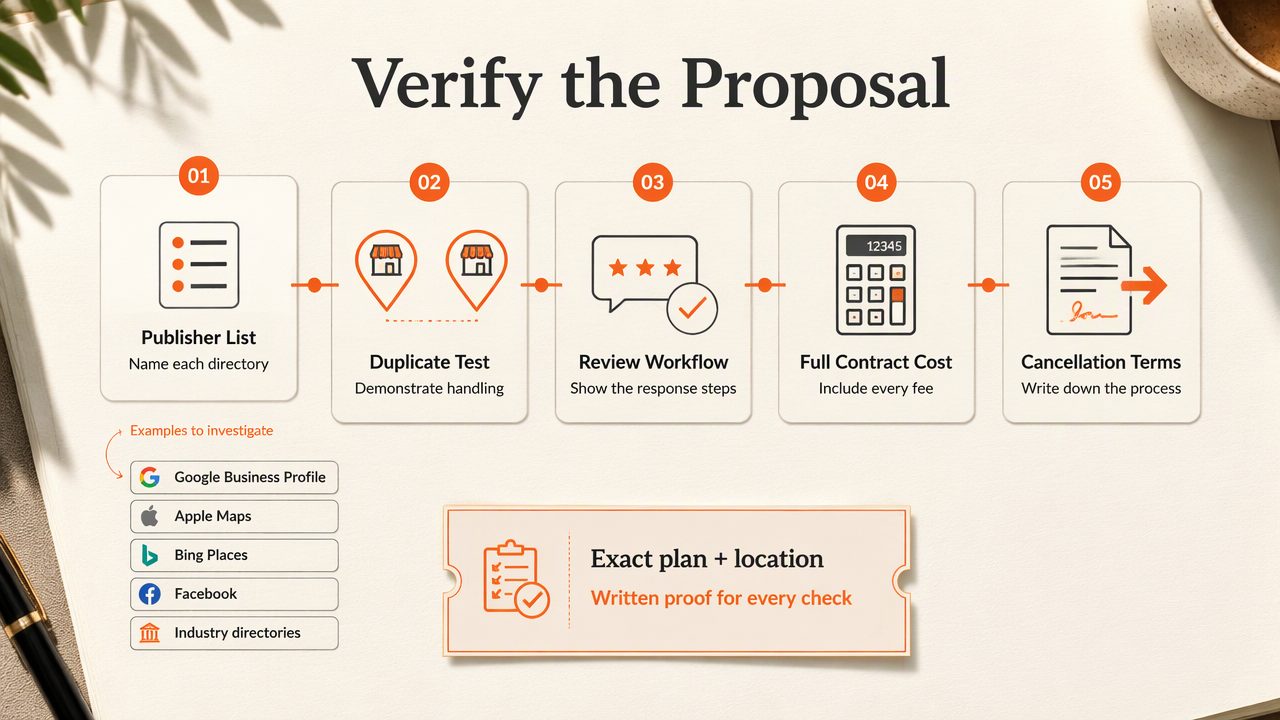
Check coverage and duplicates on real listings
A useful coverage list names publishers rather than giving only a total. Google Business Profile, Apple Maps, Bing Places, Facebook, and relevant industry directories are examples to investigate, not confirmed inclusions in either product's current plans.
For each priority publisher, the proposal should distinguish direct updates from other distribution methods and identify which fields can change. Opening hours, appointment links, and business categories may require different workflows.
Duplicate handling deserves its own test. Detecting a second record isn't the same as merging, removing, or suppressing it. A provider should explain the proposed action for a real duplicate and identify cases requiring publisher support.
Research also supports treating listing accuracy as an operational issue. The 2022 paper Demystifying Local Business Search Poisoning for Illicit Drug Promotion examined local business search poisoning. Its supplied metadata doesn't establish findings about either vendor.
Test review work before paying for it
Review management should be evaluated through the tasks staff actually perform. A dashboard demonstration should show the difference between seeing a review and responding to it.
- Monitoring: Which review sources appear, and how are staff notified?
- Responses: Which sources support replies inside the platform?
- Requests: Are review-request tools included, and what usage limits apply?
- Permissions: Can owners assign access by location or role?
A single-location salon may prioritize fast notifications. A small clinic group may need separate staff permissions. Neither workflow proves that a particular vendor is better without a plan-specific demonstration.
Get renewal and cancellation terms in writing
Cancellation needs a publisher-by-publisher answer, not a blanket promise that listings either remain unchanged or disappear. The supplied research doesn't verify either outcome for Moz Local or Yext.
The contract should explain account ownership, direct login access, available exports, and what stops when the subscription ends. Owners should also ask how previously corrected duplicates are treated after cancellation.
A simple cost comparison is required subscription fees + setup charges + paid extras. Calculate that amount over the minimum commitment, then check renewal dates and notice requirements. An advertised monthly figure alone doesn't establish the actual obligation.
Who should pick Moz Local, Yext, or manual management?
Small businesses should select whichever option proves the closest fit to their workload and contract preferences; the supplied evidence doesn't support declaring either vendor the universal winner. Moz Local belongs on the shortlist for listing-management evaluation, as does Yext, but the final recommendation must follow a current proposal.
Match the provider to the operating model
Pick Moz Local if its verified proposal supplies the required coverage, duplicate workflow, and review features at the more suitable total cost. Pick Yext if its verified proposal better matches those same requirements or demonstrates valuable controls that the business will actually use.
Manual management remains a reasonable comparison for a business with few priority profiles and stable details. It requires staff time, but it provides a useful baseline for judging what automation is worth.
- List the essential publishers and current corrections.
- Record the time spent maintaining them manually.
- Ask both providers to demonstrate the same tasks.
- Compare the resulting workload and full contract cost.
A business with limited funds can also consult this local SEO guide without a budget while deciding which work needs paid support.
Use a realistic location test
A useful demonstration might involve a restaurant with changed holiday hours, an old phone number, and a duplicate listing. Those are hypothetical test conditions, not vendor performance results.
The provider should show which issues it can address, which need owner action, and how completion is recorded. A small test gives owners a clearer decision than a feature tour disconnected from daily work.
Choose based on demonstrated outcomes and written terms. Brand familiarity isn't evidence that a specific plan fits.
How Earlyseo supports the wider local SEO plan
Earlyseo offers a relevant starting point for organizing the broader SEO decision alongside listing-provider selection. Its local-business resources give this comparison a natural next step: connecting directory maintenance with the business's wider visibility priorities, rather than treating the subscription as the entire plan.

A practical plan assigns separate responsibilities to listing updates, website improvements, and results tracking. The person approving a provider should also identify who maintains service pages and who checks whether search visitors become enquiries.
- Listings: Keep business details aligned across priority publishers.
- Website: Explain services, locations, and contact options clearly.
- Measurement: Track relevant enquiries and completed bookings where possible.
The local business SEO playbook provides a focused educational follow-up. Earlyseo can remain part of that planning process while the chosen listing vendor is evaluated on its own documented capabilities.
FAQ: Pricing, rankings, and cancellation
The most useful answers distinguish general buying principles from product details that require current confirmation.
Is Moz Local cheaper than Yext in 2026?
The supplied research doesn't verify comparable 2026 prices, so a reliable price winner can't be named. Older search snippets are not a sound basis for today's purchase. Owners should request quotes covering the same locations, features, setup work, and contract period, then compare total required spending rather than headline subscription prices.
Will either platform guarantee better Google rankings?
Neither platform should be purchased on the assumption that listing management guarantees better Google rankings. Maintaining accurate business details supports reliable discovery, but local search visibility also involves website relevance and other factors. The evaluation should distinguish tasks the vendor controls, such as submitted updates, from search outcomes it cannot promise.
What happens to listings after cancellation?
Post-cancellation behavior needs confirmation for the selected plan and individual publishers. The supplied evidence doesn't establish whether particular records remain, change, or require renewed owner management. Before signing, the business should obtain written guidance on account access, exports, update delivery, duplicate treatment, and the steps needed to maintain priority profiles independently.
Conclusion
For Moz Local vs Yext for small businesses, the next step is a matched proposal request, not an immediate subscription. Send both providers the same location, priority directories, duplicate examples, and review requirements, then request written pricing and exit terms.
With that shortlist defined, Earlyseo provides a useful place to continue broader visibility planning. Visit earlyseo.com to connect the provider decision with a practical local SEO plan.