TL;DR
Choose a one-time SEO consultation for a defined decision and ongoing coaching for repeated feedback while a team learns and implements. Neither normally includes execution, so the buying decision should start with a named task owner, a clear scope, and an agreed review point.
A business can need ongoing SEO work without needing ongoing SEO coaching. The choice between one time seo advice vs ongoing seo coaching depends on how often decisions arise, who implements recommendations, and how much feedback that person needs.
One-time SEO advice: A bounded consultation that answers a specific question or produces a prioritized plan.
Ongoing SEO coaching: Recurring guidance that helps a business apply recommendations, review progress, and develop SEO skills.
For teams building a repeatable content process, Earlyseo offers a relevant platform to consider alongside expert guidance. The buying decision starts with separating advice, learning, and execution.
Table of Contents
One-time advice vs ongoing coaching: the comparison
A focused consultation buys direction for a defined problem; ongoing coaching buys repeated feedback as a team puts that direction into practice.
Neither arrangement should be confused with an agency implementation retainer. Unless the agreement explicitly includes delivery, the business still owns writing, publishing, technical changes, and measurement. Actual packages vary, so the contract matters more than the service label.
Deliverables, workload, and follow-up at a glance
| Buying factor | One-time consultation | Ongoing coaching |
|---|---|---|
| Core purpose | Resolve a bounded question | Improve decisions and skills over time |
| Typical deliverables | Review, recommendations, prioritized action plan | Recurring sessions, task reviews, updated priorities |
| Owner workload | Carry out the plan independently | Carry out tasks between meetings |
| Follow-up support | Limited to the agreed window | Available at the agreed cadence |
| Best fit | Clear scope and capable implementer | Active team needing regular feedback |
| Cost structure | Usually a defined project or session fee | Usually recurring payments |
| Execution gap | Remains unless delivery is included | Remains unless delivery is included |
Advice is a purchase; maintenance is a responsibility
A consultation can be complete even though SEO work continues. For example, a specialist might assess category-page priorities, explain the reasoning, and hand over a plan. The store team can then implement and monitor that plan without buying weekly coaching.
Coaching makes more sense when new questions emerge during implementation. A marketing manager learning to judge search intent may benefit from reviewing successive briefs rather than receiving a single finished document.
The useful comparison isn't one payment versus many payments. It's independent implementation versus guided implementation.
Who should pick which SEO support model?
Businesses with a narrow question and an experienced implementer should favor one-time advice; teams developing SEO judgment should consider coaching.
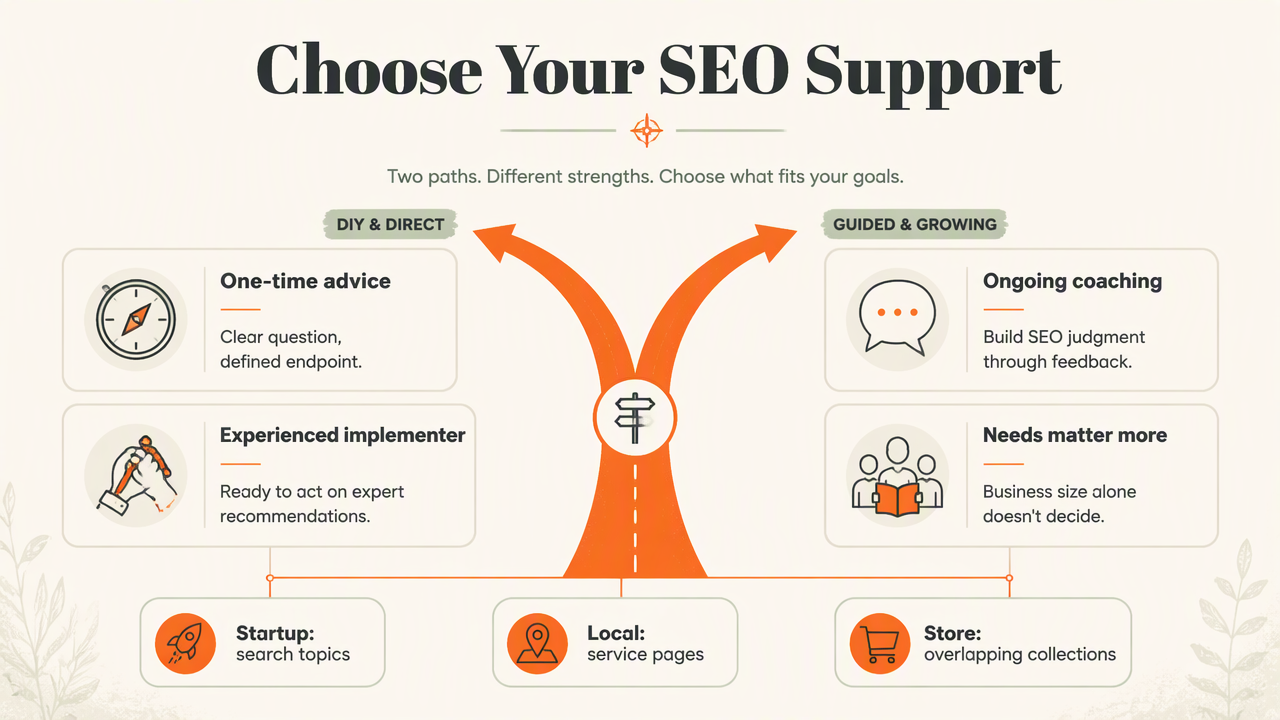
Business size alone doesn't decide the answer. A solo founder with publishing experience may need less guidance than an established company assigning SEO to a new marketing hire.
Choose a consultation for a bounded decision
A focused engagement fits questions with a clear endpoint:
- Startup: Which search topics deserve attention before the next product launch?
- Local business: Which service pages should receive the first round of improvements?
- Online store: How should overlapping collection pages be organized?
- Marketing team: Which risks need specialist review before a website move?
Each question can produce a decision, supporting rationale, and implementation checklist. A website migration SEO checklist can help define the last example's scope before a specialist reviews it.
A useful handover should explain both the recommendation and the evidence that would justify changing it later.
Choose coaching for repeated learning
Coaching suits a team producing content regularly, reviewing performance, and encountering unfamiliar choices. Examples include selecting the next topic, improving a draft, or deciding whether an existing page needs revision.
A predictable cycle helps: complete a task, collect evidence, review the result, then choose the next action. Coaching should gradually improve independent judgment, not simply create another standing meeting.
Choose implementation help when capacity is missing
Neither advice model solves a shortage of delivery capacity. If nobody can edit templates, write pages, or publish approved changes, another explanation won't complete those tasks.
The practical purchase may be a developer, writer, or implementation specialist instead. Advice becomes useful once someone has the authority, access, and time to act.
How should a business evaluate SEO advice proposals?
A business should evaluate SEO advice proposals by checking scope, deliverables, implementation ownership, review access, and success measures before comparing fees.
- Define the decision or skill gap.
- Request a sample deliverable.
- Name the implementation owner.
- Confirm follow-up boundaries.
- Agree on evidence for reviewing progress.
- Set a renewal or completion checkpoint.
Require an actionable handover
A recommendation should identify the affected page, proposed change, rationale, responsible person, and acceptance criteria. "Improve content" leaves too much open. "Revise the service page to answer pricing questions and document the approval process" gives an implementer a concrete assignment.
For content work, an agreed SEO content brief template helps make consultant recommendations usable by writers. Coaching proposals should also specify whether feedback covers drafts, published pages, analytics, or all three.
Follow-up terms deserve equal attention. Buyers should know whether questions can be submitted between sessions, who answers them, and whether unused meetings expire.
Compare the full commitment, not just the invoice
The real commitment includes the fee, preparation time, meetings, implementation hours, and any production spending. A lower-priced session can still require substantial internal effort; a recurring arrangement can be worthwhile when the team regularly applies the feedback.
For 2026 buying decisions, reporting should separate completed work, search visibility, and business outcomes. Google Search Console can inform search-performance reviews, while lead or sales records help assess commercial value. Ranking movement alone doesn't establish that coaching caused a result.
A 90-day SEO sprint can provide a bounded planning framework. That period is a review window, not a promise of rankings.
Renew coaching because the next phase needs guided decisions, not because a recurring payment already exists.
How Earlyseo handles the ongoing content workflow
Earlyseo provides a product option for organizing recurring SEO content work alongside consultation or coaching.
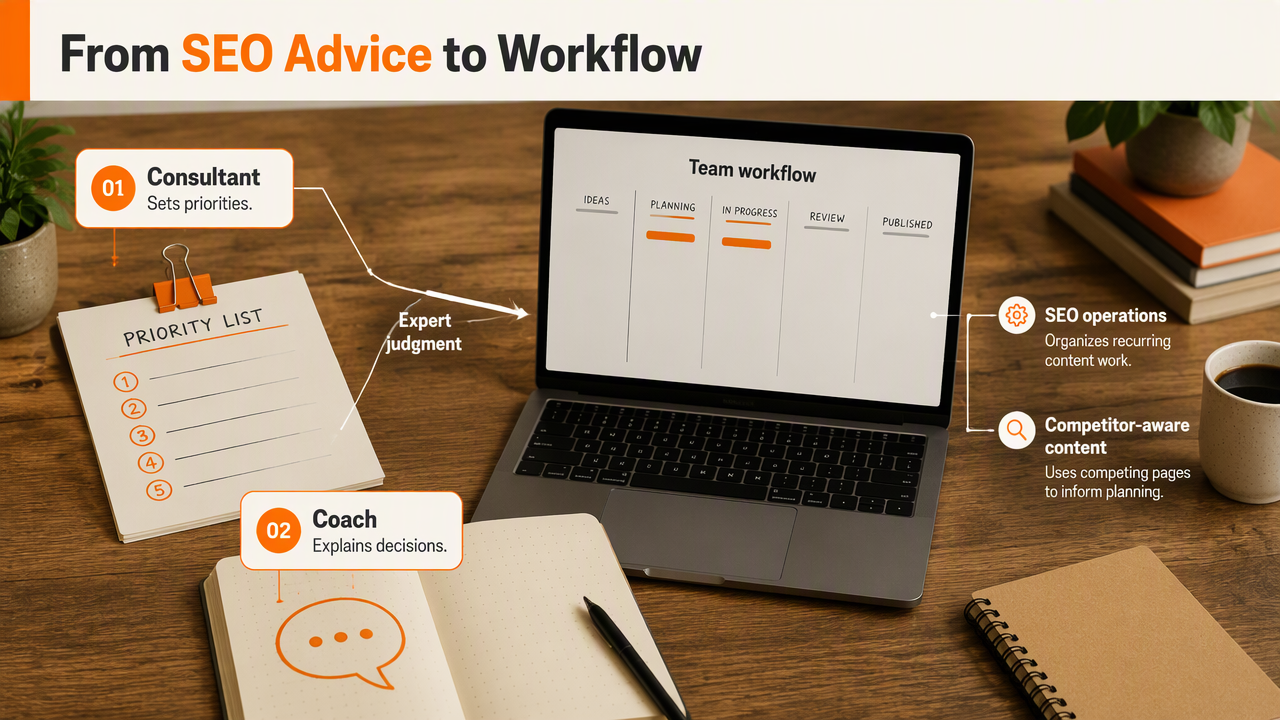
The distinction is between expert judgment and a repeatable workflow. A consultant can set priorities; a coach can explain decisions; a platform can give the team a place to organize the resulting work. Each serves a different role.
Turn recommendations into a repeatable process
The platform's SEO operations offering is relevant when a team wants to organize ongoing content activity. Its competitor-aware SEO content feature is relevant when competing pages inform content planning.
A practical division of responsibilities looks like this:
- Specialist: Sets priorities and explains tradeoffs.
- Platform: Supports the content workflow.
- Business team: Supplies expertise, approves work, and owns outcomes.
Teams can review the available features at earlyseo.com, then choose the human support that fits their decision-making needs. A defined consultation may establish the initial plan, while coaching can support staff who want feedback as they build publishing habits.
Frequently asked questions about SEO advice
The best SEO advice arrangement has clear boundaries around delivery, follow-up, and the point at which the business can work independently.
Can a one-time SEO consultation be enough?
A one-time consultation can be enough to resolve a defined issue when a capable person owns implementation. It doesn't mean the website needs no further attention. The business can continue publishing, monitoring, and maintaining pages internally, then request another specialist review when a new decision falls outside the team's experience.
How often should SEO coaching sessions happen?
SEO coaching sessions should follow the team's implementation pace. Weekly meetings may suit an active training period, while monthly reviews may suit a team completing larger batches of work. The useful interval leaves enough time for meaningful progress and evidence collection. More frequent meetings aren't automatically more valuable.
Does ongoing coaching include SEO implementation?
Ongoing coaching includes implementation only when the agreement explicitly says so. Many coaching arrangements focus on explanation, feedback, and accountability rather than writing content or changing website code. Buyers should request a task-level scope that names who drafts, edits, publishes, fixes technical issues, and checks completed work.
When should a business stop paying for coaching?
A business should stop or reduce coaching when the team can make recurring decisions independently and the next phase no longer needs regular feedback. A final review can document operating procedures, unresolved questions, and conditions for seeking help again. Coaching can then shift to occasional consultations rather than continue indefinitely.
Conclusion
Choosing one time seo advice vs ongoing seo coaching starts with the next decision, not the longest contract. A bounded question points toward consultation; repeated learning points toward coaching; available staff make either useful.
Before requesting proposals, the business should write a one-page brief naming the goal, implementation owner, expected deliverable, and review date. That brief gives providers a concrete basis for recommending the right support.