TL;DR
Restaurant SEO should start with accurate Google Business Profile details, a readable menu, and a useful page for each location. Catering and delivery pages can capture specific buying intent, while reviews help customers choose. Measure reservations, orders, and qualified inquiries alongside search visibility.
A restaurant's next booking can begin with a search for a dish, a neighborhood, or a place open tonight. SEO for restaurants connects those searches to accurate information and a clear booking or ordering path.
Restaurant SEO: The practice of improving a restaurant's visibility in organic search and local map results through its website, business listings, and relevant content.
For operators organizing that work, Earlyseo offers a content-focused starting point. The practical priority stays simple: establish reliable business details first, publish useful pages next, and connect search traffic to restaurant revenue.
Table of Contents
How can restaurants improve Google Maps visibility?
- Verify and complete the restaurant's Google Business Profile.
- Select categories that accurately describe the business.
- Keep opening hours, contact details, and website links current.
- Add menu information and representative food and venue photos.
- Request honest customer reviews and respond professionally to feedback.
Make the listing useful before chasing rankings
A complete Google Business Profile helps searchers assess the restaurant without opening several tabs. Include regular and holiday hours, the correct map pin, a phone number, and direct links to reservations or ordering where supported.
Local results depend on relevance, distance, and prominence. A restaurant can improve the clarity of its information, but it can't move closer to every searcher through optimization.
Use the same business name, address, and phone number across the website and important listings. For a broader operating checklist, the local business SEO playbook provides a relevant next step.
Treat reviews as customer feedback, not keyword slots
Review requests should invite honest feedback from customers rather than prescribe wording. A receipt link or post-visit message can make the process easier. Staff should request reviews consistently instead of asking only customers expected to leave praise.
Responses should acknowledge the experience and address specific details. Photos should also reflect the current dining room, dishes, entrance, and accessibility information.
Local visibility helps a restaurant get considered; accurate information and credible customer feedback help it get chosen.
Which pages should every restaurant website have?
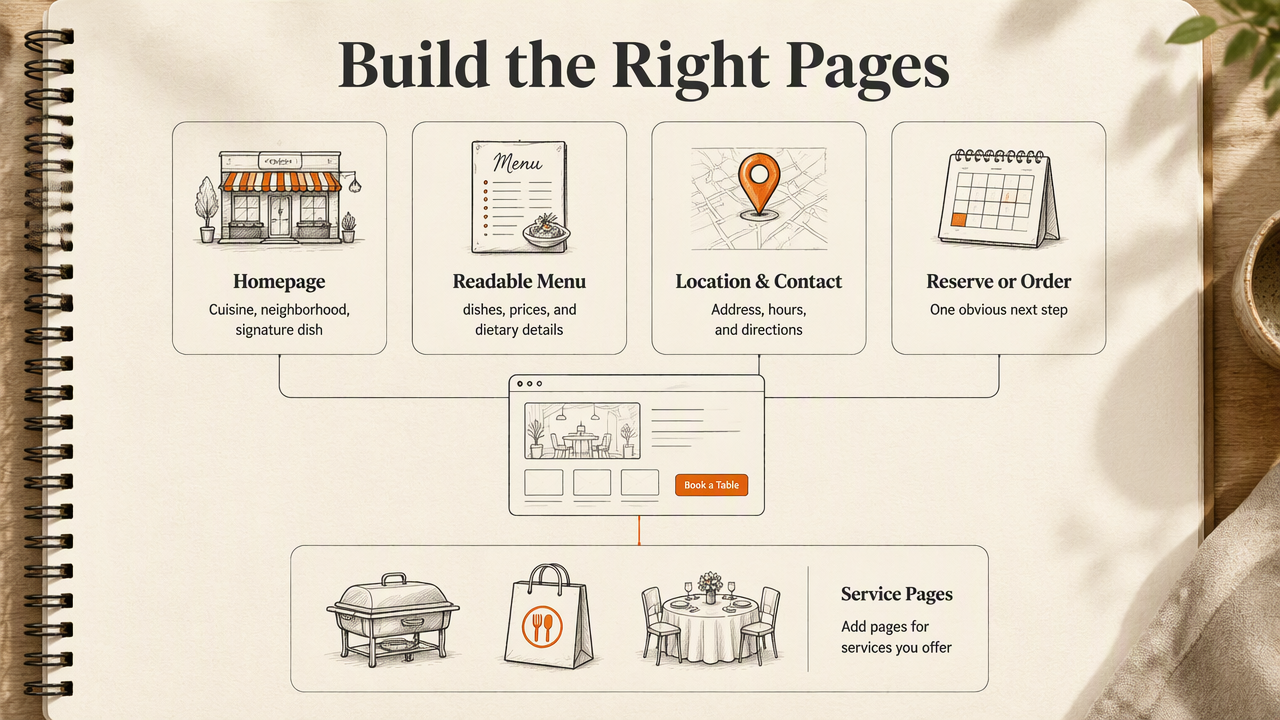
Every restaurant website should have a homepage, readable menu, contact or location page, and a clear reservation or ordering destination. Restaurants offering catering, delivery, or private dining should add dedicated service pages. Each page needs a distinct purpose, accurate details, and an obvious next action for visitors.
Match essential pages to customer decisions
A useful restaurant website answers practical questions before asking for a booking.
| Page | Customer question | Essential content |
|---|---|---|
| Homepage | What kind of restaurant operates here? | Cuisine, neighborhood, signature offering, booking links |
| Menu | What can guests eat, and what does it cost? | Text-based dishes, descriptions, current prices |
| Location | How can guests visit? | Address, hours, directions, parking, contact details |
| Reservations or ordering | How can customers transact? | Clear buttons, booking process, ordering options |
| Catering or private dining | Can the restaurant handle this event? | Capacity, packages, lead times, inquiry form |
A single-location restaurant can combine contact and location information. A multi-location business should give each venue its own useful page with its actual hours, menu differences, photos, and booking link.
Publish a menu that works beyond a photograph
An HTML menu gives visitors and search systems readable dish names, descriptions, and prices. A downloadable PDF can remain available, but it shouldn't be the only way to browse food options.
Use descriptive page titles, such as Dinner Menu | Harbor Kitchen | Portland, and link menus from the main navigation. The internal linking strategy guide explains how connected pages support discovery.
Restaurant structured data: Machine-readable information describing the business using Schema.org vocabulary. Relevant properties can identify its address, cuisine, hours, and menu URL. Markup should match visible content; it doesn't guarantee a special search appearance.
Test the website on a phone. Guests should be able to read prices, call the venue, and reach checkout or reservations without awkward zooming or obstructive pop-ups.
How should restaurants target catering and delivery searches?
- Identify services the restaurant actually provides.
- Pair each service with its real location or service area.
- Assign a dedicated page to each distinct customer need.
- Explain prices, availability, ordering requirements, and fulfillment details.
- Add a relevant inquiry or ordering action and measure completed conversions.
Choose queries with a clear commercial purpose
High-intent searches describe an immediate need, such as office lunch catering in Austin, pizza delivery in Riverside, or private dining for 20 in Boston. These examples illustrate page planning, not measured search-volume opportunities.
Check actual search results and customer inquiries before choosing targets. The competitor-aware content feature is relevant to organizing content around competing pages and uncovered topics.
A catering page should explain minimum orders, dietary options, delivery boundaries, and booking lead times. A delivery page should state the service area and link directly to the applicable ordering flow.
Add local detail instead of duplicating city pages
Location pages earn their place by describing a real venue or a genuinely served area. Swapping city names into otherwise identical copy provides little practical help.
Useful details include:
- Nearby landmarks and arrival directions.
- Location-specific menus and opening hours.
- Private-room capacity and event facilities.
- Pickup instructions and delivery coverage.
Restaurants serving visitors in several languages can consider multilingual content support, with fluent review of translated menus, dietary terms, and booking instructions.
Prepare for AI discovery and measure business outcomes
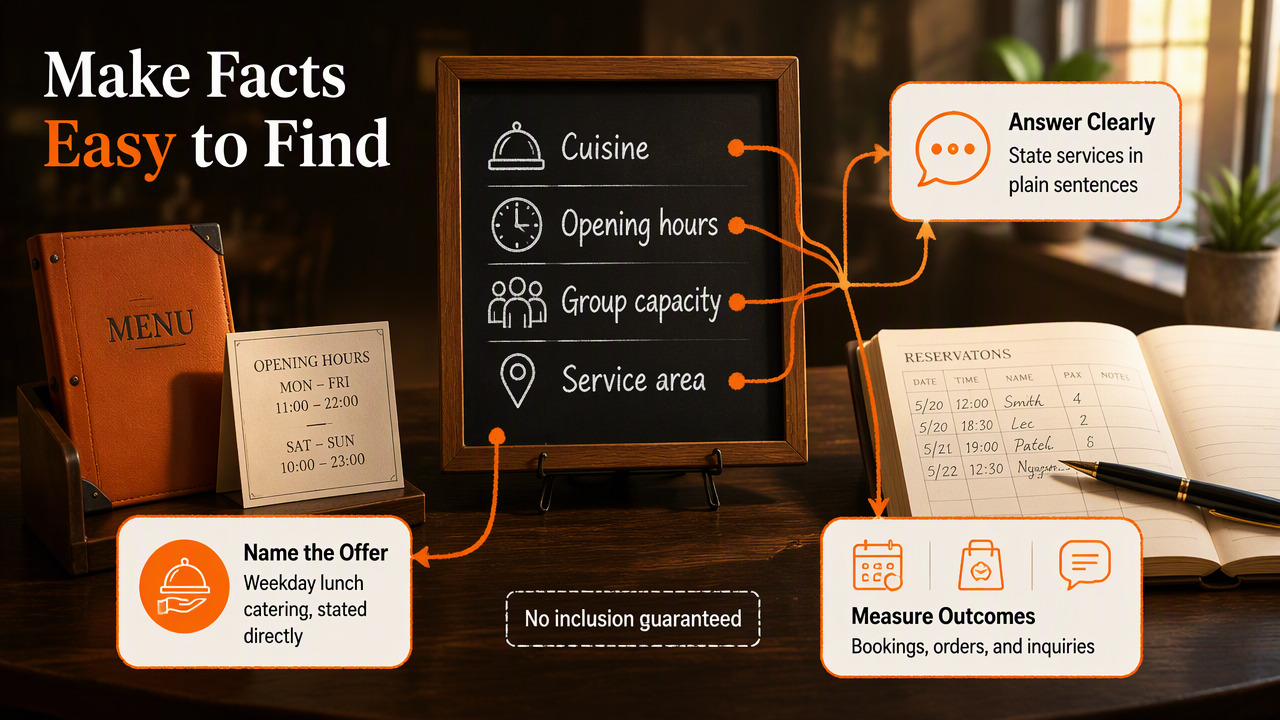
Restaurants preparing for AI discovery should publish clear, consistent facts and measure whether search visibility leads to bookings, orders, or inquiries. Answer-focused content helps explain the business, but no formatting method guarantees inclusion in ChatGPT, Google AI Overviews, or other generated recommendations.
Keep restaurant facts easy to extract
Explicit answers help search systems understand details such as cuisine, opening hours, group capacity, and service areas. A short sentence stating that a venue offers weekday lunch catering is clearer than promotional copy that leaves the service implied.
The 2022 paper PaLM: Scaling Language Modeling with Pathways examines large language model scaling, not restaurant rankings. It doesn't establish a formula for local AI citations. Operators should distinguish general AI research from evidence about restaurant discovery.
Looking toward 2027, maintaining current business facts is a practical priority as conversational search develops. Special markup or repeated keywords aren't substitutes for useful, verifiable information.
How Earlyseo handles restaurant content planning
Earlyseo provides a content-focused option for organizing restaurant search topics and supporting pages. Its role fits work around menus, location information, and service-led content, with restaurant staff supplying the operational facts.
A practical publishing queue should prioritize:
- Core menu and location information.
- Catering, delivery, and private-dining pages.
- Supporting answers based on recurring customer questions.
Staff approval should confirm prices, availability, dietary wording, and event capacity before publication.
Track actions that matter to the restaurant
A useful report separates visibility from commercial results. Google Search Console can show search queries and page performance; website analytics and booking systems can help track reservations, orders, calls, and inquiries.
Record a baseline before changes. Review results monthly by page and service, rather than treating every visit as equally valuable. The 90-day SEO sprint offers a planning framework for sequencing improvements and reviewing progress.
Restaurant SEO questions owners commonly ask
Restaurant SEO decisions depend on the venue's market, website condition, and ordering or booking setup. These answers clarify three common planning choices.
How long does restaurant SEO take?
Restaurant SEO has no guaranteed timeline. Business-information updates may become visible before competitive website rankings improve, while new pages need time to be discovered and evaluated. Operators should set monthly review points, track completed bookings or inquiries, and assess progress against a baseline rather than expect a fixed ranking deadline.
Does a restaurant need a blog?
A restaurant doesn't need a blog before it has useful menus, location details, and service pages. Supporting articles make sense when they answer genuine questions about events, cuisine, or planning a visit. A short set of accurate, maintained pages is a better starting point than a large publishing schedule without clear customer intent.
Can a delivery marketplace replace a restaurant website?
A delivery marketplace can provide another ordering channel, but it doesn't replace the restaurant's own menu, brand information, or location pages. An owned website gives the business a place to explain catering, reservations, and other services. The best ordering destination depends on the restaurant's operations and available checkout options, not SEO alone.
Conclusion
A practical SEO for restaurants plan starts with one profile audit, one readable menu, and one priority service page. Assign an owner to each task, record current booking and ordering results, and review progress monthly. Operators ready to organize the content work can explore Earlyseo at earlyseo.com, then build a publishing queue around real customer questions.