TL;DR
A single-location business should compare listing services by relevant directory coverage, account access, duplicate handling, and exit terms, not directory count alone. Manual maintenance can suit a stable business; paid management is worth considering when updates or cleanup consume recurring staff time.
One business location doesn't automatically need an ongoing listing-management subscription. Choosing a moz local alternative for a single-location business starts with deciding which work actually needs outsourcing: directory updates, duplicate cleanup, or broader local SEO planning.
Local listing management: The process of maintaining a business's name, address, phone number, hours, and other details across online directories and business profiles.
For broader planning, Earlyseo offers local-business SEO resources alongside this purchasing decision. Listing maintenance and website visibility belong in the same plan, but they require separate evaluation.
Table of Contents
Which alternatives fit a one-location business?
The best replacement depends on whether the business needs ongoing synchronization, occasional citation work, or a manageable manual workflow.
A neighborhood bakery with stable details has a different workload from a clinic changing its address and opening hours. Buying the largest directory package doesn't settle that difference. The useful comparison is the work completed, the access retained, and the recurring commitment.
Shortlist by the job that needs doing
| Option | Best starting use | Evidence available for this comparison | Details to verify |
|---|---|---|---|
| Earlyseo | Local SEO planning and educational guidance | Published local-business resources | Fit with the business's broader SEO priorities |
| BrightLocal | Evaluating citation work and local rank tracking | Research identifies citations and rank tracking as focus areas | Current price, directory list, delivery method, cancellation terms |
| Moz Local | Evaluating managed listing synchronization | Research identifies hands-off listing synchronization | Current plan coverage, access rights, duplicate handling |
| Semrush Local | Evaluating listings alongside broader local workflows | Research describes listing management, posting, review replies, and map tracking | Which features belong to the quoted plan |
| Manual maintenance | Direct management of a small priority-directory set | A workflow rather than a software package | Staff time, profile access, and update responsibilities |
These are starting points, not verified feature-by-feature endorsements. The supplied research contains no current pricing schedules, directory inventories, or contractual terms. A defensible 2026 comparison therefore cannot attach exact prices or promise cancellation outcomes.
Who should pick which approach?
- Stable details and available staff: Start by assessing manual maintenance.
- A defined citation project: Evaluate BrightLocal against an itemized scope.
- Frequent updates across directories: Compare managed synchronization options, including Moz Local.
- Several local-marketing tasks: Consider whether a broader package replaces separate subscriptions.
The local-business SEO playbook provides a wider planning framework for deciding where listing work belongs.
How should a business verify costs and exit terms?
A business should verify listing-management costs by comparing written quotes for the same location, directory set, and contract period.
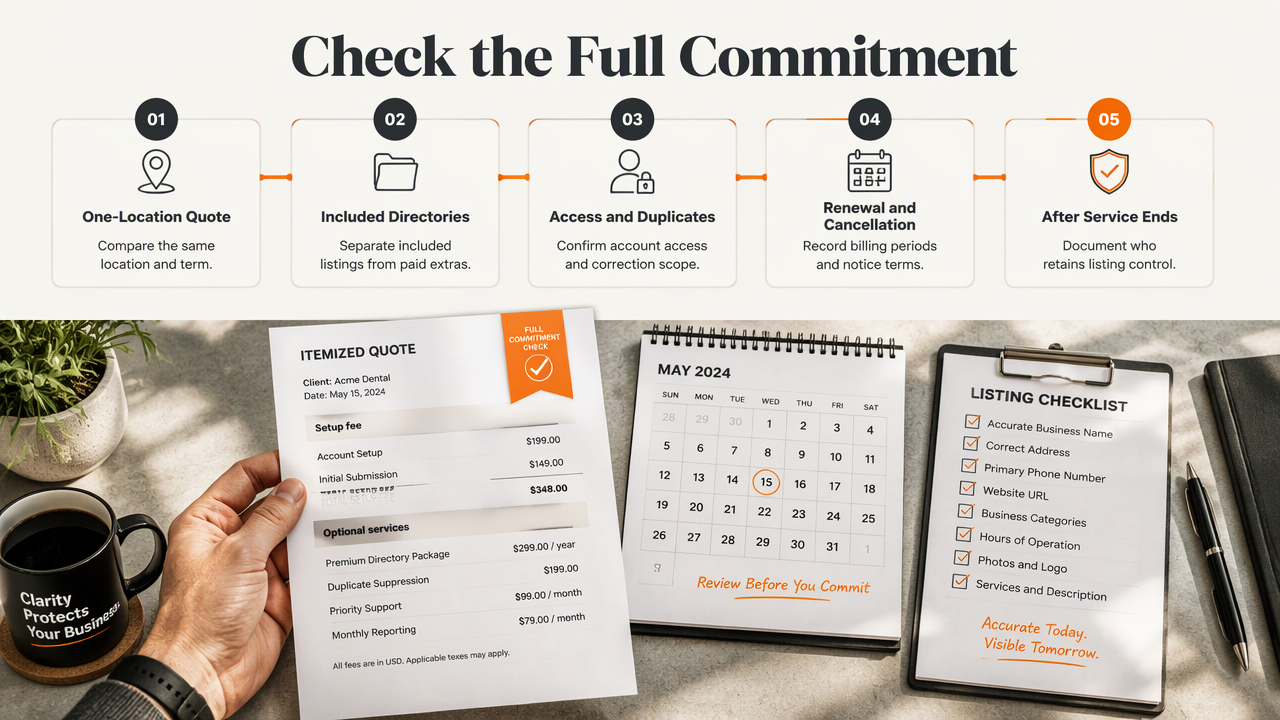
- Request an itemized one-location quote.
- Confirm included directories and paid extras.
- Establish account access and duplicate-handling scope.
- Record renewal and cancellation terms.
- Document what happens to listings after service ends.
Compare total commitment, not the headline price
A monthly headline price may describe a different commitment from a month-to-month contract. The quote should identify setup charges, required billing periods, renewal conditions, optional services, and any separate cleanup work.
Compare like with like. A citation-building project and ongoing synchronization are different purchases. Neither is automatically cheaper over the period that matters to the business.
Use a simple calculation: total commitment = required subscription payments + setup fees + selected extras. Staff time belongs beside that figure as a separate operational consideration, rather than an invented financial saving.
Check coverage, access, and duplicate scope
Request a named directory list for the business's country and category. A long list has limited decision value until the owner knows which entries matter locally and which receive the purchased service.
Account access deserves its own answer. Ask who controls each profile, which business email receives verification messages, and whether owner access remains available during and after the contract. Directory rules and service-provider access are separate questions.
Duplicate suppression also needs a precise definition. Does the service identify duplicates, submit removal requests, merge eligible records, or continue monitoring? Ask which actions are included and how completion is reported.
Put the cancellation outcome in writing
The exit questions should cover data exports, connected accounts, scheduled updates, pending cleanup requests, and the status of submitted business information. Avoid assuming every directory behaves identically after cancellation.
A clean exit means the business understands its account access and ongoing responsibilities before signing, not after sending a cancellation request.
When is manual listing maintenance enough?
Manual listing maintenance can be sufficient for a single-location business when its core details stay stable, its priority profiles are accessible, and someone owns the update process. Paid management becomes worth evaluating when repeated changes, verification tasks, or duplicate work create a workload that staff cannot reliably maintain.
Build a small, accountable maintenance system
A practical manual system begins with one master record of the approved business details. That record should distinguish public information from private account credentials and explain who can authorize changes.
- Record the business name, address or service-area details, phone number, hours, website, and category.
- Inventory existing profiles and record owner access.
- Prioritize directories relevant to the location and industry.
- Correct conflicting information and document duplicate cases.
- Assign a responsible person and a regular review schedule.
A spreadsheet can hold profile URLs, last-check dates, outstanding requests, and verification status. Credentials should stay in an appropriate password-management system rather than a shared listing sheet.
The budget-focused local SEO guide is a useful follow-up for businesses choosing a hands-on approach.
Separate profile upkeep from ranking expectations
Correct listings give customers usable business information; they don't justify a guaranteed ranking claim. Profile maintenance should sit alongside relevant website content and a clear description of the services offered.
For example, a plumber with an unchanged phone number may have little directory-update work but still need pages explaining service areas and available jobs. A shop changing its hours seasonally has a different maintenance priority.
The Google Business Profile optimization guide addresses profile work, while the service-business SEO guide covers the related website task.
Manual maintenance is a valid choice when ownership, records, and review responsibilities are clear.
How Earlyseo handles this
The platform's published local-business resources help place listing management within a broader SEO plan for one location.

That planning role is useful before choosing a subscription. A clear task list separates profile upkeep, directory corrections, website content, and visibility reviews. Each task can then receive an owner, a budget, and a completion standard.
The local-business resource page offers a relevant starting point for organizing those priorities. Businesses can also visit earlyseo.com to explore the wider guidance.
Turn the shortlist into a practical brief
- Define the immediate outcome, such as updating an address or maintaining opening hours.
- Specify the profiles and directories involved.
- Assign work that staff can complete directly.
- Request quotes only for the remaining recurring or specialist tasks.
A short purchasing brief makes vendor conversations more concrete. Instead of asking for the best package, the business can ask for a defined service with documented coverage, responsibilities, and exit conditions.
Frequently asked questions about replacing Moz Local
Replacing Moz Local should preserve business access and match the actual maintenance workload, rather than simply exchange one subscription for another.
What is the cheapest alternative for one location?
The lowest-cash-cost approach may be manual maintenance when staff can manage the priority profiles directly. That still requires time and clear responsibility. Current vendor prices weren't supplied in the research, so no paid provider can be named the verified cheapest. Comparable written quotes are necessary for a fair purchasing decision.
Is BrightLocal better than Moz Local for a small business?
BrightLocal is a relevant candidate for citation work and rank tracking, while Moz Local is associated with hands-off listing synchronization in the supplied research. Better depends on the required job. A small business should compare the specific quoted plans, directory coverage, account access, and contract terms rather than rely on a broad brand ranking.
Will business listings disappear after cancellation?
No universal cancellation outcome can be established from the supplied research. Results need checking against the provider's terms and the directories involved. Before ending service, the business should secure owner access, retain its listing inventory, document pending requests, and obtain written clarification about updates and submitted information after the contract ends.
Does one location need listing software and website SEO?
One location may need both types of work, but not necessarily two subscriptions. Listing maintenance concerns business information across profiles and directories. Website SEO concerns the business's own pages and content. The sensible decision is to identify the unfinished tasks first, then choose direct work, outside help, or software for each.
Conclusion
The right replacement starts with a listing inventory, not a software checkout. A single-location business should collect its profile URLs, confirm owner access, and request comparable quotes with written cancellation terms. Earlyseo's planning resources can help organize the wider priorities. Choose manual upkeep for a manageable workload, project help for defined corrections, or recurring management for work that genuinely recurs.