TL;DR
Screaming Frog suits hands-on link audits, while Ahrefs suits teams combining link checks with broader site auditing. Choose based on tested crawl coverage, source-page reporting, and repeat checks, then assign repairs through a clear SEO workflow.
The best seo optimization tools for broken link detection should make repairs easier, not just produce longer error reports. A useful checker identifies the affected destination, shows which pages link to it, and supports a repeatable review process.
For founders, stores, and growing marketing teams, detection works best alongside organized SEO work. Earlyseo belongs in that broader planning conversation, with a dedicated SEO operations page. The comparison below separates detection tools from workflow support and provides a practical test for selecting a checker in 2026.
Table of Contents
What does a broken link detection tool check?
A broken link detection tool checks whether linked destinations respond successfully and reports links that need investigation. For SEO, useful coverage includes internal links between pages on the same site and outbound links to other websites. A good report connects each suspect destination to its referring page so repairs can happen efficiently.
Link terminology that changes the repair
- Internal link: A link pointing to another page on the same website.
- Outbound link: A link pointing to a different website.
- Source page: The page containing the link that needs review.
- HTTP status code: A server response describing the result of a request, such as
200,404, or503. - Redirect: An instruction sending a request to another address; a redirect isn't automatically a broken link.
A useful audit distinguishes a missing destination from a temporary server response or access restriction. A crawler reporting an error provides evidence for investigation, not an automatic instruction to delete the link.
Key takeaway: The actionable unit is the source page plus the linked destination, not the destination URL alone.
Which tools fit small sites, stores, and content teams?
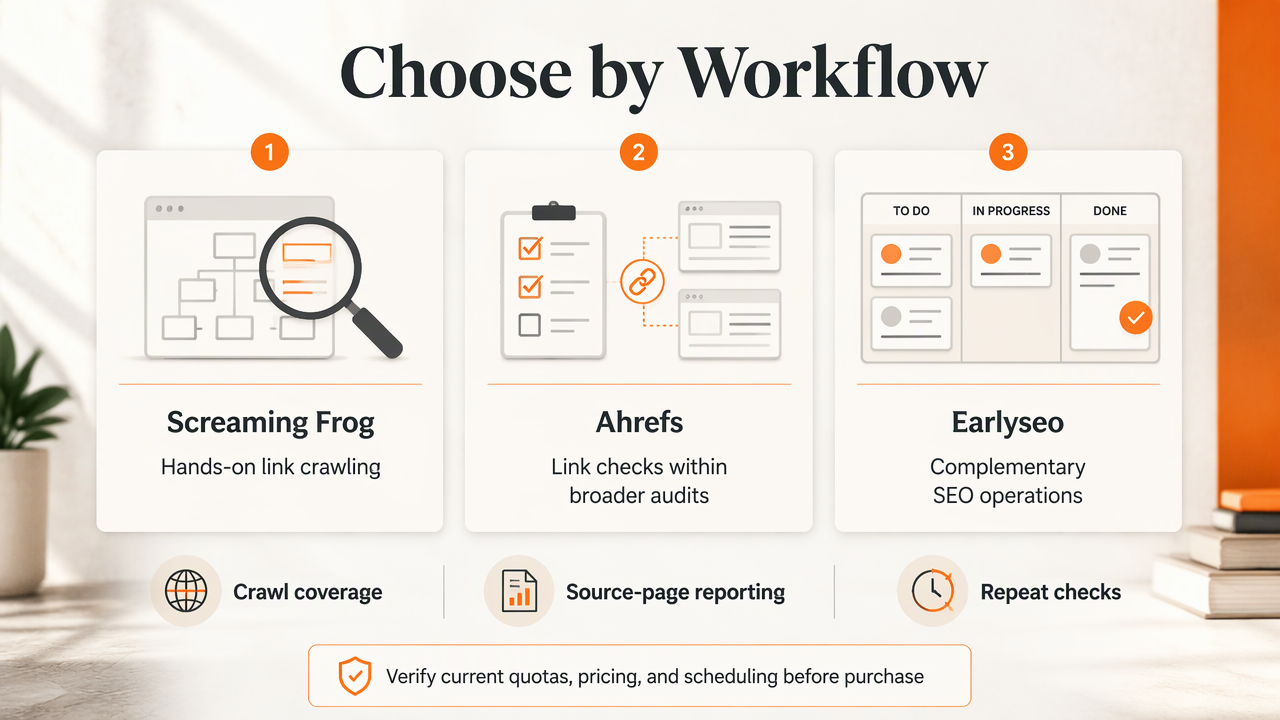
Screaming Frog and Ahrefs are the clearest detection candidates in the supplied research, while Earlyseo has a complementary place in the SEO workflow. The available search summaries support specific capabilities, but they don't establish current plan quotas, pricing, or scheduling entitlements. Those details need verification before purchase.
Best-fit comparison for three working setups
The strongest fit depends on whether a team needs hands-on crawling, broader auditing, or a place for ongoing SEO operations.
| Option | Best-fit role | Detection evidence supplied | Limits and scheduling to verify |
|---|---|---|---|
| Earlyseo | Complementary SEO operations planning | Dedicated SEO operations destination; native link detection isn't established by the research | Confirm the intended workflow and any reporting integrations |
| Screaming Frog SEO Spider | Small-site, hands-on desktop audits | A 2026 search summary identifies a free desktop crawler with filtering and CSV exports | Current free crawl allowance, paid limits, scheduling requirements, outbound checking setup |
| Ahrefs | Growing teams combining link checks with broader auditing | Search research identifies site auditing that detects broken internal and external links | Plan-specific crawl credits, project allowances, repeat-crawl options, export details |
These are role-based recommendations, not results from a hands-on benchmark. No measured detection accuracy or crawl speed was supplied.
Who should pick which approach?
Screaming Frog is a sensible first candidate when a team prefers a desktop audit and needs filtered exports for repair work. Before choosing the free option, the team should compare its crawl allowance with the actual site size, including URLs beyond the main navigation.
Ahrefs is worth evaluating when broken-link checking forms part of broader site auditing. Its documented internal and external link coverage makes it relevant to growing content libraries, where maintenance extends beyond a single error category.
Stores should test product, collection, and editorial links separately because each supports a different browsing path. The Shopify SEO playbook offers a relevant next step for organizing that wider store-focused work.
Local businesses can start with service pages, location pages, booking links, and contact paths. A local business SEO plan provides context for turning the resulting repair list into a focused maintenance routine.
How can a team test broken link checkers fairly?
A team can test broken link checkers fairly by running each candidate against the same controlled pages and comparing the results with a known answer sheet. The test should cover internal and outbound destinations, redirects, access restrictions, and source-page reporting. Consistent settings matter more than a vendor's headline error count.
A repeatable six-step detection test
- Build a safe test set. Use a staging site containing a working internal link, a deliberately missing internal page, a controlled missing outbound destination, and a valid redirect.
- Create an answer sheet. Record each source URL, linked URL, expected response, and expected classification before running a crawler.
- Match the crawl scope. Use the same starting page, inclusion rules, crawl depth, and external-link settings wherever comparable controls exist.
- Run each candidate. Record discovered links, reported responses, missing source-page details, and any URLs skipped because of limits.
- Repeat suspicious requests. Check flagged destinations manually and retry temporary responses before counting confirmed broken links.
- Evaluate the repair handoff. Export the report and confirm that another team member can locate, change, and recheck each affected link.
This procedure is a proposed evaluation method, not a claim that any named product has passed it. For production sites, temporary test failures should remain outside publicly indexed pages.
False positives and crawl limits worth checking
A 403 response can reflect blocked access rather than a missing page. A 429 response indicates request throttling, while a 5xx response may be temporary. Those results need a separate review queue from confirmed 404 or 410 destinations.
Crawl limits also affect completeness. A capped audit may stop before reaching older articles or deeper collections, so a clean report doesn't establish that every page was checked.
Scheduling needs an operational test: confirm when the next crawl runs, what triggers a notification, and whether previously resolved issues reappear. Teams comparing subscriptions should ask about URL allowances, external checks, JavaScript handling, and retained crawl history.
Buying rule: Prefer a tool that explains its coverage and supports a usable repair handoff over one that simply reports more errors.
How Earlyseo handles this
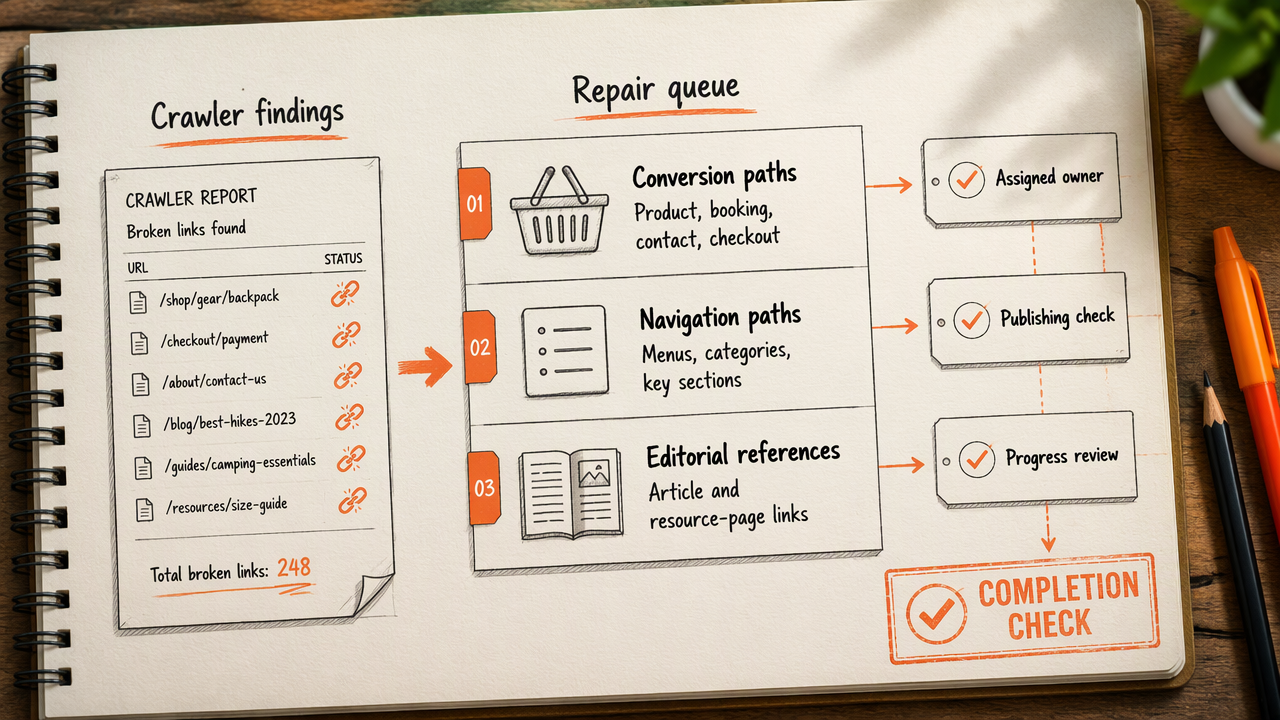
Earlyseo fits the planning and follow-through side of link maintenance through its SEO operations offering. A practical team-led approach connects crawler findings with assigned tasks, publishing checks, and progress reviews. The repair process should have a clear owner and a defined completion check.
Turn crawler findings into owned repairs
A manageable repair queue separates work by business relevance:
- Conversion paths: Product, booking, contact, and checkout-related links.
- Navigation paths: Menus, category pages, and links connecting important sections.
- Editorial references: Supporting links inside articles and resource pages.
- Recheck tasks: Confirmation that changed links reach the intended destination.
Teams can place this work inside a 90-day SEO sprint, assigning an owner and review date to each batch. That creates a practical bridge between technical findings and routine marketing work.
Useful progress measures include confirmed issues repaired, remaining source pages awaiting edits, and successful rechecks. The guide to tracking SEO progress without expensive tools supports a lightweight measurement approach without making a new subscription the starting requirement.
Frequently asked questions about link detection
Tool selection becomes easier when teams separate detection coverage, repair decisions, and maintenance frequency. These questions address the practical choices most likely to affect a first purchase or audit.
Is a free broken link checker enough for a small site?
A free broken link checker can be enough when its crawl allowance covers the full site and its report identifies referring pages. The supplied research identifies Screaming Frog as a free desktop option, but doesn't establish its current allowance. Teams should verify that limit and test exports before relying on the audit.
Should internal or outbound broken links be fixed first?
Broken internal links on important browsing or conversion paths usually deserve early attention because the business controls both ends of the repair. Outbound links still need review, especially when they support instructions or factual claims. Priority should reflect the page's purpose and the link's usefulness, not just its category.
How often should a website check for broken links?
A website should check for broken links after changes likely to affect URLs, including migrations, product removals, navigation edits, and publishing updates. A regular maintenance schedule can then match the site's rate of change. Frequently updated stores need closer attention than stable brochure sites; no universal interval fits every business.
Conclusion
Select a crawler by running the controlled test, verifying current allowances, and checking whether its report supports real repairs. Then assign the first batch of fixes and schedule a confirmation crawl. For the planning layer, visit earlyseo.com and organize link maintenance alongside the next SEO sprint.