TL;DR
Botify AI search is best understood as enterprise search visibility software built for brands managing large websites, AI answers, bots, and agent-driven discovery. Smaller teams usually need simpler execution: clean Google Search Console data, faster prioritization, and repeatable fixes before enterprise automation makes sense.
AI search has moved from a side topic to a visibility problem that affects Google results, AI Overviews, chatbots, shopping agents, and brand discovery. Botify AI search refers to Botify's positioning as an AI search optimization platform that helps large brands be found by consumers, bots, and agents across organic discovery channels. AI Overviews: an artificial intelligence feature in Google Search that produces AI-generated responses at the top of search results, according to Wikipedia's description of AI Overviews. For smaller teams, Earlyseo offers a more focused path: turn search data into practical SEO actions without the weight of an enterprise rollout.
Table of Contents
What is Botify AI search?
Botify AI search is Botify's enterprise positioning for optimizing brand visibility across classic search engines, AI-generated answers, bots, and agent-led discovery. Botify's own search result messaging says its platform helps brands "be found everywhere consumers, bots, and agents search," while its 2025 announcements frame AI visibility as a way to reduce blind spots for brands.
The phrase can be confusing because SERPs also show a separate consumer app called Botify AI, described in Google Play results as a chatbot and companion community. That app is not the same as Botify's enterprise SEO platform. One is about conversational characters; the other is about organic search visibility for brands.
Key insight: Botify's enterprise search product is about findability, crawlability, content delivery, and AI visibility, not consumer chatbot companionship.
Core terminology for AI search visibility
| Term | Meaning for SEO teams |
|---|---|
| AI search optimization | Improving how brand content appears in AI answers, search results, and discovery systems. |
| AI visibility | Measurement of whether a brand, page, product, or answer appears in AI-led search experiences. |
| Agentic discovery | Search behavior where AI agents retrieve, compare, or recommend content on behalf of a user task. |
| Crawl optimization | Making important pages easier for search bots and AI retrieval systems to access and understand. |
| Content delivery to agents | Packaging or feeding content so AI systems can retrieve accurate brand information. |
Botify's recent public positioning leans heavily into agent-driven discovery. Its 2025 press results mention Agentic Feeds, AI Agents, MCP Server integration, and Agentic Workflows, all signals that the company is aiming beyond rank tracking into AI-era content distribution.
Who should consider an enterprise AI search platform?
Enterprise AI search platforms make the most sense for companies with large websites, complex technical SEO issues, and multiple teams responsible for organic revenue. Botify's search result copy specifically targets enterprise and growth companies, which usually means retailers, marketplaces, publishers, travel sites, and global brands with millions of URLs or layered site architecture.
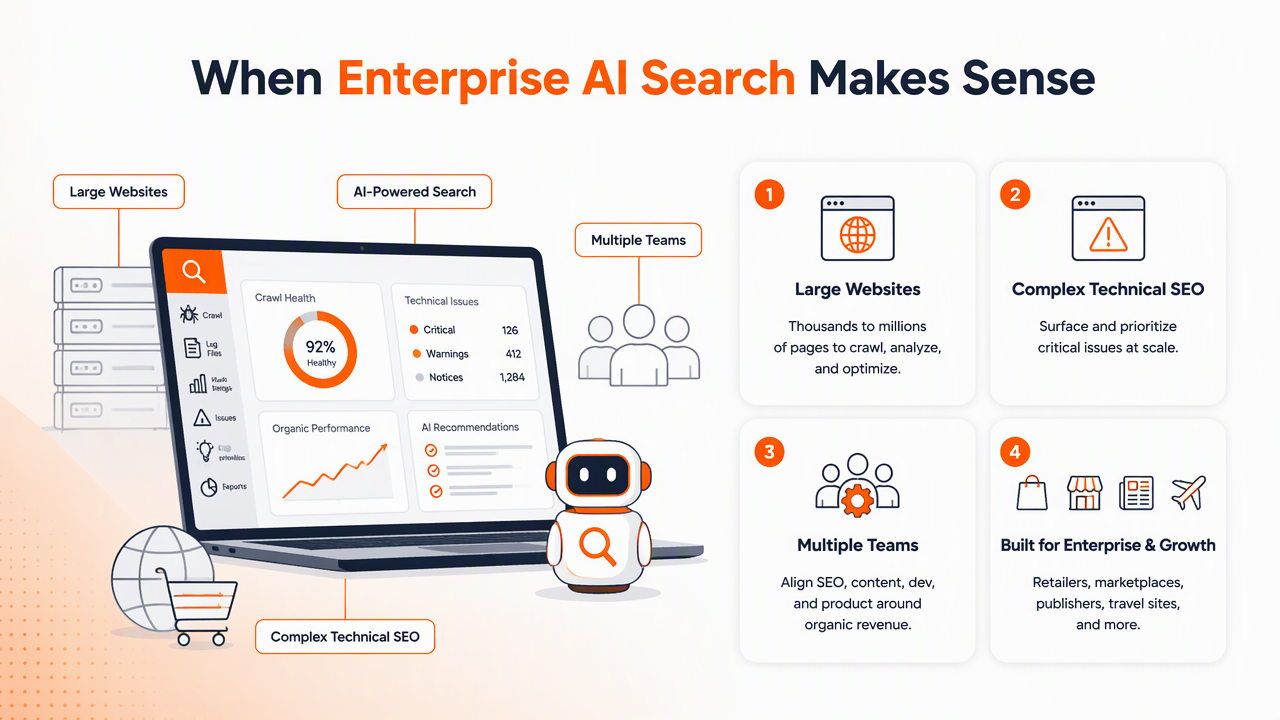
Smaller companies face a different job. A local service business, startup, or early e-commerce store often needs clean indexing, better titles, stronger category pages, and a repeatable reporting rhythm before advanced AI visibility workflows pay off. A practical first step is learning how search data works through a Google Search Console tutorial for beginners.
Best-fit teams and use cases
- Large retailers: need product, category, and faceted pages discovered correctly by bots and AI agents.
- Marketplace platforms: need crawl control across many listings, filters, and user-generated pages.
- Global brands: need visibility reporting across markets, languages, and search experiences.
- Publishers: need article discovery in Google Search, AI Overviews, and assistant-style answer formats.
- Growth-stage SEO teams: need automation when manual audits no longer scale.
The strongest fit appears where organic visibility has direct revenue impact and technical issues cannot be solved page by page. Botify's enterprise message, "AI can't advocate for what it can't see," points to that crawl-and-retrieval foundation.
When leaner execution is enough
Lean SEO teams usually gain more from disciplined execution than from a large platform change. The Earlyseo platform fits this stage by helping teams watch Google Search Console signals, spot opportunities, and act before a full enterprise stack is needed.
Early-stage teams can build a useful operating rhythm around:
- Checking which pages receive impressions but weak clicks.
- Finding pages indexed by Google but underperforming.
- Updating titles, headings, and internal links.
- Creating content around verified search demand.
- Reviewing results monthly instead of chasing daily noise.
For teams still learning the basics, a structured Google Search Console beginners guide often creates more value than another dashboard.
How does Botify compare with small-team SEO execution?
Botify is built for enterprise-scale visibility problems, while small-team SEO execution is built around speed, clarity, and cost fit. The comparison matters because AI search creates pressure to buy advanced tools before the underlying SEO process is mature.
A balanced decision should look at implementation effort, reporting depth, workflow automation, and budget fit. Botify's public materials emphasize enterprise measurement and action in one place, including AI Visibility announced in October 2025 through a PR Newswire release on Botify AI Visibility.
Enterprise platform versus focused SEO workflow
| Criteria | Botify-style enterprise platform | Focused small-team workflow |
|---|---|---|
| Implementation effort | Higher, usually needs technical SEO, analytics, and stakeholder setup. | Lower, can start from Search Console data and a few repeatable actions. |
| Reporting depth | Strong for large sites, cross-team dashboards, crawl data, and AI visibility views. | Better for simple decisions, weekly priorities, and founder-friendly summaries. |
| Workflow automation | Useful when thousands or millions of URLs need rules, feeds, or bulk action. | Useful when tasks can be handled page by page or category by category. |
| Cost fit | Best when organic revenue justifies enterprise software and onboarding. | Best when budget must stay tied to immediate traffic opportunities. |
| Primary user | Enterprise SEO leaders, technical SEO teams, digital commerce teams. | Founders, small business owners, lean marketers, local operators. |
A company should not buy enterprise AI search tooling to avoid basic SEO work. The strongest results still come from crawlable pages, useful content, clear site structure, and consistent measurement.
With Earlyseo, small teams can use search performance data as the starting point rather than building a large technical stack on day one. For teams that rely on Google Search Console as the source of truth, Earlyseo's Google Search Console feature supports a cleaner move from data to action.
How should teams prepare for AI search in 2026?
Teams should prepare for AI search by improving technical accessibility, strengthening entity clarity, and tracking visibility beyond traditional blue links. Google's AI Overviews now place AI-generated responses at the top of search results, and answer engines increasingly summarize brands rather than simply list pages.
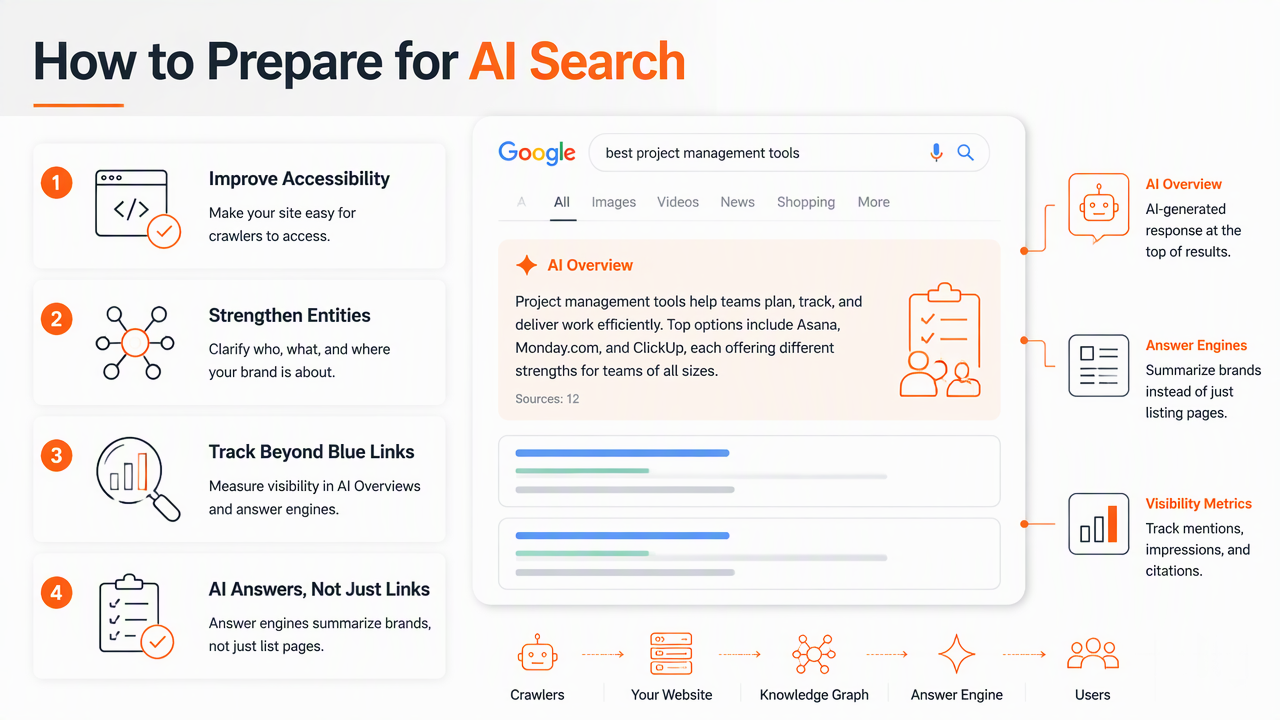
The shift does not erase SEO basics. It raises the cost of vague content, messy site architecture, and missing structured information. A page that cannot be crawled, understood, or trusted has less chance of being selected by classic search systems or AI answer systems.
Practical AI search readiness checklist
- Make key pages crawlable: block thin pages when needed, but keep revenue and authority pages accessible.
- Clarify entities: use consistent names for products, services, locations, people, and brand terms.
- Answer specific questions: create sections that give direct, self-contained answers.
- Use structured formats: add comparison tables, definitions, FAQs, and clear headings.
- Refresh important pages: update product, pricing, location, and policy information before AI systems repeat stale facts.
- Monitor search data: compare impressions, clicks, and indexed pages against content changes.
Research on AI systems also supports caution around sensitive or high-stakes information. A 2023 study by Ruopeng An, Christopher W. Byron, and Chen Chen examined popular chatbots' responses to questions about negative body image, showing why brands should treat AI-generated answers as outputs to monitor, not channels to ignore.
A simple rule helps: if a page would confuse a human reviewer, it may also confuse an AI retrieval system. Strong pages name the topic early, answer the question plainly, and support claims with visible evidence.
What to expect in 2027
AI search will likely become more operational in 2027, with more brands tracking whether agents can find, interpret, and recommend their products. Botify's 2025 references to Agentic Feeds, MCP Server integration, and Agentic Workflows suggest that enterprise SEO software is moving toward controlled content delivery, not only reporting.
Small teams should expect a simpler version of the same trend. Search work will involve fewer vanity keyword reports and more checks around answer quality, entity consistency, and revenue-page visibility. For practical next steps, earlyseo.com is positioned around the everyday search data that smaller teams need before that larger AI-search layer becomes necessary.
FAQ: Botify, AI visibility, and SEO tool choice
Botify is a serious enterprise option for AI-era visibility, but tool choice should follow site size, team maturity, and execution capacity. The questions below address the most common confusion around the topic.
Is Botify AI search the same as the Botify AI chatbot app?
No. Botify's enterprise search platform focuses on brand visibility across search engines, bots, and AI agents. The Botify AI chatbot app shown in app-store style results is a consumer platform for AI characters and companion chats. The shared name creates search confusion, so brand and product context matter when comparing results.
Does AI search replace traditional SEO?
AI search does not replace traditional SEO; it expands the surfaces where content may appear. Crawlability, indexability, page quality, internal linking, and topic clarity still matter because AI systems need accessible, trustworthy source material. The difference is that rankings are no longer the only visibility signal worth watching.
When is an enterprise platform worth the cost?
An enterprise platform is worth considering when a website has many URLs, multiple markets, technical crawl issues, and organic revenue tied to search performance. Large retailers, marketplaces, publishers, and global brands often fit that profile. Smaller teams usually benefit first from reliable Search Console reporting, prioritized fixes, and steady content improvement.
Can small businesses prepare for AI visibility without Botify?
Yes. Small businesses can prepare by creating clear service pages, adding direct FAQ answers, keeping business details consistent, and tracking Google Search Console performance. Tools like Earlyseo can support that practical workflow without requiring an enterprise implementation. The priority is making useful content easy for search systems and AI systems to understand.
Conclusion
Botify AI search represents the enterprise side of a real shift: brands now need visibility across Google results, AI Overviews, bots, and agent-led discovery. The best fit is a large organization with complex sites, technical SEO teams, and enough organic revenue at stake to justify deeper automation.
Smaller companies should take a more direct path. Start with Search Console data, fix pages that already have demand, improve entity clarity, and build answer-ready content. For a leaner operating model, visit earlyseo.com and use Earlyseo to turn search signals into concrete SEO actions before investing in enterprise AI search infrastructure.