TL;DR
SEO automation works best when bootstrapped founders automate repeatable SEO operations first, then keep positioning, offers, and final editorial judgment human. The smartest 2026 plan starts with keyword triage, content briefs, publishing workflows, internal links, and performance reviews before expanding into programmatic or multilingual SEO.
SEO automation for bootstrapped founders is no longer about replacing a marketer with a magic button; it is about turning scarce founder time into a repeatable search system. A founder with limited cash, no full SEO team, and a long list of product tasks needs automation that removes routine work without flattening strategy. SEO automation: the use of software, rules, templates, and AI-assisted workflows to handle repeatable search tasks such as keyword sorting, content brief creation, technical checks, internal linking, reporting, and refresh prioritization. Bootstrapping: a self-starting growth process designed to continue without major external input, which matches the reality of founders funding SEO from revenue rather than venture budgets. Earlyseo fits this use case by helping lean teams turn competitor-aware research, content operations, and publishing discipline into a manageable workflow.
Table of Contents
What is SEO automation for bootstrapped founders?
SEO automation for bootstrapped founders means using tools and repeatable workflows to handle SEO tasks that do not require fresh strategic judgment every time. The goal is not mass-producing low-quality pages; it is saving founder time on research, briefs, checks, internal links, reporting, and refresh decisions while keeping market insight human.
Research by Arash Rezazadeh, Marco Kohns, and René Bohnsack in the Journal of Business Research examined how startups use generative AI in growth strategies, which makes the topic especially relevant for 2026 search teams working with lean budgets and faster content cycles (study). For founders, the practical takeaway is simple: AI and automation belong inside a growth system, not outside the business model.
Key insight: automation should make SEO more consistent, not less thoughtful.
A useful founder setup treats SEO like operations. Keyword research becomes a recurring pipeline. Content briefs follow a fixed format. Publishing checks run before every page goes live. Performance reviews identify which pages deserve edits, links, or consolidation. The Earlyseo platform supports this operating rhythm, especially for small teams that need search execution without hiring an agency on day one.
Founders building from zero may also need the basics before automation. A focused content strategy for new blogs helps define the topics, offers, and audience problems that any workflow should serve.
Core terms founders should separate
- SEO automation: repeatable software-assisted execution for search tasks.
- AI content generation: drafting or expanding text with a language model.
- SEO operations: planning, production, QA, publishing, measurement, and refresh workflows.
- Programmatic SEO: creating many structured pages from templates and datasets.
- Human editorial review: the judgment layer that checks accuracy, angle, brand fit, and usefulness.
Automation can support all five areas, but treating them as the same thing creates risk. A good system starts narrow and expands only after quality controls are proven.
What should founders automate first in 2026?
Founders should automate high-volume, low-judgment SEO tasks first: keyword filtering, brief templates, on-page QA, internal link discovery, rank tracking, and content refresh queues. Strategy, positioning, and final publishing approval should remain human because those decisions depend on customer insight, product nuance, and brand trust.
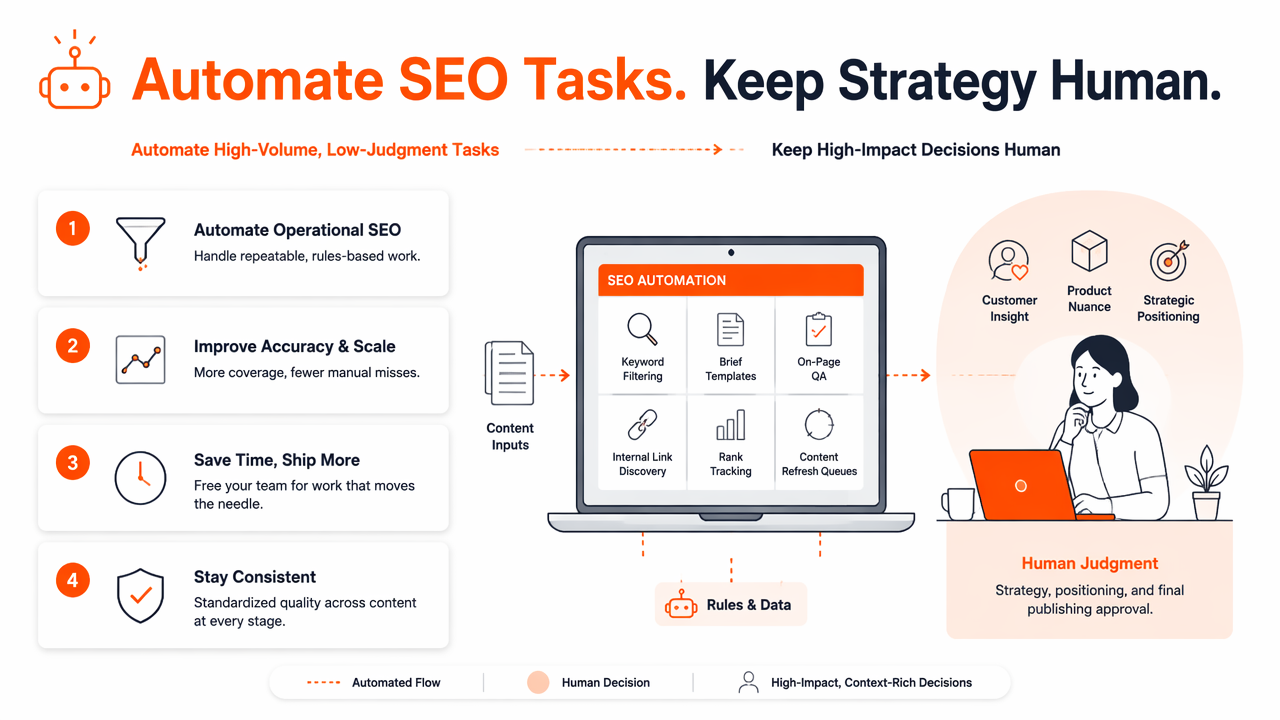
The strongest early wins usually come from removing admin work around content production. A founder does not need ten tools before the first article ships. A lean setup needs one source of keyword truth, one briefing process, one publishing checklist, and one review cadence.
For SaaS teams, SEO operations features can help turn scattered tasks into a production queue. Service companies and shops can use the same idea with fewer pages and more local or category intent.
Automation priority table for lean teams
| SEO task | Automate now? | Why it matters | Keep human |
|---|---|---|---|
| Keyword grouping | Yes | Prevents duplicate articles and scattered targeting | Final topic selection |
| Content briefs | Yes | Speeds outlines, headings, search intent, and source collection | Unique angle and examples |
| On-page checks | Yes | Catches missing titles, headings, links, and metadata | Final readability pass |
| Internal link suggestions | Yes | Helps new pages support older pages and vice versa | Anchor choice and context |
| Technical crawling | Yes | Finds broken links, redirects, indexability issues | Prioritization by business impact |
| Full article publishing | Not fully | Saves time only after a QA system exists | Accuracy, claims, tone, and offer fit |
This order keeps automation close to measurable work. It also avoids the common trap of generating content faster than the site can review, link, and improve it.
The lean SEO stack under pressure
A bootstrapped SEO stack should stay boring. The job is to reduce switching costs, not collect dashboards.
- Analytics: search performance, conversions, and landing page value.
- Research: keyword gaps, competitor pages, and customer questions.
- Production: briefs, drafts, metadata, and publishing tasks.
- Quality control: fact checks, internal links, schema, and page experience.
- Iteration: refresh queues based on impressions, rank movement, and conversions.
Companies selling internationally can add multilingual SEO content workflows later, once the core English or primary-market process is stable.
How should a 90-day automation workflow run?
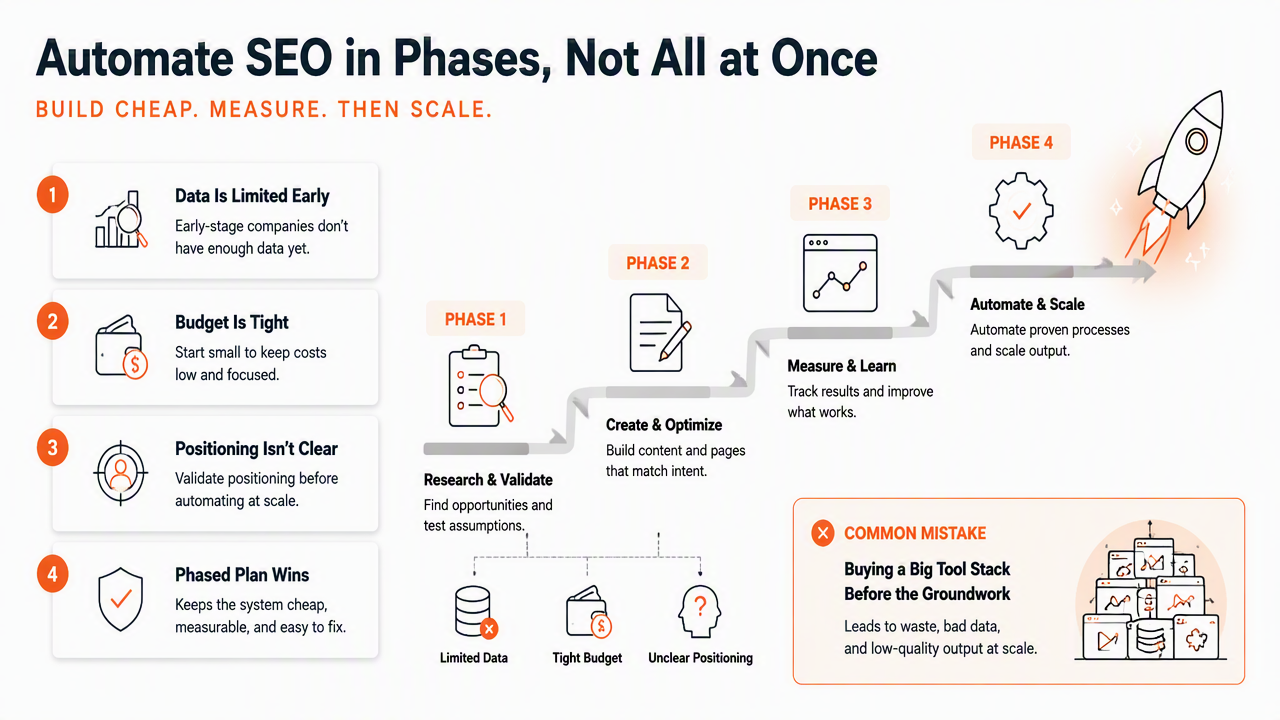
A 90-day SEO automation workflow should move through three phases: build the system, publish with guardrails, then optimize from real search data. The first month creates templates and topic queues, the second month ships controlled content, and the third month refreshes pages using impressions, rankings, internal links, and conversion signals.
A 90-day sprint works because it gives search enough time to show directional signals while keeping scope small. Founders with limited hours need a fixed operating cadence more than a giant backlog. The 90-day SEO sprint playbook is a natural fit for teams that want a structured plan rather than a loose list of tactics.
Key insight: the first 90 days should prove the workflow before scaling content volume.
Research by Hajer Zarrouk, Teheni El Ghak, and Abderazak Bakhouche studied economic and technological determinants of FinTech startup success and growth (study). While that paper focuses on FinTech, it supports a broader founder lesson: technology choices matter most when tied to growth execution, not when purchased as isolated tools.
A practical 90-day sequence
- Days 1 to 15, audit and choose targets: map existing pages, search queries, competitors, and product-led topics.
- Days 16 to 30, build templates: create brief formats, title rules, internal link rules, and QA checklists.
- Days 31 to 60, publish in batches: ship a controlled set of pages that cover clear intent clusters.
- Days 61 to 75, connect pages: add internal links, improve navigation, and fix thin or overlapping pages.
- Days 76 to 90, refresh from data: update titles, add missing answers, improve CTAs, and mark the next sprint backlog.
This sequence works for SaaS, local services, Shopify stores, and niche content sites because it separates setup from scale.
A simple weekly operating rhythm
- Monday: review impressions, clicks, and ranking movement.
- Tuesday: approve briefs and assign drafts or edits.
- Wednesday: publish or update pages.
- Thursday: add internal links and fix technical blockers.
- Friday: record learnings, prune weak ideas, and plan the next batch.
For SaaS founders, a dedicated SaaS SEO playbook can shape the workflow around product categories, alternatives, integrations, and problem-aware pages.
What should stay human in automated SEO?
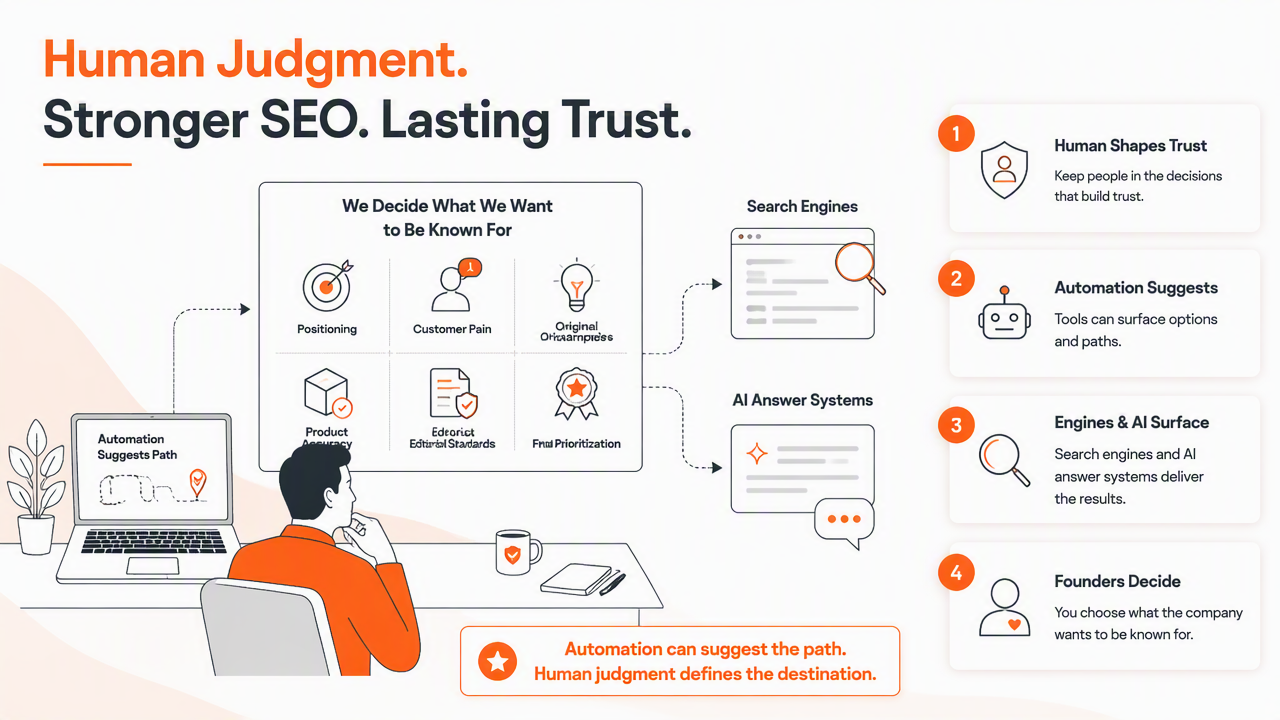
Human review should stay in charge of positioning, expertise, source judgment, original examples, conversion messaging, and final approval. Automation can surface opportunities and draft repeatable elements, but founders still need to decide what the company believes, which customers matter most, and which claims can be defended.
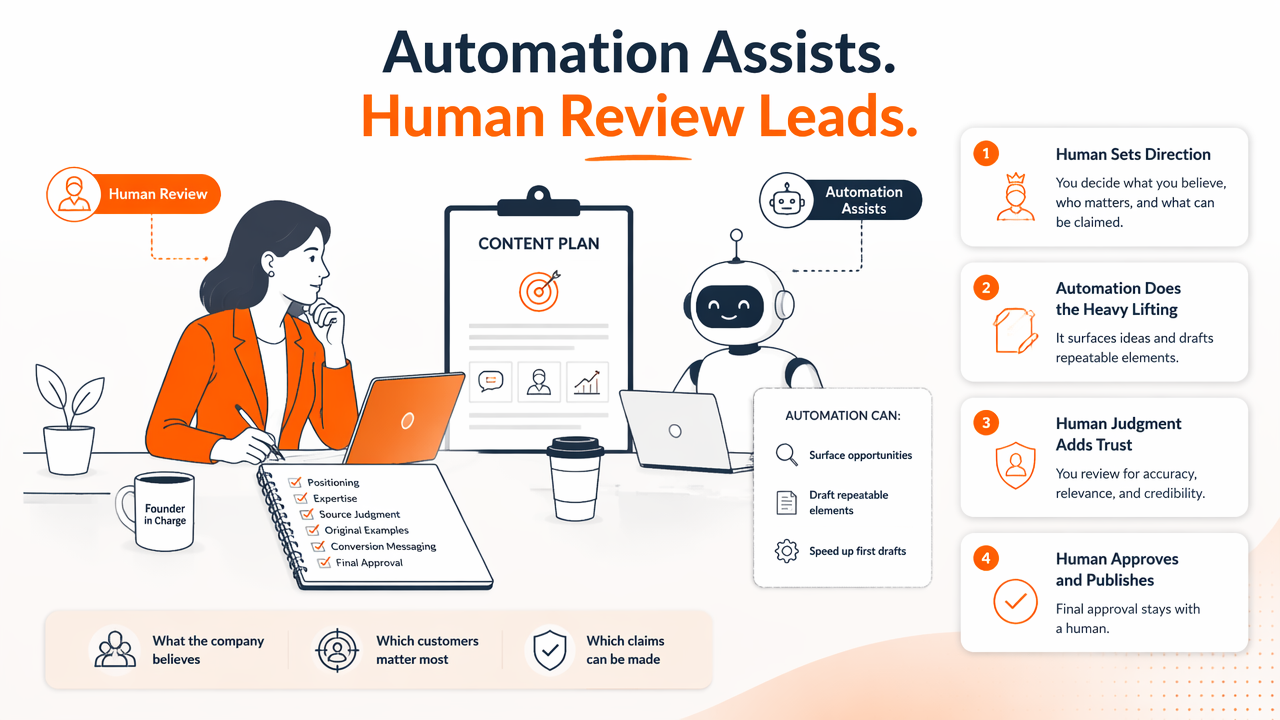
Search content often fails when every page sounds interchangeable. A founder-led page can win with sharper examples: a pricing objection from a sales call, a customer phrase from support, a workflow screenshot, or a product comparison rooted in real use. These assets are hard for generic automation to invent honestly.
The most useful automation supports judgment. Competitor-aware SEO content can help identify what ranking pages cover, but the founder still needs to add the missing insight, product fit, and proof.
Key insight: automation can produce structure, but trust still comes from evidence.
A small business should also keep reputation-sensitive pages under close review. Medical, legal, financial, safety, and technical claims need stronger fact checks than simple list posts. Product pages need clear offers. Local SEO pages need accurate service areas, hours, reviews, and contact details.
Human checkpoints that protect quality
- Search intent: does the page answer the actual query, not just match a keyword?
- Accuracy: are claims, dates, prices, and product details still true?
- Differentiation: does the page say something competitors do not say?
- Conversion fit: does the next step match the visitor's stage?
- Internal links: do links guide readers to deeper help rather than random pages?
- Brand voice: does the page sound like the company, not a generic template?
A helpful next step is reviewing an internal linking strategy for SEO, since links are one of the easiest areas to automate partly and approve manually.
How Earlyseo handles this
Earlyseo is built for founders who need SEO momentum without turning content into a blind assembly line. The workflow combines research, brief creation, content operations, and publishing discipline so small teams can focus on judgment rather than repetitive setup.
The practical value sits in the middle: enough automation to keep output moving, enough control to keep pages useful. For teams comparing agency retainers, tool stacks, and solo execution, earlyseo.com gives a founder-friendly path to start lean and scale later.
Frequently Asked Questions
These answers cover the common decisions founders face before building an automated SEO workflow.
Is SEO automation safe for a new website?
SEO automation is safe for a new website when it supports research, structure, QA, and reporting rather than publishing unchecked content at scale. New domains need trust, clear topical focus, and clean technical foundations. Automation should help maintain consistency while human review protects accuracy, originality, and user value.
How much SEO can a bootstrapped founder automate?
A bootstrapped founder can automate a large share of repetitive SEO work, including keyword clustering, briefs, metadata drafts, internal link suggestions, technical checks, and reporting. The founder should still own positioning, offer clarity, examples, expert review, and final approval. That split keeps costs low without sacrificing credibility.
Should SEO automation come before hiring an agency?
SEO automation should often come before an agency when the company still lacks a clear content strategy, clean analytics, and a repeatable publishing process. An agency can help later, but automation first can clarify topics, workflows, and performance baselines. Founders considering outside help can review what to ask before hiring an SEO agency.
Can e-commerce founders use the same workflow?
E-commerce founders can use the same workflow with different page types: collections, product pages, buying guides, comparison pages, and seasonal refreshes. The automation layer can support metadata, internal links, category briefs, and update queues. Small shops can pair this with an e-commerce SEO guide for small online stores.
Conclusion
SEO automation for bootstrapped founders works best as a disciplined operating system, not a shortcut. The smartest 2026 approach is to automate repeatable tasks first, run a 90-day workflow, measure real search movement, and keep human judgment in charge of trust, positioning, and proof.
A practical next step is simple: choose one product or service category, build a 10-topic queue, create one brief template, publish for 30 days, then refresh based on search data. For founders ready to turn that process into a repeatable system, visit earlyseo.com and start with the smallest workflow that can ship consistently.