TL;DR
A new blog should start with a narrow topic cluster, publish answer-first pages, and measure early traction before scaling. The best first move is not more content, but a focused SEO plan that connects keywords, intent, internal links, and clear business goals.
A new blog rarely wins by publishing random posts; it wins by becoming the clearest answer source in a narrow topic. A strong content strategy for new blogs seo connects audience questions, search intent, on-page structure, and internal linking before the first article goes live. For founders, local businesses, ecommerce stores, and growing marketing teams, Earlyseo helps turn early content planning into a repeatable SEO workflow without bloated enterprise processes.
Content strategy: the planning, development, and management of content so each page serves a defined audience need and business goal.
Search engine optimization: the practice of improving website and page visibility in search engine results pages through technical quality, relevance, and usefulness.
Key insight: a new blog does not need hundreds of posts. It needs a small set of well-structured pages that search engines and AI answer systems can understand, connect, and trust.
Table of Contents
What is a content strategy for new blogs SEO?
A content strategy for new blogs SEO is a plan for publishing search-focused articles that match real user intent, support business goals, and build topical authority over time. It decides what to write, why it matters, how pages connect, and how performance will be measured after publishing.
Competitor research shows most top articles cover pillars, workflow, tools, and measurement. The missing piece for many new blogs is prioritization. A young site with low authority should not chase every high-volume keyword; it should build a tight content base around problems it can answer better than broader publishers.
Research on generative AI by Stefan Feuerriegel, Jochen Hartmann, and Christian Janiesch in Business & Information Systems Engineering describes generative AI as systems that can create text, images, and other outputs from learned patterns, which matters because search results now include AI-generated summaries and answer experiences (Feuerriegel et al., 2023). New blog content needs clear definitions, tables, and concise answer blocks so both search engines and AI systems can parse it.
Core planning terms for new blog SEO
| Term | Practical meaning for a new blog |
|---|---|
| Search intent | The reason behind a query, such as learning, comparing, buying, or solving a problem |
| Topic cluster | A group of related articles connected to one main topic and linked together |
| Pillar page | A broad guide that introduces a topic and links to deeper supporting posts |
| Supporting post | A focused article that answers one specific question or use case |
| Internal link | A link from one page on the same site to another relevant page |
A new blog should treat these terms as operating rules, not theory. Each planned article needs a query, an intent type, a next action, and at least one future internal link target.
How should a new blog choose its first topics?
A new blog should choose first topics by combining customer questions, low-competition search intent, business relevance, and cluster fit. The safest starting point is a small cluster of 8 to 12 articles around one audience problem instead of a broad editorial calendar that spreads authority too thin.

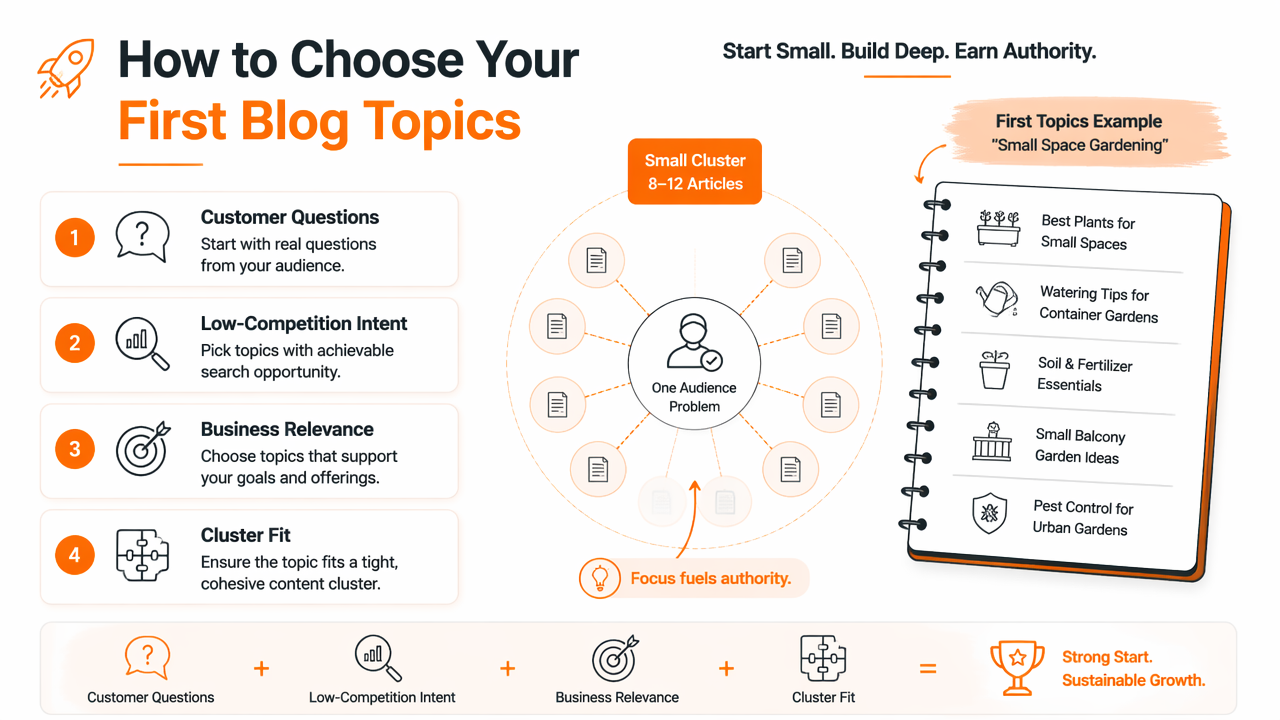
The first topics should answer questions that a business can credibly solve. A local accountant might start with tax deadlines, bookkeeping mistakes, and business entity questions. A Shopify store might start with sizing, comparison, care guides, and buying questions related to its products.
The Earlyseo platform is useful at this stage because early planning needs structure more than guesswork. Teams can organize blog ideas, connect them to pages, and keep execution tied to SEO basics rather than chasing disconnected keywords.
A simple topic selection matrix
| Topic filter | Good signal | Weak signal |
|---|---|---|
| Audience pain | Customers ask it often | Only marketers talk about it |
| Search intent | Query implies a clear need | Query is vague or entertainment-led |
| Business fit | Product, service, or expertise can help | Topic attracts the wrong audience |
| Ranking path | Specific long-tail angle exists | Only large publishers dominate |
| Cluster value | Supports future internal links | Stands alone with no related articles |
A new blog should earn relevance before reach. Specific, connected topics usually beat broad posts that have no internal support.
A practical first cluster might include one pillar page, four beginner guides, three comparison or problem posts, and two conversion-supporting pages. For publishing operations, the Earlyseo blogs workspace can help keep articles grouped by topic instead of scattered by calendar date.
First 10 posts for a small business blog
- One pillar guide that explains the main topic in plain language.
- Three beginner posts that define common terms and questions.
- Two problem-aware posts that address mistakes, costs, or risks.
- Two comparison posts that help readers choose between options.
- One local or niche-specific article that proves relevance.
- One product or service support article that connects search traffic to revenue.
This mix covers awareness, research, consideration, and selection stages, a pattern seen in competitor guidance. The difference is scope: new blogs should start smaller, then expand once early impressions and clicks show where demand is forming.
How do search intent and structure turn posts into rankings?
Search intent and structure turn posts into rankings by making each article easy for readers, crawlers, and AI answer engines to interpret. A strong post answers the main question early, uses headings that match related queries, and gives search engines clear signals about depth and relevance.

The top search results for blog content strategy commonly include definitions, pillars, tools, and metrics. New blogs can improve on that format by making every section self-contained. That means a short answer first, then examples, then a table or list that clarifies decisions.
AI search has raised the value of clean structure. A literature review by Ilie Gligorea, Marius Cioca, and Romana Oancea in Education Sciences examined adaptive learning with artificial intelligence, highlighting how AI systems depend on structured inputs and patterns to personalize outputs (Gligorea et al., 2023). Content built with clear sections, definitions, and consistent formatting is easier for machines to interpret.
The answer-first article format
- Start the introduction with the problem and the target topic.
- Add a clean definition near the top.
- Use H2 headings that match real questions or decisions.
- Place a 40 to 60 word direct answer under question headings.
- Add examples, tables, and bullets after the short answer.
- Link to related pages where the reader can go deeper.
- End with a specific next step, not a vague summary.
For technical publishing guidance, the Earlyseo documentation gives teams a reference point for keeping implementation consistent across pages.
Internal links build the first authority map
Internal links help new blogs show which pages matter and how topics relate. A pillar page should link to supporting posts, and supporting posts should link back to the pillar and across to closely related answers.
Good internal links use descriptive anchor text. Weak links use generic anchors or point to unrelated pages. A new blog should also avoid orphan posts, which are published articles with no meaningful links from other pages.
For WordPress sites, the Earlyseo WordPress integration helps keep content operations closer to the publishing system, which matters when a small team needs consistent titles, metadata, and internal links.
What should a 90-day SEO blog plan include?
A 90-day SEO blog plan should include one topic cluster, a clear publishing cadence, on-page optimization rules, internal linking tasks, and weekly performance reviews. The goal is to create enough connected content to learn what search engines reward without publishing so much that quality drops.
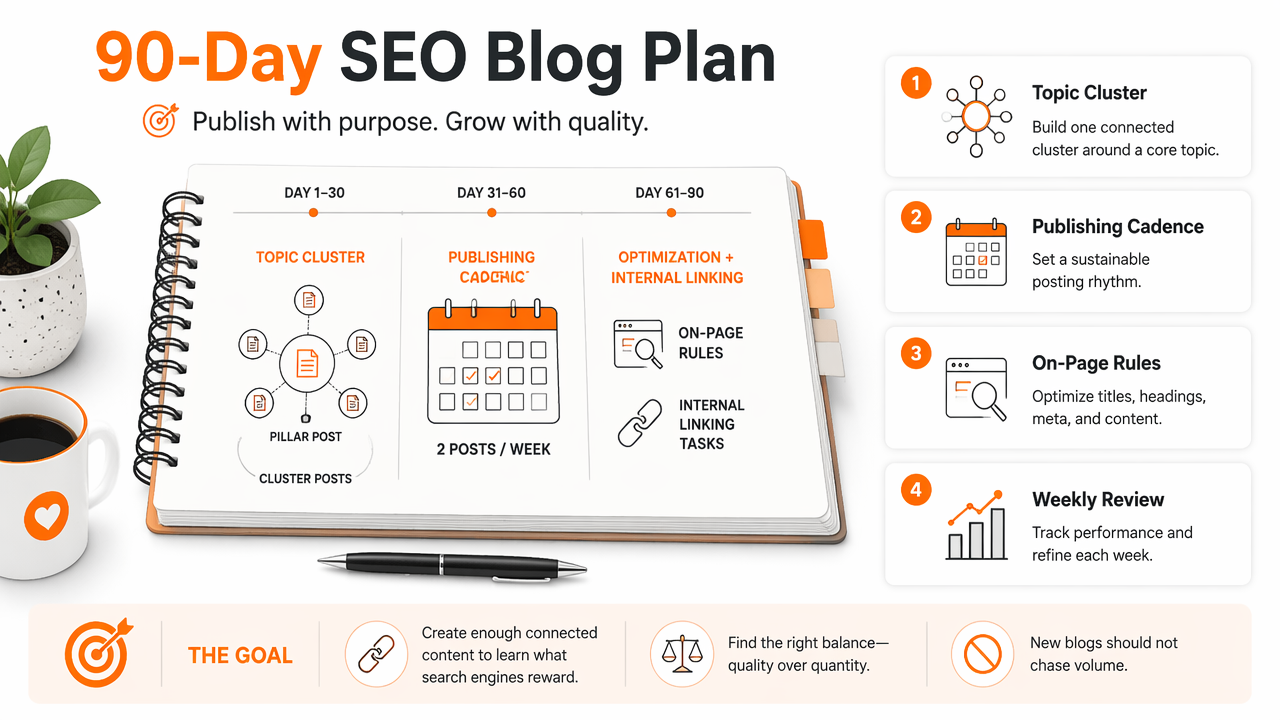
New blogs should not expect every article to rank quickly. Early progress often appears first as impressions, then low-volume clicks, then stronger rankings on long-tail searches. Search Console data, article indexing status, and engagement patterns should guide the second batch of content.
For sites that publish on modern CMS platforms, integrations matter because process friction reduces consistency. Ecommerce teams using Shopify can connect SEO workflows through the Earlyseo Shopify integration, while content teams can review broader platform options on earlyseo.com.
90-day publishing schedule
| Phase | Days | Main work | Output |
|---|---|---|---|
| Foundation | 1 to 15 | Pick cluster, map intent, define templates | Keyword map and content brief set |
| Build | 16 to 45 | Publish pillar and first supporting posts | 4 to 6 optimized articles |
| Connect | 46 to 65 | Add internal links, update metadata, improve snippets | Stronger page relationships |
| Expand | 66 to 90 | Publish comparison and problem posts | 4 to 6 additional articles |
| Review | Weekly | Check impressions, clicks, indexation, and queries | Next topic decisions |
A 90-day plan should stay flexible. If one article earns impressions for an unexpected query, the next post can answer that query directly and link back to the original page.
Metrics that matter before traffic scales
- Indexed pages: confirms search engines can discover and store articles.
- Impressions: shows whether pages are appearing for queries.
- Click-through rate: reveals whether titles and descriptions earn clicks.
- Average position: helps identify posts near page one that need improvement.
- Internal link coverage: confirms key pages are not isolated.
- Conversions or assisted actions: ties content to leads, sales, or signups.
The Search Console refresh priority for this article is a click-through gap: 237 impressions, 2 clicks, 0.8 percent CTR, and 4.6 average position. That profile suggests the page is already visible, so sharper titles, clearer snippets, richer sections, and stronger internal links can help earn more clicks without changing the URL.
How will blog SEO change in 2026 and 2027?
Blog SEO in 2026 and 2027 will reward content that is structured for both search result pages and AI-generated answer systems. New blogs should publish pages that contain concise answers, named entities, comparison tables, definitions, and clear source references.
Generative AI does not remove the need for blogs. It changes what gets cited. Pages with vague advice, thin introductions, and buried answers are harder for AI systems Pages with clean headings, direct answers, and factual structure are better candidates for citation.
Technical discoverability is also becoming more visible. The Earlyseo llms.txt resource reflects a growing interest in making site content easier for large language models to understand. Not every standard is settled, but structured access and clear content organization are likely to matter more as answer engines mature.
AI-ready content traits
- Named entities such as Google Search Console, Shopify, WordPress, Webflow, and Earlyseo appear where relevant.
- Definitions are short, accurate, and placed near the top.
- Tables compare options instead of hiding distinctions in long paragraphs.
- Sections answer one question at a time.
- Sources are linked when research or external studies are referenced.
- Claims avoid unsupported numbers or fake authority.
The future of new blog SEO is not keyword stuffing. The stronger play is useful structure, clear topical focus, and content that machines can quote without losing context.
FAQ for new blog SEO strategy
How many posts should a new blog publish before judging SEO results?
A new blog should usually publish a focused starter cluster before judging performance. Ten connected posts can reveal which topics earn impressions, which titles attract clicks, and which related queries deserve follow-up content. Results should be reviewed weekly, but strategy changes should wait until enough pages are indexed.
Should a new blog target high-volume keywords first?
A new blog should usually avoid high-volume keywords at the start unless the topic has a specific niche angle. Long-tail queries, local modifiers, comparison terms, and problem-focused searches give younger sites a clearer path to visibility because the intent is narrower and content can be more precise.
What is the biggest mistake in early blog SEO?
The biggest mistake is publishing isolated articles with no cluster plan. Search engines need context, and readers need a path from one answer to the next. A new blog that links related posts together builds stronger topical signals than a blog that publishes disconnected ideas.
Does AI content work for new blogs?
AI-assisted content can work when human strategy, editing, examples, and fact checks guide the final page. AI-only drafts often lack original angle and may repeat generic advice. Strong new blogs use AI for planning or outlines, then add specific expertise, accurate sources, and business context.
Conclusion
A strong content strategy for new blogs seo starts with one tight topic cluster, clear intent mapping, answer-first structure, and weekly performance review. The next action is simple: choose one audience problem, map 8 to 12 related articles, publish the first pillar and three supporting posts, then improve titles and internal links based on early Search Console data.
Earlyseo can support that process by keeping planning, publishing, and optimization connected without making a small team manage a heavy SEO stack. For a practical next step, visit earlyseo.com and turn the first blog cluster into a structured 90-day SEO plan.