TL;DR
New websites usually lose early search momentum through crawl blockers, weak keyword targeting, thin pages, slow performance, and missing local or product signals. The fastest fix is a simple launch checklist: verify indexing, map one intent per page, publish useful content, connect internal links, and measure Search Console data weekly.
A new website can look finished while still being nearly invisible to Google, Bing, ChatGPT, and Google AI Overviews. The most damaging seo mistakes new websites make are rarely dramatic; they are small launch choices that stop crawling, confuse page purpose, or make trust signals too weak to rank. SEO: search engine optimization is the practice of improving a website so search engines and answer engines can crawl, understand, rank, and cite its pages. Early-stage teams also need AI-search basics, because a 2024 IEEE Access review of GPT technologies and applications shows how generative systems depend on structured, retrievable information.
Table of Contents
What are the most common SEO mistakes new websites make?
The seo mistakes new websites make most often are blocking crawlers, targeting vague keywords, publishing thin pages, ignoring internal links, skipping local or product markup, and failing to measure results. These errors slow discovery before a site has enough authority to recover quickly, so prevention usually beats repair.
Search engines need three things from a new domain: access, clarity, and proof. Access means pages can be crawled and indexed. Clarity means each page answers a specific search intent. Proof means the business shows trust through helpful content, accurate details, and credible links.
Key insight: early SEO is less about tricks and more about removing friction between a useful page and the systems that need to understand it.
Launch mistake matrix for faster triage
| Mistake | Warning sign | First fix |
|---|---|---|
| Crawling or indexing blocked | Pages missing from Google Search Console | Check robots.txt, meta robots, canonical tags, and sitemap status |
| One page targets many intents | Impressions appear for unrelated searches | Split the page into focused topics with clear headings |
| Thin service or product pages | Pages rank beyond page one or not at all | Add use cases, FAQs, proof, specs, and original examples |
| No internal link plan | Important pages have few or no links | Link from navigation, category pages, and relevant articles |
| Slow mobile experience | Users leave before content loads | Compress images, reduce scripts, and test Core Web Vitals |
| Missing local signals | Map results and local packs are absent | Add consistent name, address, phone, service area, and reviews |
Beginners often treat this list as a one-time launch task. A better habit is weekly inspection for the first 90 days, because new pages can shift from indexed to ignored if quality, duplication, or crawl signals change.
How can a new site tell SEO is already off track?
A new site can tell SEO is off track when important pages are not indexed, impressions rise without clicks, rankings appear for the wrong queries, or organic traffic stays flat after fresh pages go live. Search Console, analytics, crawl reports, and manual SERP checks should be reviewed together, not separately.

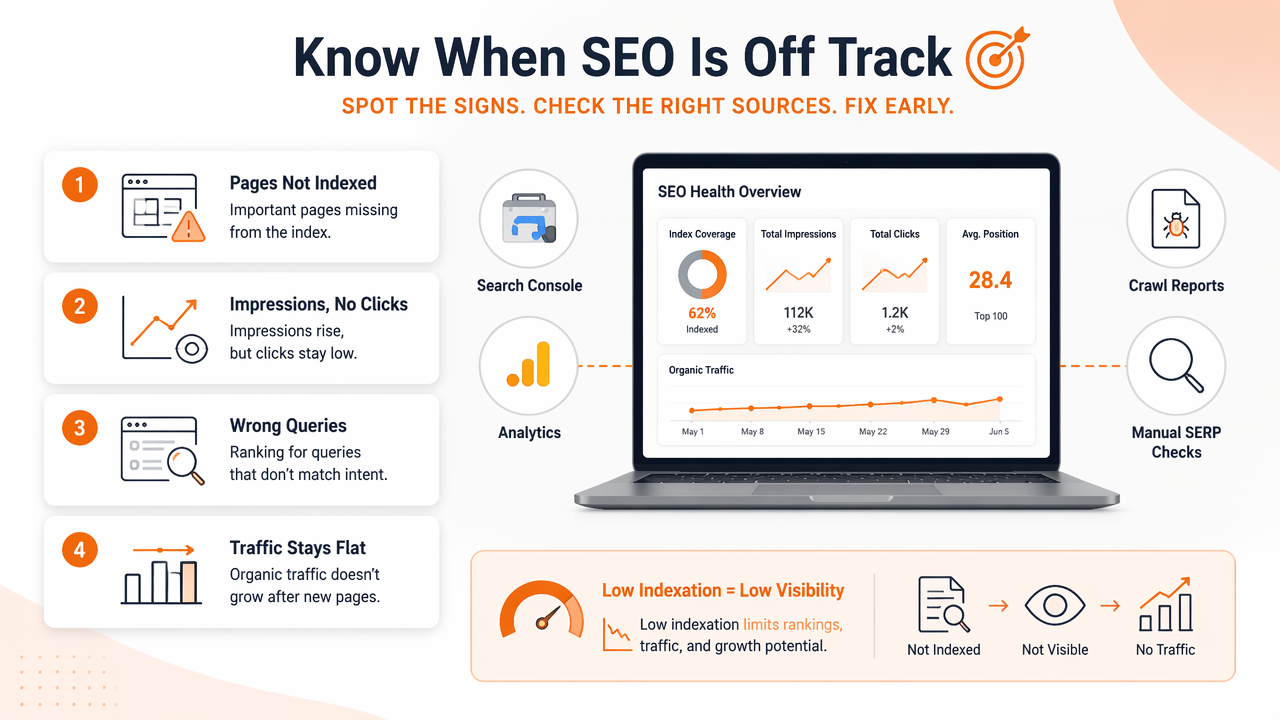
A low click-through rate can mean the page is visible but not compelling. A strong average position with no clicks often points to weak titles, vague meta descriptions, poor brand recognition, or a result that does not match the searcher's intent.
Use a short diagnostic sequence before rewriting pages:
- Check whether the page is indexed.
- Compare the target keyword with actual Search Console queries.
- Review the title tag and meta description for a clear promise.
- Inspect the page on mobile.
- Confirm the page has internal links from relevant pages.
- Compare the page against the current top results.
A FAQ, according to the Wikipedia definition supplied in the research data, is a curated list of questions and answers about misunderstood or important aspects of a topic. New websites should use FAQs only where they answer real buying, booking, or research questions, not as filler.
For teams building a repeatable audit process, the Earlyseo documentation can help turn checks into a repeatable workflow rather than a random monthly review.
Signals that deserve attention first
- Indexed but not ranking: the page may lack depth, backlinks, internal links, or intent match.
- Ranking but not earning clicks: the snippet may be unclear, too generic, or less useful than nearby results.
- Crawled but not indexed: Google may see duplication, low value, or mixed canonical signals.
- Traffic without leads or sales: the page may attract informational searches when the business needs commercial intent.
Research on misinformation and disinformation in social media is not an SEO manual, but it reinforces a useful content lesson: online systems and users reward clearer source signals, stronger evidence, and less ambiguity.
Which technical errors block early rankings?
Technical errors block early rankings when search engines cannot crawl, render, index, or interpret a page correctly. New websites should fix crawl access, canonical tags, redirects, sitemaps, mobile performance, and structured data before chasing backlinks or publishing large volumes of content.

The most common launch issue is accidental noindexing from staging settings. Another frequent issue is a template that creates many near-identical pages, such as location pages with only the city name changed.
Technical SEO should make a useful page easy to discover, not turn a weak page into a strong one.
Technical checklist for new websites
- Submit an XML sitemap after launch and after major URL changes.
- Keep
robots.txtopen for important public pages. - Use one canonical URL for each page.
- Redirect old or duplicate URLs with permanent redirects.
- Compress images before upload, especially hero images.
- Test mobile templates, forms, menus, and checkout flows.
- Add structured data for products, local businesses, articles, FAQs, or breadcrumbs where relevant.
WordPress sites should confirm that theme settings, SEO plugins, and hosting caches do not conflict. The WordPress integration page is useful for teams that want publishing and optimization steps to connect more cleanly.
E-commerce technical issues need separate checks
E-commerce stores have extra risk because filters, variants, tags, and collections can create crawl waste. Product pages also need unique descriptions, availability details, shipping information, review signals, and clear category paths.
Shopify stores should pay special attention to duplicate collection URLs, thin product descriptions, and image-heavy templates. The Shopify integration page gives store owners a cleaner path for connecting content work with store visibility.
Which content, local, and authority habits slow trust?
Content, local, and authority habits slow trust when a new site publishes generic pages, hides business details, ignores internal linking, or builds low-quality backlinks. Search systems need evidence that the business is real, the page is useful, and the website deserves to be cited.
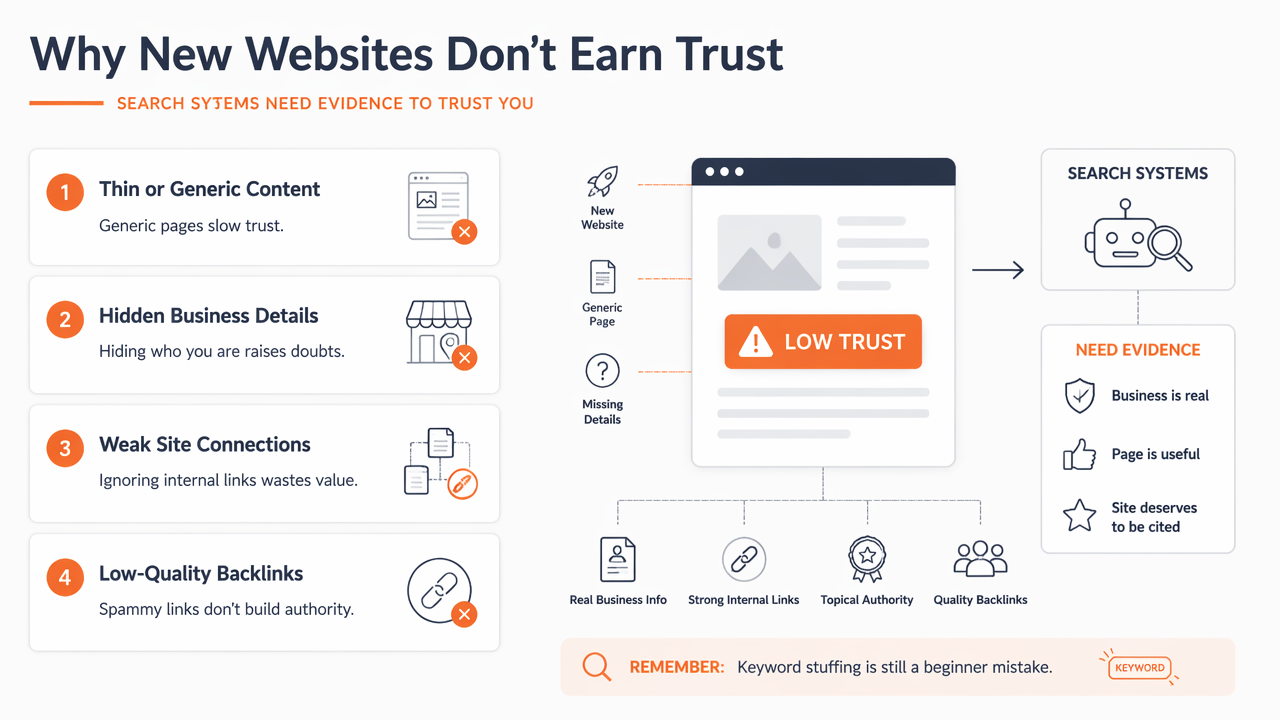
Keyword stuffing is still a beginner problem, but the 2026 version looks different. Instead of repeating one phrase, many pages now repeat the same AI-generated structure, examples, and definitions. That sameness makes a new website harder to distinguish.
A stronger content page usually includes:
- One clear search intent.
- A direct answer near the top.
- Specific examples from the business, product, service, or location.
- Helpful images, tables, or steps.
- Links to related pages.
- Proof such as reviews, policies, author details, or case examples.
Local businesses should not skip Google Business Profile, consistent business details, local landing pages, and review generation. A plumber, clinic, restaurant, or consultant can rank nationally for blog posts and still miss nearby buyers if local signals are weak.
Backlinks also need patience. New domains should avoid spam directories, paid link schemes, and irrelevant guest posts. Better early links come from suppliers, chambers of commerce, local sponsorships, founder interviews, partner pages, and genuinely useful resources.
AI search makes structure more important
Answer engines prefer content that can be extracted without guesswork. A 2023 Artificial Intelligence Review paper on deep learning modelling techniques covers the broader progress and challenges of AI models, which connects to a practical SEO point: machine-readable structure matters.
Definition blocks, comparison tables, concise FAQs, author details, and clean headings help both search engines and AI assistants understand a page. Sites that want to prepare for LLM discovery can review the Earlyseo llms.txt resource as AI-citation practices mature.
How should new websites prevent SEO mistakes in 2026?
New websites should prevent SEO mistakes in 2026 by treating SEO as a launch system, not a late-stage cleanup task. The strongest workflow combines keyword mapping, technical QA, content standards, internal linking, measurement, and AI-search formatting before publishing each important page.
A practical 30-day prevention plan looks like this:
- Map each core page to one primary search intent.
- Create titles and descriptions before design sign-off.
- Crawl the staging site before launch.
- Publish only pages with clear value and unique information.
- Add internal links from navigation and relevant content.
- Submit the sitemap and inspect priority URLs.
- Review Search Console data weekly for the first month.
- Improve pages based on impressions, queries, and click behavior.
The Earlyseo platform fits this positive workflow by helping small teams keep SEO tasks organized across launch, publishing, and measurement. For teams comparing options, more information is available at earlyseo.com.
Future-ready SEO will also depend on cleaner entity signals. Product names, locations, authors, services, policies, and documentation should be easy for both search engines and AI tools to identify. Plain-language pages with structured sections are more durable than pages written only to satisfy a keyword count.
Frequently asked questions
How long does SEO take for a new website?
SEO for a new website often takes months, not days, because search engines need time to crawl pages, test relevance, and compare quality against established competitors. Early wins usually come from branded searches, local pages, low-competition topics, and technically clean pages with precise intent.
Should a new website publish many blog posts quickly?
A new website should not publish many weak posts just to look active. A smaller set of focused pages usually performs better than a large batch of generic articles. Each post should answer a real search query, link to a relevant business page, and add something more useful than the current ranking results.
Are backlinks necessary for a brand-new site?
Backlinks are helpful, but a brand-new site should build them carefully. The safest early sources are real business relationships, local organizations, partners, suppliers, and useful content that earns mentions naturally. Low-quality link packages can create risk without building lasting authority.
Does AI content hurt SEO for new websites?
AI-assisted content does not automatically hurt SEO, but generic, unedited, unsupported content can perform poorly. New websites need human review, accurate facts, original examples, clear authorship, and business-specific details. AI can help with drafts and structure, but trust comes from usefulness and accuracy.
Conclusion
The fastest way to avoid the seo mistakes new websites make is to run SEO before launch, during publishing, and after the first Search Console data arrives. Crawl access, focused pages, useful content, local trust, internal links, and clean measurement create a stronger base than quick fixes after traffic stalls. For a guided setup, Earlyseo helps growing teams turn those steps into a repeatable SEO process. Visit earlyseo.com, choose one priority page, and start with an indexability check, intent review, and internal-link update today.