TL;DR
A new domain should focus first on crawlability, clear site structure, indexable pages, and a small set of high-intent topics. Early wins usually come from specific keywords, local or niche relevance, clean internal links, and consistent publishing rather than broad competitive terms.
A new domain starts with no search history, no authority signals, and no earned trust, so seo for brand new domain needs a tighter plan than SEO for an established site. Search engine optimization: SEO is the practice of improving a website's visibility and performance in search engine results pages by helping search engines understand pages and helping searchers find useful information. For founders and small teams, Earlyseo gives that early setup a focused place to manage pages, content signals, and visibility work without turning launch week into a spreadsheet marathon.
Table of Contents
What is SEO for a brand new domain?
SEO for a brand new domain is the process of making a fresh website crawlable, understandable, useful, and trustworthy before search engines have much performance data. The goal is not instant rankings for broad keywords; the goal is to build a clean foundation that can earn impressions, clicks, links, and branded searches over time.
A fresh domain usually lacks backlinks, historical click data, topical depth, and user behavior signals. That means early SEO work should prioritize clarity over scale.
Key insight: a new domain does not need hundreds of pages at launch; it needs a small number of useful pages that search engines can crawl, index, and connect to a clear topic.
Common early assets include a homepage, core service or product pages, location pages when relevant, a few supporting articles, an XML sitemap, a clear navigation menu, and basic analytics. The Earlyseo documentation can help teams keep setup tasks organized while the site is still small.
Strong early SEO also separates a brand-new site from a domain migration. Competitor articles often focus on changing domains, redirects, and ranking recovery. A clean new domain has a different challenge: it must create relevance and trust from zero.
New domain SEO priorities by launch stage
| Stage | Main job | What to ship |
|---|---|---|
| Pre-launch | Make the site crawlable | Sitemap, robots rules, indexable templates, fast pages |
| Launch week | Give search engines clear context | Homepage, core pages, metadata, internal links |
| First 30 days | Build topical focus | 3 to 8 useful articles or guides tied to commercial pages |
| First 90 days | Earn proof | Backlinks, local citations, reviews, mentions, refreshed content |
| Month 4 onward | Expand what works | New clusters, conversion pages, linkable assets, AI search files |
How should a new domain be prepared before launch?
A new domain should be prepared before launch by fixing crawl access, choosing the right keyword map, publishing essential pages, and connecting tracking tools before the first index request. Pre-launch SEO matters because mistakes in templates, redirects, or noindex tags can slow discovery.
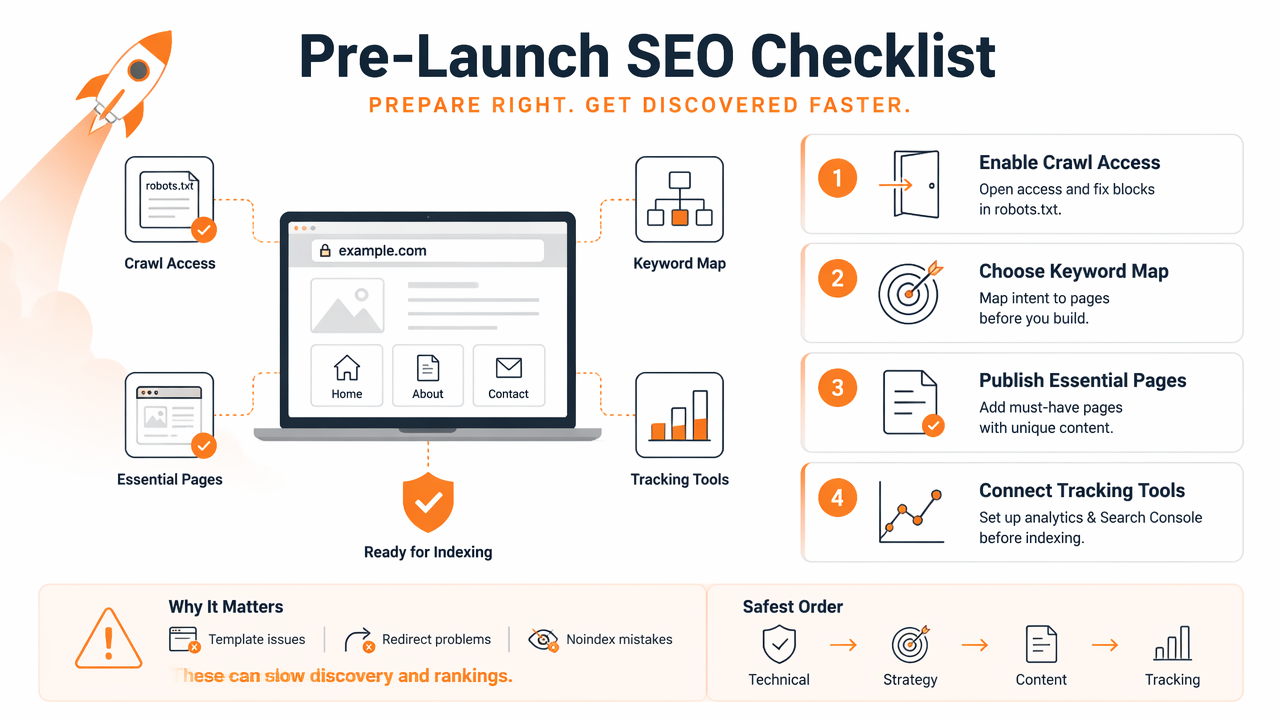
The safest order is technical first, content second, authority third. A beautiful site with blocked pages has no search value, and a fast site with thin pages gives search engines little reason to rank it.
Pre-launch checklist for clean indexing
- Confirm every important page returns a
200status code. - Remove accidental
noindextags from pages meant for Google. - Create an XML sitemap and submit it after launch.
- Keep
robots.txtsimple and avoid blocking CSS, JavaScript, or core folders. - Set one preferred version of the domain, such as
https://example.com. - Write unique title tags and meta descriptions for priority pages.
- Add internal links from the homepage to the most important pages.
- Install analytics and Search Console before promotion starts.
A small site should avoid complex URL experiments at launch. Simple slugs, stable categories, and direct navigation help crawlers and users understand the site faster.
For WordPress launches, the WordPress integration guide is useful when SEO tasks need to fit a common publishing workflow. Shopify stores can follow the Shopify integration setup to keep product and collection optimization closer to store operations.
Metadata and page structure that help early discovery
Each important page needs one clear purpose. A homepage should explain the brand, category, audience, and main offer. A service page should answer what the service is, who it serves, where it is available when location matters, and what action a visitor can take next.
Good structure usually includes:
- One descriptive
H1per page - Short, specific title tags
- Internal links to related pages
- Descriptive image alt text where images add meaning
- Schema markup for organizations, products, articles, or local businesses when accurate
Search engines do not need clever labels. They need consistent signals across headings, copy, links, and URLs.
Which keywords should a new domain target first?
A new domain should target specific, lower-competition keywords that match its strongest commercial or local relevance. Broad keywords can come later, but the first content set should prove topical depth in a narrow area.

The best early keyword map starts with pages that can win because they are specific. A new accounting firm in Austin, for example, has a better starting point with "bookkeeping for Austin restaurants" than "accounting services." An online store may start with product-use queries, comparison terms, or collection-level searches.
Key insight: early keyword research should create a publishing order, not a giant list of phrases that never become pages.
Keyword choices that fit new-domain reality
| Keyword type | Best use | Example pattern |
|---|---|---|
| Branded | Capture direct interest | Brand name, product name, founder name |
| Local | Win nearby intent | Service plus city or neighborhood |
| Long-tail informational | Build topical proof | How to solve a specific problem |
| Commercial niche | Support sales pages | Best tool or service for a narrow audience |
| Comparison | Convert informed buyers | Product A vs Product B, method A vs method B |
A new site should publish around one core topic before expanding. Search engines need repeated evidence that the domain is relevant to a subject, not one isolated post surrounded by unrelated pages.
Earlyseo can support that planning by keeping content work tied to pages rather than random blog ideas. For teams publishing often, the Earlyseo blog hub also gives a natural place to keep learning while building the first content cluster.
A simple first cluster for a service business
A small local service site can start with one commercial page and four supporting articles. The commercial page targets the service and location. The articles answer common buying questions, pricing concerns, process questions, and mistakes to avoid in that category.
A sample cluster could include:
- Main page: "Emergency plumber in Denver"
- Article: "What to do before an emergency plumber arrives"
- Article: "How much does emergency plumbing cost in Denver?"
- Article: "Water shut-off valve locations in older Denver homes"
- Article: "Emergency plumber vs regular plumber: when each fits"
Each article should link back to the main service page where relevant. That internal linking pattern helps the commercial page inherit context from helpful supporting content.
How does a new domain build trust without old backlinks?
A new domain builds trust by combining useful content, consistent brand information, quality external mentions, local proof, and natural backlinks over time. Search engines cannot rely on domain history, so the site must show legitimacy through visible, verifiable signals.
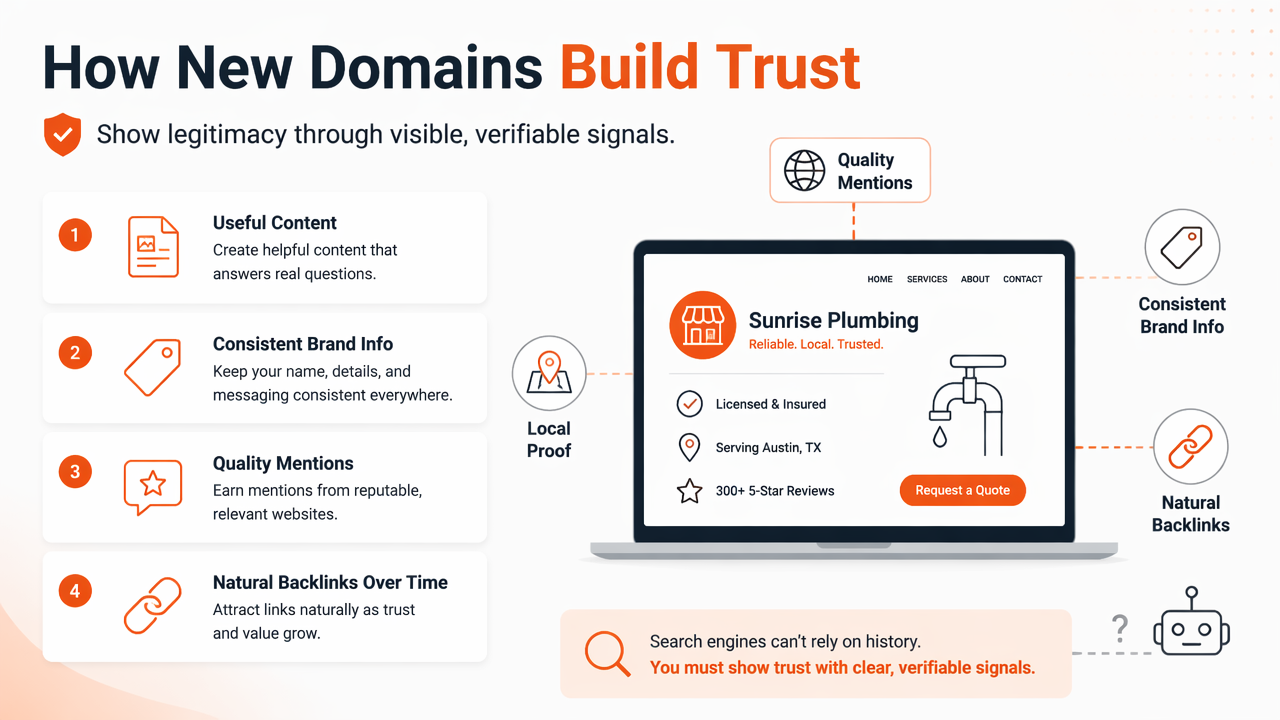
Trust signals differ by business type. A local clinic needs location, staff, services, reviews, and accurate citations. A SaaS startup needs product explanations, documentation, comparison pages, and third-party mentions. An ecommerce site needs product detail, policies, reviews, and clear contact information.
Authority signals that matter early
- Consistent NAP data: Local businesses should keep name, address, and phone details consistent across directories.
- About and contact pages: Real company details reduce uncertainty for users and crawlers.
- Original examples: Screenshots, case details, pricing context, and process notes make pages harder to copy.
- Relevant backlinks: A few links from industry sites, local groups, suppliers, podcasts, or partners can be more useful than many weak links.
- Helpful documentation: Product businesses should publish setup, support, and use-case pages early.
Avoid shortcuts such as mass-generated pages, irrelevant directory blasts, or copied manufacturer descriptions. These create clutter without building a reason to rank.
For startups preparing for AI assistants as well as classic search, publishing a clear AI discovery file can help machines understand site content. The llms.txt resource explains the file pattern for structured AI access.
How Earlyseo handles early visibility work
The Earlyseo platform is built for young sites that need practical SEO steps before a large marketing team exists. It helps organize page-level optimization, publishing priorities, and visibility checks in one workflow.
That matters because new domains often lose momentum after launch. The website goes live, then SEO becomes a vague weekly task. A tool-based process keeps technical checks, content updates, and page improvements connected to growth goals.
Brand recall also matters. A founder can tell a team or contractor to visit earlyseo.com and review the SEO workflow instead of passing around separate notes, exports, and draft documents.
What should happen in the first 90 days?
The first 90 days should turn a new domain from technically live into search-ready, topic-focused, and promotion-worthy. The work should move from setup to publishing, then from publishing to earning proof through mentions and updates.

A realistic new-domain plan avoids daily ranking panic. Search Console impressions may arrive before clicks. Pages may appear for unexpected queries. Early data should guide revisions, not trigger a full strategy reset.
First 90-day SEO schedule
| Timeframe | Focus | Success signal |
|---|---|---|
| Days 1 to 7 | Crawl, index, tracking | Pages appear in Search Console |
| Days 8 to 30 | Publish first cluster | Impressions start on long-tail queries |
| Days 31 to 60 | Improve pages from data | Better titles, clearer sections, stronger internal links |
| Days 61 to 90 | Promotion and authority | Mentions, citations, backlinks, branded searches |
During this period, every update should have a reason. If a page gets impressions but no clicks, the title and meta description may need sharper wording. If a page has no impressions, the issue may be indexing, weak internal links, unclear intent, or competition that is too strong.
A useful 90-day review asks three questions:
- Which pages earned impressions fastest?
- Which queries show buyer or local intent?
- Which pages deserve supporting content or better internal links?
By month three, a new site should have a repeatable publishing and improvement rhythm. That rhythm is more valuable than a one-time launch checklist.
FAQ
New-domain SEO questions usually focus on timing, page count, backlinks, and whether blogging is required. The clearest answers depend on competition, site quality, and consistency, not the age of the domain alone.
How long does SEO take for a brand new domain?
A brand new domain can begin earning impressions soon after indexing, but meaningful traffic usually takes longer because the site has no history or authority. The first 90 days should focus on crawlability, focused content, internal links, and early promotion rather than expecting broad keyword rankings.
How many pages should a new website launch with?
A new website should launch with enough pages to explain the business clearly and support its first topic cluster. For many small companies, that means a homepage, core service or product pages, about and contact pages, policy pages when needed, and a few useful articles tied to the main offer.
Does a new domain need backlinks right away?
A new domain does not need a large backlink profile on day one, but it does need credible external signals over time. Local citations, supplier links, partner mentions, industry directories, guest features, and genuinely useful resources can all help search engines discover and trust the site.
Is blogging required for a new domain?
Blogging is not required for every new domain, but helpful informational pages often support commercial rankings. A service business can use articles to answer buyer questions. An ecommerce site can publish guides, comparisons, and collection support. The key is relevance, not volume.
Conclusion
SEO for brand new domain works best when the first plan is narrow, organized, and measurable. Start with crawlable pages, a focused keyword map, clean internal links, and a 90-day publishing rhythm. Then add trust through mentions, citations, and useful updates. For teams that want a guided system rather than scattered tasks, Earlyseo can turn launch SEO into a repeatable workflow. Visit earlyseo.com, pick the first cluster, and publish the next search-ready page before the week ends.