TL;DR
Fix overlapping pages only when they serve the same search intent and show evidence of competing for visibility. Compare Google Search Console data, choose a primary page, then merge, redirect, rewrite, or clarify internal links while preserving useful content.
Two pages ranking for the same keyword aren't automatically an SEO problem. Keyword cannibalization for small business websites becomes worth fixing when similar pages compete to answer the same search need and the less suitable page attracts visibility that belongs elsewhere.
Keyword cannibalization: Overlap between pages targeting the same search intent that weakens or misdirects organic search performance.
A plumber's emergency service page and a plumbing advice article can share words without competing. Two nearly identical emergency service pages deserve closer inspection. In 2026, the practical goal remains clear: give each valuable search intent a suitable destination, rather than assign every keyword to a separate URL.
Table of Contents
What does keyword cannibalization look like?
Keyword cannibalization looks like multiple pages offering substantially the same answer to the same search intent, with evidence that their overlap harms performance. Repeated keywords alone don't establish a problem. A service page, buying guide, and troubleshooting article can all mention the same topic while satisfying different needs.
Four common small-business page overlaps
Page purpose matters more than matching vocabulary.
| Page type | Potential conflict | Healthy distinction |
|---|---|---|
| Service pages | Two pages sell the same boiler repair service in the same area | Boiler repair and boiler installation address different jobs |
| Location pages | Two URLs target the same service in the same city | Separate towns have genuinely useful local details |
| Product collections | "Running shoes" and "Shoes for running" list the same products | Trail running shoes serve a narrower shopping need |
| Blog posts | Two articles answer "How much does boiler repair cost?" | A pricing guide and a repair-versus-replacement guide answer different questions |
For service companies, service-business SEO guidance helps separate service offers from supporting educational content. Stores need similar distinctions between collections and buying guides; small-store ecommerce SEO provides related planning context.
Search overlap is not sales cannibalization
Marketing cannibalization means a company's new product reduces sales, revenue, or market share for an existing product. Search cannibalization concerns page targeting, not necessarily lost sales.
Tahirov and Glock's 2022 literature review examines manufacturer encroachment and channel conflicts, a different business problem. Ballerini, Herhausen, and Ferraris's 2023 study examines SME ecommerce platform adoption and performance. Neither should be treated as evidence that overlapping keywords automatically reduce rankings.
Shared wording is a clue to investigate, not a reason to delete a page.
How can a small business detect competing pages?
Detect competing pages by pairing Google Search Console query data with a review of page intent:
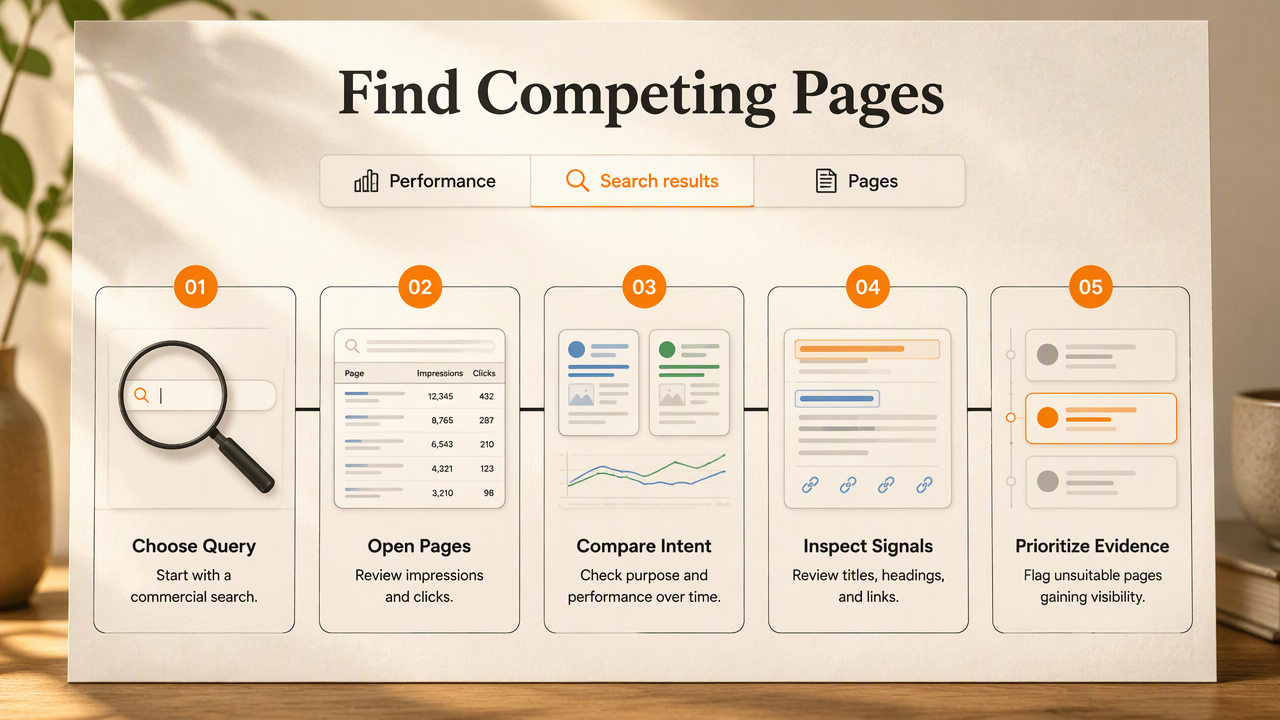
- Select a commercially relevant query.
- Inspect the pages receiving impressions and clicks.
- Compare their purposes and performance over time.
- Check titles, headings, and internal links.
- Prioritize cases where the unsuitable page repeatedly attracts visibility.
Build a short evidence sheet
In Google Search Console, open Performance, select Search results, filter for a query, and examine the Pages tab. Use comparable date ranges and consistent country and device filters. A single snapshot can exaggerate ordinary ranking movement.
Record these fields in a spreadsheet:
- Query or closely related query group
- URLs receiving impressions and clicks
- Intended page and actual page purpose
- Average position and click-through rate
- Leads or sales, where tracking is available
- Proposed action and review date
Average position can shift with devices, locations, and query variations. Ranking swaps alone aren't proof. Stronger evidence combines repeated overlap, similar intent, and a page that doesn't fit the visitor's task.
Confirm the mismatch before editing
A search such as site:example.com "boiler repair" can uncover related pages, but it isn't a complete index report or a performance diagnosis. Read the pages themselves and check which URL navigation and contextual links emphasize.
For example, a plumber might find an old seasonal promotion appearing for the main repair query. If the current service page better matches that query, the promotion deserves review. If an advice article attracts informational searches, keeping both pages may be the right decision.
How should competing pages be fixed?
Fix competing pages according to their purpose, not a blanket deletion rule:
- Keep pages with distinct intent.
- Rewrite pages that need clearer differentiation.
- Merge pages serving the same need.
- Redirect retired URLs to relevant replacements.
- Noindex utility pages only when search visibility isn't needed.
- Clarify internal links to the primary target.
A decision tree for choosing the right action
The first question is whether both pages deserve independent search visibility.
| Decision question | Action | Practical example |
|---|---|---|
| Do both pages satisfy different needs? | Keep and differentiate | Repair service versus repair-cost guide |
| Could one page serve a distinct need? | Rewrite its focus | Change a duplicate guide into a replacement comparison |
| Do both answer the same need with useful material? | Merge content, then redirect | Combine two overlapping pricing articles |
| Is one obsolete with a clear replacement? | Apply a permanent 301 redirect |
Retired service offer to its current equivalent |
| Must the page remain accessible but not searchable? | Consider noindex |
An internal campaign utility page |
| Are pages distinct but links favor the wrong one? | Improve internal linking | Link service mentions to the service page |
Choose the primary page using intent match, useful content, existing performance, relevant backlinks, and business value. The highest-ranking URL isn't always the best long-term destination.
Handle redirects and indexing deliberately
A merge should preserve useful explanations, examples, and answers before the old URL redirects. Update internal links to the final destination and remove retired URLs from the XML sitemap. Avoid sending unrelated pages to the homepage simply to dispose of them.
Use rel="canonical" for duplicate or near-duplicate versions where one preferred URL should represent the content. A canonical is a signal, not a guaranteed instruction, and isn't a replacement for differentiating distinct pages.
A noindex directive removes a page from search eligibility; it doesn't consolidate pages like a redirect. Google must be able to crawl the page to see the directive.
A redirect needs a relevant destination. A page with no suitable replacement needs a separate removal decision.
How can future content stay clearly differentiated?
Prevent future overlap by giving each page a defined search purpose before publication:
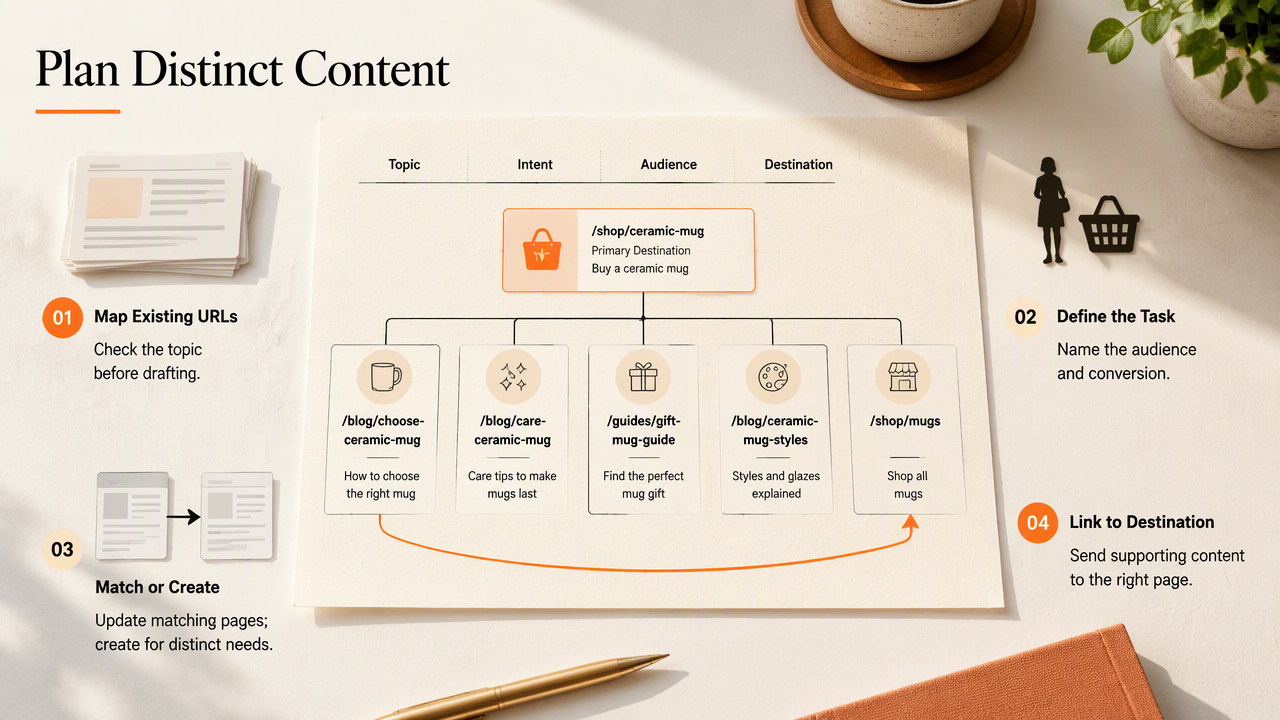
- Map the proposed topic to existing URLs.
- Specify the visitor's task and intended conversion.
- Update an existing page when the purpose matches.
- Create a new page only for a distinct need.
- Link supporting content to the appropriate commercial destination.
Assign page roles before drafting
A simple content map can record a primary topic, intent, audience, destination, and supporting pages. One URL can cover several closely related phrases. Finding low-competition keywords should expand useful coverage, not generate one article per wording variation.
Location pages benefit from genuine differences such as service availability, local examples, and area-specific information. A local business SEO playbook provides a broader framework for organizing those pages.
Website analysis as a planning starting point
Website analysis gives content planning a concrete starting point: the pages already published and the roles they should serve.
The website-analysis page from Earlyseo is a relevant starting point for businesses exploring site review. Search Console evidence and a written page map can guide the editorial decisions that follow.
- Assign a clear commercial destination for each core offering.
- Give supporting articles distinct questions to answer.
- Record changes so later performance comparisons remain meaningful.
FAQ: Ranking overlap and recovery
Ranking overlap needs case-by-case interpretation because shared keywords, indexing choices, and recovery timelines describe different issues.
Can two pages rank for the same keyword?
Two pages can rank for the same keyword without needing a fix. Search results can reflect several intents, and different pages may satisfy different visitors. Review whether each URL offers distinct value and whether the intended page attracts relevant traffic. Shared keywords alone don't establish harmful competition.
Should overlapping pages always be noindexed?
Overlapping pages shouldn't automatically be noindexed. Distinct pages may only need clearer targeting or internal links. Duplicate articles may benefit from merging and redirecting instead. Reserve noindex for pages that need to remain accessible but shouldn't appear in search, after considering their traffic, links, and business purpose.
How long does recovery take after a fix?
Recovery has no fixed timeline because Google must recrawl and reassess changed pages. Track the intended URL's query visibility alongside clicks and conversions, using comparable reporting periods. Log the implementation date and avoid repeated changes before enough evidence accumulates. Improved page clarity doesn't guarantee a particular ranking increase.
Conclusion
Resolving keyword cannibalization for small business websites starts with one confirmed overlap, not a site-wide purge. Select a valuable query, compare its URLs, document the preferred destination, and apply the smallest suitable change.
For a structured next step, explore Earlyseo. Businesses can visit earlyseo.com while building a page map and scheduling a follow-up performance review.