TL;DR
Automated SEO reporting works best when software collects repeatable data, while humans interpret priorities, risks, and next steps. The strongest setup tracks traffic, rankings, conversions, content output, technical health, and AI visibility in separate weekly and monthly views.
Automated SEO reporting turns scattered SEO data into a repeatable decision system, not just a prettier dashboard. For founders, local businesses, ecommerce stores, and lean marketing teams, the real win is faster action: spot ranking drops, connect content work to conversions, and decide what needs attention next. The Earlyseo platform fits this workflow by pairing SEO operations with content execution, so reports connect naturally to publishing plans instead of sitting in a folder.
Table of Contents
What is automated SEO reporting?
Automated SEO reporting is the scheduled collection, organization, and delivery of search performance data from tools such as Google Search Console, analytics platforms, rank trackers, crawlers, and content systems. It helps teams monitor SEO visibility, traffic, technical health, and business outcomes without rebuilding the same report by hand every week.
Automated SEO reporting: a process that pulls SEO data into recurring dashboards or documents, then highlights performance changes, risks, and next actions.
Search engine optimization means improving the visibility and performance of websites and pages in search engine results. In a reporting workflow, that broad goal becomes measurable through rankings, impressions, clicks, conversions, indexation, page quality, and content output.
Key insight: automation should remove repetitive data collection, not replace judgment about strategy, intent, content quality, or business impact.
Manual reporting versus automated reporting
Manual reports often depend on screenshots, copied tables, and last-minute commentary. Automated reports depend on reusable data connections, scheduled refreshes, and standard sections.
| Reporting area | Manual approach | Automated approach |
|---|---|---|
| Data collection | Copy metrics from several tools | Pull metrics from connected sources |
| Delivery | Build slides or sheets each cycle | Send recurring dashboards or summaries |
| Consistency | Format changes often | Same structure every period |
| Analysis | Time goes into assembly | Time goes into interpretation |
| Best fit | One-time audits | Weekly, monthly, and client reporting |
Automation can also support technical workflows. Research by Pereira, Martin, and Roussel on asynchronous computing tasks examined how systems can suspend and resume work around events, a useful parallel for reporting pipelines that wait for data refreshes before creating outputs (2023 paper).
Which SEO metrics should be automated?
The best metrics to automate are repeatable, time-based signals that reveal movement across acquisition, visibility, conversion, content production, and technical health. Strategic interpretation should stay human because context changes the meaning of the numbers.
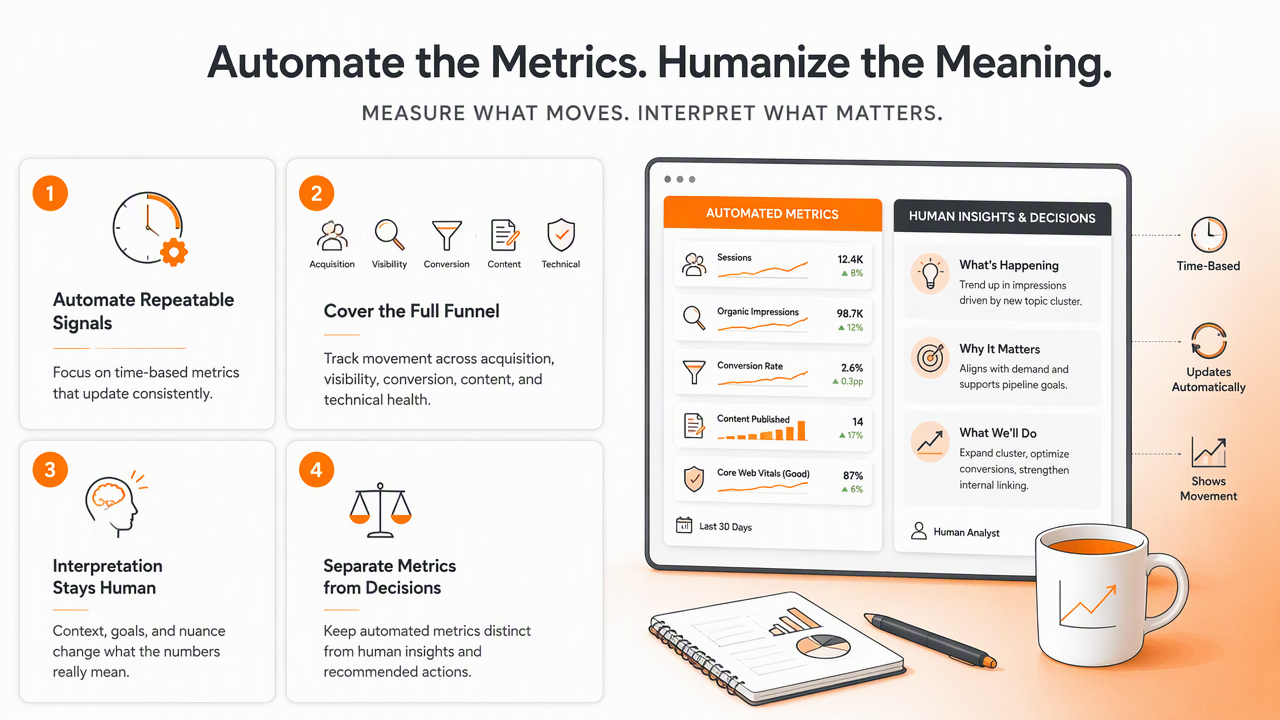
A useful report separates automated metrics from decision notes. Ranking drops need diagnosis. Traffic gains need attribution. Conversion changes need channel and landing page context. AI visibility mentions need source checks because summaries can shift by query phrasing and model behavior.
Metric categories for recurring reports
| Category | Automate these metrics | Needs human interpretation |
|---|---|---|
| Organic traffic | Sessions, users, clicks, impressions | Seasonality, brand demand, campaign effects |
| Rankings | Keyword position, URL movement, SERP features | Search intent changes, competitor changes |
| Conversions | Leads, purchases, assisted conversions | Offer strength, attribution limits, sales quality |
| Content output | Published pages, refreshed pages, briefs completed | Topic fit, originality, internal link quality |
| Technical SEO | Crawl errors, 404s, redirects, index coverage | Severity, fix order, developer effort |
| AI visibility | Mentions in AI answers, cited pages, entity coverage | Accuracy, brand positioning, citation gaps |
For teams building the operating layer behind these sections, SEO operations should connect reporting with tasks, owners, and content queues. A report that shows a problem but creates no owner usually becomes background noise.
Metrics that belong in alerts
Some signals deserve fast alerts instead of waiting for a monthly review:
- Sharp drops in clicks or impressions for revenue pages
- Indexing changes on key templates, product pages, or service pages
- New 404 errors from important internal links
- Ranking drops for high-intent keywords
- Conversion tracking outages or missing events
- Sudden AI answer changes for branded or category queries
AI analysis can speed up review, but it still needs checks. A 2023 Nature paper by Singhal and coauthors studied large language models encoding clinical knowledge, showing how advanced models can handle complex information while still requiring careful evaluation in high-stakes settings (Nature, 2023). SEO reporting has lower stakes, yet the lesson holds: machine summaries need human validation.
How should weekly and monthly SEO reports be structured?
Weekly reports should focus on movement and immediate action, while monthly reports should explain strategy, business impact, and priorities for the next cycle. A weekly view keeps execution honest. A monthly view keeps leadership aligned.
The cleanest format starts with an executive summary, then separates traffic, rankings, conversions, content, technical issues, and AI visibility. Agencies can adapt the same structure for clients using a repeatable SEO reporting template, while internal teams can tie each section to a sprint board or content calendar.
Sample weekly report sections
- Top movement: biggest ranking gains, ranking losses, traffic spikes, and traffic drops.
- Action queue: tasks opened, tasks completed, blocked items, and owner names.
- Traffic pulse: clicks, impressions, organic sessions, and landing pages with major changes.
- Content output: pages published, pages updated, briefs approved, and internal links added.
- Technical watchlist: crawl errors, indexation changes, broken links, and slow templates.
- AI visibility checks: branded mentions, cited pages, and missing citations for priority topics.
Weekly reporting should answer one question: what changed enough to require action before the next week ends?
Sample monthly report sections
| Monthly section | What it should show | Decision it supports |
|---|---|---|
| Executive summary | Wins, losses, and priority actions | Leadership alignment |
| Organic acquisition | Traffic by page type and query group | Channel investment |
| Rankings and SERPs | Keyword clusters, competitors, SERP features | Topic and page priorities |
| Revenue or leads | Organic conversions and landing page value | Budget and forecasting |
| Content production | New pages, refreshes, briefs, and gaps | Publishing capacity |
| Technical health | Indexation, crawlability, redirects, speed issues | Fix sequencing |
| AI visibility | AI mentions, cited URLs, entity gaps | Answer-engine optimization |
A 90-day cycle works especially well for new sites because it gives enough time to publish, measure, and adjust. A business building that cadence can pair monthly reporting with a 90-day SEO sprint so reports feed the next set of tasks.
How Earlyseo turns reports into action
Earlyseo helps connect SEO reporting to execution by tying content planning, competitor awareness, and operations into the same workflow. That matters because many dashboards show what happened, while growing teams need to know what should happen next.
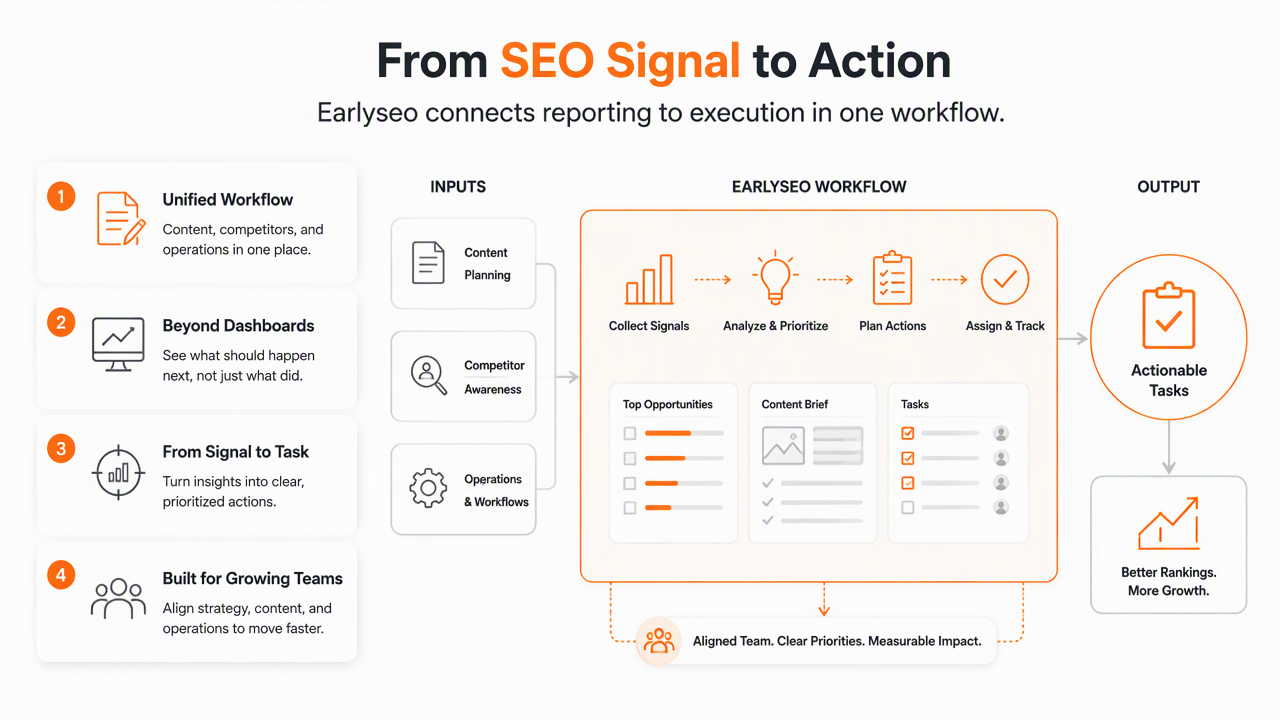
A practical reporting system should move from signal to task. For example, a ranking decline might trigger a content refresh brief. A competitor gaining AI citations might trigger a comparison update. A technical issue on product pages might trigger a template fix before more content gets published.
Action framework for report findings
| Report finding | Likely next action | Earlyseo fit |
|---|---|---|
| Competitor earns more visibility for a topic | Update content angle and SERP coverage | Use competitor-aware SEO content planning |
| New blog has weak topical depth | Build supporting articles and internal links | Use a structured new blog content strategy |
| Ecommerce pages get impressions but few clicks | Improve category and product content | Follow a Shopify SEO workflow |
| Local service pages rank unevenly | Separate service, location, and proof sections | Apply local business SEO |
| International pages underperform | Review language targeting and localized content | Use international SEO guidance |
The Earlyseo platform is most useful when reports include a clear next-step field beside each metric. That field turns a dashboard into an operating habit.
What to expect in 2027
SEO reporting will likely track more answer-engine visibility, not just classic blue-link rankings. Google AI features, ChatGPT-style answers, and other AI search surfaces are making citation quality, entity clarity, and source coverage harder to ignore.
Reports should begin storing AI visibility snapshots now:
- Priority prompts or queries tested each month
- Brand mention presence or absence
- Pages cited by AI systems when visible
- Competitors cited for the same query set
- Content gaps that prevent citation-worthy answers
Earlyseo is positioned for that shift because content operations and visibility tracking increasingly belong together. For teams comparing workflows, earlyseo.com offers a practical place to review how reporting, content production, and SEO execution can stay connected.
Frequently asked questions
Automated reports work best when they answer common operating questions in a consistent format. The following answers cover cadence, tools, AI metrics, and the line between automation and expert review.
How often should SEO reports be automated?
Most teams should automate weekly and monthly SEO reports. Weekly reporting should focus on changes that need quick action, such as traffic drops, ranking movement, indexing issues, and publishing progress. Monthly reporting should focus on business outcomes, strategy changes, content performance, technical trends, and priorities for the next cycle.
Can automated reports replace an SEO specialist?
Automated reports cannot replace an SEO specialist because data still needs context. A dashboard can show that impressions dropped, but a specialist checks seasonality, query intent, competitor changes, technical issues, and content quality. Automation removes repetitive work so expert time can move toward diagnosis and prioritization.
What is the biggest reporting mistake small businesses make?
The biggest mistake is tracking too many metrics without linking them to decisions. A small business usually needs a short report covering organic traffic, leads or sales, top pages, local or product visibility, content output, technical issues, and next actions. Extra charts add little value unless they change what happens next.
Should AI visibility be included in SEO reports?
AI visibility should be included when searchers in a market use AI answers to compare brands, products, services, or advice. The report should track whether the brand is mentioned, which pages are cited, which competitors appear, and what content gaps might explain missing citations. Manual review is still needed because AI answers can vary.
Conclusion
Automated SEO reporting should make SEO easier to act on, not harder to understand. The right setup collects repeatable metrics, separates weekly movement from monthly strategy, adds AI visibility signals, and assigns next steps to real owners. For teams ready to connect reporting with content execution, Earlyseo and the resources on earlyseo.com can help turn search data into a practical operating rhythm.