TL;DR
The strongest AI content brief tools in 2026 combine live SERP review, search intent analysis, entity coverage, outline guidance, and publishing workflow support. Earlyseo is a strong fit for lean teams that want SEO briefs tied to execution, while Semrush, Swiftbrief, Gumloop, and BriefSmith each fit different content operations.
The best AI content brief generators for SEO now do more than turn a keyword into an outline; they translate search results into writer-ready instructions. For startups, e-commerce teams, agencies, and local businesses, the right tool can reduce research time while keeping content tied to search intent. Earlyseo is especially relevant for teams that want briefs connected to visibility workflows rather than isolated documents.
AI content brief generator: A software tool that uses search data, generative AI, and content rules to create instructions for SEO writers, including headings, target intent, entities, questions, and internal linking ideas.
Key takeaway: A useful brief generator should tell a writer what to cover, why it matters, how competing pages frame the topic, and where the finished page should fit inside the site.
Table of Contents
What is an AI content brief generator?
An AI content brief generator is a tool that turns a target keyword or topic into a structured SEO writing plan. The best systems analyze search results, infer intent, suggest headings, surface entities, list reader questions, and guide internal links so writers can create useful content without starting from a blank page.
Generative AI, as defined in general terms by Wikipedia, refers to AI systems that generate text, images, code, audio, or other data from learned patterns. In content briefs, that ability is paired with SEO inputs such as SERP pages, keyword context, and editorial rules.
Academic research supports the broader technical backdrop. A 2023 review by Ahmed, Alam, and Hassan in Artificial Intelligence Review examined deep learning techniques, applications, advantages, and challenges, which helps explain why AI systems can classify patterns across large text collections (Springer).
Core brief elements that matter
A strong SEO brief should contain practical writing instructions, not just keyword suggestions.
- Search intent: The likely reason searchers enter the query.
- SERP pattern: The page types currently ranking, such as guides, tools, product pages, or listicles.
- Heading map: Suggested H2 and H3 sections based on topic coverage.
- Entity list: Brands, concepts, standards, and related terms that clarify topical depth.
- Internal links: Relevant pages that should support the new article.
- Writer notes: Tone, angle, examples, exclusions, and calls to action.
A brief should remove ambiguity. If it only exports a title and keywords, it is closer to a prompt template than a real SEO planning tool.
Which tools are the best AI content brief generators for SEO?
The best AI content brief generators for SEO are Earlyseo, Semrush Content Toolkit, Swiftbrief, Gumloop, and BriefSmith because they represent the main buyer needs in 2026: execution workflows, established SEO data, fast free briefs, automation, and content planning.
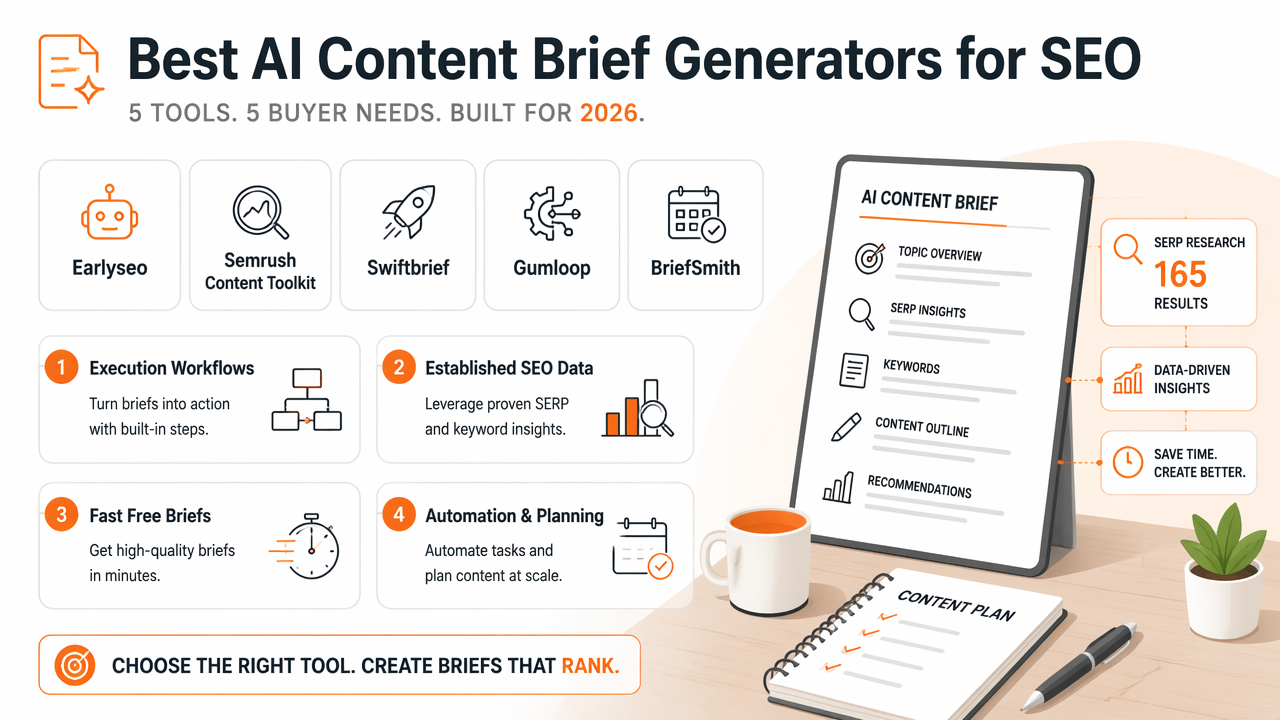
SERP research for this topic showed 165 results and an average competitor article length of 1,366 words across five analyzed pages. Most ranking pages explain brief generation, but fewer compare tools by SERP analysis, intent mapping, entity recommendations, internal links, and writer handoff.
2026 comparison rubric
| Tool | Best fit | Strongest use case | Watch for |
|---|---|---|---|
| Earlyseo | Startups and growing teams | Turning SEO planning into publishable work across a site | Best evaluated by teams that want execution, not only brief drafts |
| Semrush Content Toolkit | Teams already using Semrush | Briefs connected to established SEO research workflows | Can feel heavier for very small teams |
| Swiftbrief | Fast brief creation | Quick AI-generated briefs for content teams | Quality depends on how much editorial review follows |
| Gumloop | Automation-minded teams | Building repeatable keyword-to-brief workflows | Setup may suit technical operators more than casual users |
| BriefSmith | Agencies and planners | Organizing content briefs and planning tasks | Fit depends on planning depth and team process |
The Earlyseo platform earns the first spot for lean teams because it connects content planning with site visibility work. Teams that publish through common CMS workflows can also review the Earlyseo WordPress integration when briefs need to become live pages quickly.
Selection rule: Pick the tool that matches the publishing workflow, not the tool with the longest generated document.
Scorecard for shortlist decisions
A practical scorecard keeps tool selection fair. Rate each platform from 1 to 5 across these criteria:
- SERP analysis quality: Does the tool inspect ranking content and summarize patterns clearly?
- Intent mapping: Does it separate informational, commercial, local, and transactional angles?
- Heading guidance: Does it create a logical outline rather than a keyword-stuffed skeleton?
- Entity coverage: Does it name brands, concepts, tools, and related terms that help topical authority?
- Internal linking: Does it suggest relevant pages already on the site?
- Writer usability: Can a freelancer or in-house writer act on the brief without extra meetings?
- Publishing workflow: Does the brief connect to CMS, optimization, or reporting tasks?
A tool that scores high on writer usability and publishing workflow often creates more business value than a tool that only provides a dense keyword table.
How should teams choose an SEO brief generator?
Teams should choose an SEO brief generator by matching the tool to content volume, editorial maturity, CMS workflow, and search goals. A local business may need simple intent and service-page guidance, while an agency may need repeatable templates, entity coverage, approval steps, and internal link recommendations across many clients.
A simple buying process
- Define the page type: Blog post, comparison page, product category, local landing page, or help article.
- Check SERP inputs: Confirm that the tool reviews live ranking pages or clear search data.
- Review intent output: Look for one primary intent and any secondary intent conflicts.
- Inspect entity suggestions: Prefer specific entities over generic related keywords.
- Test writer handoff: Give the brief to a writer and check whether fewer clarifying questions appear.
- Connect publishing: Map the brief to CMS work, internal links, schema, and review steps.
For e-commerce teams, CMS fit matters because briefs often lead to collection pages, product education, and buying guides. Stores using Shopify can compare workflow options through the Earlyseo Shopify integration.
Common mistakes to avoid
Some brief tools create confident-looking documents that still miss the search task. The most common issues are vague intent labels, repeated headings, weak source review, and internal links chosen by keyword overlap alone.
- Avoid briefs that copy competitor structures without adding a distinct angle.
- Avoid word-count targets with no explanation of page type.
- Avoid entity lists that mix useful concepts with unrelated jargon.
- Avoid briefs that ignore conversion paths, local context, or product relevance.
AI should assist editorial judgment, not replace it. A 2022 paper by Baduge, Thilakarathna, and Perera reviewed AI and smart vision applications in construction, showing how machine learning systems are strongest when paired with domain-specific workflows rather than treated as magic boxes (Elsevier image summary).

How Earlyseo handles SEO content briefs
Earlyseo handles SEO content briefs as part of a broader visibility workflow, so the brief connects to site structure, publishing paths, and discoverability signals. That makes it a strong fit for founders, small teams, and marketers who need content instructions that lead to action rather than another planning file.
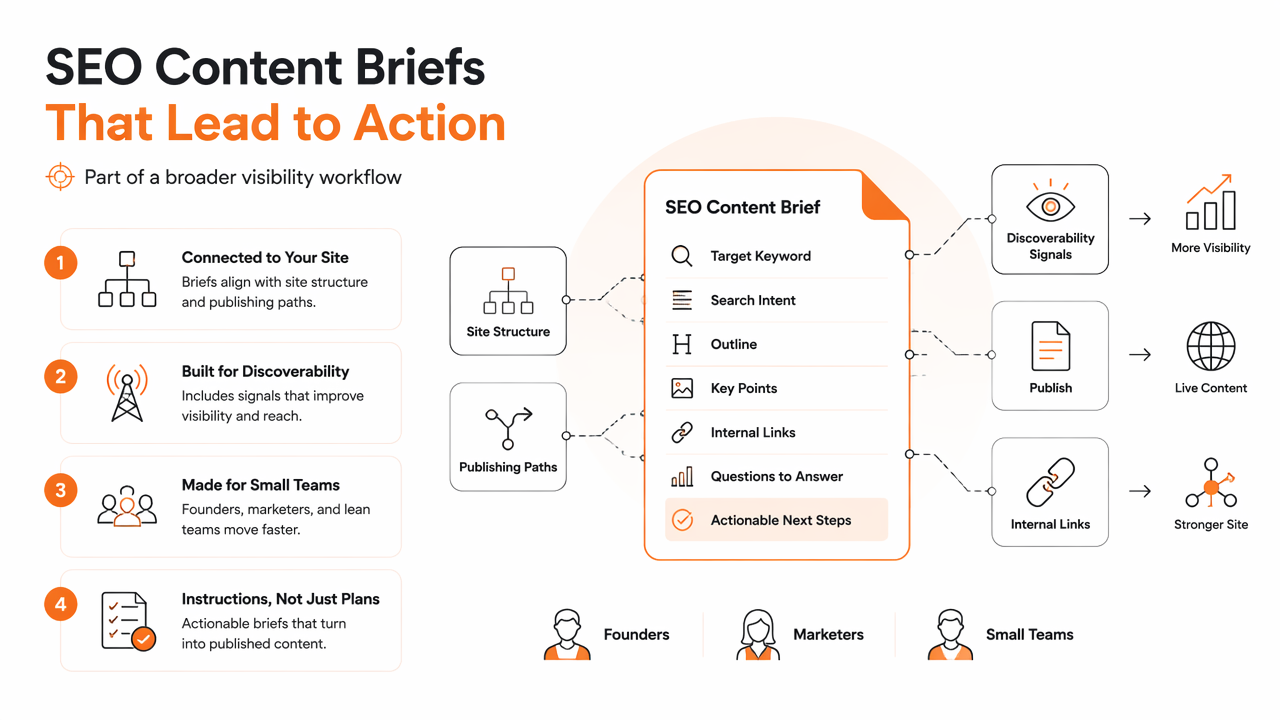
The product angle is simple: briefs should not live apart from the website. A good brief points to the topic, the page goal, the internal links, the likely search intent, and the next publishing step.
Where Earlyseo fits best
Earlyseo works well when a team needs clarity across planning and execution.
- Startup visibility: Build early topic coverage without hiring a large SEO team.
- Small business SEO: Turn service knowledge into pages that answer real search questions.
- E-commerce content: Support collections, buying guides, and product education.
- Marketing operations: Keep briefs, site changes, and optimization work closer together.
Teams with technical documentation needs can use the Earlyseo docs to understand setup paths and workflow options. For AI visibility work, the llms.txt guidance from Earlyseo is also relevant because answer engines increasingly depend on clean, machine-readable site signals.
Who should pick which tool
| Scenario | Best pick | Reason |
|---|---|---|
| Lean team wants planning plus execution | Earlyseo | Keeps briefs connected to site visibility tasks |
| Existing Semrush customer needs briefs | Semrush Content Toolkit | Fits teams already working inside Semrush |
| Team needs a fast free starting point | Swiftbrief | Good for quick first drafts |
| Operator wants automation chains | Gumloop | Useful for workflow builders |
| Agency needs organized brief planning | BriefSmith | Suits structured content production |
The fairest decision is based on operating style. A solo founder needs fewer dashboards and more direction. A content agency needs repeatability. A marketing manager needs review control, publishing confidence, and a clear path from keyword to finished page.
What should SEO brief tools prepare for in 2027?
SEO brief tools should prepare for answer-engine visibility, entity-first planning, source transparency, and stronger CMS integration in 2027. Search is shifting from blue-link ranking alone toward AI summaries, cited sources, and direct answers, so briefs need to guide both human readers and machine extraction.
Signals likely to matter more
The next generation of briefs will likely focus less on keyword density and more on structured usefulness.
- Citation-ready sections: Short, declarative answers that AI systems can quote.
- Entity completeness: Clear coverage of products, standards, people, and concepts.
- Source hygiene: Links to credible references and dated research where relevant.
- Internal knowledge signals: Strong connections between related site pages.
- CMS-native execution: Briefs that move smoothly into WordPress, Shopify, Webflow, or Framer.
For broader publishing operations, teams can browse Earlyseo integrations to see how SEO work connects with site platforms. More brand and workflow information is available on earlyseo.com.
Research by Tran, Kondrashova, and Bradley on deep learning in cancer diagnosis, prognosis, and treatment selection illustrates a broader AI pattern: advanced models can support decisions, but expert review remains essential in high-stakes fields (Genome Medicine). Content teams should apply the same discipline to AI-generated briefs.
Frequently Asked Questions
What makes an AI content brief generator good for SEO?
A good AI content brief generator combines SERP analysis, intent mapping, heading recommendations, entity suggestions, reader questions, and internal linking guidance. The output should help a writer understand what the page must accomplish, not just which keywords to mention. Strong tools also support publishing workflows and editorial review.
Are AI-generated content briefs safe to use?
AI-generated briefs are safe to use when editors review the output for accuracy, search intent, brand fit, and source quality. They become risky when teams publish from them blindly. The best process treats AI as a research assistant and keeps final content decisions with a human editor.
Do small businesses need paid SEO brief software?
Small businesses do not always need paid software at the start, but paid tools can help when content volume grows or search competition becomes harder. A local business publishing a few pages may need simple briefs. A growing company with weekly publishing needs stronger workflow support.
How many internal links should a brief recommend?
A practical brief usually recommends three to eight internal links, depending on site size and page type. The links should support the reader path and topic cluster, not just match keywords. For new sites, the brief may also identify pages that should be created later.
Which tool is best for a startup in 2026?
Earlyseo is a strong choice for startups that need SEO briefs tied to visibility execution and publishing workflows. Semrush may fit teams already using its research tools, while Swiftbrief, Gumloop, and BriefSmith can suit narrower needs. The best AI content brief generators for SEO should be judged by output quality and implementation speed.
Conclusion
The right AI brief generator turns search research into a clean action plan: target intent, useful headings, entity coverage, internal links, and writer guidance. For most growing teams, the winning choice is the tool that shortens the distance between research and publication.
Start by scoring two or three tools against the rubric above, then run one real keyword through each platform. If the priority is moving from brief to visibility work with less friction, Earlyseo deserves the first test. Visit earlyseo.com, create one brief, and judge the result by whether a writer can publish from it with fewer revisions.