TL;DR
Content publishing automation works best when it handles repetitive production steps while editors keep control of strategy, facts, and final approval. The highest-value workflow automates formatting, metadata, internal links, featured images, CMS upload, QA checks, and post-publish monitoring.
Publishing speed is often an SEO problem disguised as a content problem. Content publishing automation for SEO uses software to turn approved briefs, drafts, assets, metadata, links, and QA rules into publish-ready pages with less manual CMS work. A content management system, commonly called a CMS, is software used to create, manage, modify, and publish digital content, which makes it the natural place where automation either saves hours or creates messy errors. Platforms such as Earlyseo fit this need by helping growing teams move from content planning to search-ready publishing without treating human review as optional.
Table of Contents
What is content publishing automation for SEO?
Content publishing automation for SEO is the use of software, structured workflows, and AI-assisted checks to prepare, optimize, publish, and monitor web content at scale. It does not replace editorial judgment; it removes repeatable tasks such as formatting, metadata entry, internal linking, image handling, CMS upload, and technical QA.
Content publishing workflow: the ordered process that moves a page from keyword idea to live URL, including brief creation, drafting, editing, optimization, publishing, and performance review.
A strong workflow connects content management, search intent, on-page SEO, and CMS operations. That matters because content management is not only storage; it includes the processes and technologies used to collect, manage, and publish information in digital form.
Key insight: Automation should make publishing more consistent, not less accountable.
Tasks automation should handle first
The best candidates are repetitive, rule-based, and easy to verify. Strategy, expert review, original examples, and brand judgment should stay with humans.
- Formatting: headings, tables, lists, schema blocks, excerpts, and callouts.
- Metadata: title tags, meta descriptions, slugs, canonical settings, and Open Graph text.
- Internal links: relevant anchor suggestions, target URL checks, and broken-link prevention.
- Images: featured image assignment, alt text drafts, compression, and filename cleanup.
- CMS upload: draft creation, field mapping, scheduling, and status changes.
- QA checks: missing H1s, duplicate titles, thin sections, link errors, and indexability checks.
- Monitoring: ranking changes, traffic shifts, crawl issues, and refresh alerts.
Research on automation in knowledge work supports a careful approach. A 2021 Nature Machine Intelligence paper by Rens van de Schoot, Jonathan de Bruin, and Raoul Schram examined an open source machine learning framework for efficient and transparent systematic reviews, a useful parallel for SEO teams that need automation with traceability rather than black-box output research paper.
Where do publishing bottlenecks usually happen?
Publishing bottlenecks usually happen after the draft is approved, when teams still need to format the page, add metadata, pick images, insert links, upload content, run QA, and track results. These steps look small alone, but together they slow every campaign and create avoidable quality gaps.
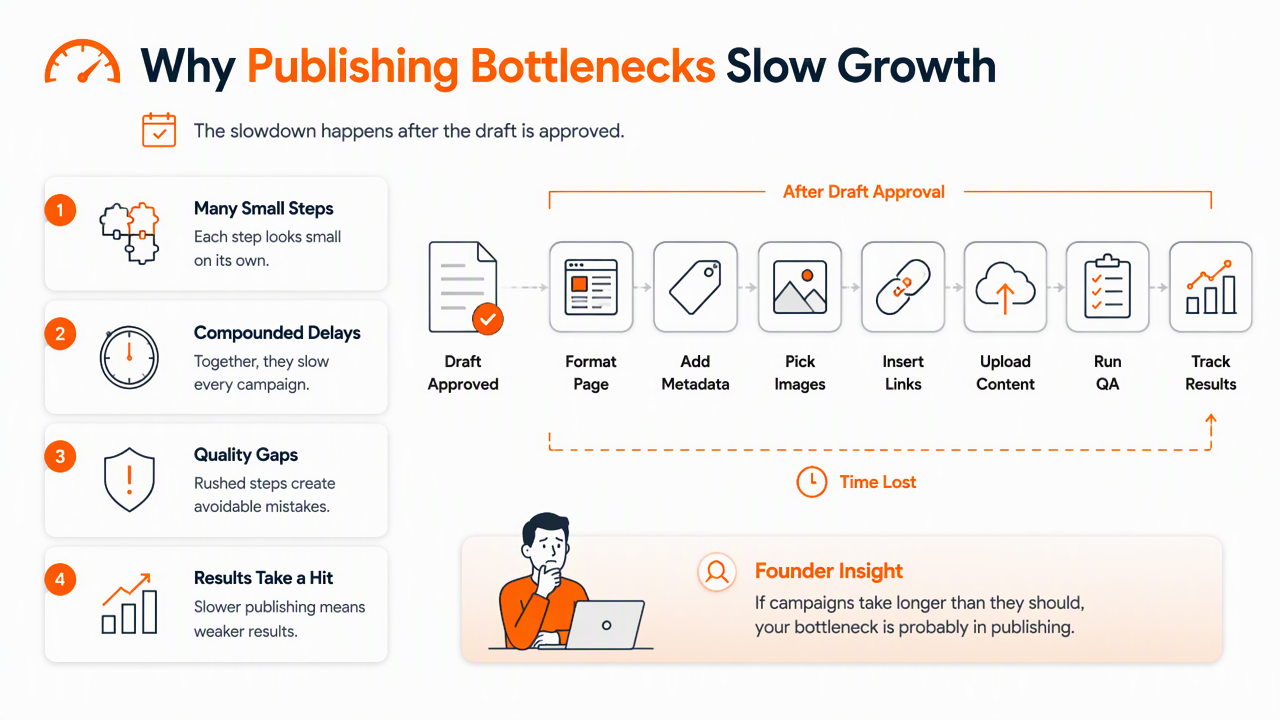
A founder may notice the delay as "content is stuck." A marketing manager sees the details: missing internal links, inconsistent slugs, uncompressed images, forgotten schema, and published pages that no one checks again.
Manual steps versus automated controls
| Publishing step | Manual bottleneck | Automated control | Human review role |
|---|---|---|---|
| Formatting | Editors rebuild headings and tables in the CMS | Template rules convert approved content into CMS-ready blocks | Confirm readability and layout |
| Metadata | Titles and descriptions are pasted by hand | Fields are generated from brief data and length rules | Approve accuracy and search intent |
| Internal links | Links depend on memory or spreadsheets | Suggested links match topic, anchor, and URL rules | Reject irrelevant anchors |
| Featured images | Image search and resizing take time | Image fields, filenames, and alt drafts are prepared | Check brand fit and factual accuracy |
| CMS upload | Copy-paste causes spacing and field errors | API or importer maps content into CMS fields | Preview before publish |
| QA checks | Issues are found after launch | Rules flag missing tags, broken links, and index settings | Resolve exceptions |
| Monitoring | Performance review is forgotten | Alerts surface drops, gains, and refresh needs | Decide updates and priorities |
Poor automation can also scale poor inputs. Duplicate angles, weak sourcing, and bland AI copy become bigger problems when the CMS receives content faster than editors can inspect it.
A practical guardrail is to separate production automation from editorial approval. The system can prepare the page, but a named reviewer should own the publish decision.
For teams still building the strategy layer, the guide to content strategy for new blogs and SEO is a useful starting point before automating production.
How should a human-review workflow work?
A human-review workflow should assign automation to repeatable production tasks and assign people to decisions that affect accuracy, usefulness, brand risk, and commercial intent. The cleanest model is a gated workflow: plan, generate, optimize, review, publish, monitor, and refresh.
The review process should be visible inside the same system or project board used for publishing. Hidden approvals in chat threads create confusion, especially when several pages move at once.
Seven-step workflow for safer automation
- Plan the page: Confirm keyword intent, audience, business goal, and page type.
- Create the brief: Define headings, entities, sources, internal links, and conversion points.
- Prepare the draft: Use AI or human writers, but keep source requirements clear.
- Run SEO checks: Validate title, meta description, headings, links, schema, and image fields.
- Review facts and brand fit: Assign an editor or subject expert to approve claims.
- Publish through the CMS: Push the approved page to draft, preview, or scheduled status.
- Monitor and refresh: Track indexing, rankings, clicks, conversions, and decay signals.
A strong brief reduces review time because the editor checks against clear requirements instead of guessing what the page was supposed to do. The SEO content brief template shows the kind of structure that makes automated production easier to review.
AI research also points toward keeping humans involved where interaction quality matters. A 2021 study by Kyoungwon Seo, Joice Tang, and Ido Roll examined the impact of artificial intelligence on learner-instructor interaction in online learning, which is a reminder that automation changes workflows around human judgment, not just task speed study.
A safe publishing rule: no page should go live only because a workflow reached the final step; it should go live because a qualified reviewer approved it.
The Earlyseo platform is built around this practical split: automate the repeatable SEO production work, keep strategy and approval in human hands, and help teams publish with fewer missed fields.
How does Earlyseo handle automated SEO publishing?
Earlyseo handles automated SEO publishing by combining search-aware content preparation with workflow steps that reduce manual CMS work. It is most useful when a team needs consistent briefs, competitor-aware structure, multilingual output, and repeatable publishing standards without building a custom automation stack from scratch.
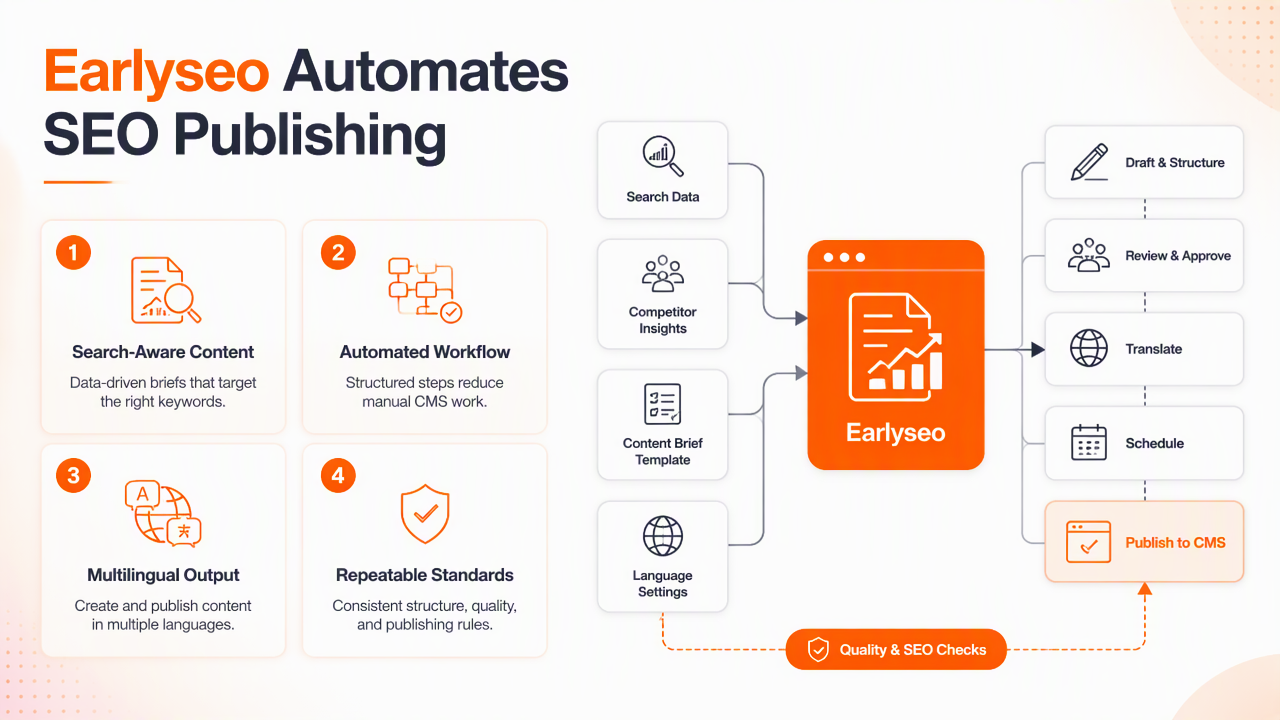
The platform's fit is strongest for startups, agencies, local businesses, and growing ecommerce teams that need more pages live, but still need quality controls before publishing. More details are available on earlyseo.com for teams comparing production workflows.
Earlyseo workflow fit by team type
| Team type | Publishing pain | Useful automation angle | Related next step |
|---|---|---|---|
| Startup | Low visibility and limited time | Move from idea to optimized draft faster | Build a repeatable blog engine |
| Small business | Inconsistent metadata and pages | Standardize local and service-page SEO | Improve page quality before launch |
| Agency | Many clients and approvals | Reuse workflows while keeping client context | Follow an agency content process |
| Ecommerce | Many product and category pages | Scale metadata, links, and refresh checks | Prioritize commercial pages |
| Global brand | Translation and localization load | Prepare multilingual SEO content | Localize without starting from zero |
Teams that publish across several markets can connect automation with multilingual SEO content, especially when titles, slugs, hreflang planning, and localized search intent need structure.
For agencies handling multiple clients, automation should protect consistency without flattening every brand into the same voice. The agency SEO content playbook gives a more focused path for packaging briefs, approvals, and recurring publication work.
Competitive research is another practical use case. Instead of copying rival articles, a publishing workflow can identify missing entities, weak sections, content gaps, and internal-link opportunities. Earlyseo's competitor-aware SEO content approach supports that process when teams need stronger pages before the CMS stage.
When automation is not enough
Automation should not decide positioning, claims, pricing, legal language, or medical, financial, and technical advice without expert review. These areas need accountability because errors can damage trust faster than publishing speed can repair it.
A realistic rule is simple: automate preparation, not responsibility. That mindset keeps content operations fast without turning SEO into bulk page generation.
What will change in 2027?
SEO publishing automation in 2027 will likely shift from simple CMS posting toward closed-loop systems that connect content creation, technical QA, search performance, and AI-answer visibility. The biggest gains will come from monitoring and refresh automation, not just faster first drafts.
Search is already less limited to classic blue links. Content teams now need pages that serve search engines, AI answer systems, and human readers. That means clearer definitions, better structure, stronger entity coverage, and citations that machines can parse.
Automation priorities for the next planning cycle
- Answer-ready structure: concise definitions, tables, FAQs, and direct answers near headings.
- Entity consistency: clear names for products, companies, standards, places, and concepts.
- Refresh triggers: alerts when rankings, clicks, internal links, or competitors change.
- CMS governance: reusable templates, required fields, role-based approvals, and audit logs.
- Performance feedback: content updates based on impressions, conversions, and query shifts.
Academic work outside SEO also shows how automation-heavy fields value process visibility. Dong-Gyu Ahn's 2021 review of Directed Energy Deposition focused on the state of a technical process field, and the broader lesson for content operations is that complex automated systems need documented stages, quality checks, and clear evaluation criteria review.
For 2027 planning, the practical question is not whether AI can publish more content. The better question is whether the publishing system can prove each live page has a clear purpose, clean metadata, working links, accurate claims, and a refresh path.
Frequently asked questions
Is automated publishing bad for SEO?
Automated publishing is not bad for SEO when it improves consistency, technical quality, and review discipline. Problems start when automation publishes weak, duplicate, or inaccurate pages without oversight. Search performance still depends on useful content, crawlable pages, relevant links, and clear intent matching.
Which CMS tasks should be automated first?
The best first tasks are metadata entry, slug formatting, internal-link suggestions, featured image fields, schema preparation, and pre-publish QA. These jobs follow rules and are easy to check. Editorial judgment, expert review, and final approval should remain human-led.
Can small businesses use publishing automation without a large team?
Small businesses can use publishing automation effectively by starting with a narrow workflow, such as service pages, location pages, or weekly blog posts. A simple setup with templates, required SEO fields, and review gates often saves more time than a complex custom system.
How often should automated content be reviewed after publishing?
Automated content should be reviewed after indexing, after the first meaningful performance period, and whenever rankings, clicks, products, competitors, or facts change. Many teams use monthly checks for priority pages and quarterly checks for lower-priority evergreen content.
Conclusion
Content publishing automation for SEO is worth adopting when the goal is faster, cleaner, and more accountable publishing, not unchecked volume. The next practical step is to map the current workflow, mark every manual CMS task, decide which checks can be automated, and assign a human owner to every approval gate. Teams ready to turn that map into a repeatable SEO publishing process can head to earlyseo.com and evaluate where Earlyseo fits into the next content sprint.