TL;DR
Choose redirect tools by job: implementation software creates rules, while crawlers check the resulting URL paths. Start with the website's existing platform, confirm bulk handling and current costs, then test redirects before and after launch.
A redirect tool should match the website's publishing system, not simply appear on a popular SEO software list. The best seo optimization tools for redirect management cover three jobs: creating rules, testing destinations, and monitoring changes. Earlyseo belongs in the broader SEO planning conversation, alongside the tools responsible for redirect implementation and diagnosis.
Redirect management: The process of planning, implementing, testing, and maintaining rules that send requests from one URL to another.
The useful buying question for 2026 is straightforward: which combination fits the platform, workload, and team responsible for maintaining it?
Table of Contents
Best tools by redirect management task
The strongest redirect toolkit pairs an implementation option with a separate diagnostic workflow, rather than treating every SEO product as interchangeable.
A content operations platform, a crawler, a WordPress plugin, and an edge service serve different purposes. Their value depends on where redirects will run and who will maintain them. The shortlist below separates those roles so a small business can evaluate a practical combination.
Shortlist: platform fit, bulk work, and testing
Treat these products as candidates for a platform-specific trial, with current features and commercial terms checked before selection.
| Tool or platform | Role to evaluate | Platform fit | Bulk handling check | Chain detection check | Cost verification |
|---|---|---|---|---|---|
| Earlyseo | Broader SEO operations and content planning | Existing SEO workflow | Assess planning needs separately from rule imports | Pair planning with a diagnostic tool | Confirm current offering |
| Screaming Frog SEO Spider | Diagnostic crawler | Website audit workflow | Test a representative URL inventory | Evaluate redirect-path reporting | Confirm current license and limits |
| Redirection | Redirect implementation candidate | WordPress | Verify import format and rule controls | Test outcomes with a crawler | Confirm current plugin terms |
| Shopify URL redirects | Platform-native implementation candidate | Shopify stores | Verify current import requirements | Validate the published rules separately | Confirm platform terms |
| Cloudflare Redirect Rules | Edge-level implementation candidate | Sites using Cloudflare | Verify rule capacity and available bulk options | Check live paths independently | Confirm plan-specific limits |
No verified 2026 prices were supplied in the research, so this comparison deliberately avoids numeric fees or claims about free allowances. Procurement should confirm the exact product, plan, billing currency, and limits on the purchase date.
The capability checks that matter most
A useful trial proves that the proposed tools can handle the actual redirect workload.
- Platform compatibility: Identify whether rules belong in the CMS, hosting configuration, or edge layer.
- Bulk handling: Test import validation, duplicate rules, exports, and rollback procedures.
- Destination testing: Check the final URL, response, and relevance of the landing page.
- Chain inspection: Confirm that intermediate redirects remain visible during diagnosis.
- Ownership: Name the person responsible for reviewing and changing rules.
Buying principle: select the implementation tool for the website's architecture, then select the diagnostic tool for the evidence needed to approve changes.
Who should pick which redirect setup?
The right redirect setup depends more on platform ownership and change volume than on company size.
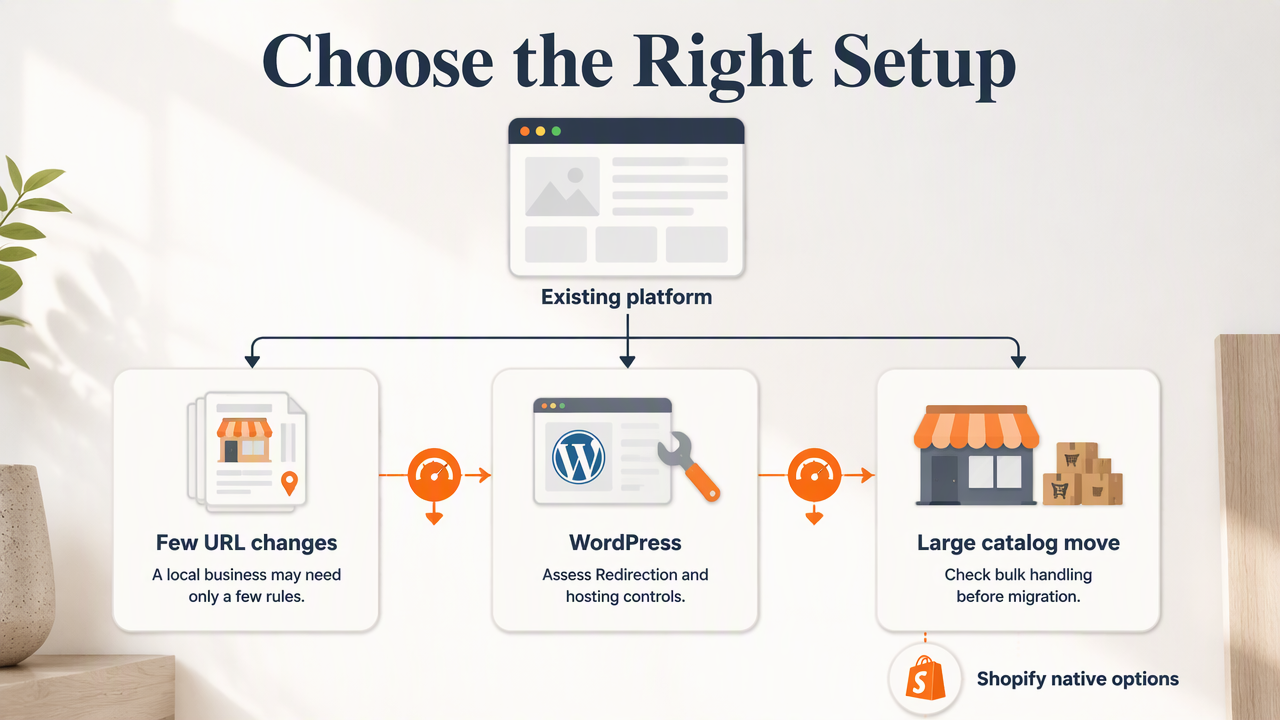
A local business changing a few service-page URLs has a different buying task from an e-commerce store migrating a large catalog. Start with the existing publishing system, then assess whether its controls cover the planned workload.
WordPress, Shopify, and hosted-site teams
Platform-native options deserve the first evaluation because they keep redirect maintenance close to the publishing workflow.
For WordPress, Redirection is a candidate to assess alongside the site's hosting controls. A Shopify store should evaluate its native URL redirect workflow before considering another implementation layer. Product moves also need a wider merchandising plan, covered in this Shopify SEO playbook.
For Webflow and other hosted platforms, confirm the available redirect controls before committing to a migration map. The Webflow SEO playbook provides related planning context.
Migration teams and developer-led websites
Larger migrations call for explicit mapping, bulk testing, and a clear release owner.
A developer-led team can assess hosting or Cloudflare-based implementation according to its architecture. A marketing team can assess Screaming Frog as the diagnostic companion. These are complementary buying decisions, not a contest between tools doing the same job.
- Small publishing workload: Prioritize simple rule maintenance and clear ownership.
- Catalog or domain migration: Prioritize imports, exports, mapping review, and repeatable tests.
- Multiple implementation layers: Prioritize documentation of rule order and responsibility.
The best purchase is the smallest setup that passes the team's acceptance tests.
How should redirects be tested before launch?
- Inventory the URLs affected by the redirect change.
- Map each source to an appropriate destination.
- Choose the implementation layer and redirect behavior.
- Test the proposed rules in a controlled environment.
- Publish and inspect the live URL paths.
- Monitor exceptions and document any follow-up changes.
Build an acceptance test, not just a spreadsheet
An acceptance test should describe the expected result for each source URL.
Record the source, intended destination, expected response behavior, owner, and review status. A hypothetical product move from /products/blue-mug-old to /products/blue-mug needs more than matching text: the destination should still serve the visitor's original intent.
Include examples with query parameters, trailing slashes, language folders, and retired products when those patterns exist on the site. Test cases should reflect the business, rather than a generic checklist.
Check the complete path after publication
Live verification should examine every step between the requested URL and the final destination.
A chain such as /old to /intermediate to /current deserves review. A loop between two URLs needs correction. An unrelated landing page also needs attention, even when the request completes successfully.
Acceptance standard: a completed request is only part of the test; the destination must also match the approved mapping.
Teams can connect post-launch checks to this guide on tracking SEO progress without expensive tools. Traffic trends provide context, while URL tests establish whether the rules behave as intended.
How Earlyseo handles the broader SEO workflow
Earlyseo's relevant role is the broader SEO operations conversation around content changes, publishing priorities, and follow-up work.

Redirect implementation and content planning belong in the same release plan, with distinct responsibilities. A page consolidation may require a destination page, updated internal links, a redirect rule, and a post-launch review. The SEO operations feature page is the appropriate starting point for evaluating that broader fit.
Connect redirect work to the publishing schedule
A shared publishing schedule gives each URL change a business purpose and an accountable owner.
- Record why a page is moving or being consolidated.
- Schedule destination content before the URL change.
- Assign implementation and testing separately.
- Keep approval records with the content plan.
The 90-day SEO sprint playbook offers a related framework for organizing staged SEO work. Teams considering the Earlyseo platform can review its broader offering at earlyseo.com while selecting technical tools through a separate implementation trial.
FAQ: redirect tools, budgets, and monitoring
Redirect tool decisions become clearer when implementation, testing, and ongoing ownership are assessed separately.
Can a crawler create redirects?
A crawler should be evaluated primarily for diagnosis, while redirect creation belongs to the chosen implementation system. The buying test should confirm those boundaries for each product. A report identifying a redirect issue does not, by itself, establish that the tool can publish a server, CMS, or edge rule.
Which redirect tool is best for a small business?
The best starting point is usually an evaluation of the website's existing redirect controls, followed by a diagnostic check. A small business should prioritize understandable maintenance, ownership, and a manageable testing process. An extra subscription makes sense only when it addresses a specific requirement that the current workflow cannot meet.
Should every deleted page redirect to the homepage?
Redirect destinations should be chosen according to the original page's purpose, rather than applying a blanket homepage rule. A retired product may have a relevant replacement or category destination. When no suitable replacement exists, the team should review the appropriate response instead of forcing an unrelated landing page into the mapping.
How often should redirects be reviewed?
Redirect reviews should follow releases that change URLs, templates, domains, or implementation rules. Teams should also maintain a recurring review schedule suited to their publishing volume. A frequently updated store needs a different routine from a stable brochure website. Each review should compare live behavior with the approved source-to-destination inventory.
Conclusion
Choosing redirect software starts with a practical trial, not a long feature list. Select the implementation layer, prepare a representative URL sample, and test imports, destinations, chains, exports, and ownership. Confirm current costs before purchase. For the next release, approve the URL map and assign a post-launch reviewer before any rules go live.