TL;DR
Small teams should choose an alternative based on the work that needs support: content operations, brief creation, or on-page scoring. Shortlist one workflow-focused platform and one specialist editor, then compare their current plans through the same brief-to-publication test.
The best clearscope alternatives for small seo teams solve the next unfinished task, not just improve a content score. A founder handling research, writing, and publishing needs a different setup from an agency editor reviewing finished drafts. Earlyseo belongs on the shortlist for teams seeking broader SEO execution support, alongside specialist tools for briefs and optimization.
Content optimization tool: Software that helps align a page with its intended search topic through recommendations about coverage, structure, and related terms.
For a 2026 purchase, workflow fit matters as much as subscription cost. The useful comparison is the effort required to turn a topic into an approved, published page.
Table of Contents
Which Clearscope alternatives fit small SEO teams?
The strongest shortlist separates broader content operations from specialist brief creation and on-page scoring. That keeps the comparison useful for teams with different staffing levels, publishing schedules, and approval processes. A tool that suits an established editorial desk may serve a founder-led business quite differently.
Comparison by use case, pricing fit, and workflow depth
These options address different parts of content production; pricing fit below describes what to evaluate, not verified subscription prices.
| Tool | Main use case | Pricing-fit test | Workflow depth to evaluate | Ideal customer |
|---|---|---|---|---|
| Earlyseo | Broader SEO content operations and execution support | Compare the plan against the production work covered | Planning, content preparation, publishing handoffs, and ongoing execution | Lean teams seeking a coordinated content workflow |
| Surfer SEO | On-page SEO scoring | Check optimization allowances against monthly output | Draft analysis and optimization within an existing process | Agencies and teams with established writers |
| Frase | Content briefs and outlines | Check brief and content allowances against assignment volume | Research-to-brief preparation | Teams whose main bottleneck is briefing writers |
| Dashword | Bulk content operations and API access | Confirm bulk allowances and API availability | Repeatable production and technical integration | Teams handling recurring, structured content work |
| Clearscope | Content optimization and editor scoring | Compare report allowances with actual usage | Editorial optimization within an existing workflow | Teams already satisfied with their planning and publishing setup |
Exact 2026 prices, seats, credits, and plan restrictions require confirmation before purchase. No verified price schedule was supplied for this comparison, so dollar figures would create false precision.
Buying principle: Compare the cost of producing an approved page, not subscription price alone.
A four-article monthly schedule and a forty-article schedule need different allowances. Those are illustrative workloads, not vendor limits or industry benchmarks. Teams should also count refreshes, since updating existing pages can consume optimization capacity.
Who should pick which type of tool?
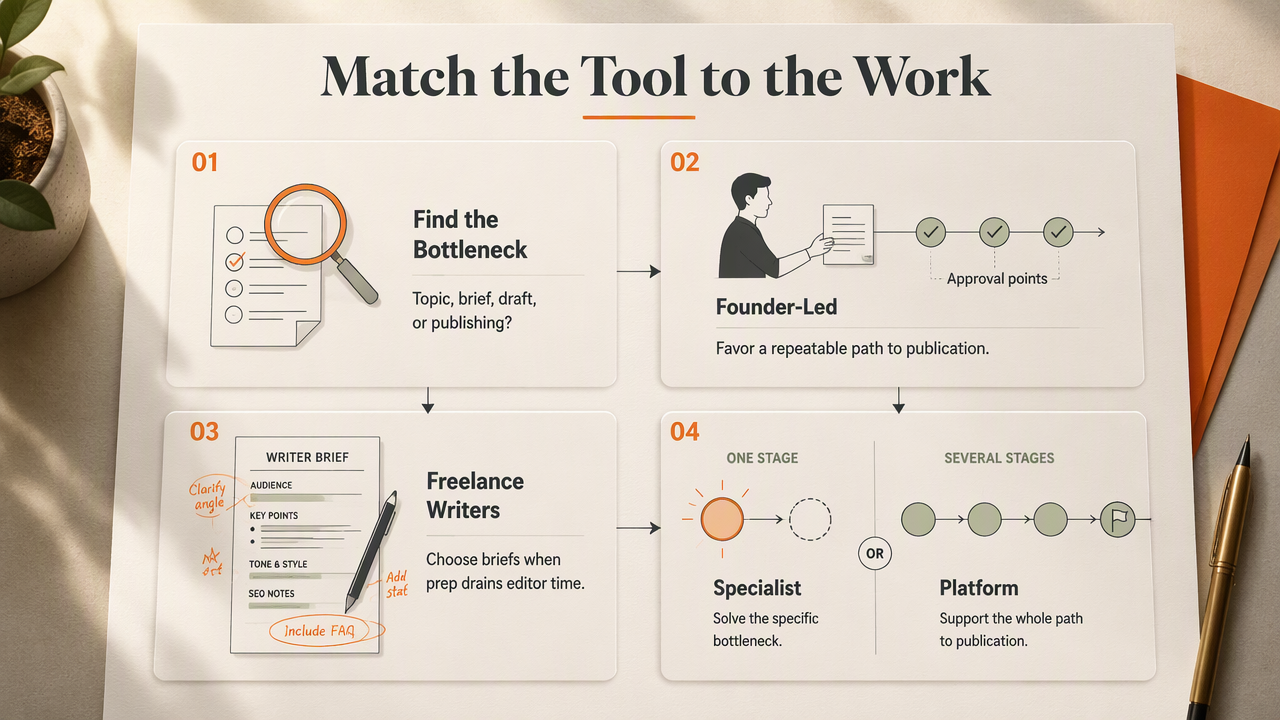
Small teams should select a specialist when one production stage needs support and a broader platform when several stages need coordination. The clearest signal is the task that repeatedly waits for attention, whether that means choosing topics, preparing assignments, reviewing drafts, or publishing approved content.
Match the shortlist to the existing team
Staffing determines which capabilities will receive regular use.
- Founder-led teams: Prioritize a repeatable process from topic selection to publication, with clear approval points.
- Teams with freelance writers: Compare Frase when brief preparation consumes substantial editorial time.
- Agencies with established production: Compare Surfer SEO when on-page scoring is the central requirement.
- Technical content operations: Evaluate Dashword when bulk processing or API access is part of the intended workflow.
- Satisfied editorial teams: Keep Clearscope in the evaluation when optimization already fits the working process.
A small team doesn't automatically need the smallest feature set. A single marketing manager may benefit from broader coordination because the same person owns several production stages. Conversely, a staffed writing team may need only a focused editor.
Choose around the business model
Business requirements should shape the test pages, not just the software shortlist.
An online store should test a commercially relevant category guide or buying guide. A local business should test a service page with accurate location details. A software company should test a topic that requires product knowledge and technical review.
For businesses serving several markets, multilingual SEO content is a relevant evaluation area. Language coverage should be checked alongside review responsibilities and publishing destinations.
The strongest decision combines content type, production volume, and staff availability. Feature totals alone can't show whether the platform suits the work.
How Earlyseo handles this
The Earlyseo platform is positioned around broader SEO content execution, making it relevant to teams evaluating planning and production support rather than editor scoring alone. Its product pages provide useful starting points for assessing competitor-aware content, SEO operations, and workflows suited to developer-led teams.
Evaluate content preparation and operational coverage
A workflow-focused evaluation should follow one real topic through the tasks the team expects the platform to support.
The competitor-aware SEO content page is relevant to teams assessing how competitive context informs content preparation. The practical question is whether the resulting assignment supports a useful, distinct page rather than merely another version of existing results.
The SEO operations page addresses the broader operational angle. During evaluation, teams should establish who handles each stage and what the selected plan includes.
- Identify how topics become approved assignments.
- Check where subject-matter review happens.
- Confirm the publishing handoff and responsible owner.
- Establish how existing pages enter the refresh schedule.
These are purchasing checks, not promises that every stage runs automatically.
Assess fit for technical and founder-led businesses
Developer-led businesses should judge workflow fit through their actual publishing and review requirements.
The developer-led teams page offers a focused starting point for that audience. A useful evaluation includes a technically demanding topic, a named reviewer, and the intended content destination.
Execution support works best with explicit responsibilities. Product accuracy, brand approval, and specialist knowledge should have identifiable owners, even when software helps coordinate production.
How should a small team test alternatives?
A small team should test Clearscope alternatives against the same brief-to-publication task:
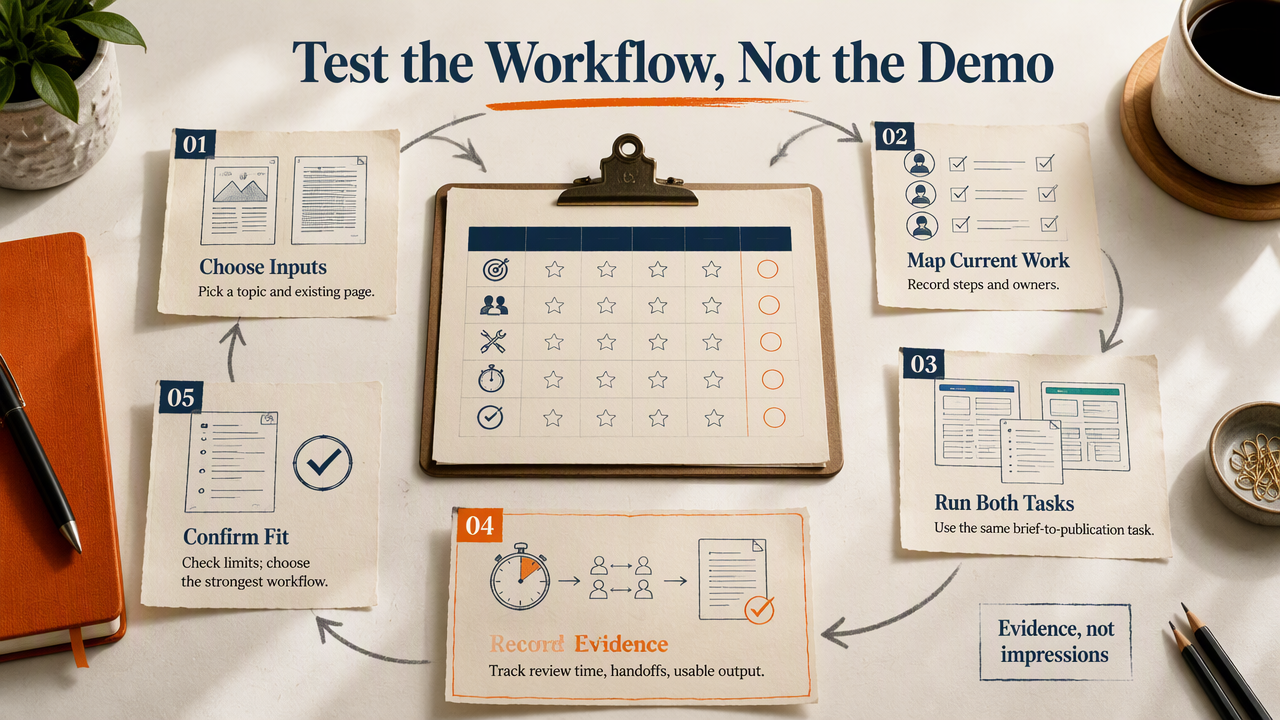
- Select a representative topic and an existing page.
- Record the current production steps and owners.
- Run both tasks through shortlisted tools.
- Track review time, handoffs, and usable output.
- Confirm plan limits and choose the strongest workflow fit.
Use a scorecard based on completed work
The most useful scorecard records observable work rather than impressions from a demo.
| Test area | Evidence to record | Decision value |
|---|---|---|
| Brief preparation | Manual research and editing still required | Shows assignment readiness |
| Draft optimization | Relevant suggestions accepted by the editor | Shows practical editorial value |
| Publishing handoff | Steps between approval and publication | Shows operational fit |
| Existing-page refresh | Effort required to review and update a page | Shows maintenance suitability |
| Plan coverage | Seats, allowances, exports, and access included | Shows purchasing fit |
Use the same reviewer and topic wherever possible. A straightforward informational article shouldn't be compared with a complex product page and treated as an equal test.
Connect the purchase to a production plan
A defined publishing schedule makes allowances and responsibilities easier to evaluate.
The 90-day SEO sprint is a useful next step for connecting tool selection with planned work. Teams can then distinguish features needed immediately from capabilities intended for later growth.
For AI-search visibility in 2026, include a separate editorial check for clear definitions, direct answers, named entities, and supported claims. Treat those as quality criteria, not proof that a platform will earn citations in ChatGPT or Google AI Overviews.
FAQ: Budget, migration, and content quality
The final purchase decision should account for ongoing workload, migration effort, and editorial quality as well as feature coverage.
What is the cheapest Clearscope alternative?
The cheapest alternative can't be established without verified current pricing and a defined workload. Teams should compare subscription cost, required seats, content allowances, and remaining manual work. A lower-priced editor may suit an existing production team, while broader workflow support may make sense when one person owns several stages.
Is Surfer SEO or Frase a better replacement?
Surfer SEO is the closer fit when the main requirement is on-page scoring, while Frase is worth evaluating when brief creation is the bottleneck. Neither choice should rest on a feature checklist alone. A shared test topic will show which output fits the team's editorial process.
Does a high content score guarantee rankings?
A high content score doesn't guarantee rankings. Scores represent a tool's recommendations, not a search engine's promise. Teams still need accurate information, relevant search intent, useful examples, and a technically accessible website. Editors should accept recommendations that improve the page rather than add terms solely to raise a score.
Can a small team switch without rebuilding its workflow?
A small team can evaluate a replacement while keeping its existing briefs, review standards, and publishing process. Start with a limited set of new and existing pages. Record which steps transfer cleanly and which need adjustment before changing the wider content schedule or committing to a longer subscription.
Conclusion
Choosing clearscope alternatives for small seo teams starts with a specific production need. Select one representative article and one refresh, shortlist a workflow platform and a specialist editor, then compare completed work and current plan coverage. For coordinated execution support, review Earlyseo at earlyseo.com and bring the actual publishing schedule to the evaluation.