TL;DR
Human review makes SEO automation safer by keeping strategy, facts, brand judgment, and publishing decisions out of full autopilot. The best setup automates research, briefs, optimization, and reporting while assigning clear human approvals at every quality risk point.
AI can now draft briefs, cluster keywords, scan competitors, and propose internal links in minutes, but search visibility still depends on judgment. Human-in-the-loop SEO automation means software handles repeatable SEO tasks while editors, strategists, and subject-matter experts approve decisions that affect accuracy, originality, brand trust, and revenue. For teams building that model, Earlyseo provides a practical way to combine automation with human-curated SEO execution.
Table of Contents
What is human-in-the-loop SEO automation?
Human-in-the-loop SEO automation is an SEO operating model where AI systems generate, analyze, or optimize work, and qualified humans review the outputs before strategic or public-facing decisions go live. It is not anti-AI. It is a control system for using AI without handing brand reputation to probability-based text generation.
Human-in-the-loop SEO automation: a workflow that combines automated SEO research, content production, optimization, and reporting with human checkpoints for intent, accuracy, expertise, compliance, and final approval.
Search teams use this model because SEO has both mechanical and editorial work. Keyword grouping, SERP scraping, metadata drafts, schema checks, and rank monitoring can be automated. Positioning, examples, claims, expertise, tone, and publishing priorities need people.
Key takeaway: automation should remove repetitive work, not remove accountability.
Academic fields already treat automation as a way to improve throughput while keeping transparency and review visible. A 2021 Nature Machine Intelligence paper on an open source machine learning framework for systematic reviews focused on efficiency and transparency in evidence review workflows. SEO teams can borrow that mindset: speed matters, but traceability matters too.
Core terms for cleaner workflows
- Automation: software performs a repeatable SEO task, such as clustering keywords or checking missing title tags.
- Human checkpoint: a named reviewer approves, edits, rejects, or escalates the automated output.
- Governance: the rules that define who owns each checkpoint, what evidence is required, and what cannot be published without review.
- Audit trail: saved notes, prompts, sources, approvals, and changes that explain why a page was created or updated.
Why AI-only SEO workflows break trust
AI-only SEO workflows often break trust because they optimize for output volume before validating intent, claims, differentiation, and usefulness. The risk is not just bad prose. The bigger risk is publishing pages that sound confident but fail to answer the searcher, misstate facts, or repeat competitor ideas with no clear reason to rank.
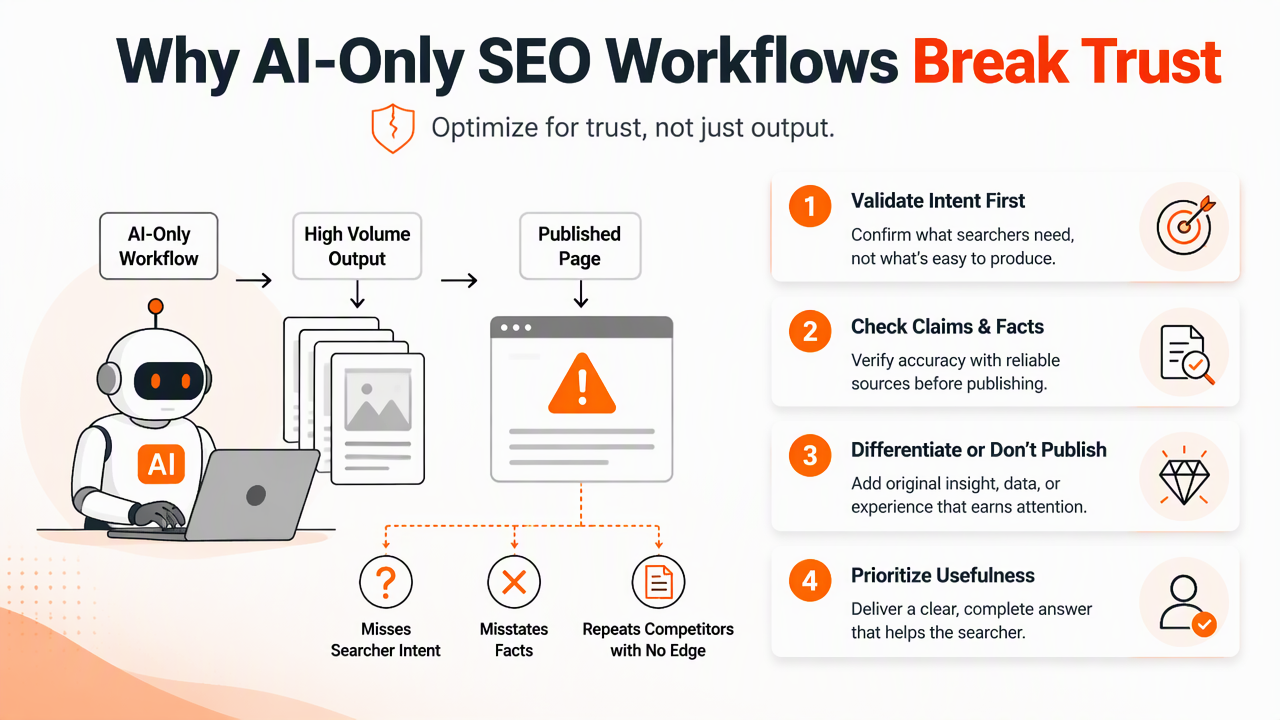
Competitor analysis in the current SERP shows that top articles focus heavily on content workflows, technical task automation, and human review. The missing piece is governance. Teams do not only need a checklist; they need a decision model for what gets automated, what gets reviewed, and what gets blocked.
For newer sites, this matters even more. A thin batch of AI pages can create index bloat, weak topical authority, and mixed signals around brand expertise. A tighter content plan, such as a content strategy for new SEO blogs, gives automation a better job to perform.
Where automation creates risk fastest
| Workflow area | Common automation use | Human risk check |
|---|---|---|
| Strategy | Keyword clustering and topic selection | Does the topic match business value and audience need? |
| Briefs | SERP summaries and outline drafts | Does the brief add a distinct angle, data, or expertise? |
| Drafts | AI-assisted article creation | Are claims accurate, sourced, and useful? |
| Optimization | Title tags, headings, internal links | Does optimization improve clarity rather than keyword stuffing? |
| Publishing | CMS upload and formatting | Does the page meet brand, legal, and conversion standards? |
| Reporting | Rank and traffic summaries | Does the analysis explain cause, not just movement? |
Where should human review happen in an SEO automation workflow?
Human review should happen at six points: strategy, brief creation, draft review, optimization, publishing, and performance review. Each checkpoint protects a different quality layer, so skipping one creates blind spots that later analytics cannot fully repair.
A simple governance model keeps teams from arguing over every page. It assigns ownership by risk level, not by ego. Low-risk metadata edits may need one SEO approval. Medical, legal, financial, or product-comparison content may need expert review before publishing.
Research in other technical fields shows why staged review is normal when automation meets real-world decisions. A 2023 Nature article on computational approaches simplifying drug discovery covers automation in a complex research setting, while a 2022 Nature Reviews Materials article on end-to-end design of wearable sensors reflects how technical systems require design choices across a full process. SEO is lower stakes than drug discovery, but the workflow lesson is clear: automated steps still need accountable design.
A six-step governance model
- Strategy approval: an SEO lead confirms target audience, search intent, business value, and page type.
- Brief approval: an editor checks SERP findings, required sources, unique angle, and internal-link targets.
- Draft review: a writer or subject expert verifies claims, examples, definitions, and product relevance.
- Optimization review: an SEO specialist checks headings, metadata, schema, internal links, and entity coverage.
- Publishing approval: a content owner confirms formatting, compliance, CTAs, and brand tone.
- Performance review: the team compares rankings, clicks, conversions, and engagement against the original intent.
Decision rights by content risk
- Low risk: glossary pages, simple FAQs, metadata refreshes, and image alt text can move with light review.
- Medium risk: blog posts, landing pages, local SEO pages, and product explainers need editorial and SEO approval.
- High risk: claims-heavy pages, comparison pages, regulated topics, and multilingual content need subject-matter review.
- Strategic risk: pillar pages, category pages, and revenue pages need leadership sign-off before launch.
For ongoing production, the SEO operations layer should define these thresholds before content enters the queue.
How Earlyseo handles human-reviewed SEO automation
Earlyseo handles automation as a managed SEO production system, not a one-click article generator. The Earlyseo platform is most useful for teams that want faster execution but still need humans to shape topics, check quality, and keep pages aligned with business goals.
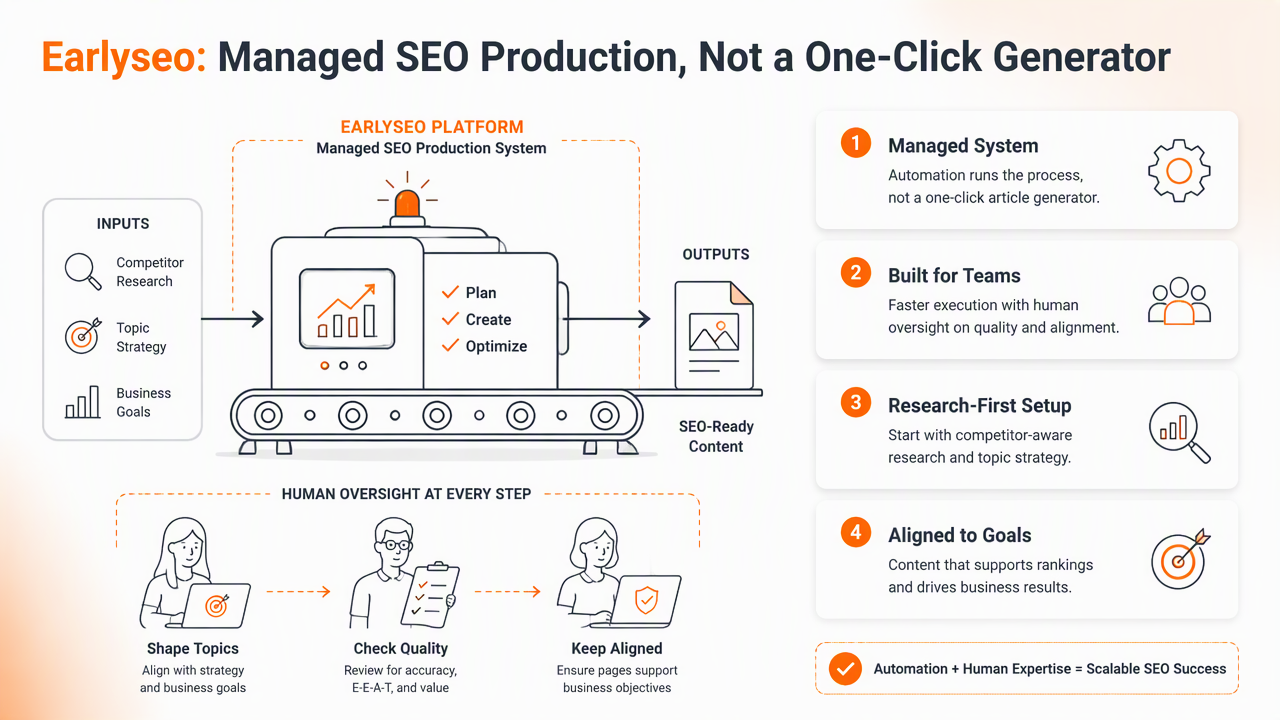
A strong setup starts with competitor-aware research. Automated SERP analysis can reveal ranking patterns, missing subtopics, and page formats, while human editors decide which patterns deserve attention and which ones would make content too similar. That split is the difference between informed SEO and copycat SEO.
Teams using Earlyseo can pair automation with human-curated content service support when internal bandwidth is thin. For pages where competitive differentiation matters, competitor-aware SEO content helps turn SERP research into briefs that still need editorial judgment.
Automation versus human judgment
| SEO task | Safe to automate | Human should own |
|---|---|---|
| Keyword discovery | Collecting terms and volumes | Choosing business priorities |
| SERP analysis | Extracting headings and patterns | Defining the original angle |
| Content briefs | Drafting structure and entities | Setting expertise, examples, and claims |
| Draft production | Creating first-pass sections | Editing for accuracy and usefulness |
| Internal linking | Suggesting relevant URLs | Confirming context and anchor fit |
| Reporting | Summarizing movement | Deciding what action comes next |
Good fit use cases
- Startup visibility: fast topic coverage with founder or expert review before publishing.
- E-commerce SEO: category, collection, and buying-guide optimization, especially when paired with a Shopify SEO playbook.
- Local SEO: service pages, location pages, and review-informed content supported by a local business SEO plan.
- International SEO: translated or localized pages where automated drafts need native-market review through multilingual SEO content.
More implementation details are available on earlyseo.com for teams comparing managed SEO production with fully internal workflows.
What should SEO teams expect in 2027?
SEO teams should expect 2027 to bring more agentic automation, stronger content-quality enforcement, and more demand for proof that humans shaped important pages. The winning teams will not be the ones that publish the most AI content. They will be the ones that build the clearest review systems.
Agentic SEO workflows will likely handle more multi-step tasks, such as finding decaying pages, drafting refresh briefs, recommending internal links, and preparing CMS updates. Human oversight will shift from line-by-line editing to exception handling, quality sampling, and strategic approval.
The practical goal for 2027 is not "AI writes, humans fix." A better goal is "AI prepares, humans decide."
Measurement will also mature. Ranking reports alone will not prove quality. Teams will need to connect content changes to qualified traffic, assisted conversions, indexed pages, crawl health, and topic-level growth. A focused 90-day SEO sprint can help teams test that operating model before scaling it.
FAQ blocks, comparison tables, clean definitions, and source-backed summaries will also matter more as AI answer engines summarize pages directly. Clear structure helps both humans and machines understand the page.
FAQ: Is human review still needed when AI tools improve?
Yes. Better AI reduces repetitive editing, but it does not replace accountability for claims, brand fit, legal risk, or strategic positioning. Human review becomes more selective as tools improve. The goal is fewer low-value edits and more high-value decisions around intent, usefulness, and what the business should publish.
FAQ: Which SEO tasks should never be fully automated?
Strategy, expert claims, final publishing approval, and performance interpretation should not run on full autopilot. Automation can prepare options, summarize evidence, and flag issues. A qualified person should still decide whether a page deserves to exist, what it should say, and whether results justify more investment.
FAQ: Does human-in-the-loop SEO slow down publishing?
A well-designed workflow usually speeds up publishing because reviewers only focus on the decisions that matter. Clear checkpoints reduce rework, unclear briefs, and last-minute rewrites. The process feels slower only when every reviewer comments on everything instead of owning a defined quality gate.
FAQ: How many reviewers does a small business need?
A small business can start with two roles: one SEO owner and one subject-matter reviewer. The SEO owner handles intent, optimization, links, and reporting. The subject expert checks accuracy, customer language, and trust signals. As traffic grows, editorial, design, and conversion review can be added.
Conclusion
Human-in-the-loop SEO automation works best when automation handles the repetitive work and people own the decisions that affect trust. A practical next step is to map the current workflow into six checkpoints: strategy, briefs, drafts, optimization, publishing, and performance review. Then assign one owner to each checkpoint, define what blocks publication, and test the model on a small batch of pages. For teams that want managed execution with human review built in, Earlyseo is a strong place to start.