TL;DR
Seasonal businesses should update existing pages before search demand rises, keep recurring offers on stable URLs, and compare results with equivalent seasonal periods. A three-phase calendar helps teams prioritize preparation, peak-season conversions, and off-season improvements.
The busiest sales week is often too late to start earning search visibility. Practical SEO advice for seasonal businesses starts with the buying calendar, not the opening date. A holiday retailer, summer tour operator, or snow-removal company needs useful pages available while customers are researching and comparing options.
For teams organizing that work, Earlyseo is an option to evaluate for a seasonal content workflow. The immediate goal is straightforward: connect each recurring demand window to a durable page, an update deadline, and a business outcome.
Table of Contents
What is seasonal SEO?
Seasonal SEO is the practice of aligning search content, website updates, and conversion information with recurring changes in customer demand. It helps businesses prepare for predictable buying periods while maintaining useful pages throughout the year. The focus is not simply publishing holiday articles; it is matching search intent to timing.
Seasonality: A recurring pattern in time-series data at intervals shorter than a year, such as weekly, monthly, or quarterly cycles.
Evergreen URL: A stable web address that remains useful across multiple seasons, even when dates, prices, or availability change.
Search intent: The task behind a search, such as learning, comparing providers, checking availability, or booking.
Map research, purchase, and maintenance demand
Customers often search for advice before they search for a provider, so the content calendar should follow the full buying cycle.
A pool installer might separate these needs:
- Research: Installation costs, permit questions, and pool-type comparisons.
- Purchase: Local installation availability, quotes, and scheduling.
- Maintenance: Opening, cleaning, winterizing, and repairs.
The same business can serve several seasonal windows without turning every page into a sales pitch. A local operator can use a local-business SEO planning framework to connect those needs with service pages and geographic relevance.
Seasonal SEO follows customer preparation, not just the date a business expects sales to peak.
How should businesses time seasonal SEO updates?
- Identify when seasonal searches begin rising, not only when sales peak.
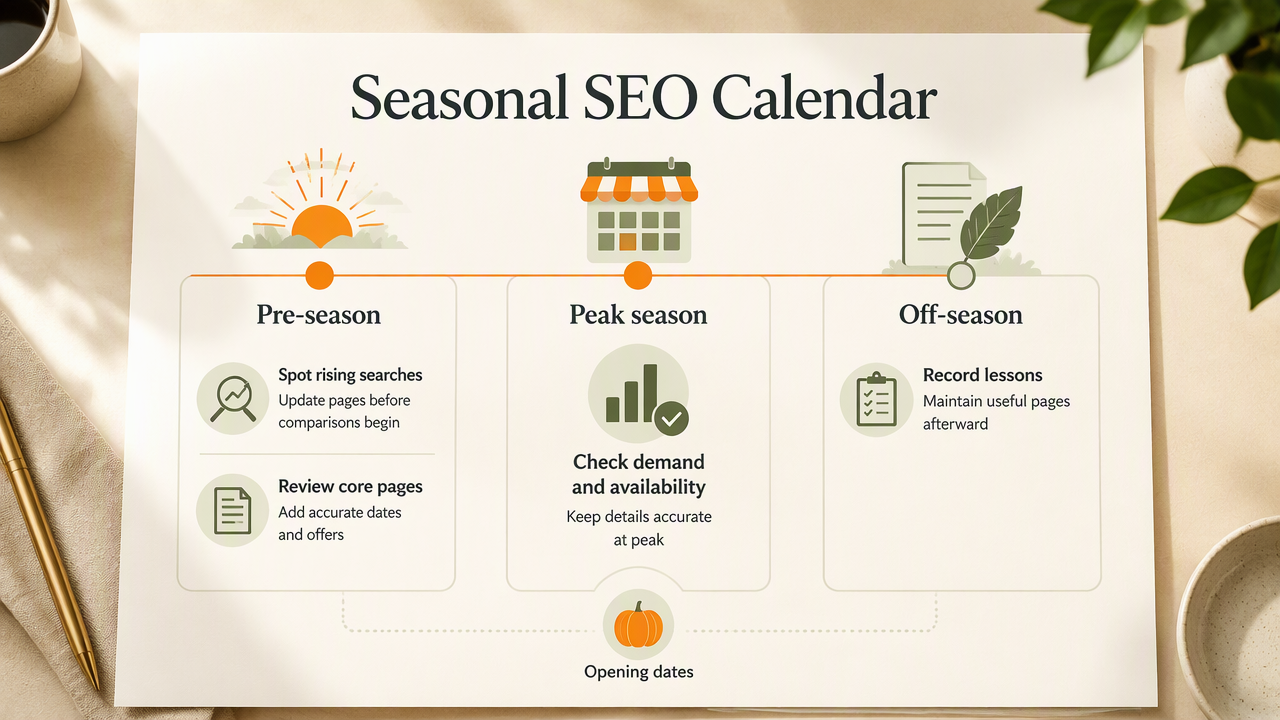
- Work backward from that rise to schedule page updates and reviews.
- Publish accurate offer details before customers start comparing options.
- Monitor demand and availability during the peak.
- Record lessons and maintain useful pages afterward.
Use a three-phase seasonal action plan
Pre-season preparation, peak-season accuracy, and off-season maintenance each need a different priority.
| Phase | Main SEO action | Practical example | Measure |
|---|---|---|---|
| Pre-season | Refresh core pages and supporting guides | Update a pumpkin patch page with opening dates, ticket details, and directions | Relevant impressions and indexed pages |
| Peak season | Keep buying information current | Confirm stock, booking slots, hours, and shipping deadlines | Organic bookings, sales, or qualified leads |
| Off-season | Retain useful pages and improve the next cycle | Add storage advice and next-season notification options | Relevant traffic and sign-ups |
A starting plan might allow several weeks for reviewing existing pages and longer for building a new topic area. Those are planning allowances, not ranking guarantees. Timing should reflect the site's history, competition, publishing capacity, and how early customers research.
A 90-day SEO sprint can provide an organizing structure for owners who need deadlines rather than an open-ended task list.
Choose keywords by demand window and intent
Seasonal keyword research should group queries by customer task and buying window rather than one annual search-volume figure.
Compare Google Trends patterns with Google Search Console queries and actual order or booking dates. Trends shows relative interest, while Search Console shows the site's own search exposure. Neither replaces sales records.
A Christmas-tree seller might need an early guide about tree sizes, a later page about delivery areas, and a peak-season update about remaining stock. Regional weather and holiday calendars can shift these windows, so each market deserves its own review.
How should seasonal pages stay useful year-round?
- Keep recurring offers on stable, descriptive URLs.
- Update dates, prices, availability, and supporting details each season.
- Preserve useful advice when sales pause.
- Add links from relevant guides and category pages.
- Redirect retired pages only when a genuinely equivalent destination exists.
Separate recurring offers from genuinely dated events
Recurring services usually belong on evergreen URLs, while distinct events may justify separate dated pages.
For example, a recurring holiday hamper collection could use /holiday-hampers/, with the current year in visible copy when relevant. A specific 2026 festival can have its own event page because its schedule, venue, and details form a distinct record.
Canonicalization: Converting multiple representations into a standard form. In SEO practice, a canonical URL signals the preferred version among duplicate or closely similar pages; it is not a substitute for redirecting a permanently replaced page.
Avoid creating near-identical annual pages solely to change the year. That creates more URLs to maintain and can leave searchers landing on stale offers. Keep historical event pages only when they remain useful, and label past dates clearly.
Keep closed-season pages helpful and connected
An off-season page should explain the next available action instead of leaving an empty storefront.
A kayak-rental page can show typical operating months, trip planning advice, access information, and a notification form. A seasonal shop can retain sizing, care, or gift-selection guidance while clearly stating that ordering is paused.
Relevant internal links help visitors move between educational content and commercial pages. An internal linking strategy is especially useful when seasonal categories temporarily leave the main navigation.
A closed season changes the call to action; it doesn't automatically remove the page's value.
How can businesses measure seasonal demand shifts?
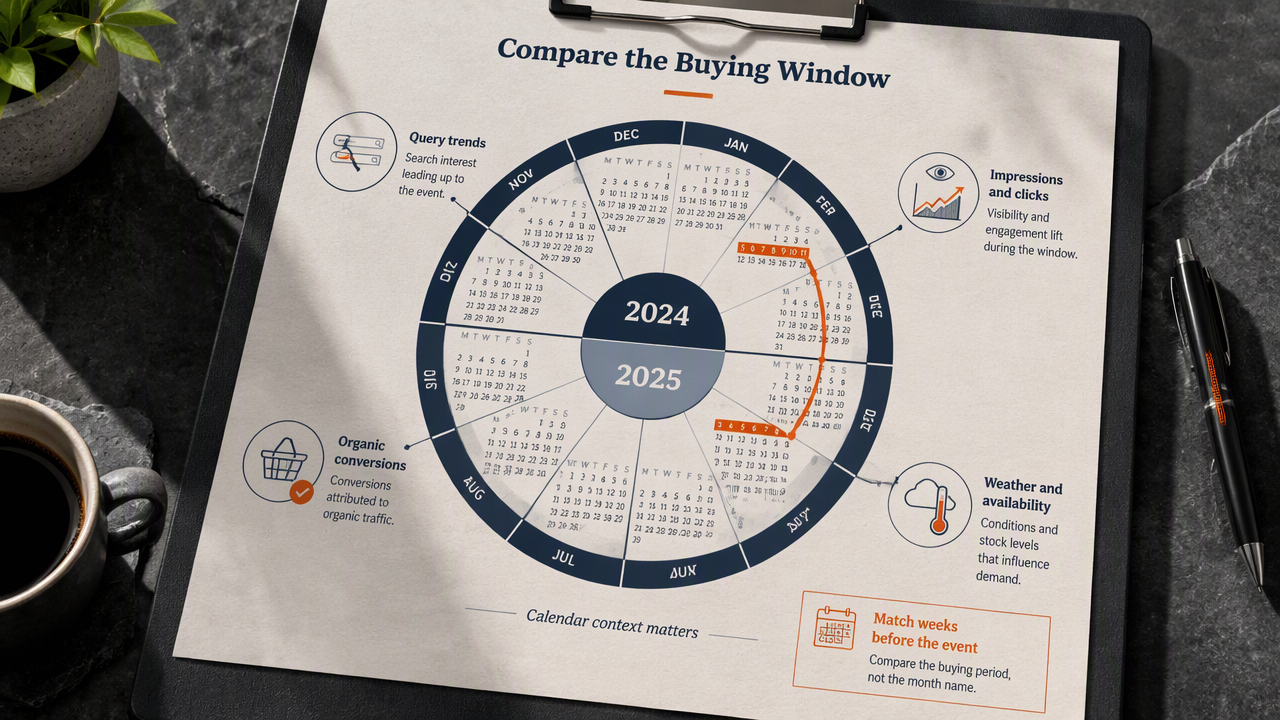
Seasonal demand shifts are best assessed by comparing equivalent buying periods and separating visibility, engagement, and commercial outcomes. Review search impressions, clicks, and organic conversions alongside query trends and availability. A traffic decline after a holiday can reflect lower demand rather than weaker rankings, so calendar context belongs in every report.
Compare equivalent periods before changing strategy
A fair seasonal comparison matches the buying window, not merely the month name.
For a movable holiday, compare the weeks leading up to the event across years. For a weather-sensitive service, annotate unusual conditions, opening dates, service-area changes, and capacity limits.
Track three questions:
- Demand: Did relevant search interest and impressions change?
- Visibility: Did important pages lose clicks or query positions?
- Conversion: Did organic visitors still book, buy, or submit qualified inquiries?
For example, stable impressions with fewer clicks warrants a search-results review. Stable clicks with fewer bookings points toward availability, pricing, or the booking experience. These patterns guide investigation; they do not prove a cause.
A structured SEO reporting template can keep those distinctions visible.
How Earlyseo handles this
Earlyseo's SEO operations offering is a relevant starting point for organizing repeatable seasonal content work.
A practical brief should identify the target URL, demand window, intended customer action, update owner, and review date. Those fields turn seasonal preparation into a repeatable process rather than a fresh planning exercise each year.
For AI-assisted drafting in 2026, retain human checks on prices, opening hours, stock, and local details. Yenduri and colleagues' 2024 review in IEEE Access examines GPT technologies, applications, and challenges; it is background on AI, not evidence of seasonal ranking gains.
Seasonal SEO planning FAQ
The most useful seasonal decisions concern preparation time, page retention, and the role of paid promotion.
When should a seasonal business start SEO?
A seasonal business should begin before customers start researching its busiest period. Existing pages may need a shorter preparation window than a new website or unfamiliar topic. Historical search patterns, publishing capacity, and booking lead times should determine the schedule. Starting several months ahead can be a practical planning choice, but no fixed timeline guarantees rankings.
Should seasonal pages be removed after the peak?
Recurring seasonal pages should usually remain available when they still provide useful information. Update the availability message and offer an appropriate next step, such as planning advice or next-season notifications. Remove or redirect a page when its purpose has genuinely ended, not simply because demand has fallen. Past events should be clearly marked as historical.
Can paid ads replace seasonal SEO?
Paid ads can support immediate visibility during a short selling window, but they do not replace useful organic landing pages. Seasonal SEO builds information customers can discover before, during, and after the peak. A combined plan can use advertising for timely offers while organic content answers research questions and supports recurring demand across future seasons.
Conclusion
The strongest SEO advice for seasonal businesses is to prepare before demand rises and preserve useful assets afterward. The next planning session should identify one peak period, refresh its core landing page, assign an update owner, and set an equivalent-period reporting baseline.
Teams considering Earlyseo can review workflow options at earlyseo.com, then build a seasonal calendar around clear deadlines and verified business details.