TL;DR
Small businesses should choose SERP software around a specific task: finding reachable keywords, understanding competitors, or planning better pages. Start with a small keyword sample, compare the decisions each tool supports, and check current pricing before subscribing.
A ranking report shows position; SERP analysis helps explain what deserves that position. The best serp analysis tools for small businesses connect search results to practical decisions about keywords, page formats, and content.
SERP analysis: The process of examining a search engine results page to understand search intent, competing pages, and visible search features.
Earlyseo offers a useful starting point for connecting that research with website and content review. Other shortlisted tools serve different needs, from keyword discovery to competitor investigation. For a small team, the strongest choice is the one that helps decide what to publish or improve next, not simply the one with the longest feature list.
Table of Contents
Best SERP analysis tools by business need
The strongest shortlist pairs each tool with a specific job, rather than declaring one platform best for every small business.
The supplied search research highlights LowFruits, Ahrefs, Mangools SERPChecker, Surfer, and Semrush. The comparison below separates their roles from the supporting website and content workflow available through the featured platform. These are task-based recommendations, not hands-on performance rankings.
Six options and their clearest use cases
| Tool | Clearest role | Best-fit business need |
|---|---|---|
| Earlyseo | Website and content review, plus SERP presentation tools | Turning research into practical page improvements |
| LowFruits | Keyword research and SERP analysis | Building a focused keyword shortlist |
| Ahrefs | SERP checking and competitor research | Investigating pages already ranking |
| Mangools SERPChecker | Dedicated Google SERP analysis | Examining competing results for selected queries |
| Surfer | SERP analysis, keyword research, and topical planning | Planning content around competing pages |
| Semrush | Broader SEO research and position tracking | Combining competitive investigation with ongoing monitoring |
LowFruits fits a keyword-first process: identify possible topics, inspect the results, and decide which deserve further work. Ahrefs fits businesses that need a closer look at ranking competitors. Mangools SERPChecker suits a narrower task: examining the results for a particular query.
Surfer is relevant when content planning is the main job. The research identifies SERP analysis, keyword research, and topical maps among its tools. Semrush belongs on the shortlist when the business also wants ongoing position tracking.
Who should pick which approach?
A founder building an initial topic list should prioritize keyword discovery and readable result analysis. A marketing manager investigating established competitors should prioritize deeper competitive research. A content team should prioritize a clear path from search intent to page requirements.
- New websites: Start with a narrow keyword and page-planning workflow.
- Growing marketing teams: Compare competitor research and reporting needs.
- Content-heavy businesses: Assess how research becomes a usable brief.
- Local businesses: Make location-specific results a purchase requirement.
Current prices, quotas, and plan inclusions need checking before purchase. The supplied research doesn't establish a reliable 2026 price comparison.
What makes a SERP analysis tool useful?
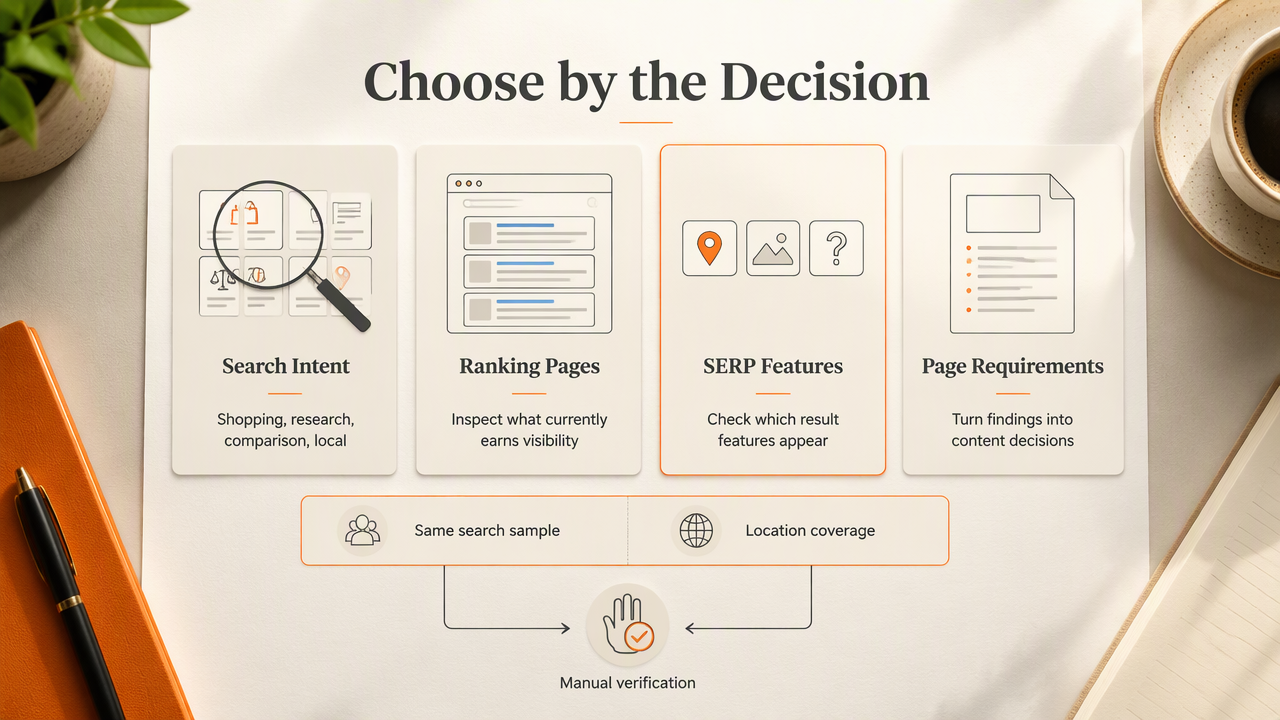
A useful SERP analysis tool helps a small business understand search intent, inspect ranking pages, identify search features, and translate findings into page requirements. Selection should depend on the decisions it supports, the locations it covers, and the amount of manual checking needed to trust its recommendations.
Five criteria for a practical evaluation
A consistent test makes different products easier to compare. Use the same sample of business-relevant searches and record what each tool helps establish.
- Search intent: Can the results distinguish shopping, research, comparison, and local-service needs?
- Ranking-page detail: Can the business inspect individual URLs and the formats that dominate?
- SERP features: Are maps, shopping results, videos, snippets, and AI answers visible or identifiable?
- Geographic fit: Can the workflow represent the intended country, city, and device?
- Actionable output: Does the analysis support a specific page update or content brief?
For example, a bakery researching birthday cakes near me needs to examine local results and ordering pages. A software startup researching invoice template needs to distinguish downloadable resources from product landing pages. The same keyword difficulty score wouldn't answer both questions.
Evidence should match the buying decision
Research metadata isn't a substitute for product testing. Hund, Wagner, and Beimborn's 2021 review of digital new idea addresses a broader topic, not a comparison of these SEO products. It shouldn't be treated as proof that one tool ranks above another.
Likewise, O'Brien, Roll, and Kampen's 2021 paper on engagement in human-computer interaction concerns engagement rather than SERP-tool performance. A practical trial should therefore test whether staff can turn the interface into a decision.
A useful analysis ends with a page decision: create, update, consolidate, or leave unchanged.
How Earlyseo handles this
Earlyseo provides a practical next step for businesses connecting SERP observations with website review, content checks, and search-result presentation.
The useful distinction is between understanding competing results and preparing a page that answers the same search need. These tasks belong in one workflow, even when separate tools support them.
Connect competitor observations to page checks
The website analysis feature is a relevant destination after a business identifies a page worth improving. The content analyzer supports the next stage: reviewing the page's content against a clearly defined purpose.
A business can first record the dominant result format, then review whether its own page serves that format. For a product-category query, that means considering selection, navigation, and buying information rather than automatically commissioning a long blog post.
- Record the searcher's likely task.
- Identify the page type that appears repeatedly.
- Review the existing page against that task.
- Set one measurable objective for the revision.
Check the proposed search-result presentation
The SERP preview tool gives the workflow a focused place to review proposed title and description presentation. A preview is a planning aid; search engines determine the actual displayed result.
A clear title should describe the page's offer. A useful description should make the next step understandable, such as comparing products, checking service coverage, or finding an answer.
How should small businesses run SERP analysis?
- Select a small group of commercially relevant searches.
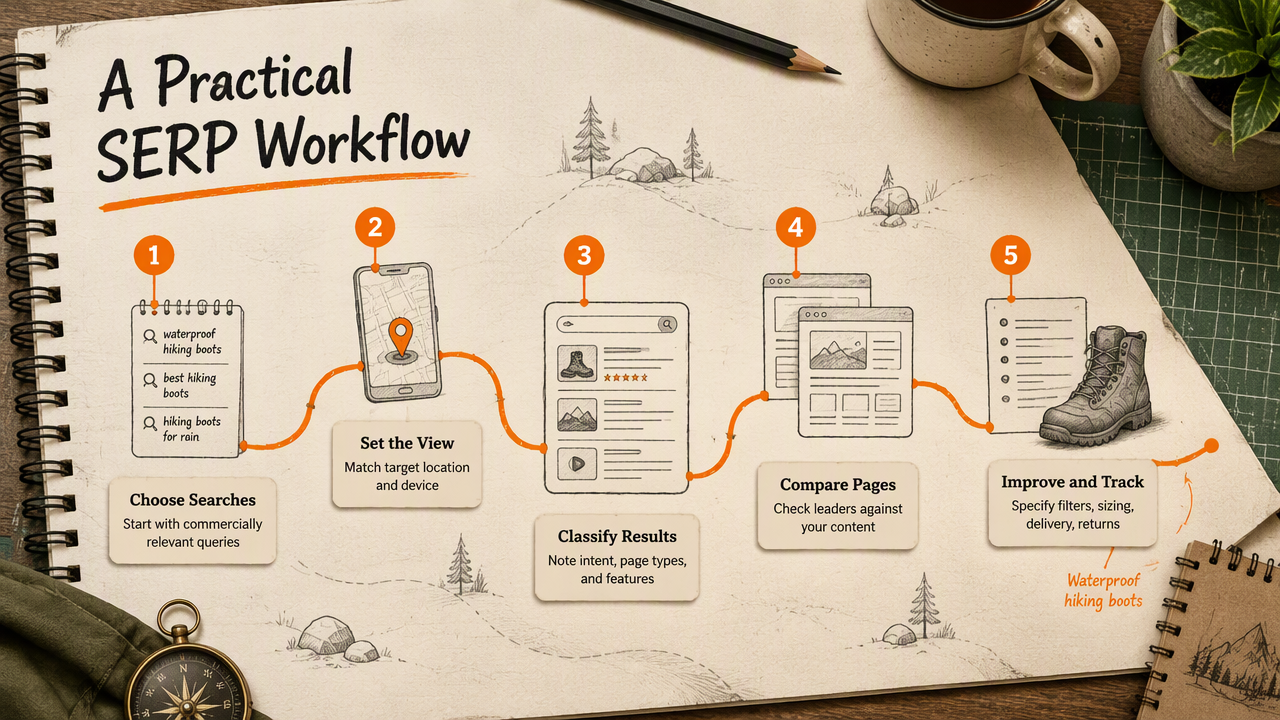
- Inspect results for the target location and device.
- Classify intent, page types, and search features.
- Compare leading pages with the business's existing content.
- Write a brief with concrete page requirements.
- Publish the improvement and track outcomes over time.
Build a brief from observable requirements
Consider a small shop targeting waterproof hiking boots. If category pages dominate, the brief should address product selection, filters, sizing, delivery, and returns. If informational guides dominate another query, the brief may instead require explanations, comparisons, and supporting examples.
A competitor gap isn't simply a phrase missing from a page. It can be an unanswered buying question, unclear service coverage, or a format mismatch. The small-store ecommerce SEO guide offers a relevant follow-up for translating these observations into store improvements.
Content requirement: A specific element a page needs to satisfy the searcher's task, such as a comparison table, booking information, or product specifications.
Track business outcomes alongside rankings
Rank tracking records movement; analysis explains what might need changing. Keep a simple change log with the query, revised URL, publication date, and intended outcome. Compare impressions, clicks, and relevant conversions over time without treating every movement as proof of causation.
The guide to tracking SEO progress without expensive tools supports a lean measurement routine.
A small business needs evidence of useful traffic, not just a more attractive ranking chart.
Plan for changing search layouts in 2027
Search planning should account for both conventional results and AI-generated answers. During future tool trials, inspect how each product represents changing layouts rather than assuming an organic position describes the entire page.
For citation-friendly content, favor direct definitions, clear comparisons, and verifiable supporting details. These also help human readers judge the page quickly.
Frequently asked questions about SERP software
These answers address common buying questions before a small business commits to a subscription.
Can a small business analyze SERPs without a paid tool?
A small business can begin with manual searches and a spreadsheet recording intent, ranking URLs, page formats, and visible features. That approach suits a short keyword list. Paid software becomes more useful when repeated research, multiple locations, or competitor comparisons make manual collection time-consuming.
Is SERP analysis the same as rank tracking?
SERP analysis examines the composition of search results and the pages competing within them. Rank tracking monitors a website's position for selected queries over time. Both support SEO, but they answer different questions: what a page needs to compete, and whether its visibility is changing.
Which features matter most for local businesses?
Local businesses should prioritize location-specific results, local-pack visibility, and accurate service-area comparisons. A national result alone may not represent what nearby customers see. The analysis should also distinguish directories, business listings, and service pages so the next action matches the actual local search opportunity.
Conclusion
The best serp analysis tools for small businesses support a clear decision, not just another report. Start with five relevant queries, compare the resulting page requirements, and trial a tool against those tasks. For a practical research-to-page workflow, explore Earlyseo at earlyseo.com and review one priority page before expanding the tool budget.