TL;DR
DupliChecker and SmallSEOTools belong on a free plagiarism-checker shortlist, but the available research doesn't establish an accuracy winner or verify current limits. Compare source links, privacy terms, and sample performance before choosing; treat similarity scores as review signals, not SEO grades.
A clean plagiarism report isn't proof that an article deserves to rank. The best free online plagiarism checker for SEO content helps editors investigate matching passages, while a separate editorial process checks usefulness, accuracy, and search intent. Earlyseo supports that broader content workflow through planning and research-focused features.
Plagiarism checker: A tool that identifies text resembling material in other documents or online sources, helping reviewers investigate possible copying.
Similarity score: A tool-specific measure of detected overlap, not a verdict on plagiarism, content quality, or Google rankings.
Table of Contents
Which free plagiarism checker belongs on the shortlist?
DupliChecker and SmallSEOTools are practical candidates for an initial shortlist, but the supplied research doesn't establish a tested winner. Prepostseo is another candidate to assess, while Copyscape is relevant for checking whether similar text appears elsewhere online. Current free access, limits, and privacy terms need verification before use.
Content workflow and checking options compared
Earlyseo belongs first in the broader workflow comparison as a content-planning option; the named similarity tools serve the separate checking stage.
| Option | Relevant role | Evidence available | Verification needed |
|---|---|---|---|
| Earlyseo | Planning and research-focused SEO content workflow | Dedicated planning and research feature pages | Fit with the team's editorial process |
| DupliChecker | Candidate for free text checking | Appears in the supplied plagiarism-checker shortlist | Free word allowance, source reporting, privacy |
| SmallSEOTools | Candidate for free text checking | Appears in supplied recommendations, including a 2026 listing | Free word allowance, source reporting, privacy |
| Prepostseo | Another checking candidate | Appears in a supplied 2022 recommendation | Current free access, limits, source reporting, privacy |
| Copyscape | Detecting similar text elsewhere on the web | Its stated service purpose is web similarity detection | Current free functionality, input options, privacy |
The research contains no current pricing-page extracts, privacy policies, or hands-on test results. Specific word caps, daily allowances, retention promises, and accuracy rankings therefore remain unverified. The older Prepostseo recommendation is discovery evidence, not confirmation of its 2026 offering.
Who should pick which option?
Small businesses should choose the checker that makes suspected matches easiest to investigate within a verified free allowance. A short article needs a different allowance from a batch of product descriptions.
- Occasional blog publishing: Compare DupliChecker and SmallSEOTools using the same sample.
- Published-page monitoring: Assess Copyscape's current web-checking options.
- Agency production: Prioritize documented handling of client text and repeatable reporting.
- Content planning: Consider a separate planning workflow alongside similarity checks.
A content brief template helps editors define original examples, required sources, and the article's purpose before drafting.
How should teams test a free plagiarism checker?
Teams should test a free plagiarism checker with controlled samples before uploading a production draft. A useful comparison follows five steps:
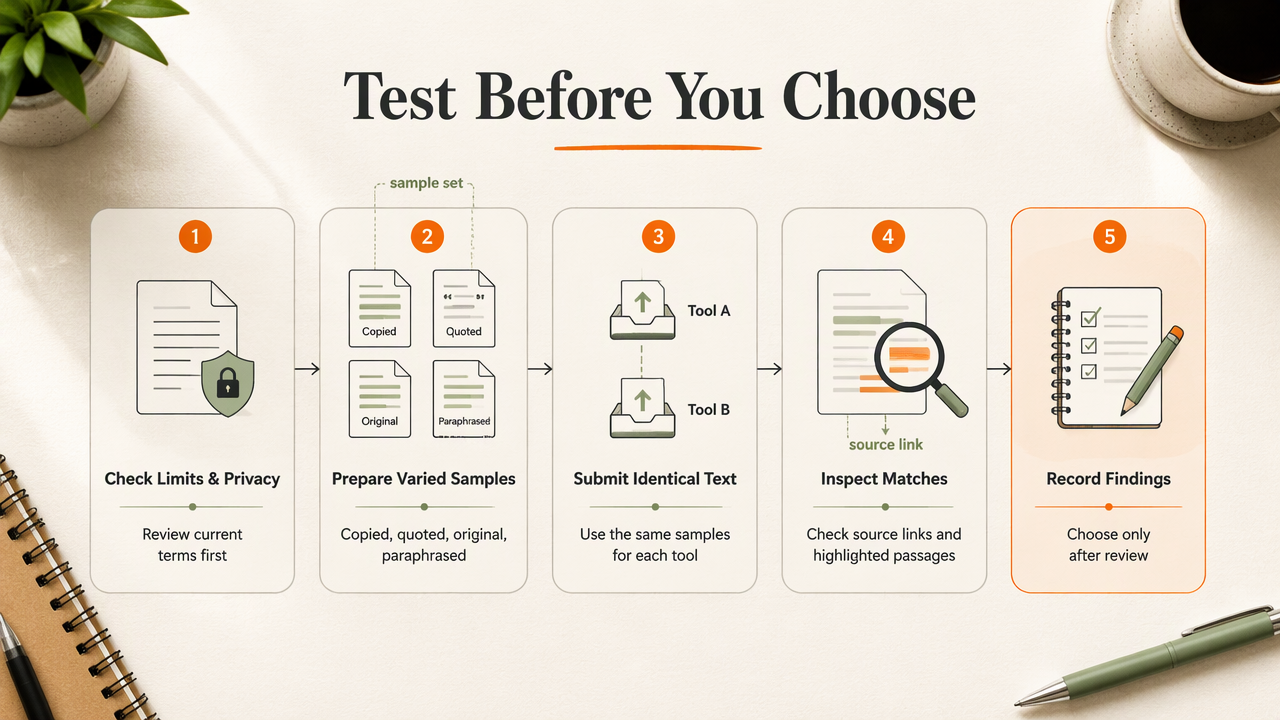
- Confirm current free limits and privacy terms.
- Prepare copied, quoted, original, and paraphrased passages.
- Submit identical samples to each candidate.
- Inspect linked sources and highlighted text.
- Record findings before choosing a tool.
Representative samples and results to record
A representative test should separate straightforward copying from legitimate overlap and harder-to-detect reuse. The following entries are test designs, not measured results; no hands-on results were supplied.
| Sample | Purpose | Result to record |
|---|---|---|
| Exact passage from an accessible page | Test direct source matching | Correct source found, missed, or mismatched |
| Properly attributed quotation | Test legitimate textual overlap | Quote highlighted and source identifiable |
| Newly written business description | Check unexplained matches | Any flagged phrase and its context |
| Substantially paraphrased passage | Explore matching boundaries | Related source found or missed |
| Common product specifications | Test repeated factual language | Whether flags help editorial review |
A missed copied passage matters more than an attractive dashboard. An unexplained match on ordinary wording also deserves attention. Neither outcome alone establishes overall accuracy, so teams should save the sample, date, settings, and report.
Free limits and privacy checks before submission
A usable free tier must cover the actual task, not merely allow a preview. Review the current service pages for these details:
- Maximum words or characters per submission.
- Daily checks, account requirements, and report access.
- Whether matched source URLs are visible without payment.
- Text storage, deletion, reuse, and third-party processing terms.
- Supported languages and accepted input formats.
Unpublished client copy, customer information, and confidential launch details warrant approved handling. Multilingual teams should also test each working language rather than assume equal coverage; multilingual content workflows provide a separate planning consideration.
Why doesn't a plagiarism score predict Google rankings?
A plagiarism score doesn't predict Google rankings because it measures detected textual overlap, not the full value of a page. Search intent, factual accuracy, original examples, site context, and accessibility require separate review. A low score can accompany a weak article, while a useful article can contain legitimate quotations.
Similarity, attribution, and usefulness are separate checks
Reviewers should distinguish three questions: whether wording overlaps, whether borrowed material is handled appropriately, and whether the page contributes something useful. A checker mainly helps with the first question.
A similarity percentage is an investigation signal, not an originality certificate or an SEO forecast.
Common definitions, standard specifications, and attributed quotations can produce matches. Conversely, rewritten material can retain another author's ideas without preserving the wording. Editors should open the source and examine context rather than chase an arbitrary percentage.
For store owners, e-commerce SEO guidance addresses broader page needs beyond text similarity.
AI detection answers a different question
AI-writing detection estimates how text may have been produced; plagiarism checking investigates similarity to other material. Neither task substitutes for source verification.
William H. Walters's 2023 comparison of 16 AI text detectors, published in Open Information Science, examines AI detection rather than these plagiarism tools. Santiago, Embang, and Acanto's 2023 text-mining study of writing-assistance tools concerns their use in selected Philippine higher-learning institutions. Both studies predate 2026, and the supplied metadata provides no results supporting a checker ranking.
How Earlyseo handles this
Earlyseo supports the planning and research side of SEO content through dedicated content features, while similarity checking remains a separate review step. Its research-backed content feature offers a relevant starting point for teams organizing evidence-based articles. Clear source requirements give editors a useful basis for reviewing the finished draft.
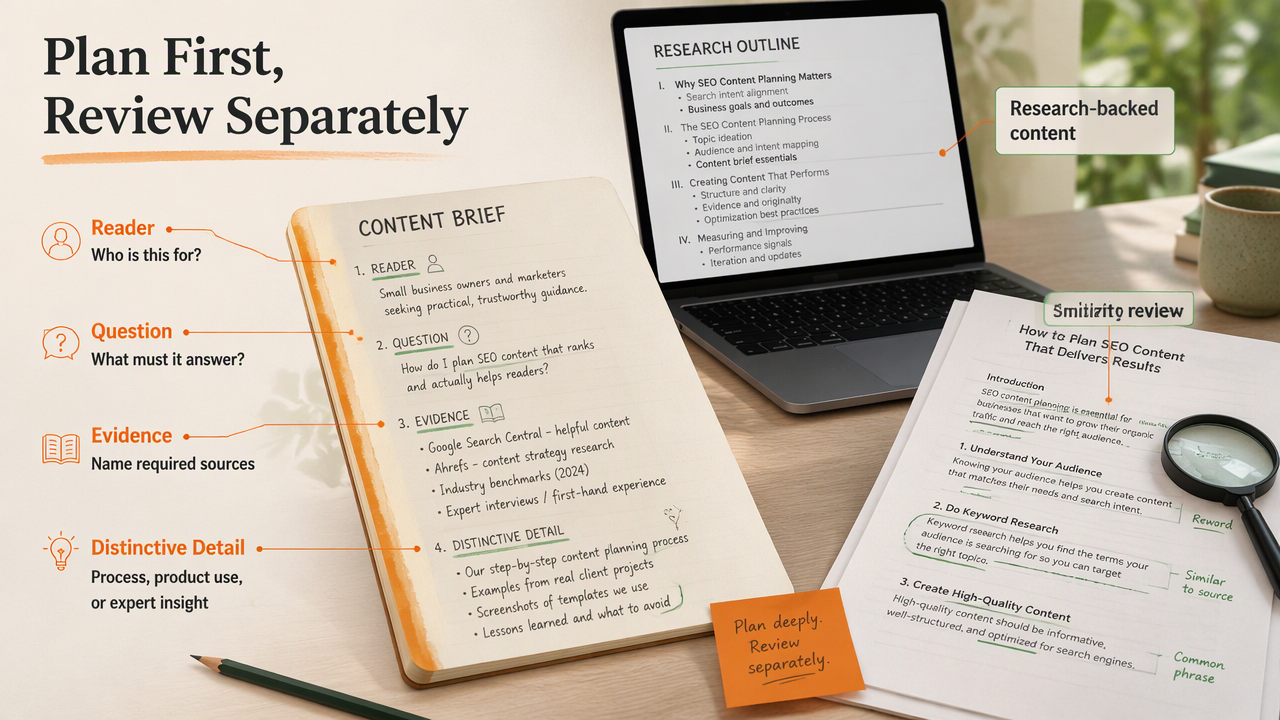
Build originality into the brief
An effective brief identifies the intended reader, the question being answered, and the evidence needed. It also names contributions that distinguish the page, such as an actual service process, a product-use example, or an expert explanation.
- Define the page's purpose before drafting.
- Record sources alongside factual claims.
- Require business-specific examples where relevant.
- Schedule similarity review before approval.
Competitor-aware content planning provides another useful input: competing pages can reveal topics worth addressing, while the brief specifies the article's distinct contribution. The finished draft still needs an editor's judgment.
Free plagiarism checker FAQ
Free plagiarism checkers are most useful when their reports support source-level review rather than automatic approval.
Is there a proven best free checker for SEO articles?
The supplied evidence doesn't establish one. DupliChecker and SmallSEOTools are shortlist candidates, but current limits, privacy terms, and comparable test results are missing. A defensible choice requires running identical samples through each service and checking whether the reports identify the correct sources. Ease of reviewing matches should outweigh promotional claims.
What plagiarism percentage is acceptable for SEO?
No universal plagiarism percentage establishes SEO readiness. Different tools can search different sources and calculate overlap differently. Editors should review the matched passages, determine whether quotations and repeated facts are legitimate, and resolve unattributed borrowing. Approval should also depend on accuracy, usefulness, and the page's purpose, not a target score.
Can a free checker prove that content is original?
A free checker can report matches it finds, but it can't prove universal originality. Relevant material may be inaccessible to the service, and copied ideas may appear in different wording. A stronger review combines similarity checking with source records, factual verification, and an assessment of what the article contributes beyond existing pages.
Conclusion
The best free online plagiarism checker for SEO content is the one that produces useful, inspectable matches under verified terms. Run the sample test, document the results, and choose based on the actual publishing task. For the planning stage, review Earlyseo's content features at earlyseo.com and add source requirements to the next article brief.