TL;DR
For full-copy syndication, request partner-side noindex when keeping the original as the searchable version is the priority. Canonical tags and attribution links aren't guarantees; agree on indexing controls before publication, then measure referral traffic separately from rankings.
Publishing the same article on several websites creates a distribution opportunity, not an automatic ranking boost. The most useful SEO tips for syndicated content start with a business decision: should partner copies attract search traffic, or should they mainly introduce the original publisher to another audience?
Content syndication: Authorized republication of existing content on another website or platform, usually with attribution to its original publisher.
A planned distribution workflow gives each article a clear destination, owner, and measurement goal. Earlyseo can support the content-planning side of that process, while publisher agreements establish how partner copies enter search.
Table of Contents
What is content syndication in SEO?
Content syndication in SEO means republishing existing material on another website while managing how search engines handle the original and its copies. Its practical benefits can include audience exposure, referral visits, and brand recognition. Search rankings remain a separate outcome, influenced by indexing decisions and the version Google selects.
Syndication differs from guest posting: a guest article is created for another publisher, while syndicated content already exists elsewhere. Permission matters, too. An authorized copy belongs in a distribution plan; an unauthorized scrape calls for a different response.
Three publishing formats and their tradeoffs
The amount of reused content helps determine the appropriate publishing agreement.
| Format | What the partner publishes | Main consideration |
|---|---|---|
| Full-copy syndication | The complete article, with attribution | Agree whether the partner copy should be indexed |
| Excerpt distribution | A short selection linking to the original | Give readers a clear reason to visit the source |
| Original adaptation | A distinct article with new analysis or examples | Make the page useful beyond minor wording changes |
Changing a title or swapping a few words doesn't create a meaningfully different resource. An adaptation should serve a different audience, question, or use case.
For smaller publishers, a content strategy for a new blog helps identify which articles deserve an owned-site home before distribution begins.
How does Google handle syndicated duplicates?
Google handles syndicated duplicates by evaluating similar pages and selecting a representative version for search. Duplicate content doesn't automatically trigger a penalty, but the original publisher isn't guaranteed selection. Canonical signals express a preference; partner-side noindex is the documented approach when the syndicated copy should stay out of Google Search.
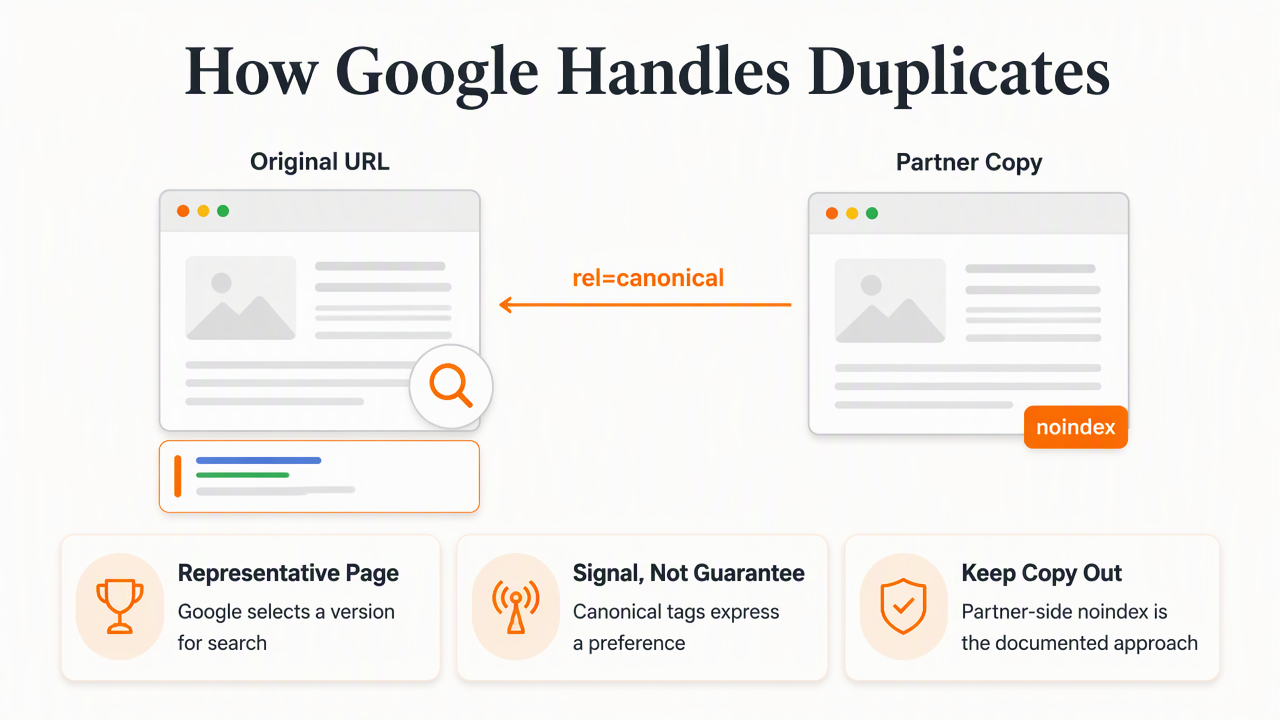
Canonical tags express a preference, not an instruction
A cross-domain rel="canonical" points from a partner copy to the preferred original URL. Google treats canonicalization as a signal rather than a binding instruction, so the tag cannot promise that the original will rank or receive every benefit associated with the copy.
Google's duplicate-URL consolidation guidance specifically says canonical links aren't recommended for syndicated content. The guidance instead recommends that syndication partners block indexing of their copies.
An attribution link serves a separate purpose: it identifies the source and gives readers a route back. Neither that link nor an earlier publication date guarantees Google's selection.
Noindex controls eligibility when Google can crawl the copy
A partner can apply a robots meta tag containing noindex or an X-Robots-Tag HTTP header. Google's documentation on blocking indexing explains that Google must be able to crawl the page to discover this instruction.
Blocking the URL through robots.txt isn't a substitute. That can prevent Google from seeing the page's indexing directive.
Key distinction: Canonicalization asks Google to prefer a version. Noindex tells Google not to include the partner page in search results once the directive is processed.
Neither control guarantees that the original ranks well. Excluding a copy and improving the original's search performance are different jobs.
How to set up a syndication agreement?
A syndication agreement should settle search visibility before a partner receives the article.
- Define the audience and distribution goal.
- Choose full-copy publication, an excerpt, or an adaptation.
- Agree on partner indexing controls.
- Specify attribution, links, and permitted edits.
- Assign verification and update responsibilities.
- Record publication URLs and measurement rules.
Publisher agreement checklist
Written requirements make syndication easier to verify than informal promises.
- Permissions: Identify approved articles, websites, territories, and reuse limits.
- Indexing: State whether full copies require
noindexand who implements it. - Attribution: Require a visible publisher credit and a working source link.
- Timing: Establish original publication and partner publication dates.
- Editing: Define acceptable changes to headlines, claims, images, and links.
- Maintenance: Name the contact responsible for corrections and removal requests.
- Verification: Require access to the published URL and confirmation of agreed controls.
A content brief template can document the article's audience, approved claims, and source material before those details enter a partner agreement.
Publishing the original first is sensible housekeeping, not a ranking safeguard. The agreement should rely on verifiable controls rather than a promised waiting period.
Who should choose full copies, excerpts, or adaptations?
Full-copy syndication fits publishers seeking access to a partner's existing audience. When original-page search visibility is the priority, partner-side noindex belongs in the agreement.
Excerpts fit businesses that want readers to continue on the owned website. For example, a local accounting firm could distribute a short tax-deadline summary that links to its complete checklist.
Original adaptations fit partners serving a genuinely different audience. A retailer's product-care guide could become a distinct maintenance article with new examples, rather than a lightly rewritten duplicate.
If a partner requires an indexed full copy, the publisher should assess that exposure as a business tradeoff. No agreement can guarantee which indexed version Google selects.
Post-publication checks and measurement
A live-page check should confirm the actual implementation, not just the agreement.
Inspect the attribution link, robots directive, canonical tag if present, and crawl accessibility. On the owned site, Google Search Console's URL Inspection can help compare the declared canonical with Google's selected canonical when that information is available.
Track partner referral visits and relevant actions separately from original-page impressions and clicks. A distribution campaign can generate useful leads without improving rankings. A repeatable SEO operations workflow helps assign these checks and follow-up tasks.
How Earlyseo supports syndication planning
Earlyseo supports the planning side of syndication by helping teams organize original content around audience needs and research. The useful starting point is a strong owned-site article with a clear purpose, followed by a separate distribution brief that records where and how partners may republish it.

Build an original-first content workflow
A connected planning workflow keeps creation and distribution aligned.
- Use the AI content planner to organize topics for the owned website.
- Develop source-grounded originals through research-backed content planning.
- Attach a partner brief covering format, attribution, publication dates, and approved updates.
For a startup, that might mean creating a detailed buying guide first, then distributing excerpts to relevant industry publications. For a marketing team, the same workflow can separate evergreen originals from partner-specific adaptations.
Planning principle: Create the authoritative resource first, then choose a distribution format that matches the campaign's goal.
Frequently asked questions about syndicated SEO
The main syndication questions concern indexing controls, source attribution, and the difference between reach and ranking performance.
Does syndicated content cause a duplicate-content penalty?
Authorized syndication doesn't automatically cause a duplicate-content penalty. The more common concern is selection: Google may show a partner's indexed version instead of the original. Spam policies are a separate issue. Publishers should focus on indexing agreements, attribution, and original-page quality rather than treating every legitimate duplicate as a penalty risk.
Is a canonical tag enough to protect the original?
A canonical tag alone doesn't guarantee that Google selects the original or that it ranks well. For syndicated copies, Google's documented recommendation is to have partners block indexing. If a partner insists on an indexed copy, the publisher should treat the canonical as a preference signal and accept the remaining selection uncertainty.
Can a syndicated article still send traffic with noindex?
A noindexed article can still receive visitors through the partner's newsletters, social posts, navigation, and direct links. Those readers can follow attribution links to the original publisher. Noindex concerns search eligibility, not general page access. Referral reporting helps show whether that distribution delivers engaged visitors or useful business actions.
Should every partner receive the complete article?
Not every partner needs the complete article. Excerpts can introduce a topic while directing readers to the original resource. Distinct adaptations can serve another audience with new examples or analysis. Full copies make sense when audience exposure justifies the arrangement and both publishers agree on permissions, attribution, and indexing.
Conclusion
Apply these SEO tips for syndicated content to one pilot article before expanding distribution: agree on indexing, verify the published copy, and measure referral outcomes separately from search performance. For original-content planning, teams can explore Earlyseo at earlyseo.com, then prepare a publisher brief before approaching the first partner.