TL;DR
Startup landing pages should target one clear search intent, publish on a crawlable domain, load fast, and prove trust above the fold. The best 2026 approach balances conversion copy with indexable content, structured answers, internal links, and measurement in Google Search Console.
A startup landing page has one job on launch day, but search engines need more than a sharp headline to understand why it deserves traffic. SEO for startup landing pages works best when the page is built as a focused answer to one commercial problem, not as a thin ad destination. A startup, by definition, seeks to validate a scalable business model, and a landing page is a single web page created for a campaign or destination in online marketing. Tools like Earlyseo help early teams shape that page into something search engines, AI answer engines, and buyers can understand without turning it into a bloated website.
Table of Contents
What is SEO for startup landing pages?
SEO for startup landing pages is the process of making a focused startup page discoverable, understandable, and persuasive in organic search. It combines one primary keyword, a clear page purpose, crawlable technical setup, fast performance, trust signals, and conversion-focused copy so the page can rank without losing its lead-generation role.
SEO landing page: a single, indexable page built to rank for a specific search intent while guiding visitors toward one business action, such as a demo request, signup, waitlist, purchase, or local inquiry.
Key takeaway: a startup landing page should not try to rank for every phrase in a market. It should own one useful problem, explain the offer clearly, and make the next action obvious.
Competitive SERP patterns show a consistent rule: strong pages publish on the company's own domain, map one keyword theme to one page, and treat speed, headings, and trust proof as ranking and conversion factors. Reddit-style startup advice in the research data also points in the same direction: use one primary keyword naturally in the title, H1, URL, and meta description.
For a young company, that discipline matters because the page often has little domain authority, few backlinks, and no long content history. The landing page has to make relevance obvious. That means plain language beats clever slogans, and a specific search query beats a broad category term.
- Good target: "AI meeting notes for sales calls"
- Weak target: "productivity software"
- Good target: "Shopify SEO audit tool"
- Weak target: "grow ecommerce traffic"
A landing page can still be concise. It just cannot be empty. Search engines need enough context to connect the offer to a real query, and buyers need enough proof to trust an unknown brand.
How should a startup landing page be structured for search?
A startup landing page should follow a simple search-first structure: 1. match one intent; 2. state the offer in the H1; 3. answer the buyer's core question above the fold; 4. add proof; 5. explain features and use cases; 6. close with a clear call to action.
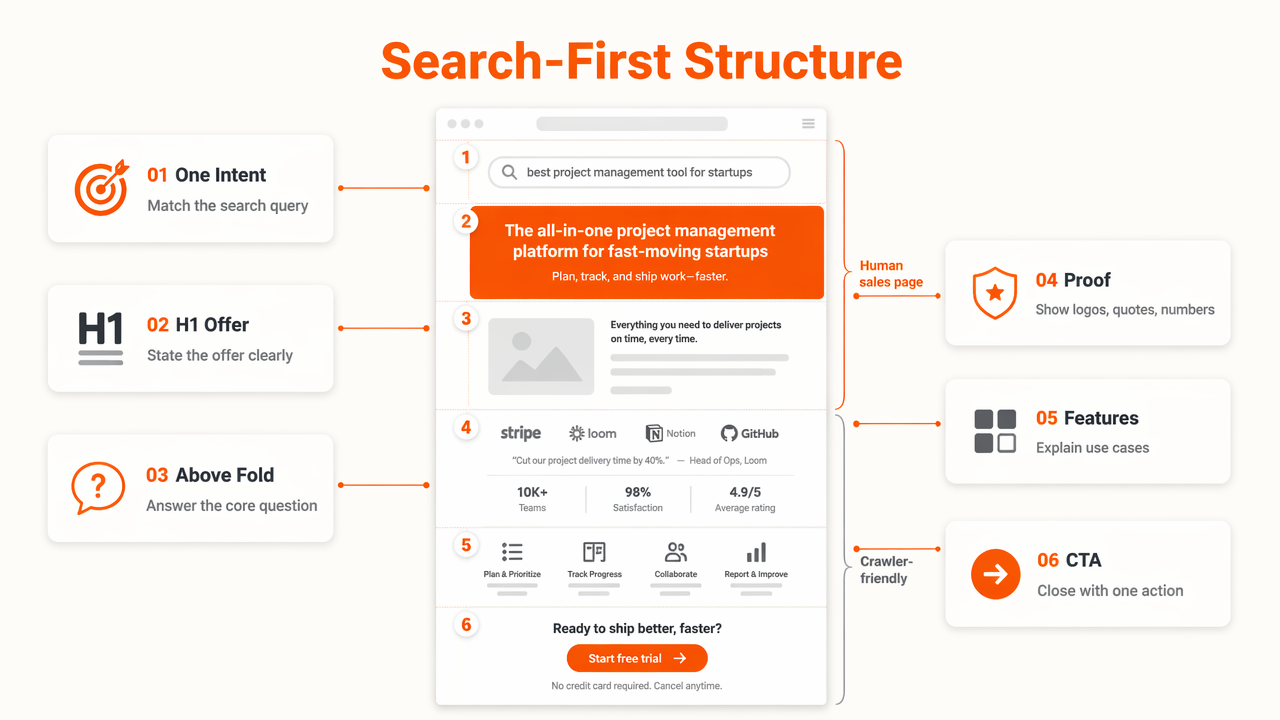
The page should feel like a sales page to a human and a clean answer document to a crawler. That balance is where many early pages miss. A hero section with only a tagline, email field, and no supporting copy may convert warm visitors, but it rarely gives search systems enough substance.
Recommended landing page sections
| Page element | SEO job | Conversion job |
|---|---|---|
| URL slug | Signals the topic in plain words | Builds confidence before the click |
| Title tag | Matches the search query | Sets the promise in search results |
| H1 | Confirms page relevance | Explains the offer fast |
| Hero copy | Defines audience and outcome | Reduces confusion |
| Feature blocks | Adds topical depth | Shows what the product does |
| Use cases | Captures related intent | Helps visitors self-identify |
| Social proof | Supports trust | Lowers perceived risk |
| FAQ | Answers objections | Captures long-tail queries |
| CTA | Clarifies the next step | Turns interest into action |
A practical homepage-style landing page can use 700 to 1,200 words and still stay sharp. The key is section density, not length for its own sake. Every block should answer a searcher's next question.
For startups publishing on WordPress, the Earlyseo WordPress integration can help connect optimization workflows to pages that change often during validation. Ecommerce teams working from a product-led landing page can use the Shopify integration to keep technical edits closer to store operations.
A strong page also needs internal links. One landing page should not sit alone unless it is a paid-only campaign page. Link from the homepage, relevant blog posts, documentation, comparison pages, and product pages so crawlers understand importance.
Useful anchor text should describe the page topic. Generic anchors like "learn more" waste context. A link that says "AI meeting notes for sales teams" helps search systems and visitors understand the destination before the click.
Which technical SEO checks matter before launch?
The technical checks that matter most before launch are indexability, canonical tags, mobile rendering, Core Web Vitals, structured data, clean metadata, and analytics. A startup page should be crawlable from day one because early impressions in Google Search Console reveal whether the positioning matches real demand.

Technical SEO does not need to be complex at this stage. It needs to prevent silent failure. A beautiful page that is blocked by noindex, hidden behind client-side rendering problems, or duplicated across campaign URLs can lose weeks of learning.
Pre-launch checklist for a crawlable page
- Confirm the page returns a
200status code. - Remove accidental
noindextags. - Add a self-referencing canonical URL.
- Write a unique title tag under normal search-result limits.
- Write a meta description that matches the offer.
- Use one H1 and logical H2 sections.
- Compress images and avoid layout shift.
- Submit the URL through Google Search Console after publishing.
Performance still matters because landing pages are often media-heavy. Competitor research for 2026 landing page optimization highlights speed and Core Web Vitals as standard expectations, not advanced extras. Hero videos, oversized background images, and third-party scripts should earn their place.
Structured data can also help, especially Organization, SoftwareApplication, Product, FAQPage, or LocalBusiness where relevant. Markup should describe visible content only. Search engines can ignore or distrust markup that says more than the page proves.
For teams using Webflow, the Earlyseo Webflow integration supports a cleaner workflow between design changes and search checks. The Earlyseo platform is most useful when landing page edits happen weekly, since keyword targeting, metadata, and indexability can drift during fast startup cycles.
Key takeaway: the best technical setup is boring. Crawlable, fast, mobile-friendly, and measured beats clever experiments that make the page harder to index.
How can startup landing pages earn trust and AI visibility in 2026?
Startup landing pages can earn trust and AI visibility by using named entities, clear definitions, specific proof, structured answers, and transparent product context. Search engines and AI systems prefer pages that explain who the company serves, what the product does, why it exists, and how claims are supported.
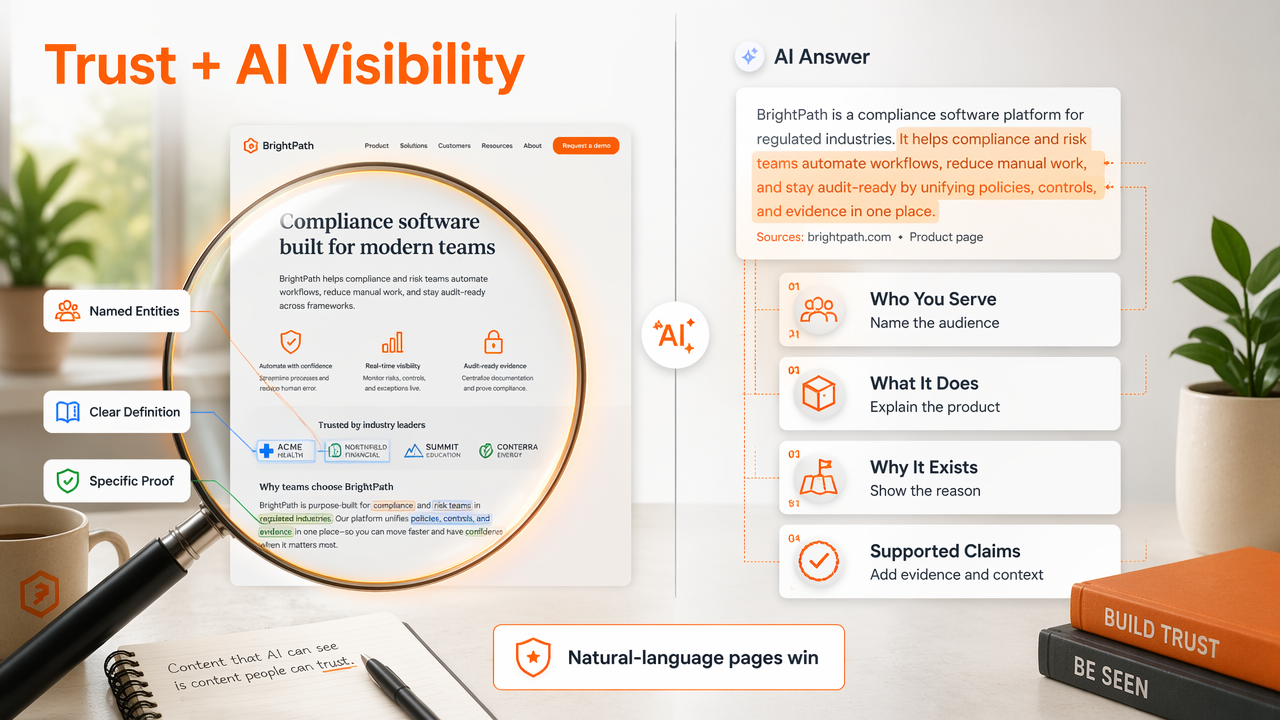
AI answer engines have changed how landing pages get discovered. A 2024 paper by Aamo Iorliam and Joseph Abunimye Ingio compared generative AI tools for natural language processing, showing the broader shift toward systems that parse and summarize natural-language content rather than simply list blue links (study). That makes extractable page sections more valuable.
Clear entity language helps. Name the product category, audience, platform, locations, integrations, and use cases. Instead of saying "a better way to manage work," a startup page should say "project management software for architecture firms" if that is the real offer.
Trust signals that support search and conversions
- Customer names or logos, when permission exists
- Founder or company details with real names
- Product screenshots instead of abstract graphics
- Pricing, trial, or waitlist terms where possible
- Security, compliance, or data-handling notes
- Clear support channels and documentation
- Specific use cases by industry, role, or platform
HubSpot is a useful entity example because it is clearly described as a US-based developer and marketer of software for marketing, sales, and customer service, founded in 2006. A startup page does not need HubSpot's authority, but it does need that kind of plain entity clarity.
Answer blocks also matter. Each major section should start with a direct sentence that could stand alone in a search result or AI Overview. FAQs should answer real objections, not repeat sales copy. Documentation can support those answers, especially when a product is technical. Linking to Earlyseo documentation gives startups a model for making product information easier to parse.
The llms.txt idea is also gaining attention as brands think about AI crawlers and answer engines. Early teams that want to prepare content for AI discovery can review the Earlyseo llms.txt resource while keeping the main landing page readable for humans first.
Research about media and technology predictions by Nic Newman and Federica Cherubini, available through the University of Oxford archive, shows how digital discovery keeps shifting as platforms change (report). For 2026, the practical move is not chasing every new format. The safer move is publishing clear, structured, well-linked information that can be reused by search, AI systems, and buyers.
FAQ: Startup landing page SEO questions
Startup landing page SEO usually comes down to focus, crawlability, proof, and measurement. These common questions cover the decisions that affect early visibility most often.
How many keywords should a startup landing page target?
A startup landing page should target one primary keyword theme and a small set of closely related phrases. A single page can rank for variations, but it should not mix unrelated intents. For example, "AI notes for sales calls" and "sales call transcription tool" can fit together, while "CRM software" is likely too broad.
Should a startup use a landing page or a blog post for SEO?
A landing page is better for commercial intent, such as signups, demos, trials, and purchases. A blog post is better for informational intent, such as tutorials, comparisons, and problem education. Many startups need both: the blog captures early research, while the landing page converts high-intent visitors.
Can a short landing page rank in Google?
A short landing page can rank when the query is specific, the page is technically clean, and the content fully answers the intent. Thin pages struggle when they provide only a slogan and a form. Short does not mean weak; the page still needs clear copy, proof, headings, and relevant internal links.
How long does SEO take for a new startup landing page?
Early impressions can appear within days or weeks after indexing, but meaningful rankings usually take longer because new domains have limited trust. Search Console data should guide changes. If impressions grow but clicks stay low, improve the title and meta description. If impressions never appear, revisit targeting and indexability.
What should be measured after launch?
The core metrics are impressions, clicks, click-through rate, average position, conversions, and assisted conversions. Startup teams should also track which queries trigger impressions, because those terms reveal how Google understands the page. Earlyseo can support this review process, and more guidance is available at earlyseo.com.
Conclusion
SEO for startup landing pages works when the page is specific enough to rank and clear enough to convert. The next action is simple: pick one primary query, rewrite the hero section around that intent, add proof and FAQs, check indexability, then review Search Console every two weeks. For a faster workflow, connect the page to Earlyseo, document the target keyword, and keep improving the page based on real impressions rather than guesses. A focused refresh can move an almost-there page from position 12.8 into click territory.