TL;DR
Featured snippets are earned by pages that answer a search query clearly, quickly, and in a format Google can extract. The best approach is to find snippet-triggering queries, rewrite the answer block, match the current snippet format, and keep improving the page with Search Console data.
Winning a featured snippet can move a page from quiet first-page visibility to the most noticeable organic result on the search engine results page. For teams learning how to get featured snippets, the practical answer is not tricking Google, it is making a page easier to understand, extract, and trust. Earlyseo helps growing sites turn question-led keywords into structured pages that are more likely to qualify for snippet-style visibility.
Table of Contents
What is a featured snippet?
A featured snippet is a highlighted organic answer that Google extracts from a web page and shows near the top of a search results page. It usually answers a question directly, often as a paragraph, list, table, or video result, so searchers can understand the answer before clicking.
SERP: A search engine results page is the page a search engine displays after a query, including organic listings, ads, featured snippets, People Also Ask boxes, and knowledge panels.
Featured snippets are not paid placements. They are selected from indexed pages that Google sees as useful for a specific query. A page can rank below another result and still be chosen for the snippet if its answer is clearer or better structured.
Key insight: A snippet-worthy page does not just contain the right answer. It places the answer where search engines can identify it fast.
Research on knowledge graphs by Ji, Pan, and Cambria in IEEE reviewed how entities and relationships help machines represent knowledge, which explains why clear nouns, definitions, and connected concepts matter for search extraction source.
Featured snippet formats worth targeting
Most snippet opportunities fit a small set of answer formats. Matching the format already showing in Google is usually safer than inventing a new one.
| Snippet format | Best query type | Content structure to use |
|---|---|---|
| Paragraph | What is, why, when | 40 to 60 word direct answer under the heading |
| Numbered list | How to, steps, process | 3 to 8 ordered steps with concise labels |
| Bulleted list | Best, types, examples | Short items with consistent phrasing |
| Table | Comparison, pricing, sizes | Columns that answer the exact comparison |
| Video | Demonstration, tutorial | Clear video title, transcript, and supporting text |
How to get featured snippets in 2026
Getting featured snippets in 2026 requires choosing queries that already trigger snippets, answering the query in a clean extractable block, and improving the page until it becomes the easiest source for Google to cite. The process works best when content structure, topical authority, and search intent all line up.
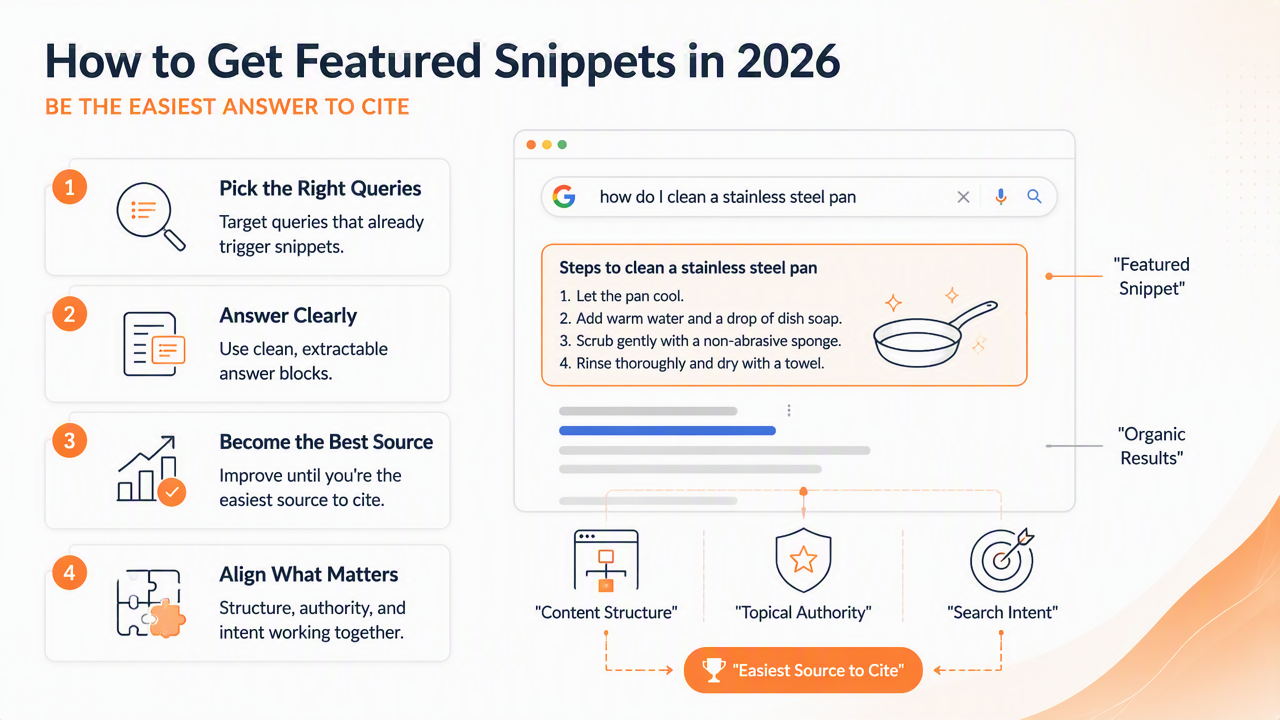
- Find snippet-triggering queries: Check keywords where Google already shows a paragraph, list, table, or video answer.
- Prioritize near-ranking pages: Pages already ranking on page one or close to it usually have the best chance.
- Rewrite the answer block: Place a direct 40 to 60 word answer immediately under the relevant heading.
- Match the visible format: Use a numbered list for step snippets, a table for comparison snippets, and a paragraph for definitions.
- Add supporting detail: Follow the short answer with examples, clarifications, and related subtopics.
- Improve trust signals: Strengthen internal links, update dates, author expertise, and source citations.
- Track and refine: Use Search Console impressions, rankings, and click behavior to decide which sections need rewriting.
The Earlyseo platform is especially useful for turning scattered keyword ideas into a content brief with answer-led headings and snippet-ready structure. That matters because Google is not only reading individual sentences, it is also interpreting how the page topic fits together.
A snippet optimization workflow for small teams
A focused workflow prevents endless rewriting. The page should improve one answer target at a time rather than becoming a long FAQ with weak structure.
- Query: the exact search phrase that triggers the opportunity.
- Intent: the answer format the searcher expects.
- Current winner: the page Google currently extracts.
- Format gap: the structural reason that page may be winning.
- Revision: the smallest edit that makes the answer clearer.
For example, a page targeting local SEO might add a heading such as "What is local SEO?" followed by a concise definition, then a table comparing Google Business Profile, citations, reviews, and location pages. For click-through support after earning visibility, the guide to writing meta descriptions that get clicks pairs well with snippet work.
What content structure wins snippets most often?
The content structure that wins snippets most often is a direct answer block followed by deeper supporting context. Google needs a clean extract, but readers need enough detail to trust the answer and continue through the page.
Strong snippet pages usually share three traits: a question-style heading, a short answer immediately below it, and formatting that mirrors the search result. The heading should match a real query. The answer should not start with background history. The follow-up section should prove the answer with examples, comparisons, or instructions.
A 2022 survey of attention mechanisms in computer vision by Guo, Xu, and Liu examined how models focus on important parts of complex inputs source. Search systems are different, but the lesson for SEO is practical: pages that highlight the most relevant answer in predictable places are easier for machines to process.
Snippet-ready page anatomy
A page does not need to be stuffed with repeated keywords. It needs clear sections that answer one thing at a time.
| Page element | What it should do | Example |
|---|---|---|
| H1 | Name the main topic | How to Get Featured Snippets |
| Intro | State the main method | Earn snippets by matching intent and format |
| H2 question | Target a People Also Ask style query | What is a featured snippet? |
| Answer block | Give the extractable answer | 40 to 60 words under the H2 |
| Supporting section | Add depth | Examples, tables, steps, citations |
| Internal links | Build topical context | Related SEO guides and assets |
Visual assets can help when the query needs an example, workflow, or comparison. For pages that need clearer supporting images, featured image generation can help produce consistent visuals for SEO articles without slowing production.
How should Search Console guide snippet updates?
Search Console should guide snippet updates by showing which queries already earn impressions, where the page ranks, and which terms deserve a clearer answer block. A page with impressions and a first-page average position is often closer to a snippet than a new page with no search data.
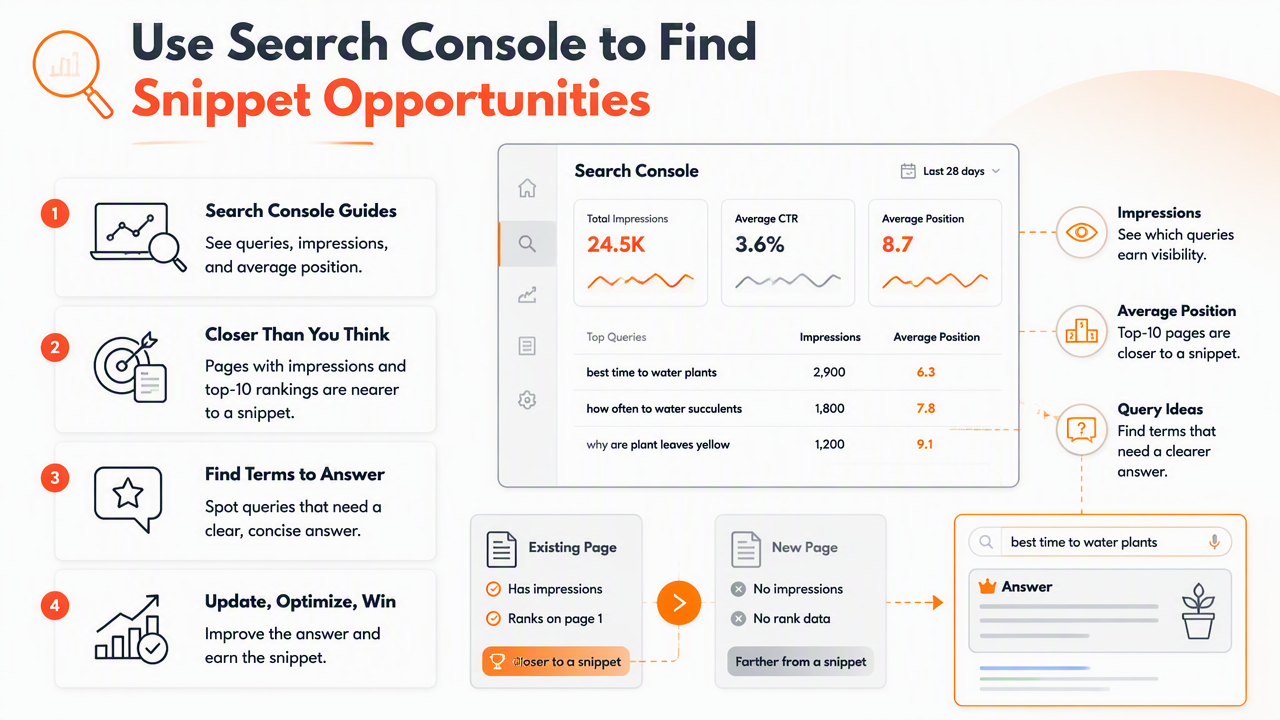
The most useful opportunities are queries with strong impressions, low click-through rate, and rankings near the first page. These pages already have relevance. The job is to make the answer more extractable and more useful than the result currently occupying the snippet.
Key insight: Snippet optimization should start with pages Google already understands, not only with brand-new content.
A practical review cycle can run every two to four weeks for active content. The team can export queries, group them by intent, and update one section per target. This keeps revisions measurable.
Search Console checks before editing
Before rewriting, the SEO team should document the current result. That reduces guesswork and avoids broad edits that hurt rankings.
- Record the target query and current average position.
- Search the query in an incognito browser and note the snippet format.
- Compare the page section against the current snippet source.
- Add or rewrite the answer block under the matching heading.
- Request indexing after meaningful changes.
- Review impressions, position, and CTR after fresh data appears.
Authority still matters. A page with thin backlinks may struggle against trusted domains even with better formatting. For newer sites, the guide on getting backlinks for a new website supports the off-page side of snippet competitiveness.
What will change for snippets in 2027?
Featured snippets in 2027 will likely become more connected to AI-style answers, entity understanding, and mixed media results. The safest strategy is to build pages that answer questions clearly, cite sources carefully, define entities, and support answers with tables, lists, images, and updated context.
AI Overviews and answer engines are making extractable content more valuable, not less. A page that gives a clean definition, a concise process, and a well-labeled comparison table is easier for both classic search and AI systems The risk is writing only for extraction and forgetting the reader. Thin answer blocks can win visibility briefly, but a page still needs depth, original examples, and trustworthy sourcing to keep rankings. A helpful page should satisfy the quick answer and the next three follow-up questions.
with Earlyseo, content teams can treat snippet work as an ongoing refresh process rather than a one-time edit. More guidance is available on earlyseo.com for teams building organic visibility from the ground up.
FAQ about featured snippets
How long should a featured snippet answer be?
A featured snippet answer often works best at 40 to 60 words for definition and explanation queries. That length gives Google a clean extract while leaving room for the page to add examples, steps, and related context below the answer.
Can schema markup guarantee a featured snippet?
Schema markup cannot guarantee a featured snippet. It can help search engines understand page entities, article structure, FAQs, products, and other details, but Google still chooses snippets based on query relevance, page quality, extractability, and search intent.
Does a page need to rank first to win a snippet?
A page does not always need the number one traditional organic ranking to earn a featured snippet. It usually needs to be highly relevant and competitive for the query. Near-ranking pages are strong candidates because Google already considers them useful.
Are featured snippets still worth targeting with AI results growing?
Featured snippets are still worth targeting because the same formatting helps AI answers, People Also Ask results, and classic organic listings. Clear definitions, steps, tables, and cited support make content easier for search systems to interpret and reuse.
Conclusion
Learning how to get featured snippets comes down to disciplined editing: find queries that already trigger answer boxes, match the winning format, write a short direct answer, and support it with useful depth. The next step is to pick one near-ranking page, update one answer block, add one relevant table or list, then measure the result in Search Console before expanding the process across the site.