TL;DR
An SEO audit finds search visibility problems, while an SEO implementation service fixes prioritized issues and builds ongoing momentum. Most small teams should audit first only when the site has unclear problems, then move quickly into implementation with clear owners, timelines, and measurable outcomes.
The choice between an seo implementation service vs seo audit comes down to one blunt question: does the business need diagnosis, or does it need execution? Search engine optimization, commonly defined as improving website visibility and performance in search engine results pages, covers both analysis and action. An audit can reveal crawl problems, weak content, missing internal links, or poor local signals. Implementation turns those findings into shipped pages, technical fixes, content updates, and reporting. For teams without spare SEO capacity, the gap between knowing and doing is often where growth stalls. Earlyseo is built around that execution gap, especially for teams that need SEO work shipped without building a full in-house operation.
Table of Contents
SEO implementation service vs SEO audit: the core difference
An SEO audit identifies what is holding a site back, while an SEO implementation service prioritizes, fixes, publishes, and monitors the work needed to improve search performance.
SEO audit: a structured review of technical SEO, content, rankings, backlinks, competitors, and measurement setup.
SEO implementation service: an execution-focused service that applies SEO recommendations across content, technical updates, internal links, metadata, reporting, and workflows.
A good audit is valuable because it reduces guesswork. It can show whether traffic is limited by indexing, thin content, poor topic coverage, slow pages, missing schema, weak local pages, or unclear keyword targeting. The issue is that the audit itself does not change rankings. It creates a map.
Implementation is the part that changes the site. That may include rewriting title tags, publishing service pages, fixing duplicate content, creating product collection copy, improving internal links, or building a 90-day content plan. For teams comparing diagnosis with execution, the key test is simple: who will do the work after the recommendations are delivered?
Key insight: An audit creates clarity; implementation creates movement. Strong SEO programs usually need both, but not always at the same time.
Comparison table: audit vs implementation deliverables
| Category | SEO audit | SEO implementation service |
|---|---|---|
| Main purpose | Find issues and opportunities | Fix issues and grow visibility |
| Typical output | Report, checklist, priority list | Published updates, technical tickets, content, tracking |
| Timeline | Often short and project-based | Usually ongoing or sprint-based |
| Owner after delivery | Client team, developer, marketer | Service provider plus internal approver |
| Best fit | Unclear site health or pre-redesign review | Limited internal SEO capacity |
| Success signal | Clear diagnosis and priorities | Completed work, indexed pages, ranking movement |
A technical-heavy site may begin with a deeper crawl review, and a beginner-friendly technical SEO audit checklist can help teams understand the moving parts before buying help.
What does an SEO audit actually include?
An SEO audit includes a structured review of site accessibility, indexation, content quality, keyword alignment, internal linking, authority signals, analytics, and competitor positioning.
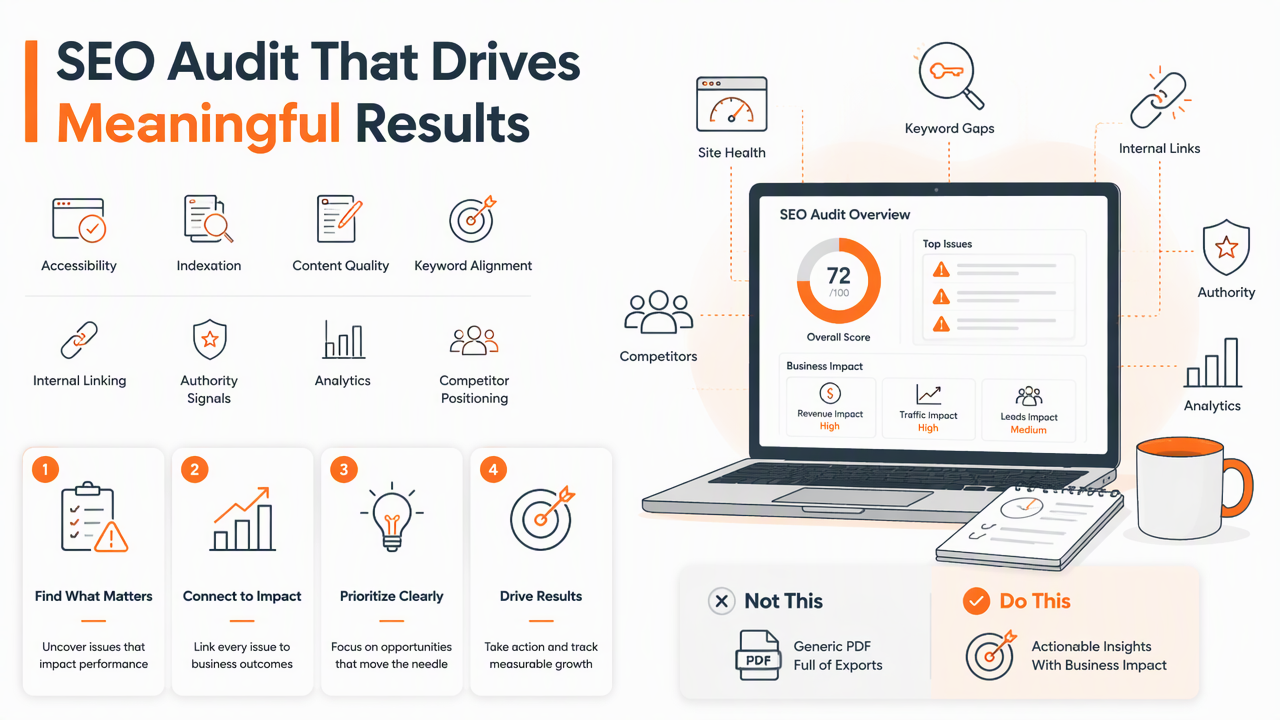
A full audit should not be a generic PDF full of tool exports. The useful version connects each issue to business impact. For example, a missing title tag on a low-value archive page matters less than non-indexed product categories, broken local landing pages, or service pages that miss buyer intent.
Common audit areas include:
- Technical SEO: crawlability, indexation, canonicals, redirects, XML sitemaps, page speed, mobile rendering, and structured data.
- On-page SEO: titles, headings, meta descriptions, URL structure, schema, and content depth.
- Content strategy: topic gaps, duplicate pages, outdated articles, search intent mismatch, and content briefs.
- Internal linking: orphan pages, weak hub pages, anchor text patterns, and crawl depth.
- Local or ecommerce signals: Google Business Profile alignment, location pages, category copy, filters, and product templates.
Research in natural language processing also matters for modern audits. A 2023 survey by Bonan Min, Hayley Ross, and Elior Sulem covered the rise of large pre-trained language models and their effect on language tasks, which helps explain why clearer entity coverage and better structured content now matter beyond classic blue-link search (ACM Computing Surveys).
Audits are strongest when a site has messy history: migrations, redesigns, platform changes, years of content, or unexplained traffic drops. They are weaker as a standalone purchase when the business already knows the problem but lacks time to fix it.
Audit red flags that reduce value
A weak audit often produces activity without action. Common warning signs include:
- No prioritization by revenue impact or effort.
- No explanation of who should fix each issue.
- No distinction between urgent, useful, and optional changes.
- No content plan tied to search intent.
- No follow-up system for measuring completed work.
For founders still choosing external support, the guide on what to ask before hiring an SEO agency is a useful companion because the same questions apply to audit providers.
What does an SEO implementation service handle?
An SEO implementation service handles the actual work after strategy is set, including content production, technical coordination, metadata updates, internal linking, page improvements, and performance reporting.
Implementation is best understood as SEO operations. The service takes a backlog of opportunities and turns it into published assets or completed fixes. For a local business, that might mean building location pages and improving service pages. For an ecommerce store, it may mean optimizing collections, product templates, and informational content. For a startup, it often means building the first search footprint around clear commercial topics.
The Earlyseo platform is designed for this execution layer, with support for content operations, competitor-aware planning, and ongoing publishing. Teams that already have a diagnosis can move straight into SEO operations rather than paying for another static report.
Implementation usually follows this sequence:
- Confirm business goals and priority search segments.
- Convert audit findings or opportunities into a ranked backlog.
- Assign owners for content, development, approvals, and tracking.
- Ship technical fixes and page updates in short cycles.
- Publish new content based on intent and competition.
- Review indexing, rankings, traffic quality, and conversions.
Key insight: Implementation is not just "doing tasks." It is the operating system that keeps SEO work moving after the first recommendations are known.
How Earlyseo handles implementation work
Earlyseo focuses on turning SEO plans into shipped work, especially for small teams that need momentum without managing every brief, outline, and optimization task manually. Its competitor-aware SEO content is useful when the market already has ranking pages and the business needs sharper positioning.
For companies building a content base from scratch, a structured 90-day SEO sprint can help replace scattered tasks with a clear publishing and optimization rhythm. More details about service fit are available on earlyseo.com.
Which option fits each business type?
The right choice depends on site maturity, internal capacity, and whether the main problem is uncertainty or unfinished work.
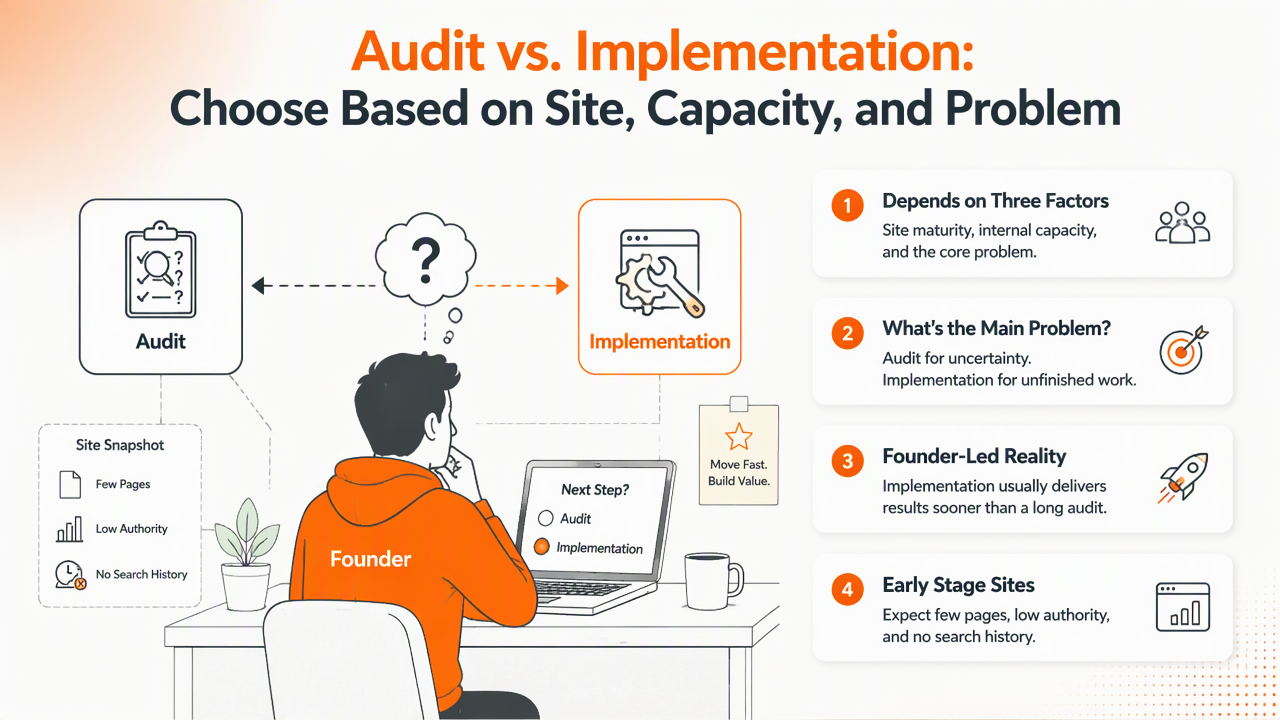
A founder-led startup usually needs implementation sooner than a long audit unless the website has serious technical uncertainty. The site may have few pages, low authority, and no search history, so the main job is creating useful pages around pain points, use cases, and alternatives.
A local business often benefits from a light audit followed by fast execution. Service pages, location pages, reviews, internal links, and Google Business Profile alignment matter more than a large strategic document. The local business SEO playbook fits this use case well.
An ecommerce store may need both. Product filters, duplicate URLs, thin collection pages, and template issues can create technical risk. After that, implementation should focus on collection content, buying guides, internal links, and product-led informational pages. Smaller stores can use ecommerce SEO guidance for online stores to understand the basics before hiring.
A growing marketing team may already know the gaps. In that case, implementation support can add publishing capacity, content refreshes, reporting, and coordination with developers.
Decision guide by business scenario
| Business type | Pick an audit when | Pick implementation when | Best next move |
|---|---|---|---|
| Founder-led startup | Technical setup is unclear | Few pages exist and visibility is low | Build core pages and content clusters |
| Local business | Rankings dropped or site was rebuilt | Service and location pages are missing | Fix local pages and on-page basics |
| Ecommerce store | Crawl, filters, or duplicates are suspected | Collections need content and internal links | Audit templates, then optimize priority categories |
| Growing marketing team | Leadership needs an outside review | Backlog is too large for the team | Run monthly SEO operations |
The practical rule is simple: buy an audit to answer "what is wrong?" Buy implementation to answer "what gets shipped next?"
What should SEO buyers expect in 2026 and 2027?
SEO buyers should expect audits and implementation services to account for classic search, AI-generated answers, entity clarity, and stronger content operations in 2026 and 2027.
Search is no longer limited to traditional rankings. AI answer systems summarize pages, compare brands, and extract definitions, tables, and concise explanations. A 2023 Nature paper by Karan Singhal, Shekoofeh Azizi, Tao Tu, and coauthors examined how large language models encode specialized knowledge, showing why structured, accurate content is becoming more important in information retrieval contexts (Nature). A 2024 survey by Yifan Yao, Jinhao Duan, and Kaidi Xu also examined LLM security and privacy issues, a reminder that AI systems bring new risks alongside new discovery channels (High-Confidence Computing).
For SEO services, this means static audits will need clearer action maps. Implementation providers will need to publish content that is accurate, well-structured, entity-rich, and easy for search engines and AI systems to parse.
Useful 2026 service requirements include:
- Clear definitions near the top of important pages.
- Tables for comparisons, pricing logic, and use cases.
- Content briefs tied to search intent and competitors.
- Internal links that show topical relationships.
- Technical fixes that support crawling and rendering.
- Reporting that separates shipped work from outcome metrics.
Earlyseo is strongest when a business has decided that visibility needs steady execution, not another disconnected spreadsheet. Visit earlyseo.com when the next step is turning SEO recommendations into a working publishing and optimization system.
FAQ: SEO audit and implementation questions
An SEO audit and an implementation service are often confused because both belong to the same growth process, but they solve different operational problems.
Is an SEO audit worth it for a small business?
An SEO audit is worth it for a small business when rankings have dropped, the site has been redesigned, pages are not getting indexed, or no one knows why traffic is flat. If the problems are already obvious, such as missing service pages or weak local content, implementation may create value faster than another report.
Can SEO implementation happen without an audit?
SEO implementation can happen without a full audit when the site is small, technically simple, and the first priorities are clear. A lightweight review should still check indexation, analytics, search intent, and page quality before publishing work begins. Larger sites usually need a deeper audit to avoid fixing symptoms while missing structural issues.
How long does SEO implementation take to show results?
SEO implementation timelines vary by competition, authority, site condition, and publishing volume. Early signals may include faster indexing, improved keyword coverage, and better rankings for less competitive terms. Stronger commercial gains usually need consistent execution across technical fixes, content updates, internal links, and conversion-focused pages over several months.
What is the safest choice when budget is limited?
The safest limited-budget choice is a focused audit only if the business lacks diagnosis. If the diagnosis is clear, budget should move toward implementation of the highest-impact tasks. A small shipped backlog usually beats a large unused report, especially for startups, local firms, and small ecommerce stores.
Conclusion
The seo implementation service vs seo audit decision is not really about which service sounds smarter. It is about the current bottleneck. If the site has unknown technical or content problems, start with a focused audit. If the main issue is stalled execution, choose implementation and measure shipped work every month. The strongest path is often a small audit, a ranked backlog, and a 90-day execution sprint with clear owners. For teams ready to turn recommendations into published pages, technical fixes, and steady SEO operations, Earlyseo gives that process a practical place to start.