TL;DR
SEO affiliate programs suit businesses that want referral income without managing delivery. Reseller programs suit agencies that want to sell client services and manage the relationship. The deciding factors are support capacity, contract rights, and profit after fulfillment costs, not the advertised payout.
An SEO referral commission and an SEO service margin pay for different jobs. The first rewards a recommendation; the second compensates a business for selling and managing delivery.
For founders and small agencies comparing seo affiliate programs vs reseller programs in 2026, that distinction matters more than the headline payout. Both can complement an existing business, but they create different responsibilities.
SEO partnership: A commercial arrangement that pays a business for referring customers to an SEO provider or selling SEO services supplied by another provider.
Earlyseo offers an affiliate destination for businesses exploring the referral route. The practical starting point is deciding whether the business intends to recommend a provider or sell an ongoing service.
Table of Contents
What separates SEO affiliate and reseller programs?
SEO affiliate programs pay partners for qualifying referrals, while reseller programs let partners sell SEO services supplied by another business. Affiliates typically leave contracting, billing, and delivery with the provider. Resellers typically manage the client relationship and package the service, although the signed agreement determines each party's exact responsibilities.
Affiliate marketing: A marketing arrangement that rewards an affiliate for generating a qualifying visit, signup, or sale for a merchant.
SEO reseller: A business that sells SEO services fulfilled partly or entirely by another provider, often within its own service package.
White-label SEO: SEO fulfillment delivered without the fulfillment provider's branding. White labeling is a delivery arrangement, not automatically a right to control customer data or move accounts.
Commercial responsibilities at a glance
| Decision factor | SEO affiliate program | SEO reseller program |
|---|---|---|
| Earnings | Commission on eligible referrals | Client revenue minus supplier and operating costs |
| Customer relationship | Provider usually contracts with the buyer | Reseller usually contracts with the client |
| Fulfillment | Provider delivers its product or service | Supplier delivers agreed work; reseller manages scope |
| Support | Provider usually handles product support | Reseller often handles client-facing support |
| Pricing | Provider sets the customer price | Reseller may set package pricing, subject to terms |
| Disclosure | Paid recommendations need applicable disclosures | Branding, subcontracting, and disclosure follow contracts and applicable rules |
| Main commercial exposure | Attribution, reversals, payout eligibility | Delivery costs, scope changes, refunds, unpaid invoices |
These are typical structures, not universal program terms. A referral agreement may include onboarding duties, and a reseller agreement may let the supplier communicate directly with clients.
The clearest test is identifying who signs the customer contract, issues the invoice, and answers when delivery needs attention.
How should partnership earnings be evaluated?
- Evaluate partnership earnings using the current written commission schedule or supplier price list.
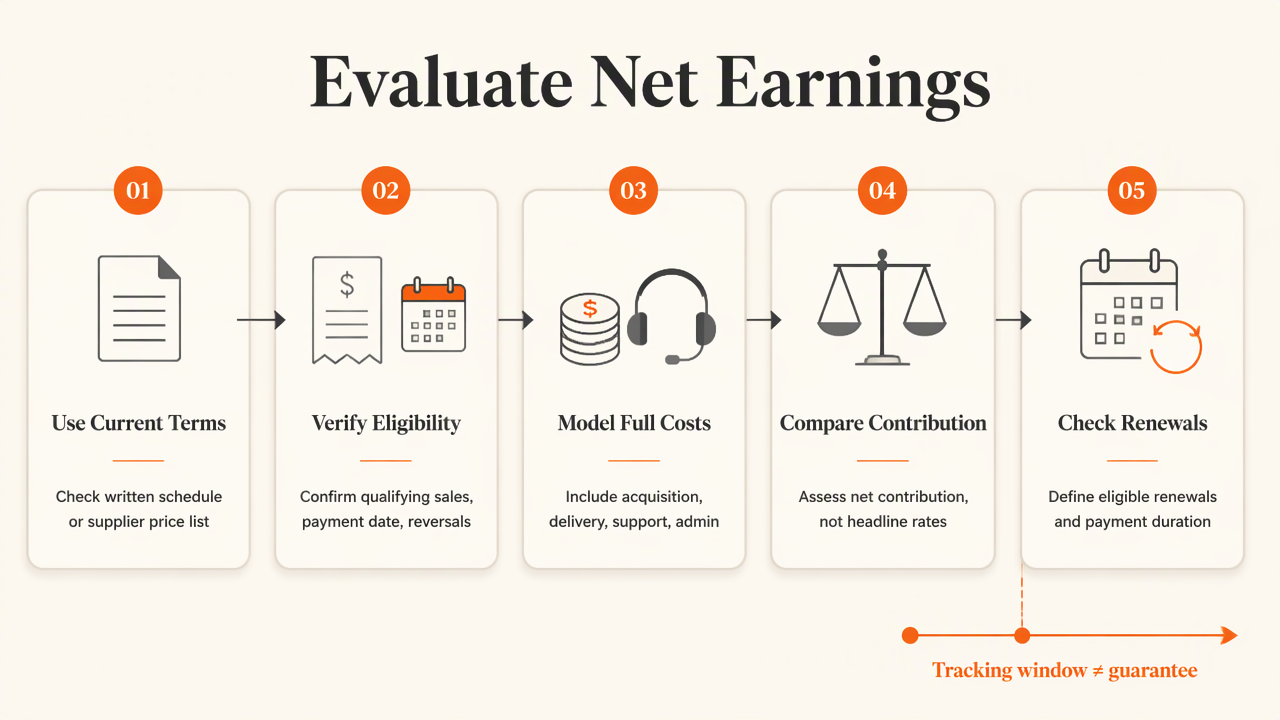
- Confirm which transactions qualify, when payment becomes payable, and which reversals apply.
- Include acquisition, fulfillment, support, and administration costs.
- Compare contribution after those costs, rather than treating an affiliate commission rate and a reseller margin as equivalent.
Affiliate terms that affect payment
A recurring commission only has value when the agreement defines eligible renewals and the duration of payments. A tracking window indicates how long a referral may qualify; it doesn't guarantee credit for every purchase during that period.
Check these terms before publishing recommendations:
- Attribution: First-click, last-click, coupon, or another rule, plus competing-referral treatment.
- Eligibility: Paid subscriptions, trials, upgrades, existing customers, and self-referrals.
- Payment: Thresholds, approval delays, currencies, and payout methods.
- Reversals: Refunds, chargebacks, cancellations, and invalid transactions.
- Promotion: Restrictions on paid search, trademark bidding, email, and discount claims.
No specific commission rate should be assumed from an older roundup. A dated agreement is the stronger basis for a 2026 revenue forecast.
Reseller costs beyond the supplier invoice
A useful planning formula is client revenue - supplier fees - acquisition costs - account management - other delivery costs. The result is contribution before remaining business overhead and taxes, not guaranteed net profit.
Resellers should budget for kickoff calls, revisions, reporting, technical coordination, and payment collection. An inexpensive content package can still demand substantial management time if the client expects strategy and implementation too.
A supplier agreement should define deliverables, revision limits, turnaround expectations, escalation routes, cancellation rights, and access to completed work. The companion guide to questions before hiring an SEO agency helps frame delivery due diligence.
Digital distribution research offers useful background, but not a commission benchmark. The 2021 paper by Alexander Parfenov, Lubov Shamina, and Jiahui Niu examines distribution logistics management during digitalization. It should not be treated as evidence that either partnership model earns more.
Who should pick which partnership model?
Affiliates are a better fit for businesses with a relevant audience and limited service capacity; resellers are a better fit for businesses already equipped to manage paying clients. The decision should follow the existing workflow, not a claim that one model is universally more profitable or easier to scale.
Match the partnership to the existing business
- SEO educators and publishers: Affiliate referrals fit tutorials, tool reviews, and product comparisons when recommendations remain independent.
- Web designers and marketing agencies: Reselling can extend an existing client relationship into recurring SEO delivery.
- Local marketing consultants: Reselling fits clients seeking coordinated reporting and implementation, provided responsibilities are explicit.
- E-commerce store owners and startup founders: Buying suitable SEO help usually comes before building a partnership income stream.
A practical hybrid is possible: an agency can charge for strategy while referring a separate software subscription. The proposal should clearly distinguish agency fees from any referral compensation.
Separate recommendations from service promises
Affiliates should explain material financial relationships clearly and follow applicable advertising requirements. Resellers should describe the scope accurately and establish whether subcontracting needs to be disclosed under the agreement or local rules. Neither model justifies promising specific rankings.
Tracking quality also deserves attention. The 2021 survey by Shadi Sadeghpour and Natalija Vlajic examines click fraud in digital advertising, not SEO affiliate payout rates. Its topic is relevant when reviewing how a program validates traffic and transactions.
A referral and a managed service can coexist, but the buyer should understand which company supplies each part.
How Earlyseo handles the partnership starting point
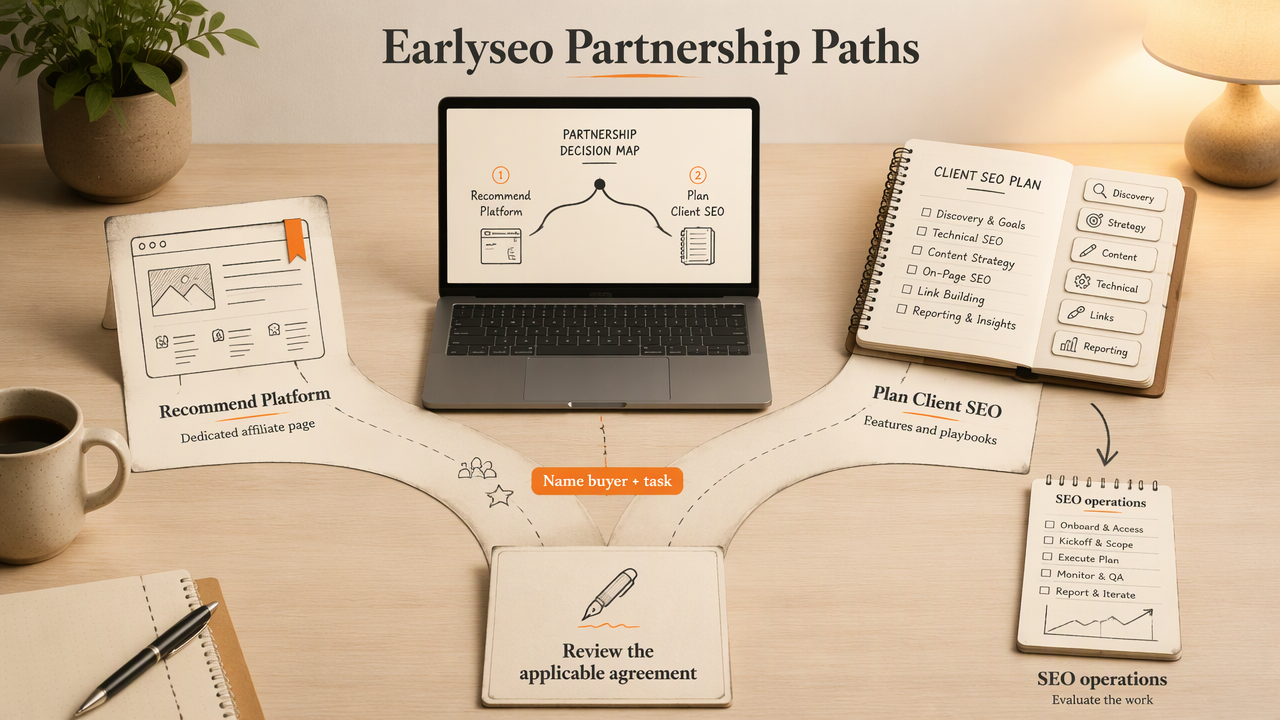
Earlyseo gives prospective referral partners a dedicated affiliate page and businesses evaluating content workflows separate feature and playbook resources. Those destinations support two distinct decisions: whether to recommend the platform and how SEO work might fit into a client service. Neither decision should substitute for reviewing the applicable agreement.
Connect the referral offer to a concrete workflow
The Earlyseo platform's SEO operations page is a useful starting point for evaluating the work a recommendation would support. A good affiliate explanation identifies the relevant buyer and task rather than relying on a payout alone.
For agencies considering service packaging, the agency SEO content playbook offers a separate planning resource. That workflow evaluation remains distinct from establishing resale rights, pricing permissions, or white-label terms.
Define a measurable first engagement
A bounded pilot makes delivery expectations easier to assess. The 90-day SEO sprint playbook provides a planning reference for turning a broad SEO discussion into a defined engagement.
- Identify the business goal and intended audience.
- Specify the work, approver, and reporting schedule.
- Assign responsibility for publishing and implementation.
- Review completed deliverables before expanding scope.
Prospective partners can visit earlyseo.com to explore the product context before choosing the commercial arrangement.
FAQ: SEO partnership contracts and obligations
SEO partnership agreements should resolve payment eligibility, customer responsibilities, and exit rights before promotion or delivery begins.
Program labels describe the model; signed terms establish the obligations.
Are SEO affiliate commissions always recurring?
SEO affiliate commissions aren't automatically recurring. A provider may pay once, reward eligible renewals, or use different terms for different products. The agreement should state the commission basis, duration, exclusions, and cancellation treatment. A recurring label alone doesn't establish lifetime payments or continued earnings after the partnership ends.
Does a reseller own the customer?
An SEO reseller often manages the customer relationship, but customer ownership isn't a single contractual right. Billing authority, contact permissions, data access, renewal rights, and account transfer rights can differ. The reseller should check each separately, especially when the fulfillment provider hosts reports, holds credentials, or communicates directly with clients.
Can a business be an affiliate and a reseller?
A business can operate both models when the relevant agreements permit it. An agency might resell managed SEO while referring software that clients purchase directly. Clear proposals should separate service charges, software charges, and referral compensation. The business should also confirm whether referring its own clients qualifies for commissions.
Which model has lower operating responsibility?
Affiliate partnerships usually carry fewer delivery responsibilities because the provider supplies the product or service. Affiliates still handle content production, promotion, disclosure, and program compliance. Resellers generally take on more client-facing work, including scope management and reporting. Lower operating responsibility doesn't mean guaranteed income or freedom from contractual obligations.
Conclusion
Choosing between seo affiliate programs vs reseller programs starts with one practical decision: referral income or managed-service revenue. A prospective partner should obtain the current agreement, map billing and support responsibilities, and calculate contribution after direct costs. Then run one clearly scoped referral campaign or client pilot before committing to a larger partnership.