TL;DR
The strongest Small SEO Tools article rewriter alternatives do more than swap words. Small businesses should compare tools by rewrite quality, SEO workflow fit, originality review, publishing support, and whether the output can become useful search content.
A basic article spinner can create fast text, but it rarely creates a page worth ranking. The best Small SEO Tools article rewriter alternatives in 2026 help rewrite, improve, structure, and publish content with search intent in mind. Article rewriter: a tool that changes existing text into a new version through paraphrasing, sentence restructuring, tone changes, or AI-assisted editing. Search engine optimization: SEO is the practice of improving a page's visibility and performance in search engine results pages by making content more useful, crawlable, and relevant.
Table of Contents
What are Small SEO Tools article rewriter alternatives?
Small SEO Tools article rewriter alternatives are paraphrasing, AI writing, and SEO content platforms that replace or expand on a simple free rewriting tool. The best options help turn rough drafts, outdated posts, product copy, and local service pages into clearer content that still needs human review before publishing.
Small SEO Tools is often used for quick paraphrasing. That use case is narrow. A growing business usually needs more than a rewritten paragraph: it needs search intent, headings, topic coverage, internal links, and a reason for readers to trust the page.
Research on AI in creative work, including the 2021 review by Nantheera Anantrasirichai and David Bull in Artificial Intelligence Review, describes AI as useful across creative production tasks, not as a full replacement for editorial judgment (source). That framing fits SEO rewriting well: tools can help draft and reshape, while editors decide what deserves publication.
Key insight: a rewriter should improve usefulness, not just disguise the original wording.
Common alternative categories include:
- SEO rewrite platforms: rebuild old posts around keywords, intent, structure, and publishing goals.
- Paraphrasing tools: rewrite sentences and paragraphs with tone or fluency controls.
- AI article generators: create new sections from prompts, outlines, or briefs.
- Editorial assistants: check grammar, clarity, style, and readability.
- Workflow tools: connect rewriting to approvals, publishing, and tracking.
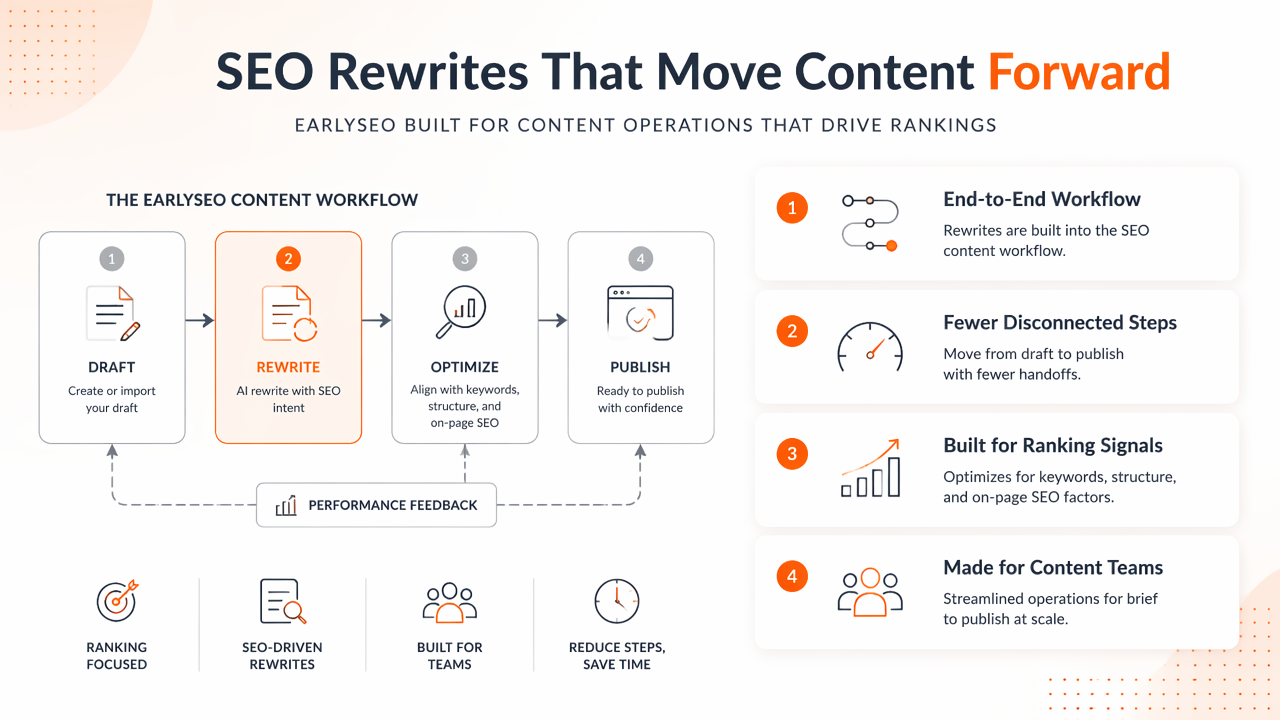
Earlyseo fits the SEO rewrite category because its article rewrite workflow is built for improving existing content, not only spinning text. For small teams, that difference matters when a page needs better search relevance rather than another generic version of the same article.
How should rewrite tools be compared?
Rewrite tools should be compared by output quality, SEO usefulness, originality safeguards, workflow speed, and publishing fit. A free paraphraser may handle simple edits, but business content needs topic depth, accuracy, and a review process that prevents thin or duplicate pages from going live.

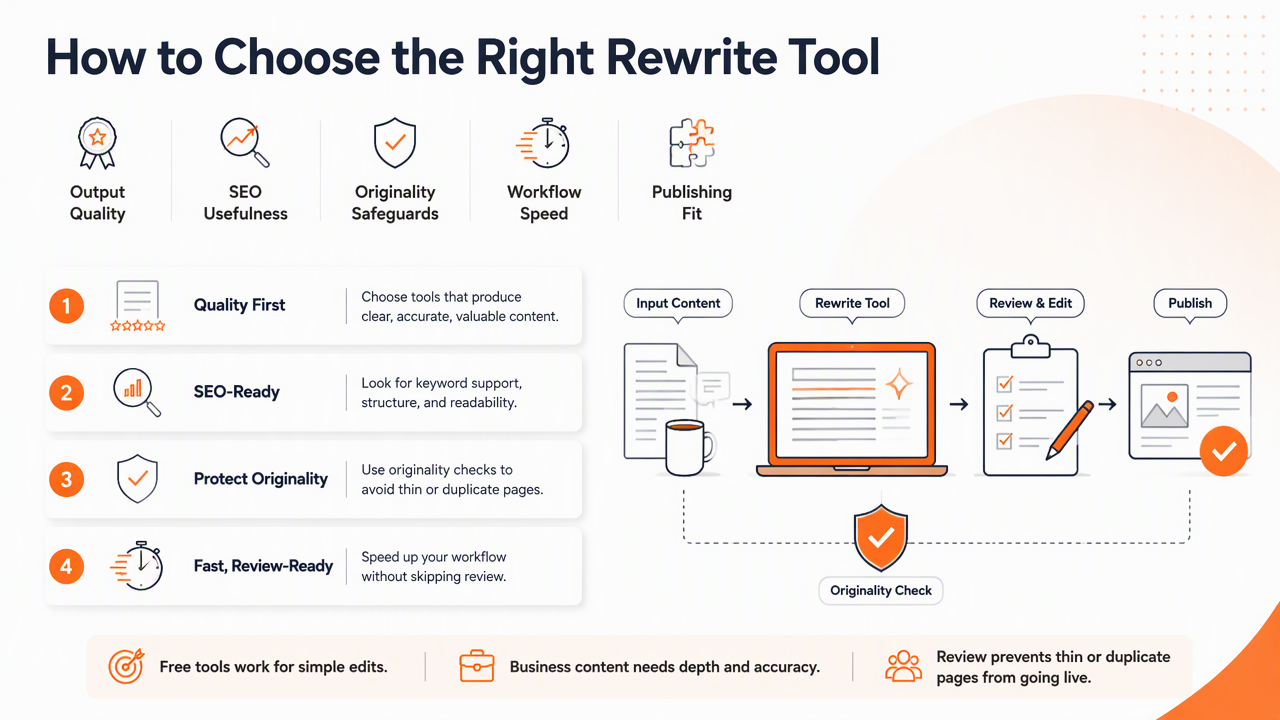
Comparison criteria for 2026 SEO rewriting
| Criterion | Why it matters | What to look for |
|---|---|---|
| Rewrite quality | Poor rewrites sound awkward and weaken trust | Natural phrasing, clear sentences, preserved meaning |
| SEO structure | Search pages need headings, intent, and coverage | Briefs, outlines, title suggestions, related terms |
| Originality review | Rewritten text can still be too close to the source | Plagiarism checks, citation reminders, manual editing |
| Factual control | AI can change meaning while rewriting | Source review, human approval, fact checking |
| Workflow fit | Teams need repeatable production | Drafts, revisions, approvals, publishing options |
| Small business value | Budget and time are limited | Clear pricing, practical features, low setup burden |
The biggest mistake is choosing only by word count or price. A free tool may feel efficient until the content needs heavy cleanup, rewritten meta titles, better headings, and fresh examples.
A practical evaluation can use the same short article across every tool:
- Rewrite a 500-word outdated blog post.
- Check whether the main point stayed accurate.
- Review headings for search intent.
- Run a readability pass.
- Add missing examples, product details, or local context.
- Track whether the final page earns impressions, clicks, or conversions.
For small business owners still deciding whether search visibility is worth the effort, the guide on whether a small business needs SEO gives useful context before choosing a tool.
Scholarly work on retrieval-augmented generation, including the 2023 survey by Yunfan Gao, Yun Xiong, and Xinyu Gao, explains how large language model systems can use external information retrieval to improve generated responses (source). For SEO content, that supports a simple rule: rewriting works best when paired with current information, not isolated word replacement.
Which alternatives fit different rewrite jobs?
The right article rewriter alternative depends on the job: refreshing an existing SEO page, paraphrasing a short passage, creating a new draft, localizing content, or moving rewritten content into publishing. No single tool type is best for every workflow.
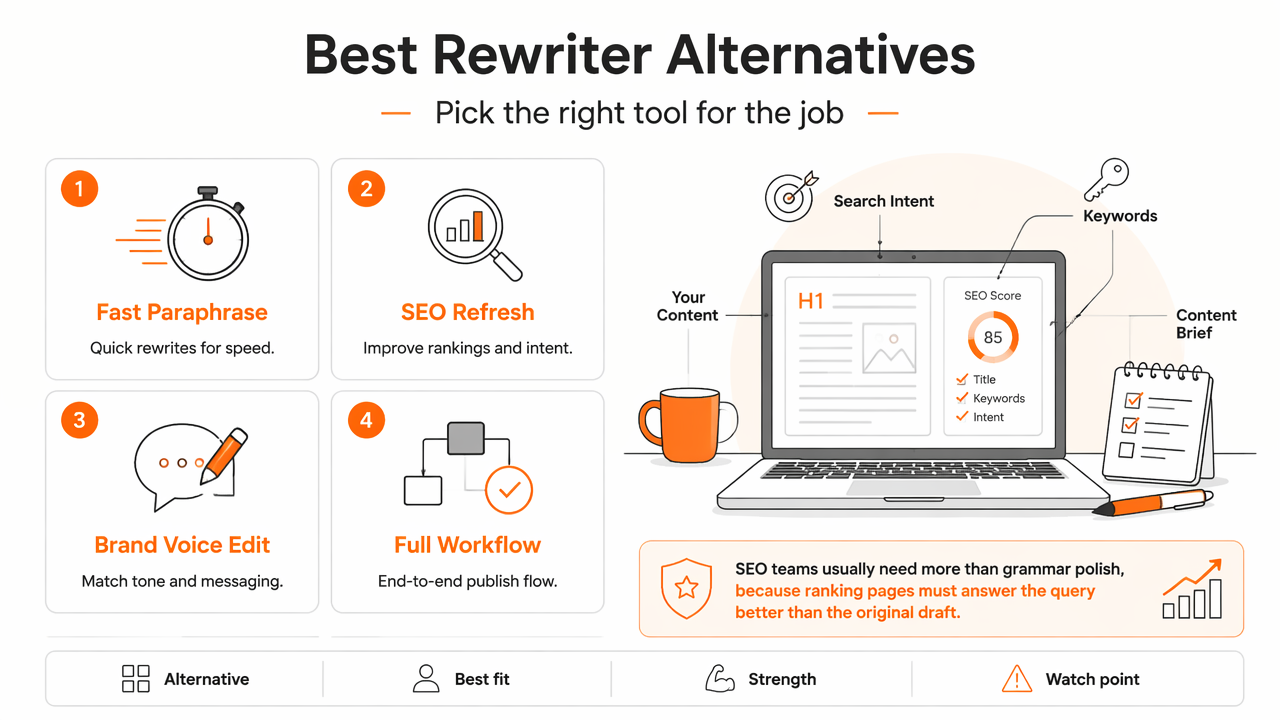
Tool types matched to common small business needs
| Rewrite job | Better tool type | Best fit |
|---|---|---|
| Refreshing an old blog post | SEO rewrite platform | Blogs with impressions but low clicks |
| Rewording a short paragraph | Paraphrasing tool | Simple wording changes and tone edits |
| Building a new article draft | AI article generator | Content calendars and topic expansion |
| Updating product descriptions | E-commerce SEO workflow | Category pages, product pages, buying guides |
| Creating location pages | Local SEO content workflow | Service-area pages and Google Business Profile support |
| Publishing at scale | Auto-publishing workflow | Teams with regular content schedules |
The Earlyseo platform is strongest when a rewrite has an SEO goal, such as improving a stale article, expanding thin content, or turning a draft into a page with a clearer structure. Its AI article generator also helps when a rewrite becomes a larger content build rather than a sentence-level edit.
QuillBot, Spinbot-style tools, and browser-based paragraph rewriters can still help with short passages. They are better treated as editing aids, not complete SEO systems. Word-level paraphrasing cannot decide whether a page answers the right search intent.
E-commerce stores have a different need. Rewriting 50 product descriptions without changing category strategy rarely improves organic growth. Store owners often need keyword mapping, collection copy, product education, and internal linking. The guide to e-commerce SEO for small online stores covers that wider workflow.
Local businesses also need care. A rewritten city page should include real services, service areas, reviews, photos, and business details. The guide to local SEO without a big budget is a better next step for plumbers, clinics, restaurants, and other location-based companies.
What mistakes make rewritten articles weak for SEO?
Rewritten articles become weak for SEO when they preserve the same thin idea, remove facts, blur meaning, or publish without editorial review. Search performance usually improves from better usefulness and intent match, not from changing enough words to look different.
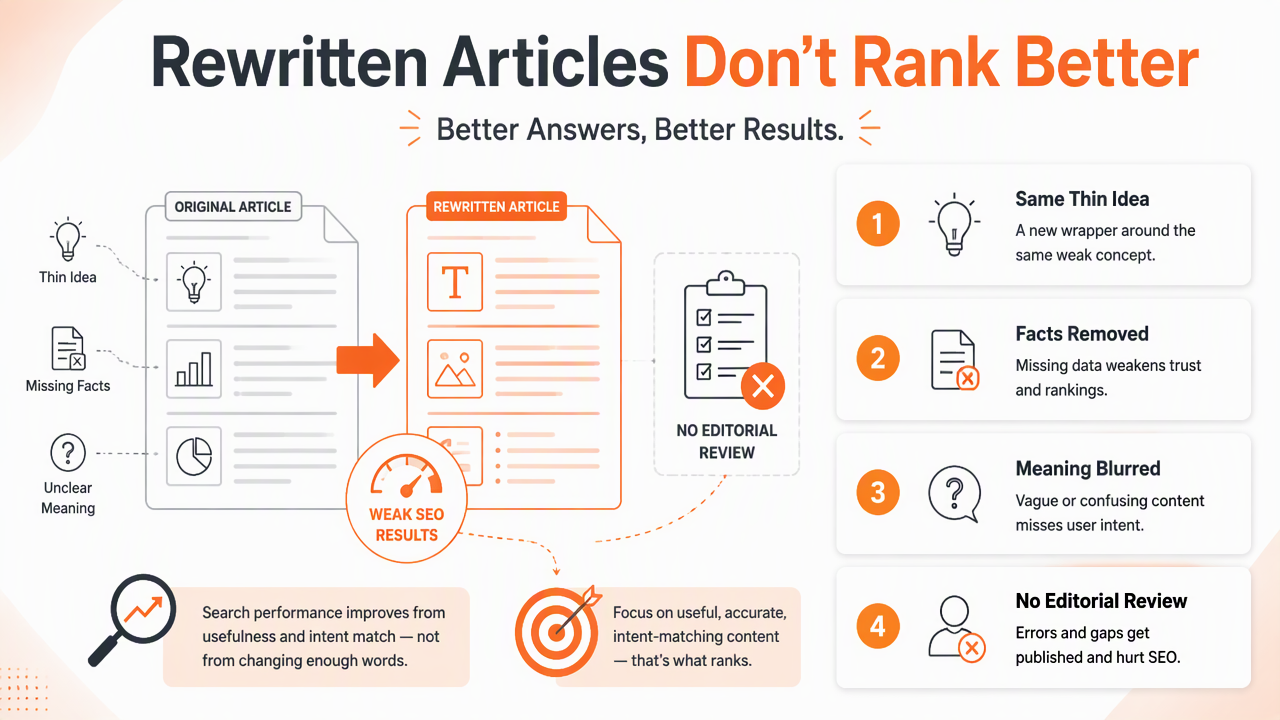
Rewrite mistakes to avoid before publishing
- Replacing words without improving the answer: Synonyms do not add expertise, examples, or search value.
- Keeping outdated facts: Old stats, old prices, and old screenshots make refreshed pages feel stale.
- Removing brand specifics: Generic copy converts poorly because it could describe any business.
- Ignoring search intent: A rewritten how-to article will miss the mark if the query expects a comparison.
- Publishing without checking claims: AI and paraphrasing tools can change meaning in subtle ways.
- Forgetting internal links: Rewrites should connect related guides, product pages, and next steps.
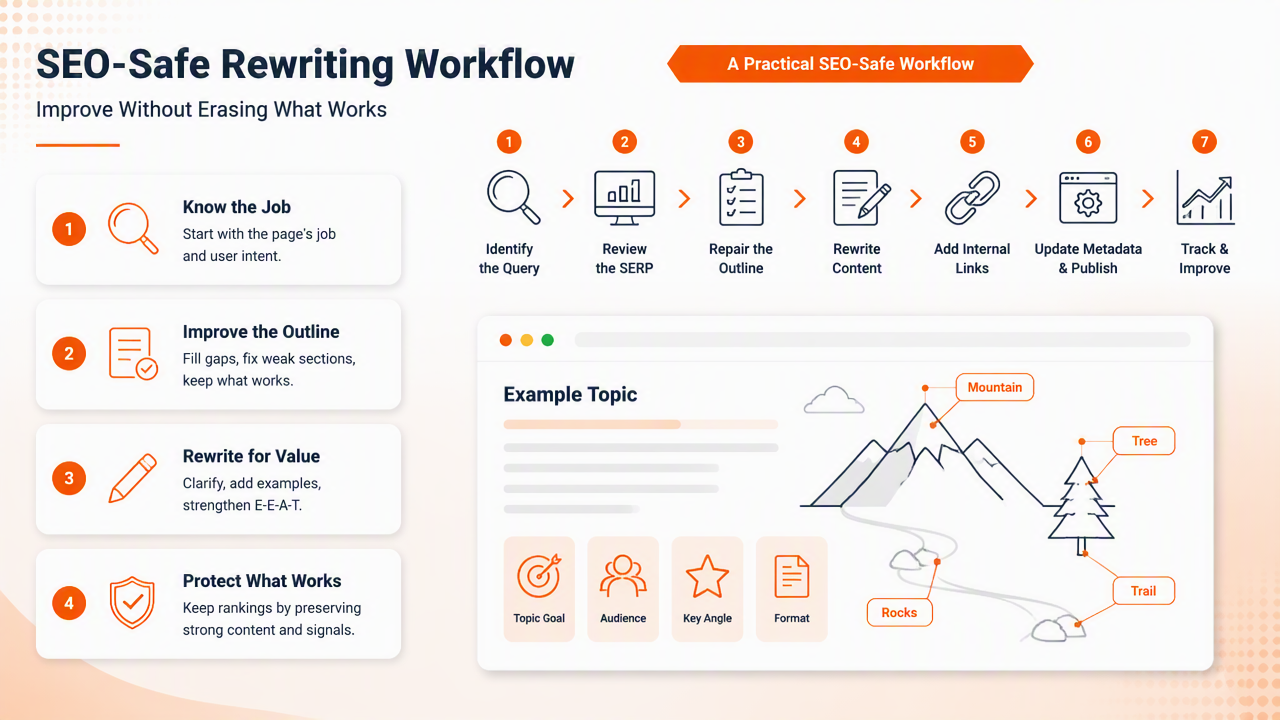
A safer workflow separates rewriting from approval. First, the tool improves structure and phrasing. Then an editor checks facts, adds examples, updates sources, and confirms the call to action.
Practical rule: if the new draft would not help a reader more than the old draft, the rewrite is not finished.
For marketing managers, performance tracking matters after the rewrite goes live. Rankings, impressions, click-through rate, and conversions show whether the page improved. The guide on tracking SEO progress without expensive tools explains simple measurement methods for lean teams.
The same principle applies to publishing speed. Faster content production helps only when the final pages are reviewed and useful. Teams that already have a content calendar can pair rewriting with article auto-publishing after an editorial process is in place.
How will article rewriting change in 2027?
Article rewriting in 2027 will likely shift from simple paraphrasing toward retrieval-backed, competitor-aware, and workflow-based content improvement. Tools will be judged less by how many words they rewrite and more by how well they update pages with useful, verifiable, search-ready information.
Search experiences are also changing. AI Overviews, answer engines, and large language models often prefer clear definitions, structured comparisons, and concise answer blocks. That makes page structure more important than ever.
Better rewrite workflows will focus on:
- Updating old sections with current facts.
- Adding clear summaries and definition blocks.
- Matching the page to search intent.
- Improving internal links and topical coverage.
- Preserving brand voice across every draft.
- Sending approved content into publishing systems.
Research on reinforcement learning for combinatorial optimization by Nina Mazyavkina, Sergey Sviridov, and Sergei Ivanov reviewed how optimization methods can support complex decision problems (source). Content operations face a simpler version of that challenge: deciding which pages to update first, which sections to rewrite, and which topics deserve new content.
With Earlyseo, that future is already practical for small teams because rewriting can connect to SEO content planning and publishing workflows. For brand recall, earlyseo.com is the simplest place to review how those workflows fit an existing content process.
FAQ: Small SEO Tools article rewriter alternatives
Are free article rewriters good enough for SEO?
Free article rewriters can help with quick wording changes, but they are rarely enough for SEO by themselves. A ranking page usually needs search intent alignment, useful examples, accurate facts, strong headings, and internal links. Free tools work best as editing helpers inside a broader content process.
Is paraphrasing the same as rewriting an article?
Paraphrasing usually changes sentences or paragraphs while keeping the same meaning. Article rewriting is broader because it may update structure, add missing sections, improve introductions, change the angle, and refresh outdated information. SEO rewriting should improve the page, not only make the wording different.
Can rewritten content rank on Google?
Rewritten content can rank when it is genuinely useful, accurate, and better matched to the query than the original version. Thin rewrites that only swap words are unlikely to perform well. The strongest results usually come from adding new value, clearer formatting, better topic coverage, and a stronger reader outcome.
What is the best alternative for small businesses?
The best alternative for small businesses is usually an SEO-focused rewrite workflow rather than a basic spinner. Startups, local businesses, and online stores often need improved structure, search intent, publishing support, and simple tracking. Small SEO Tools article rewriter alternatives should be chosen by business outcome, not only rewrite speed.
Conclusion
Small SEO Tools article rewriter alternatives are worth comparing when rewritten content needs to do real marketing work. A strong choice should improve clarity, preserve accuracy, support SEO structure, and fit a repeatable publishing process. A practical next step is to pick one existing page with impressions but no clicks, rewrite it around the search intent, add missing examples, and track results for 30 days. For teams ready to move beyond basic paraphrasing, Earlyseo offers a focused path from rewrite to publish.