TL;DR
An AI content planner works best when it connects keyword intent, competitor gaps, funnel stages, and publishing capacity into one repeatable workflow. The strongest 2026 setup pairs AI speed with human review, clear briefs, and a realistic calendar instead of chasing disconnected keyword lists.
Keyword lists do not create traffic by themselves; a usable SEO plan needs intent, priorities, briefs, and a publishing rhythm. An ai content planner for seo helps small teams turn scattered research into a clear content roadmap, especially when budgets, writers, and subject-matter experts are limited. AI content planner: software or a workflow that uses generative AI to organize SEO inputs into topics, briefs, clusters, and publishing schedules. For teams that need this structure inside one workflow, Earlyseo focuses on turning SEO ideas into planned, recurring articles without making the process feel like a giant spreadsheet.
Table of Contents
What is an AI content planner for SEO?
An AI content planner for SEO is a planning system that turns search data, audience intent, competitor coverage, and publishing capacity into a prioritized content calendar. It does not replace strategy; it organizes the raw inputs so marketers can decide what to publish, why it matters, and when each piece should go live.
Generative artificial intelligence can create text, images, code, audio, video, and other data types from patterns learned in training data. In SEO planning, its best role is not guessing rankings. Its best role is sorting messy information into usable decisions.
Key takeaway: AI planning is strongest when it narrows choices, not when it makes every choice alone.
A strong planner usually handles four jobs:
- Keyword grouping: similar queries are clustered by intent and topic.
- Competitor mapping: ranking pages are reviewed for angles, formats, and missing details.
- Funnel assignment: topics are labeled as awareness, consideration, or conversion.
- Calendar shaping: planned articles are matched to available writers, review time, and publishing dates.
A weak planner only generates a list of titles. That looks productive for a day, then creates duplicate pages, thin briefs, and unrealistic deadlines.
How should a planner turn keywords into a content strategy?
A planner should turn keywords into strategy by grouping related searches, matching each group to intent, checking competitor coverage, assigning a business goal, and producing briefs that fit the publishing schedule. The output should be a small set of content clusters, not a long list of disconnected article ideas.
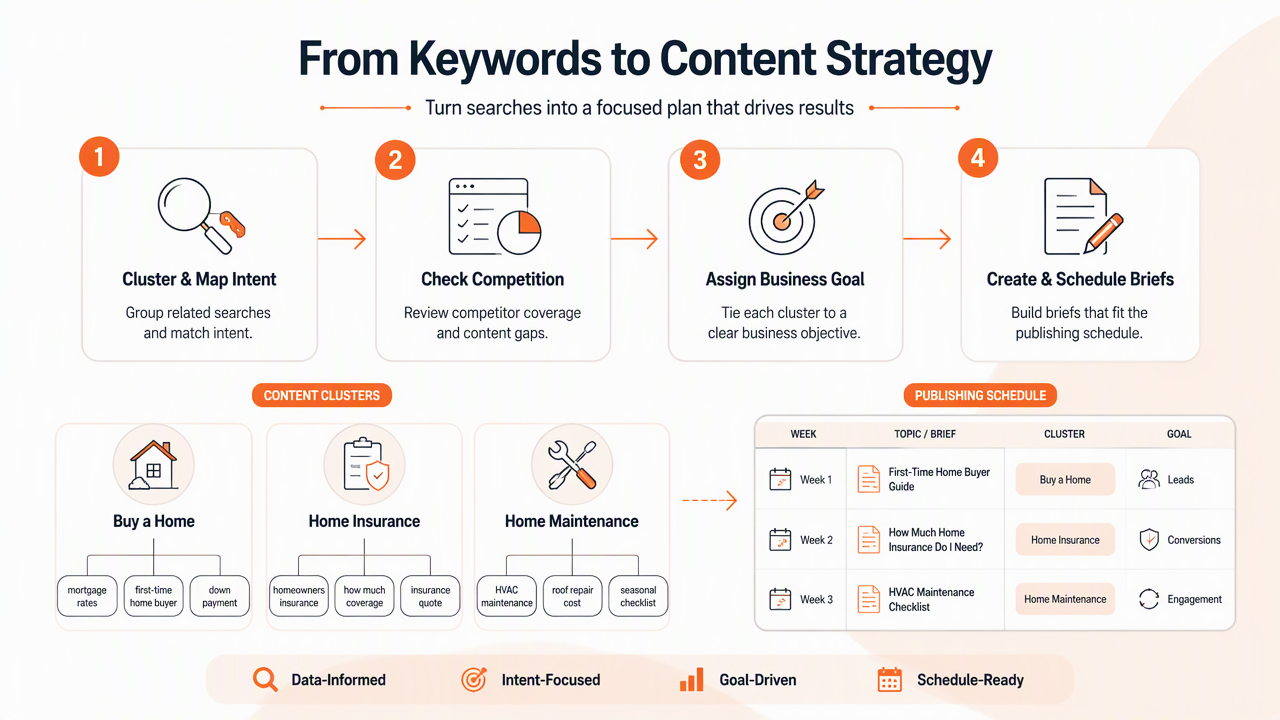
A practical 6-step workflow
The cleanest workflow starts with the audience problem and ends with a publishable brief. That order matters because AI tools can overproduce ideas when the business goal is vague.
- Collect seed topics: pull ideas from products, services, sales calls, support tickets, and existing rankings.
- Group keywords by intent: separate informational, local, comparison, and transactional searches.
- Scan competitor pages: note formats, headings, missing examples, and outdated sections.
- Map funnel stage: connect each topic to awareness, consideration, decision, or retention.
- Score effort and value: weigh difficulty, expertise needed, internal review time, and business relevance.
- Create briefs and dates: turn approved topics into outlines, required sources, and calendar slots.
Research on retrieval-augmented generation, including the 2023 survey by Yunfan Gao, Yun Xiong, and Xinyu Gao, explains how large language models can be improved by grounding generation in retrieved information rather than relying only on model memory RAG survey. That idea matters for SEO planning because fresh SERP data, product facts, and competitor evidence should guide the plan.
Workflow inputs and outputs
| Planning step | Input | Output | Example |
|---|---|---|---|
| Topic discovery | Products, services, customer questions | Seed topic list | local bookkeeping, payroll help, tax deadlines |
| Intent grouping | Keyword phrases and SERP patterns | Topic cluster | small business payroll guide |
| Competitor review | Ranking pages and headings | Differentiation notes | add local compliance examples |
| Funnel mapping | Buyer stage and business goal | Priority label | consideration content for service buyers |
| Capacity planning | Writer time, review time, publish cadence | Calendar slot | 2 articles per month |
| Brief creation | Sources, outline, internal expertise | Draft-ready brief | H2s, FAQs, examples, required proof |
Early plans should stay small. A new blog often benefits more from 10 focused articles tied to one cluster than 50 scattered ideas. For background on that approach, the guide to content strategy for new blogs explains how early sites can build topical focus before expanding.
Which data inputs make the plan usable?
The most useful planning inputs are keywords, search intent, competitor coverage, funnel stage, internal expertise, and publishing capacity. AI can organize all six, but the final plan gets stronger when each input is specific enough to guide article format, angle, depth, and review requirements.
Core inputs for reliable planning
A content planner becomes practical when it knows the limits of the business. A local clinic, ecommerce store, and SaaS startup may target similar search intent, but each needs a different article angle and proof level.
Useful inputs include:
- Audience segment: founder, buyer, local customer, technical user, or repeat shopper.
- Search intent: learn, compare, buy, troubleshoot, or find a nearby provider.
- Business priority: lead capture, product education, category growth, or local visibility.
- Existing assets: old posts, product pages, case studies, videos, or service pages.
- Expert review needs: legal, medical, financial, technical, or brand review.
- Publishing capacity: writers, editors, designers, and approval timelines.
A planner that ignores capacity creates fantasy calendars. A planner that ignores expertise creates generic articles. Good planning balances both.
Competitor and evidence requirements
Competitor review should answer a practical question: what must the article do better to deserve attention? That can mean clearer examples, fresher data, better structure, stronger local details, or a more useful comparison table.
The Earlyseo platform is built around this competitor-aware workflow, where topic ideas can be shaped by what already ranks and what those pages miss. Teams that need that angle can review the separate feature page for competitor-aware SEO content.
Evidence quality also matters. A 2024 study by Yizhou Fan, Luzhen Tang, and Huixiao Le examined how generative AI can affect learning motivation, processes, and performance, with the title warning about metacognitive laziness British Journal of Educational Technology study. For content teams, the practical lesson is simple: AI planning should support judgment, not replace careful thinking.
How does Earlyseo handle the planning workflow?
Earlyseo handles SEO planning by connecting topic research, competitor awareness, briefs, and publishing operations into a single content workflow. The goal is to move from idea to calendar without losing the reasoning behind each article, which helps small teams keep quality, cadence, and search intent aligned.
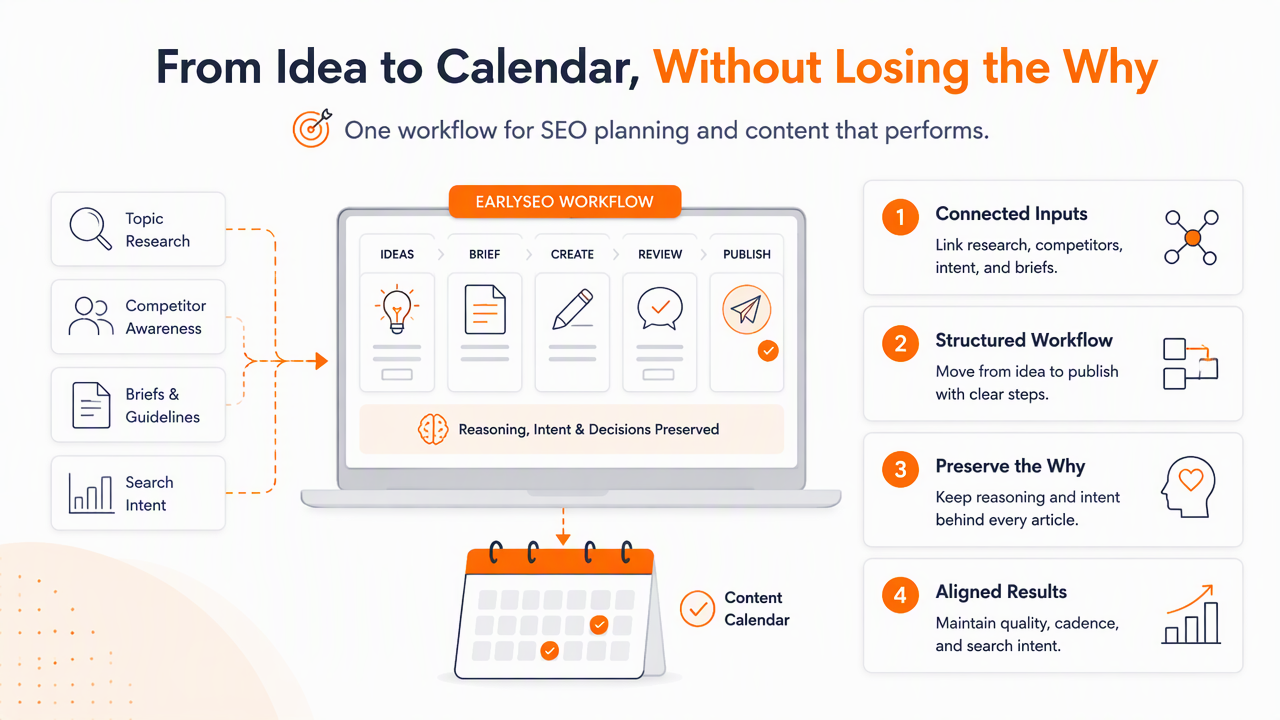
Planner types compared
| Planner type | Best for | Main limitation | Strongest use case |
|---|---|---|---|
| Simple AI title generator | Fast brainstorming | Little strategy or prioritization | First-pass idea lists |
| Spreadsheet calendar | Manual control | Hard to keep research current | Teams with mature SEO operations |
| Notion-style template | Content organization | Depends on manual setup | Editorial teams that already have briefs |
| Earlyseo workflow | SEO-led planning and recurring articles | Requires clear business inputs | Growing sites that need planned organic visibility |
Simple generators can help during brainstorming, but they often stop before the hard part: choosing what not to publish. A useful planner should make tradeoffs visible, such as whether a conversion topic deserves priority over a high-volume awareness post.
For teams running client or multi-brand programs, planning also needs repeatable operations. The agency SEO content playbook gives a practical path for scaling content delivery while keeping briefs, approvals, and publishing cycles organized.
Where human review still belongs
Human review belongs at the points where brand risk, factual accuracy, and business judgment matter. AI can cluster topics and draft outlines, but a person should approve positioning, claims, examples, and final priorities.
A strong review pass should check:
- Does the topic connect to a real product, service, or customer problem?
- Does the outline add something beyond the current ranking pages?
- Are claims supported by credible sources or internal expertise?
- Does the planned article have a clear next action?
- Does the publishing date match available review time?
Some teams pair AI planning with human editing for higher-stakes content. Earlyseo also supports that model through a human-curated content service, which fits teams that want AI-assisted planning without skipping expert review.
What should SEO teams expect in 2027?
By 2027, AI content planning will likely move from calendar creation toward continuous content operations, where planners refresh briefs, flag decaying pages, suggest internal links, and adapt topics for AI search surfaces. The winning systems will combine automation, retrieval-based research, and human editorial control.
Planning will include AI visibility, not just rankings
Search is no longer only a list of blue links. AI Overviews, answer engines, and chat-based search reward clear definitions, tables, direct answers, and named entities. That changes how planners should structure briefs.
Future-ready briefs should request:
- A direct answer under every question-style heading.
- A short terminology block near the top.
- Tables for comparisons and decision criteria.
- FAQs written as complete questions.
- Source requirements for claims, statistics, and studies.
Research-backed planning will matter more as AI search systems look for extractable, well-supported answers. Teams building those workflows can explore research-backed AI content as a way to keep briefs tied to evidence rather than loose prompts.
Common planning mistakes to avoid
The biggest mistake is treating an AI planner like a magic content machine. That approach usually creates too many topics, shallow briefs, and calendars that nobody can maintain.
Common misses include:
- Publishing every generated idea without checking overlap.
- Picking topics only by search volume.
- Ignoring local, product, or category-specific proof.
- Assigning too many articles to a small team.
- Skipping updates to old content while adding new posts.
A realistic content plan beats an ambitious calendar that stalls after the first month.
Better planning starts with fewer topics, clearer briefs, and a cadence that can survive busy weeks. In 2026, consistency still matters, but consistency without strategy just produces more pages.
FAQ
Short answers help teams compare AI planning options quickly, especially when SEO planning feels buried under tools, templates, and keyword exports.
Can AI create a complete SEO content calendar?
AI can create a first draft of an SEO content calendar, but a complete calendar still needs human prioritization. The planner can group topics, suggest article formats, and assign tentative dates. A marketer should still confirm business value, subject-matter availability, review requirements, and whether the team can actually publish at that pace.
Is an AI content planner better than a spreadsheet?
An AI planner is better for research organization, clustering, and brief creation, while a spreadsheet is better for simple manual tracking. Many teams outgrow spreadsheets when keyword lists, competitor notes, briefs, and approvals live in separate places. The best setup keeps the visibility of a calendar with the research depth of an SEO workflow.
How many articles should a small business plan first?
A small business should usually plan one focused cluster before building a large calendar. A practical starting point is a manageable set of service, comparison, and educational pages around one priority topic. The exact number depends on review time, writing support, and how quickly the business can publish without lowering quality.
Does AI planning work for local SEO?
AI planning can work well for local SEO when location, service area, customer intent, and local proof are included as inputs. Generic city pages rarely help on their own. A stronger plan includes service-specific articles, local FAQs, examples from the area, and clear connections to Google Business Profile and service pages.
Conclusion
A strong ai content planner for seo turns messy research into a plan that a real team can publish. The practical next step is to gather one priority topic, five competitor pages, clear funnel goals, and a realistic monthly publishing capacity, then turn that into briefs before expanding the calendar. For teams ready to make that process repeatable, Earlyseo offers a focused path from research to planned SEO content. Visit earlyseo.com to review how the workflow fits current content operations.