TL;DR
Value an existing website on verified organic demand, transferable content, and documented ownership rather than traffic screenshots or authority scores. Request live analytics access, separate branded from nonbranded traffic, and make unresolved SEO questions conditions of the purchase.
A website's search traffic is only worth buying when the evidence supports the asking price. The strongest SEO advice for buying an existing website starts with due diligence, not a redesign plan. For founders, store owners, and local businesses evaluating an acquisition in 2026, the goal is to identify what generates demand, what transfers with the sale, and what needs ongoing investment.
SEO due diligence: The process of checking a website's search performance, technical condition, links, and content rights before agreeing to an acquisition.
Buy documented earning potential, not a screenshot of rankings.
Table of Contents
How should buyers verify organic traffic before purchase?
- Verify organic traffic through live Google Search Console and analytics access.
- Review monthly trends across the available history, including comparable seasonal periods.
- Separate branded queries from nonbranded searches.
- Match leading landing pages to recorded conversions and revenue.
- Ask the seller to explain material changes with dated supporting records.
Request access, not just exported charts
Screenshots can show a selected date range without revealing filters, traffic sources, or missing months. Request read-only Google Search Console and Google Analytics access where available. Confirm that the properties cover the actual domain, including relevant subdomains.
Ask for the longest available history and any older exports the seller retained. Record the dates of redesigns, domain changes, publishing campaigns, and tracking changes. A traffic jump after a measurement change deserves a different interpretation from growth across established pages.
Search Console clicks and analytics sessions measure different things, so identical totals aren't required. The buyer needs a credible explanation for differences, consistent trends, and evidence that search visitors reach commercially useful pages.
Separate transferable demand from seller recognition
Branded demand: Searches containing the business name, domain, founder's name, or distinctive product names.
Nonbranded demand: Searches for a category, problem, service, or product without naming the business.
A founder-led consulting site may depend on searches for its owner. A store ranking for product categories may have demand that transfers more readily. Neither pattern guarantees future performance; the distinction helps define what the buyer is acquiring.
Check query groups by country, device, and landing page. For local businesses, confirm that the sale includes the business identity and relevant listings, not merely a domain.
Use an acquisition SEO scorecard
An acquisition SEO scorecard should separate verified strengths from unresolved questions before the buyer discusses price. The following framework is a proposed decision aid, not an industry benchmark. Its purpose is to make evidence gaps visible and assign each gap an action.
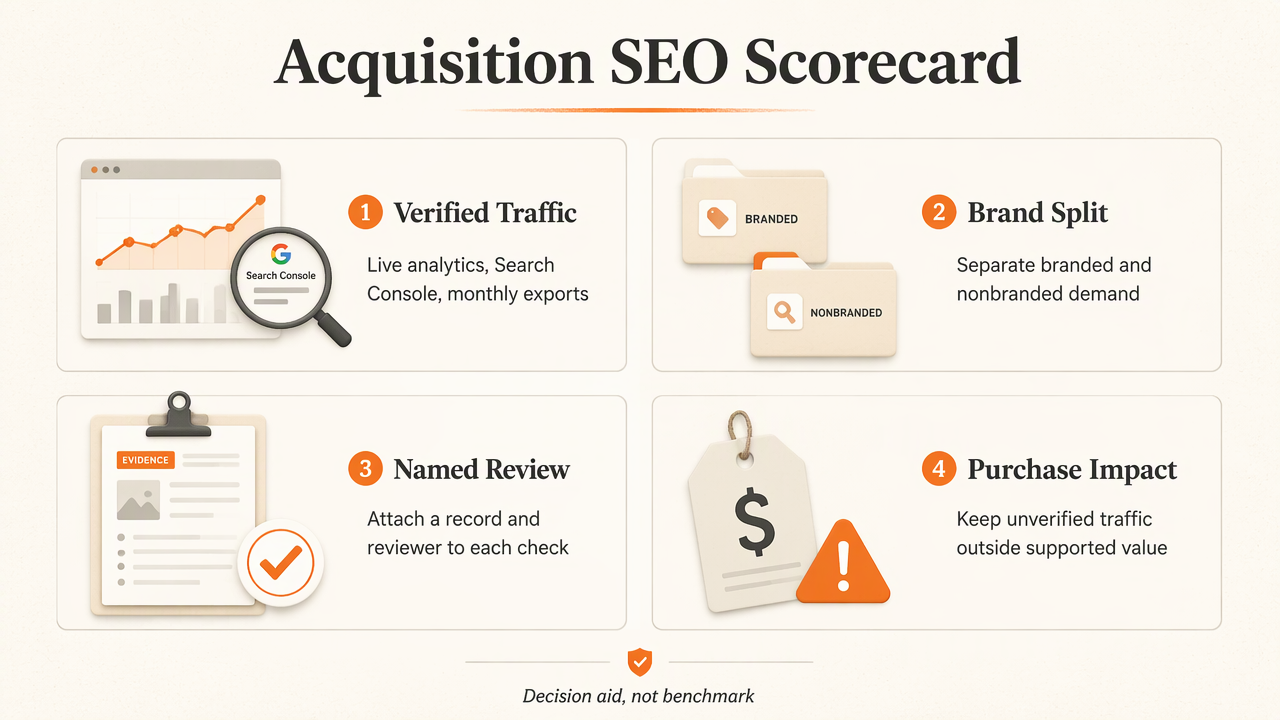
Five evidence checks that shape the offer
Each check should have a supporting record, a named reviewer, and a clear purchase implication.
| Check | Evidence to request | Decision implication |
|---|---|---|
| Verified traffic | Live analytics, Search Console, monthly exports | Unverified traffic stays outside the supported valuation |
| Branded versus nonbranded demand | Query groups, landing pages, conversion records | Seller-dependent demand needs a transfer plan |
| Backlink risks | Link samples, historical reports, paid-link disclosures | Unexplained patterns need specialist review |
| Content ownership | Writer contracts, image licenses, asset inventory | Missing rights need resolution before closing |
| Historical Search Console access | Available history, manual actions, security reports | Missing history leaves performance harder to assess |
Label each row verified, needs clarification, or unresolved. Don't average away a serious ownership issue simply because traffic looks attractive. A purchase condition is often more useful than a numerical score.
Price concentration separately from total traffic
A website can attract relevant visitors while relying heavily on one page, keyword group, supplier, or affiliate program. Calculate how much organic revenue depends on each major landing page using the seller's actual records.
For example, if one buying guide drives most affiliate income, review its freshness, commercial agreements, and competing results individually. Treat that concentration as a negotiation factor rather than assuming the whole content library contributes equally.
- Proceed: Evidence supports demand and transferable assets.
- Negotiate: Valuable assets exist, but maintenance or concentration changes the economics.
- Pause: Access, ownership, or performance explanations remain unresolved.
Which SEO assets and liabilities transfer with the sale?
The transferable SEO assets are the domain, content rights, technical infrastructure, account access, and relationships explicitly included in the purchase agreement. Rankings aren't a separately owned asset or a promise. Buyers should verify control of the resources that support performance and document any dependencies that remain with the seller.
Inspect links and domain history in context
A third-party authority score is a screening signal, not proof of search value. Review links pointing to the pages that actually attract organic visitors. Look for relevant referring sites, sensible anchor text, and explanations for unusual bursts of links.
Ask about previous domain uses, purchased links, sponsorships, expired-domain changes, and past SEO providers. Check Search Console's manual-action and security reports, while recognizing that a clean report doesn't explain every ranking decline.
Backlink tools have different coverage. An unexplained link pattern warrants investigation, not an automatic penalty diagnosis or an automatic disavow file.
Confirm rights and technical control
The asset schedule should name article text, photography, videos, downloadable files, code, themes, and licenses. Writer invoices alone may not establish an assignment of rights. Legal review should confirm the buyer's right to publish, modify, and reuse important assets.
Inspect robots.txt, noindex directives, redirects, canonical tags, and indexable revenue pages. Canonical tags identify a preferred URL among similar pages; incorrect implementation can complicate search visibility.
- Confirm registrar control, hosting access, backups, and renewals.
- Identify plugins, subscriptions, and licenses requiring replacement.
- Record dependencies on the seller's staff, credentials, or proprietary data.
A domain or platform change creates a separate implementation project. The website migration SEO checklist is useful once that change is actually planned.
How Earlyseo handles this
Earlyseo provides a practical next step for organizing website analysis and post-acquisition SEO work. Once the buyer has verified the purchase evidence, the focus can shift to preserving useful pages, prioritizing improvements, and planning content around the acquired business's customers.

Turn verified findings into a working plan
A documented acquisition baseline gives the new owner a clear starting point. Earlyseo offers a place to explore that next phase, with website analysis, competitor-aware SEO content, and SEO operations as relevant areas to review.
A sensible handoff sequence is:
- Save baseline queries, landing pages, conversions, and ownership records.
- Preserve productive URLs and content while confirming operational control.
- Prioritize updates tied to customer intent and business value.
- Track changes against the baseline before expanding the publishing schedule.
For an acquired content library, an internal linking strategy can help organize connections between useful pages.
Keep the 2027 plan focused on usefulness
A forward-looking acquisition plan should evaluate content usefulness rather than assume that publishing volume creates value. The 2024 IEEE Access review of GPT technologies examines applications, challenges, and future directions; it isn't evidence of a particular website's ranking quality.
For 2027 planning, buyers should ask who maintains factual accuracy, adds original expertise, and updates commercial information. Human review and documented editorial ownership belong in the operating budget.
Treat future search visibility as a managed business activity, not an inherited guarantee.
FAQ: Buying a website with existing rankings
The most useful acquisition questions concern evidence, transferability, and timing rather than promises of guaranteed rankings.
Does buying an established domain guarantee better rankings?
Buying an established domain doesn't guarantee better rankings. An existing website may bring useful content, relevant links, and recognized demand, but those assets require verification. A buyer should evaluate the site's current purpose, historical performance, and transferable rights rather than pay a premium for domain age alone.
What happens if the seller won't provide Search Console access?
A seller's refusal to provide Search Console access leaves an evidence gap, not automatic proof of misconduct. A supervised account review may address confidentiality concerns. If access remains unavailable, the buyer should document the uncertainty, seek other verifiable records, and avoid treating unsupported organic traffic claims as established value.
Should the buyer redesign the website immediately after closing?
An immediate redesign isn't the default recommendation. The buyer should first preserve a baseline and confirm which URLs, templates, and content support revenue. Necessary security or operational repairs can take priority. Broader design changes should have a defined purpose, testing plan, and redirects wherever existing URLs must change.
Conclusion
Before signing, require an evidence folder covering traffic, query demand, links, content rights, and account control. Convert unresolved items into purchase conditions or valuation adjustments. After closing, the Earlyseo platform can be explored at earlyseo.com to organize the next stage around verified assets and a documented SEO plan.