TL;DR
Manufacturers should prioritize searchable capability and product pages, then support them with verified technical answers and procurement details. Success should be measured through qualified inquiries and sales opportunities, not traffic alone. Start with one product family and expand after the page structure and approval process work.
A manufacturing website should help a buyer decide whether a supplier belongs on the shortlist. The strongest seo advice for b2b manufacturers starts with that decision, not a publishing quota. Engineers need specifications; procurement teams need evidence, availability, and a clear inquiry process.
Manufacturing SEO: The practice of making a manufacturer's capabilities, products, and technical information discoverable through relevant organic searches by business buyers.
For teams planning that content, Earlyseo offers a starting point for organizing search-focused publishing. The practical goal stays simple: connect each search intent to a page that answers a buying question and provides a useful next step.
Table of Contents
Which manufacturing pages attract qualified inquiries?
Manufacturing pages attract qualified inquiries when they match a buyer's specific requirements with documented capabilities and a relevant contact path. Product specifications, certification evidence, application guidance, and procurement answers serve different needs. Separate those needs into distinct pages, then connect them so buyers can move from research to supplier evaluation.
Start with sales records, RFQ forms, and conversations with application engineers. These reveal the language buyers actually use, including material names, manufacturing processes, part identifiers, and operating conditions. Search-volume estimates can help prioritize topics, but commercial relevance deserves equal weight.
Inquiry-focused page matrix
Each page type should answer a different question and request only the information needed for its next step.
| Buyer need | Best page type | Evidence to publish | Inquiry action |
|---|---|---|---|
| Specifications | Product or product-family page | Verified dimensions, materials, tolerances, drawings | Request a quote with a part reference |
| Manufacturing capability | Process or service page | Equipment scope, supported materials, documented limits | Submit a drawing for review |
| Certification | Quality page | Current certificate, issuer, scope, validity | Request relevant quality documents |
| Application suitability | Application guide | Use conditions, selection criteria, limitations | Ask for application review |
| Procurement readiness | Purchasing FAQ | Verified MOQ, lead-time policy, shipping coverage | Request availability or commercial terms |
A hypothetical buyer searching for a stainless steel enclosure needs different information from someone researching corrosion resistance. The first query fits a commercial page; the second fits a selection guide linked to relevant products.
Competitor-aware content planning can support coverage reviews. Competitor pages are useful for spotting unanswered buyer questions, while internal technical records should remain the authority for capability claims.
How should manufacturers fix technical SEO?
Manufacturers should fix technical SEO by making important product and capability pages accessible, indexable, and internally connected. The first audit should check crawl access, rendering, canonical URLs, duplicate pages, and mobile usability. Technical work should prioritize pages that support inquiries rather than treating every catalog URL as equally valuable.
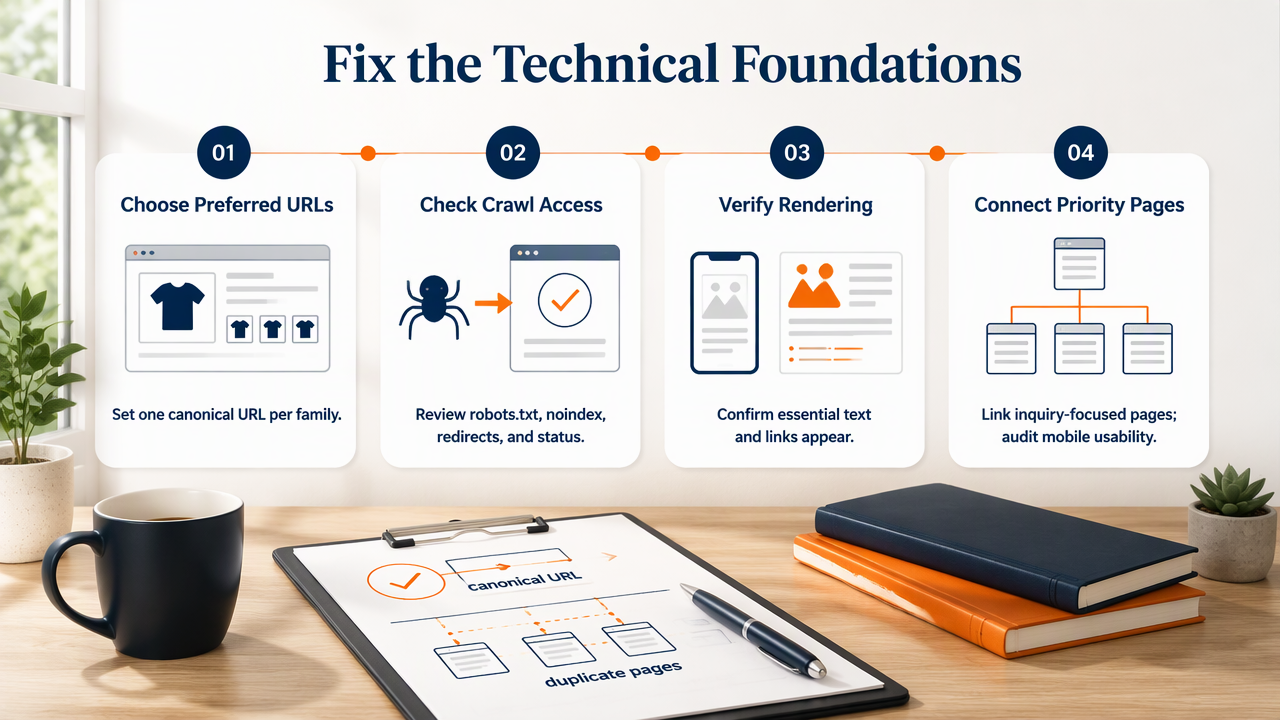
- Identify the preferred URL for each product family and capability.
- Check
robots.txt,noindex, redirects, and HTTP status codes. - Confirm that essential text and links render for crawlers.
- Add relevant pages to navigation and XML sitemaps.
- Test mobile specification tables and inquiry forms.
- Review indexed pages in Google Search Console.
Keep specifications accessible beyond downloads
An HTML page should contain the main product description and buying information, with PDFs available for detailed drawings or datasheets. Buyers shouldn't need to download several documents just to learn which materials a manufacturer supports.
Useful page elements include descriptive titles, a clear main heading, readable specification tables, and links to related applications. Descriptive filenames and image text help explain technical visuals without replacing written specifications.
Resolve catalog variants deliberately
Canonicalization: The process of choosing a standard representation when information has multiple possible representations; in SEO, canonical signals indicate a preferred URL among duplicate or similar pages.
A tracking parameter usually doesn't deserve its own search result. A distinct product variant may deserve one when it answers a different buying need. Canonical tags are signals, not substitutes for coherent navigation and consistent internal links.
Before changing product URLs or rebuilding a catalog, a website migration checklist can help preserve redirects, metadata, and important landing pages.
How can technical answers support AI visibility?
Technical answers can support AI visibility when they state a clear answer, identify the relevant product or process, and explain the evidence and limits. Manufacturers should publish concise answers in accessible HTML, then attach supporting details. That structure helps readers and answer engines interpret the information, but it doesn't guarantee citations.
A citable answer template for engineering questions
A useful answer stands on its own without implying that an unverified capability exists.
- Question: Can a named process achieve a specified tolerance?
- Answer: State only the documented capability for the relevant material and geometry.
- Conditions: Explain the applicable size range, inspection method, and other constraints.
- Evidence: Link the approved specification or technical document.
- Next step: Request a drawing review when suitability needs confirmation.
For a hypothetical material-compatibility question, an honest answer could explain that compatibility depends on the chemical, concentration, temperature, and exposure duration. The page can then request those conditions for assessment rather than promise universal resistance.
A technical content brief can record the question, evidence owner, required terminology, and approval criteria before drafting starts.
Publish evidence with clear ownership
Certification pages should identify the covered legal entity, facility, and scope. Product pages should distinguish measured results from design targets. Named reviewers, revision dates, and links to original documents give readers a way to assess technical statements.
Two research topics provide useful context without proving SEO outcomes. The 2023 review by Cioppi, Curina, and Francioni examined digital transformation and marketing. Hossain, Talapatra, and Saha's 2024 paper addressed digital twins and supply-chain resilience. Neither citation establishes a ranking benefit for manufacturing websites.
For 2027 planning, maintain reusable, verified technical answers that serve both search visitors and AI-assisted research. Citation counts should complement, not replace, inquiry quality.
How should manufacturers organize SEO work?
Manufacturers should organize SEO work around one product family, a named technical reviewer, and measurable inquiry outcomes. A small initial scope makes approval and attribution easier. Expand publishing after the team can maintain accurate pages, capture useful lead details, and identify which searches bring commercially relevant visitors.
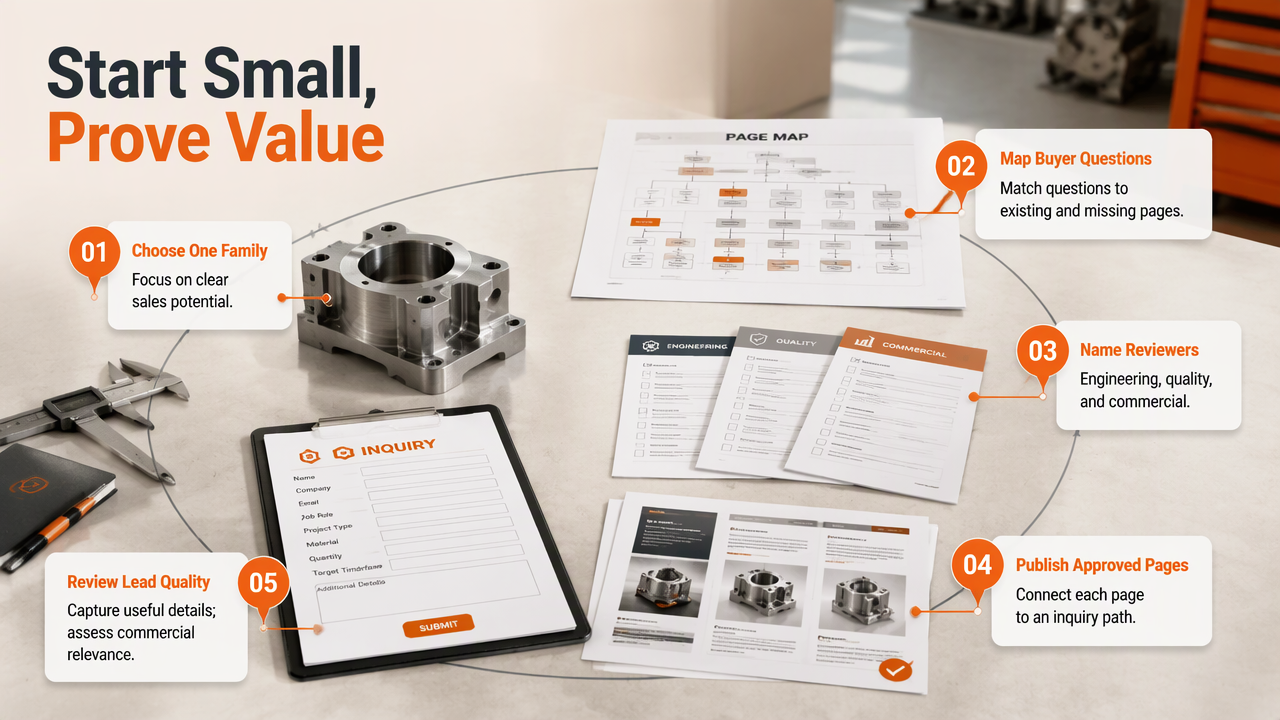
- Select a product family with clear sales potential.
- Map its buyer questions to existing and missing pages.
- Assign engineering, quality, and commercial reviewers.
- Publish approved pages and connect their inquiry paths.
- Review lead quality before expanding the content plan.
How Earlyseo handles this
The Earlyseo platform's published SEO operations offering provides a relevant place to evaluate support for ongoing content work. Manufacturers should assess the workflow against their review requirements, publishing cadence, and ownership needs. Engineering and quality teams should retain responsibility for approving factual claims.
A practical division of labor keeps search planning with marketing, capability verification with engineering, certification review with quality, and purchasing details with sales operations. That arrangement gives every claim an accountable owner.
Track opportunities rather than traffic alone
Google Search Console can show which queries and pages attract search clicks. Analytics can record RFQ submissions and document requests, while a CRM can connect inquiries to sales outcomes.
Track these measures together:
- Non-branded clicks to priority capability pages.
- RFQs containing usable project requirements.
- Inquiries accepted as qualified by sales.
- Opportunities and revenue associated with organic discovery.
An illustrative rollout can use the first month for auditing, the second for publishing, and the third for refinement. A 90-day SEO sprint provides a planning framework, not a promise of rankings within that period. Industrial buying cycles may require longer observation before revenue attribution becomes meaningful.
Manufacturing SEO questions before rollout
Manufacturing SEO plans should account for local service areas, distributor relationships, and international buyers before expanding page production.
Does local SEO matter for industrial manufacturers?
Local SEO matters when proximity affects supplier selection, plant visits, collection, installation, or field service. Eligible businesses should maintain accurate Google Business Profile information and publish genuine location details. Manufacturers serving wider markets still need capability and product pages; city-name pages alone don't explain technical suitability or purchasing requirements.
Should manufacturers compete with distributor product pages?
Manufacturers should distinguish their pages through authoritative specifications, application expertise, and clear purchasing routes. Distributor pages may address stock availability or regional ordering, while the manufacturer's website explains product identity and technical suitability. Where sales go through partners, a visible distributor locator or purchasing contact can direct organic visitors appropriately.
When should manufacturers publish multilingual content?
Manufacturers should publish multilingual content when sales coverage, customer support, and documented demand justify it. Translate specifications, units, inquiry instructions, and quality information carefully, then have qualified reviewers check technical meaning. Each language version needs clear ownership so product changes reach every relevant market rather than leaving conflicting information online.
Expansion works best when the sales and technical teams can support the audience each new page attracts.
Conclusion
Practical SEO advice for B2B manufacturers turns technical evidence into searchable buying answers. Start with one product family, build the five page types in the inquiry matrix, and assign approval owners before publishing. Then connect RFQs to sales feedback so priorities reflect commercial value. For teams evaluating content operations, Earlyseo provides a relevant next step at earlyseo.com: review the workflow against those requirements and plan a focused initial rollout.