TL;DR
Businesses should buy defined SEO work, not promises of a fixed Google position. Contracts should specify deliverables, reporting methods, and remedies for missed work, while performance reviews should track relevant traffic and qualified conversions alongside rankings.
An SEO provider can commit to completing work, but cannot control Google's ranking decisions. The clearest SEO advice on ranking guarantees is to separate those two promises before signing a contract.
SEO ranking guarantee: A provider's promise that a website will reach or maintain a specified search position, usually for selected keywords within a stated period.
A useful buying decision starts with scope: which pages need attention, which searches matter commercially, and which outcomes deserve measurement. For startup founders, local businesses, and online stores, a written plan with clear responsibilities offers a stronger basis for accountability than a headline position alone.
Table of Contents
Can an SEO provider guarantee Google rankings?
An SEO provider cannot credibly guarantee a specific Google ranking because the provider doesn't control Google's search systems, competing websites, or changing search results. A contract can guarantee work or offer a refund, but neither arrangement makes the promised position certain. Buyers should distinguish a financial remedy from a search outcome.
Google Search Central's guidance on choosing an SEO warns against providers that guarantee first-place rankings. That primary-source guidance matters more than a provider's sales pitch: a supplier's confidence doesn't grant control over the search engine.
Search visibility also depends on context. A local service query, a product search, and an informational question can produce different result formats. Device, location, and the chosen keyword set affect what a ranking report describes.
A ranking guarantee is a promise made by a supplier, not a commitment made by Google.
Why a first-place position isn't the whole result
A first-place position for an irrelevant phrase has little commercial value. A plumbing business needs searches connected to its service area and actual services, not merely a phrase that is easy to rank.
In 2026, evaluation should also account for AI Overviews and AI Mode. Google's AI features guidance explains how these search experiences relate to established SEO practices. A conventional ranking report shouldn't be treated as a complete record of visibility across every search experience.
What can an SEO provider credibly guarantee?
An SEO provider can credibly guarantee deliverables under its control, such as completing an audit, implementing agreed changes, or supplying reports on schedule. Traffic and ranking forecasts belong in a separate category: targets supported by assumptions, not certain outcomes. Accountability should attach to the work promised and the evidence supplied.
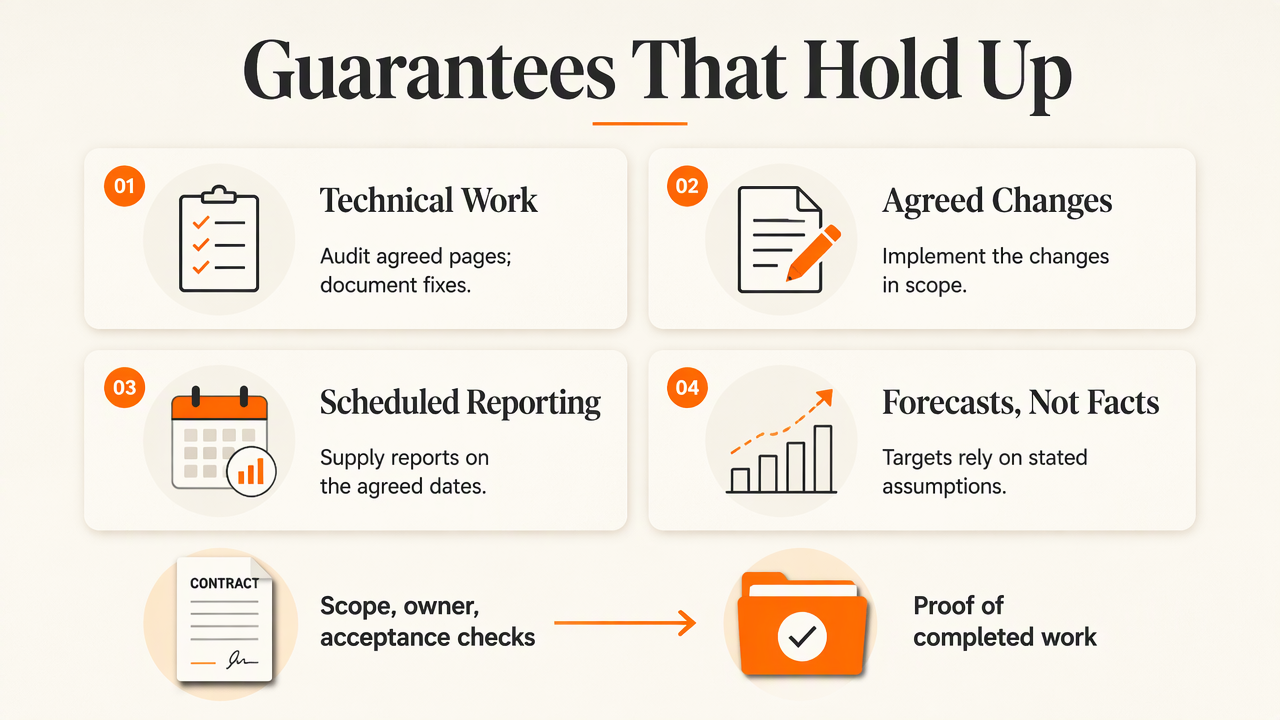
Credible commitments, misleading promises, and safeguards
| Area | Credible commitment | Misleading promise | Contract safeguard |
|---|---|---|---|
| Technical work | Audit agreed pages and document fixes | Every page will be indexed | Define scope, implementation owner, and acceptance checks |
| Content | Deliver approved briefs and reviewed pages | Every article will rank first | Specify topics, review standards, and revision terms |
| Rankings | Track agreed queries consistently | Permanent first-place placement | Record search engine, location, device, and measurement method |
| Reporting | Supply reports on an agreed schedule | Ranking gains prove business growth | Include traffic, conversions, and completed work |
| Commercial terms | Provide a remedy for missed deliverables | A refund makes rankings certain | Define eligibility, exclusions, deadlines, and refund value |
The strongest commitments are observable. An audit should identify issues and priorities; a content deliverable should have acceptance criteria; an implementation task should include evidence that the change reached the live website.
Keep forecasts separate from contractual promises
A forecast can help a business plan without becoming a guarantee. Its assumptions should explain implementation capacity, target markets, website condition, and the scope of proposed work.
For example, a store might commission revisions to category pages and product descriptions. Completion dates can be contractual. Increased organic sales remain a performance target because demand, pricing, stock availability, and checkout quality also affect results.
- Deliverable: Work the provider agrees to complete.
- Target: A result the project aims to achieve.
- Forecast: An estimate based on stated assumptions.
- Remedy: Compensation or corrective action when a contractual obligation isn't met.
How should businesses evaluate an SEO contract?
- Define the searches, pages, and markets that matter to the business.
- Record a baseline using agreed measurement tools.
- Separate deliverables from performance targets in writing.
- Assign implementation and approval responsibilities.
- Specify reporting, access, cancellation, and remedies before signing.
The contract should make progress inspectable rather than leave success open to interpretation.
Check whether the guarantee can be meaningfully tested
A vague promise creates a vague dispute. Terms such as improved visibility or top rankings need definitions: which keywords, which locations, which result types, and over what reporting period?
A buyer should also check who chooses the target phrases. A provider could satisfy a loosely written promise with searches that have little connection to customer demand. Keyword approval should happen before work starts, not after results arrive.
The refund mechanism deserves equal attention. Continued service isn't the same as returning money. Any remedy should state what triggers it, how a claim is submitted, and whether client delays change eligibility.
A structured set of questions before hiring an SEO agency can help buyers turn these concerns into an interview checklist.
Measure commercial progress without hiding the work
Rankings are useful diagnostic signals, but a performance review should connect visibility to business activity. A local business might track qualified calls; an online store might track organic purchases; a software company might track relevant demo requests.
Reports should distinguish completed tasks, observed outcomes, and the next decisions. They should also document changes that affect comparisons, such as a new tracking setup or a website redesign. An SEO reporting template can provide a consistent structure.
Reliable reporting explains both what changed on the website and what changed in search performance.
How Earlyseo handles this
Earlyseo is best evaluated through its published content and workflow resources, with attention to the practical work a business needs to organize. A deliverable-led approach gives teams a clear way to compare services: inspect the proposed process, agree on outputs, and review progress against a documented plan.

Build the engagement around inspectable outputs
The SEO operations resources provide a relevant starting point for discussions about workflow and recurring work. Buyers should ask how tasks are assigned, reviewed, and reported before deciding whether a service fits existing team capacity.
For content planning, competitor-aware SEO content offers another concrete area to evaluate. The useful question is how competitive context informs topic selection and content requirements.
A 90-day SEO sprint can serve as a planning framework for sequencing work and scheduling reviews. The period should define an execution cycle, not a deadline for a certain ranking.
Choose support that matches internal capacity
A founder with limited writing capacity may prioritize content planning and production support. A marketing manager with an established team may need clearer operations and review checkpoints instead.
Before purchase, the business should request a sample output, a responsibility map, and an explanation of which tasks remain with its own staff. Those materials make the service easier to assess than a broad claim about future visibility.
FAQ: Ranking promises and buyer protections
Ranking guarantees raise separate questions about payment, timelines, contract terms, and AI visibility, so each deserves its own test.
Does a money-back guarantee make an SEO offer reliable?
A money-back guarantee establishes a potential financial remedy, not proof that rankings will improve. Reliability depends on the work proposed, the provider's methods, and clear eligibility terms. Buyers should check whether the promise means an actual refund, account credit, or additional service, and whether exclusions make the remedy difficult to claim.
Can paying Google improve organic rankings?
Paying for Google advertising doesn't purchase a higher organic position. Advertising and organic SEO should have separate budgets, objectives, and reporting. A provider should identify which results are paid placements and which are organic listings so that a paid campaign's visibility isn't presented as evidence of organic ranking improvement.
How long should a business wait before reviewing SEO progress?
The review schedule should follow the project's scope and implementation timetable rather than a universal ranking deadline. Early reviews can check completed audits, approved content, and deployed fixes. Later reviews can assess visibility and conversions. A contract should specify checkpoints and required evidence without treating elapsed time alone as proof of success.
Can a provider guarantee mentions in AI-generated answers?
A provider cannot reliably promise that an independent AI system will mention a business in a particular answer. Content improvements can support discoverability, but answer selection remains outside the supplier's control. Buyers should request documented content work and an agreed observation method rather than contractual certainty about citations in Google or ChatGPT.
Conclusion
Practical SEO advice on ranking guarantees comes down to purchasing accountable work and measuring meaningful outcomes. Before signing, a business should request a sample report, approve the target queries, and have unclear remedy clauses reviewed.
For a deliverable-led next step, Earlyseo offers a starting point for evaluating content and workflow support. A team can review the relevant resources at earlyseo.com, then build a written scope with named owners, acceptance criteria, and scheduled progress checks.