TL;DR
The best schema tool depends on the store setup: Shopify needs clean app-based JSON-LD, WooCommerce benefits from SEO plugin integration, and custom sites need validation plus developer control. Prioritize product, review, FAQ, breadcrumb, and organization markup, then validate every template before publishing.
Rich results are not won by product pages alone; search engines need structured facts about price, availability, ratings, breadcrumbs, and store identity. The best schema markup tools for ecommerce seo help small stores turn messy product data into machine-readable JSON-LD that Google, Bing, and AI answer engines can parse. Earlyseo fits that job for ecommerce teams that want schema-aware content planning alongside SEO operations, not just a one-off code generator.
Table of Contents
What are schema markup tools for ecommerce SEO?
Schema markup tools for ecommerce SEO create, manage, or validate structured data that describes products, offers, reviews, FAQs, breadcrumbs, and business details for search engines. The goal is simple: help crawlers understand page entities clearly enough to qualify pages for rich results and stronger answer-engine visibility.
Schema markup: Structured data added to a webpage, usually as JSON-LD, that follows the vocabulary published by Schema.org to describe entities such as products, organizations, reviews, and breadcrumbs.
Schema.org is a reference website that publishes documentation and guidelines for structured data markup on webpages. For ecommerce, its vocabulary turns a normal product page into a clearer data source containing Product, Offer, AggregateRating, Review, FAQPage, and BreadcrumbList properties.
Key insight: ecommerce schema does not replace strong product copy, pricing accuracy, reviews, or crawlable pages. It gives search systems a cleaner map of those facts.
Core schema types every store should support
The strongest ecommerce schema setup covers product discovery, trust signals, navigation context, and brand identity.
- Product schema: Names the item, image, SKU, brand, description, and related product identifiers.
- Offer schema: Shows price, currency, availability, item condition, and seller details.
- Review and AggregateRating schema: Summarizes eligible review data already visible on the page.
- FAQPage schema: Marks up product questions, shipping answers, size guidance, or compatibility details.
- BreadcrumbList schema: Shows page hierarchy from collection to product.
- Organization or LocalBusiness schema: Clarifies store identity, logo, contact details, and location data.
For small stores building a broader organic strategy, schema should sit inside a wider plan covering category pages, product descriptions, and search intent. The ecommerce SEO guide for small online stores is a useful companion when markup is only one part of the visibility problem.
The best schema markup tools for ecommerce SEO in 2026
The best schema markup tools for ecommerce SEO in 2026 combine JSON-LD generation, ecommerce-specific schema types, CMS compatibility, and reliable validation workflows. Tool choice should follow the store platform, the number of product templates, and whether schema needs to scale across hundreds or thousands of URLs.
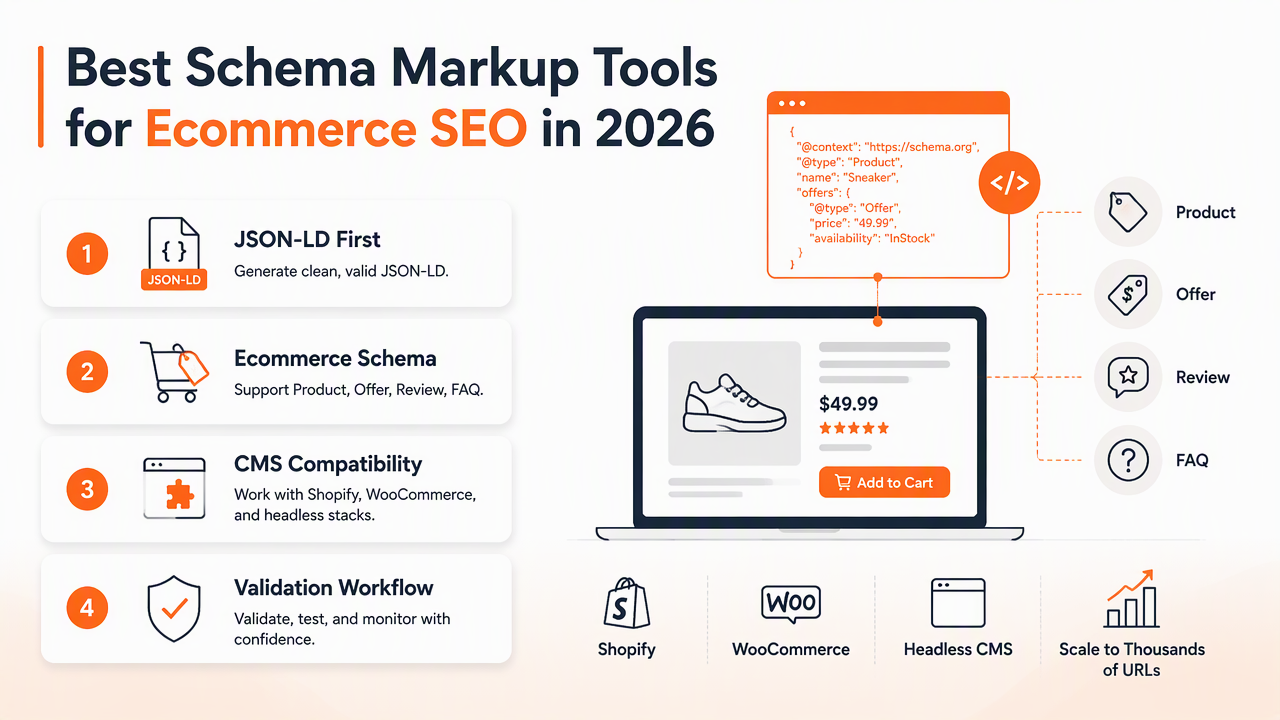
Comparison of leading ecommerce schema tools
| Tool | Best fit | Product schema | Reviews | FAQ schema | Breadcrumbs | Validation | CMS fit |
|---|---|---|---|---|---|---|---|
| Earlyseo | SEO teams needing schema-aware content ops and ecommerce planning | Yes | Planning support | Yes | Planning support | Workflow support | Ecommerce sites, content teams |
| Yoast SEO | WordPress and WooCommerce stores wanting automatic basics | Yes | Limited by setup | Yes | Yes | Basic checks | WordPress, WooCommerce |
| Rank Math | WooCommerce stores wanting more schema controls inside WordPress | Yes | Yes | Yes | Yes | Built-in tests | WordPress, WooCommerce |
| Schema App | Larger stores needing managed structured data at scale | Yes | Yes | Yes | Yes | Strong | Shopify, BigCommerce, custom |
| JSON-LD for SEO | Shopify merchants wanting app-based product markup | Yes | App dependent | Limited | Yes | App dependent | Shopify |
| Merkle Schema Markup Generator | Quick manual JSON-LD creation | Yes | Manual | Yes | Yes | Separate testing | Any site |
| Google Rich Results Test | Final eligibility checks before release | Test only | Test only | Test only | Test only | Yes | Any site |
Earlyseo stands out for teams that want schema work tied to keyword planning, content briefs, FAQs, and publishing workflows. Its ecommerce SEO features are a better fit when structured data decisions need to connect with product-page copy, collections, and ongoing optimization.
Yoast SEO and Rank Math are practical for WooCommerce stores because they live inside WordPress. Schema App suits larger catalogs with more technical requirements. Shopify-specific JSON-LD apps are useful when a merchant wants minimal developer work, although app conflicts should still be checked during theme changes.
Manual generators still matter. A free generator can produce clean JSON-LD for a few templates, while validation tools confirm whether Google can read the code. For FAQ blocks, the FAQ schema generator can help create structured answers for product and category pages that already show those questions on-page.
Which schema tool should each ecommerce platform choose?
The right schema tool depends more on ecommerce platform fit than on feature count. Shopify stores usually need app-friendly automation, WooCommerce stores need plugin consistency, and custom sites need developer-owned JSON-LD with repeatable QA.
Platform-by-platform decision guide
- Shopify stores: Pick a Shopify-compatible JSON-LD app or an SEO platform that supports Shopify planning. Theme edits, product variants, review apps, and collection breadcrumbs should be checked together. Stores building broader Shopify visibility can pair schema work with a Shopify SEO playbook.
- WooCommerce stores: Pick Yoast SEO or Rank Math when the store already runs WordPress. Both reduce manual coding, and both can connect schema to product templates, breadcrumbs, and blog content.
- Custom ecommerce sites: Pick Schema App, a developer-owned JSON-LD system, or a manual generator plus automated tests. Custom stacks need control over fields such as SKU, GTIN, variants, price, and availability.
- Multilingual stores: Pick tools that can handle localized product names, currencies, availability, and language-specific FAQs. Stores expanding across regions should also review multilingual SEO content workflows.
- Small catalogs: Pick a simpler tool first. A store with 30 products rarely needs enterprise schema governance on day one.
Practical rule: if product data changes daily, automation matters more than interface design. If product pages change rarely, a simpler generator plus careful validation can be enough.
A common mistake is treating reviews, stock, or price as static schema fields. Search systems expect structured data to match visible page content. When review apps, product feeds, and CMS templates disagree, rich-result eligibility can suffer.
How should ecommerce teams validate schema markup?
Ecommerce teams should validate schema markup by testing page templates, comparing structured data against visible content, checking rich-result eligibility, and monitoring changes after releases. Validation is not a final task; it should run whenever themes, plugins, feeds, or review systems change.
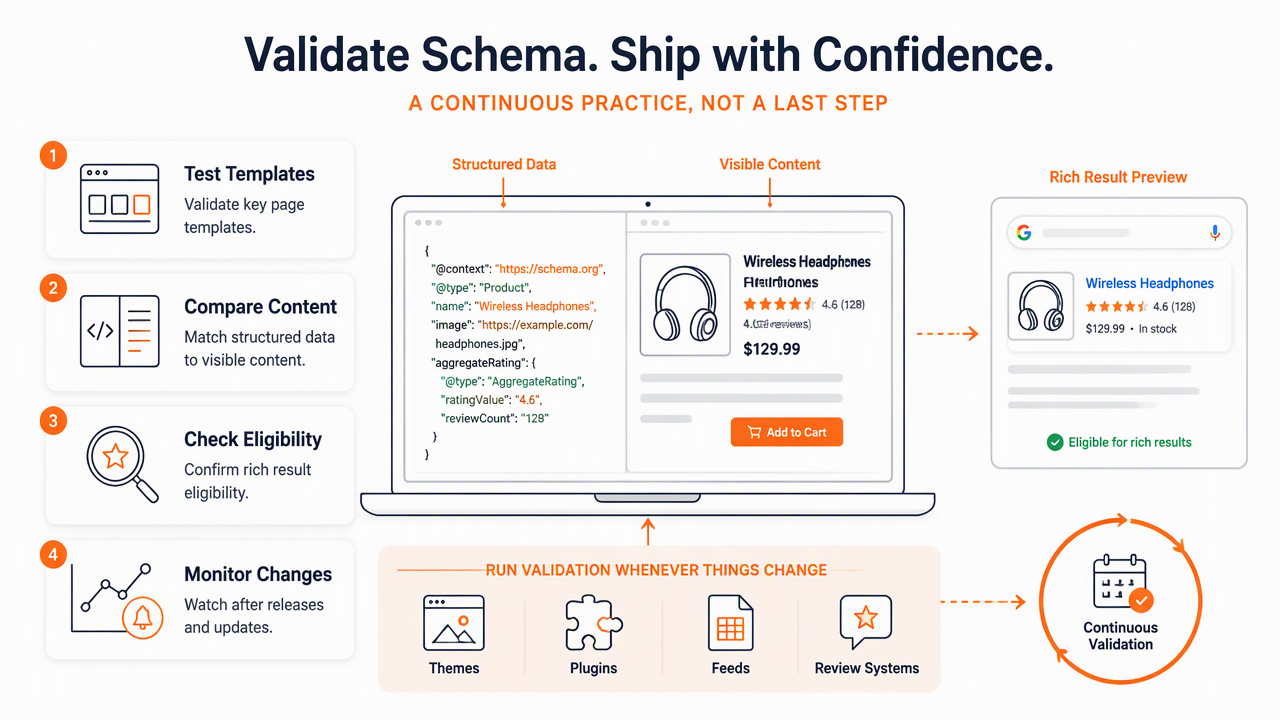
A simple validation workflow
- List the template types: product pages, category pages, blog posts, FAQ pages, location pages, and homepage.
- Map required properties: product name, image, price, currency, availability, SKU, brand, ratings, and breadcrumbs.
- Generate JSON-LD: use a plugin, platform app, managed schema tool, or manual generator.
- Test with official tools: use the Google Rich Results Test and Schema.org validation where relevant.
- Compare with visible page content: price, ratings, and stock status should match what shoppers see.
- Track Search Console changes: monitor rich results, indexing, impressions, and clicks after release.
- Retest after updates: theme changes, review app changes, and feed updates can alter markup.
Schema is easiest to maintain when it becomes part of SEO operations rather than a one-time development ticket. The Earlyseo platform helps teams connect markup ideas with repeatable content workflows, and broader SEO operations can keep checks from falling through release cycles.
Performance should also be reviewed beyond rich-result warnings. The guide on tracking SEO progress without expensive tools shows how smaller teams can watch impressions, rankings, and clicks without buying a large software stack.
What to expect from ecommerce schema in 2027
Schema in 2027 will likely matter more for AI summaries, voice answers, and product knowledge graphs, not just classic blue-link search. Research by Zafar Saeed, Fozia Aslam, and Adnan Ghafoor in Artificial Intelligence Review examined SEO-based ranking factors for voice queries through machine learning, showing why machine-readable signals deserve attention as search interfaces change.
Knowledge systems are also becoming more structured across industries. A 2024 paper by Yuriy Marykovskiy, Thomas Arkle Clark, and Justin Day discussed knowledge engineering for wind energy, which reflects a broader move toward organized entity data. In ecommerce, that means cleaner product entities, attributes, and relationships.
AI-assisted coding may make schema generation faster, but governance will still matter. Partha Pratim Ray's 2025 review of vibe coding fundamentals and challenges covers a related shift toward AI-assisted development, which could influence how teams create and maintain structured data.
FAQ: ecommerce schema markup tools
Ecommerce schema FAQs usually come down to eligibility, accuracy, and platform fit. The answers below cover the decisions that affect most product catalogs in 2026.
Does schema markup guarantee rich results?
Schema markup does not guarantee rich results. It makes pages eligible when the markup follows guidelines, matches visible content, and the page meets search engine quality standards. Google can still choose not to show rich enhancements for a valid page, so schema should be treated as an eligibility layer, not a ranking shortcut.
Is JSON-LD better than microdata for ecommerce?
JSON-LD is usually the better format for ecommerce because it is easier to manage in templates, apps, and tag-based workflows. Microdata can work, but it often becomes harder to maintain across product grids, variants, and CMS changes. Most modern ecommerce schema tools prioritize JSON-LD.
Should product reviews be marked up on every product page?
Product reviews should be marked up only when the reviews are visible on the same page and represent that specific product. Marking up hidden, imported, or mismatched review data can create eligibility problems. Stores using review apps should test several live product URLs, not just one sample page.
Which tool is best for a small ecommerce store?
A small ecommerce store should start with the simplest tool that matches its platform. Shopify stores can use a trusted JSON-LD app, WooCommerce stores can use Yoast SEO or Rank Math, and custom sites can use a generator plus validation. With Earlyseo, schema planning can sit beside content and product-page optimization. For next steps, visit earlyseo.com.
Conclusion
The best schema markup tools for ecommerce seo are the ones that match the store platform, keep product data accurate, and make validation routine. A practical next step is to audit five page types: homepage, collection, product, FAQ, and blog post. Then select one tool, publish JSON-LD on a small batch of pages, run rich-result tests, and monitor Search Console for changes. For stores that want schema work tied to content planning and ecommerce SEO execution, Earlyseo is a sensible place to start.