TL;DR
Customer questions make strong SEO inputs because they reveal real language, buying friction, and intent. The best workflow is to collect questions from sales, support, reviews, and chat logs, group them by intent, map each cluster to the right page type, then refresh content as new objections appear.
Customer questions are one of the cleanest sources of SEO content ideas because they come from people already trying to buy, compare, fix, or understand something. For founders and small teams, learning how to turn customer questions into seo content can shorten research time and produce pages that match actual demand instead of guesswork. Customer-question SEO: the practice of converting recurring sales, support, review, and chatbot questions into search-focused pages such as blog posts, FAQs, comparison pages, product pages, and service pages. Tools such as Earlyseo help teams turn those raw questions into structured briefs, content plans, and publishable topic clusters without starting from a blank page.
Table of Contents
Why customer questions make stronger SEO topics
Customer questions make stronger SEO topics because they reveal search intent, vocabulary, objections, and buying stage in one place. Traditional keyword tools show demand after it appears in search data; customer conversations show what prospects need before a content team names the topic.
Content marketing is commonly defined as creating, publishing, and distributing content for a targeted online audience. Customer-question SEO makes that definition practical by anchoring content in real requests rather than internal assumptions.
A founder might hear "How long does setup take?" on sales calls, see "Does this work with Shopify?" in chat, and read "Too hard to compare plans" in reviews. Each sentence points to a different content opportunity: an implementation guide, an integration page, and a pricing comparison explainer.
Key insight: a repeated customer question is not just support workload; it is a signal that searchers may need the same answer before they contact the business.
Research on large language models, including PaLM: Scaling Language Modeling with Pathways by Chowdhery, Narang, Devlin, and collaborators (2022), shows how modern language systems process large-scale natural language patterns, which makes clear, question-led content easier for AI systems to parse and summarize (arXiv). A 2023 overview of generative AI by Feuerriegel, Hartmann, and Janiesch also examined how generative systems create and adapt content across business settings (Springer).
For a new website, this approach also prevents the classic mistake of publishing broad educational posts before the site has earned topical trust. A related guide on building a content strategy for new SEO blogs can help teams place customer-led topics inside a broader publishing plan.
How to turn customer questions into SEO content
Customer questions become SEO content through a repeatable workflow: collect raw questions, clean duplicates, group by intent, map each cluster to a page type, write a search-focused brief, publish the answer, and update it as new conversations appear. The process works best when sales, support, and marketing share one question bank.
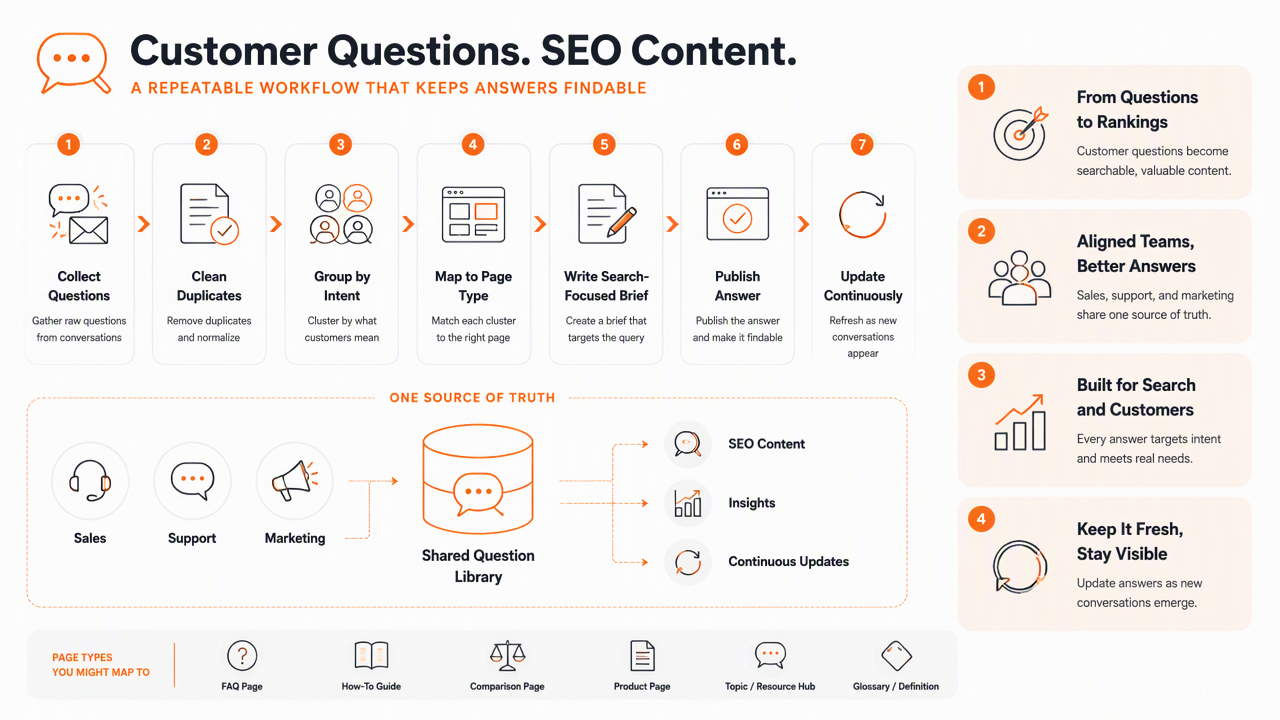
Step-by-step workflow for mining question sources
A simple pipeline keeps the work manageable and prevents useful questions from getting lost in call notes or ticket threads.
- Collect questions weekly from sales calls, demos, support tickets, chatbot logs, review sites, social comments, and contact forms.
- Copy the original wording before rewriting anything, since customer phrasing often contains search language.
- Tag each question by intent such as informational, commercial, transactional, local, technical, or retention-focused.
- Count recurrence manually or in a CRM so the team can separate one-off edge cases from repeat demand.
- Cluster similar questions into themes, not exact duplicates.
- Match each cluster to a page type based on the action the searcher needs next.
- Create a brief with target query, audience, answer angle, internal links, product proof, and FAQ ideas.
- Review performance monthly using rankings, impressions, assisted conversions, and support deflection.
Customer relationship management, or CRM, is the strategic process companies use to manage, analyze, and improve customer interactions. In SEO planning, CRM notes can become a searchable database of objections, terms, use cases, and content gaps.
The Earlyseo platform is especially useful when a small team needs to turn scattered questions into briefs at scale. Its AI content planner can help organize themes, while research-backed AI content supports pages that need sources, competitor context, and clearer structure.
Question sources worth checking every week
Not every source produces the same kind of topic. Sales calls usually reveal buying objections. Support tickets expose confusing workflows. Reviews show emotional language and competitor comparisons. Chatbot logs often capture short, keyword-like phrasing.
- Sales calls: pricing, alternatives, implementation, trust questions.
- Support tickets: setup problems, troubleshooting terms, feature gaps.
- Reviews: benefits, frustrations, comparisons, proof points.
- Chatbot logs: short natural-language queries and high-friction navigation issues.
- Search Console: queries where existing pages already get impressions but lack strong answers.
- Local business calls: service-area terms, availability questions, booking concerns.
For teams with multiple markets, recurring questions should also be checked by language and region. A pricing concern in one country may become a payment-method page elsewhere, which makes multilingual SEO content valuable when customer language differs across locations.
How each question maps to the right content type
Each customer question should map to a page type based on intent, not just keyword volume. A "what is" question usually fits a blog or glossary page, while a "which is better" question often needs a comparison page, and a "near me" question belongs on a local service page.
Content mapping table for customer questions
| Customer question pattern | Likely intent | Best SEO content type | Example angle |
|---|---|---|---|
| "What is..." | Learn | Blog post, glossary, FAQ | Define the concept and explain when it matters |
| "How do I..." | Solve | How-to guide, tutorial, checklist | Give steps, examples, and common fixes |
| "Does it work with..." | Validate | Integration page, feature page, FAQ | Explain compatibility and setup limits |
| "How much does..." | Budget | Pricing guide, service page, comparison | Explain cost drivers without hiding tradeoffs |
| "X vs Y" | Compare | Comparison page | Show who should pick which option |
| "Best for..." | Choose | Use-case page, list page | Match options to needs and constraints |
| "Near me" or city query | Act locally | Local landing page | Show service area, proof, and booking path |
| "Why is this broken?" | Fix | Support article, troubleshooting blog | Diagnose causes and next steps |
A question about "how long SEO takes" should not be buried in a general content strategy post if prospects keep asking it before buying. That question deserves either a dedicated article or a strong FAQ block on a service page, depending on how close it sits to revenue.
Commercial questions need extra care. A comparison page should define each option fairly, show selection criteria, and state who should choose which path. Searchers and AI answer engines tend to reward direct structure because it reduces ambiguity.
Earlyseo can support this mapping stage by turning a raw question cluster into a brief with headings, SERP context, and content format guidance. Teams that already draft manually can also use a SEO content brief template to keep every page consistent.
Decision rules for page selection
Clear decision rules prevent a blog from becoming the dumping ground for every question.
- Create a blog post when the question is educational, early-stage, or needs a full explanation.
- Add an FAQ block when the answer is short and supports a page that already matches the intent.
- Build a comparison page when the question includes alternatives, competitors, "versus," or "best."
- Create a service page when the question includes location, pricing, availability, or purchase readiness.
- Write a support article when the question comes from current customers and reduces repeat tickets.
The main warning is overlap. If one cluster creates three pages with nearly identical answers, rankings may split and readers may land on the wrong page. A single stronger page usually beats several thin ones.
How to write answers that rank and get cited
Answers rank and get cited when they are direct, structured, specific, and supported by clear evidence. In 2026, content built from customer questions needs to serve traditional Google results, AI Overviews, ChatGPT-style summaries, and on-site conversion paths at the same time.
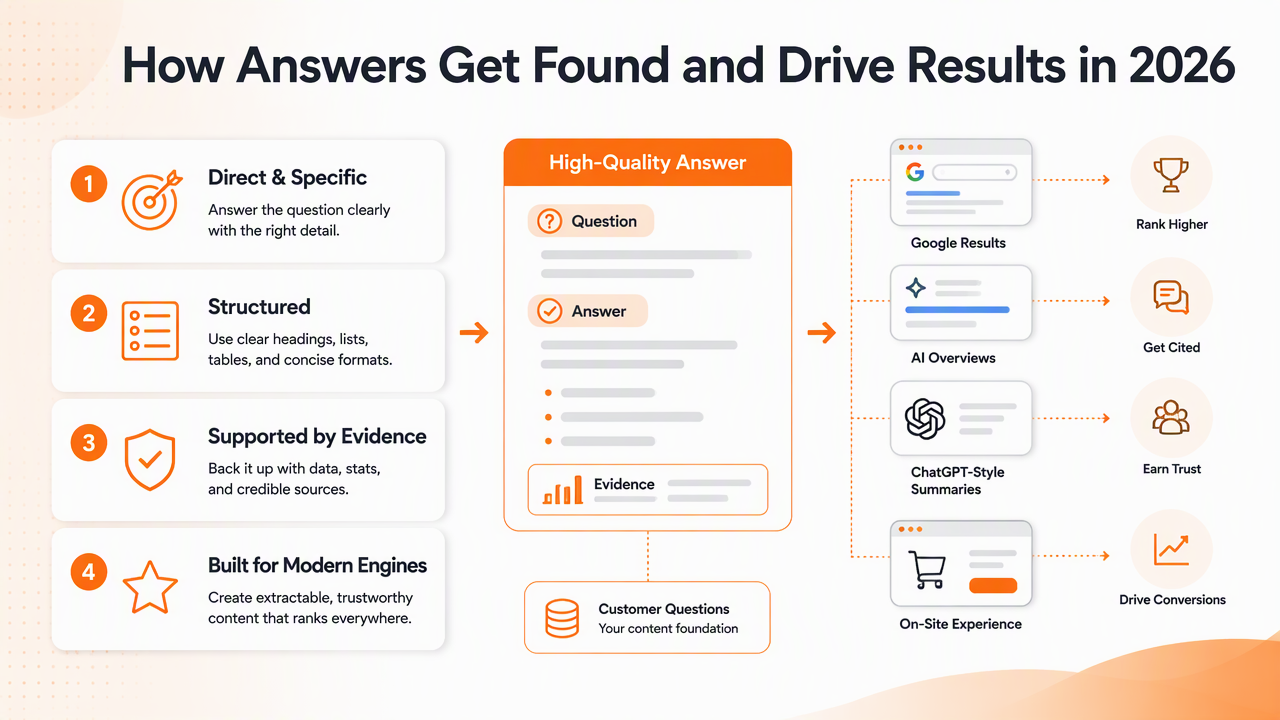
Answer format that works for people and AI systems
Modern answer engines favor extractable content. That means each section should start with a clear answer, then add detail, examples, and proof. The opening line of a section should stand alone if copied into a summary.
A practical format looks like this:
- Answer the question in one sentence.
- Define the key term if the question uses industry language.
- Give a short example from sales, support, local service, or ecommerce.
- Add a table or steps when the answer involves comparison or process.
- Link to the next action such as a product page, booking page, related guide, or template.
For AI citation potential, headings should mirror natural questions. Paragraphs should stay short. Tables should name entities clearly. Definitions should use the term, colon, and explanation format.
Citation-friendly content does not sound robotic; it simply makes the answer easy to extract without stripping away meaning.
The Proceedings of the 2021 Conference on Empirical Methods in Natural Language Processing reflect the continued research focus on how machines process, retrieve, and generate language at scale (ACL Anthology). For practical SEO, that means structured language is not decoration; it helps machines understand what a page answers.
Brief elements for customer-led SEO pages
A strong brief keeps the page tied to the original customer need while still satisfying search demand.
- Primary question: the customer wording and the search-friendly version.
- Search intent: learn, compare, buy, fix, or retain.
- Audience: founder, local buyer, ecommerce shopper, admin, or current customer.
- Required answer: the one-sentence answer the page must give near the top.
- Proof: screenshots, examples, benchmarks from internal data, case notes, or linked research.
- Internal links: related product, service, comparison, or education pages.
- FAQ candidates: follow-up questions from calls and tickets.
- Update trigger: new feature, new pricing, new competitor, or recurring support spike.
For agencies and marketing managers, competitor-aware SEO content is useful when customer questions mention rival tools, alternative vendors, or category comparisons. For service teams managing many clients, the agency SEO content playbook gives a broader operating model for turning briefs into repeatable delivery.
How to keep the question engine useful in 2026
A customer-question content system stays useful when it has ownership, refresh cycles, quality standards, and feedback from revenue teams. The goal is not to publish every question; the goal is to turn repeated demand into pages that improve rankings, sales conversations, and customer retention.
Operating rhythm for small teams
A lightweight rhythm works better than a heavy editorial process for most startups and small businesses.
- Weekly: export new sales, support, review, and chatbot questions.
- Biweekly: cluster questions and choose the next 3 to 5 content opportunities.
- Monthly: publish or update priority pages.
- Quarterly: review rankings, conversions, assisted pipeline, and support deflection.
- Twice yearly: prune thin pages, merge overlapping posts, and refresh comparisons.
Customer retention refers to a company's ability to keep customers over a period of time. Question-led content can support retention by answering setup, usage, troubleshooting, and "what happens next" questions before frustration becomes a ticket.
A practical quality score can use five checks: intent match, answer clarity, page type fit, proof, and next step. Pages that fail two or more checks should be rewritten before more content gets added.
Looking into 2027, AI search will likely make vague content even less useful. Pages that answer real customer language, identify entities clearly, and show practical tradeoffs should have a better chance of being used in summaries than generic posts written only around broad keywords.
Teams that want a repeatable system can explore Earlyseo on earlyseo.com and connect the question-mining workflow to briefs, content planning, and ongoing SEO operations.
FAQ about turning customer questions into SEO content
Customer-question SEO works best when teams treat questions as structured demand signals rather than random ideas. The following answers cover common execution choices for founders, small business owners, and marketers.
How many customer questions are needed before creating a page?
A page is usually worth creating when the same theme appears several times across sales calls, support tickets, chat logs, or reviews. Exact volume matters less than intent. A high-value pricing, comparison, or local service question may justify a page faster than a broad educational topic with weak buying relevance.
Should every customer question become a blog post?
Not every customer question should become a blog post. Short answers often belong in an FAQ section, setup questions may fit support content, and purchase-ready questions may need service or comparison pages. The best format depends on whether the searcher wants to learn, fix, compare, or buy.
Can AI help create SEO content from customer questions?
AI can help cluster questions, draft briefs, suggest headings, and identify related topics, but human review still matters. Customer language can include private details, edge cases, or emotional context that should be cleaned carefully. Earlyseo supports the planning and brief stage while keeping the strategy tied to real demand.
What is the safest next step for a small team?
The safest next step is to build a simple question bank from the last 30 days of calls, tickets, reviews, and chats. Then group the top recurring themes, choose one blog post, one FAQ update, and one commercial page improvement. For a guided workflow, visit earlyseo.com and start with the highest-intent question cluster.
Conclusion
Customer questions turn SEO from abstract keyword hunting into a practical publishing system built around real demand. The clearest process is to collect raw questions, tag intent, map each cluster to the right page type, write a direct answer, and refresh pages as new objections appear. For teams learning how to turn customer questions into seo content, the next action is simple: export 30 days of customer conversations, pick the five most repeated themes, and turn the highest-intent one into a structured brief before another generic post gets published.